

REO and Bank-Owned Property: A Different Acquisition Path
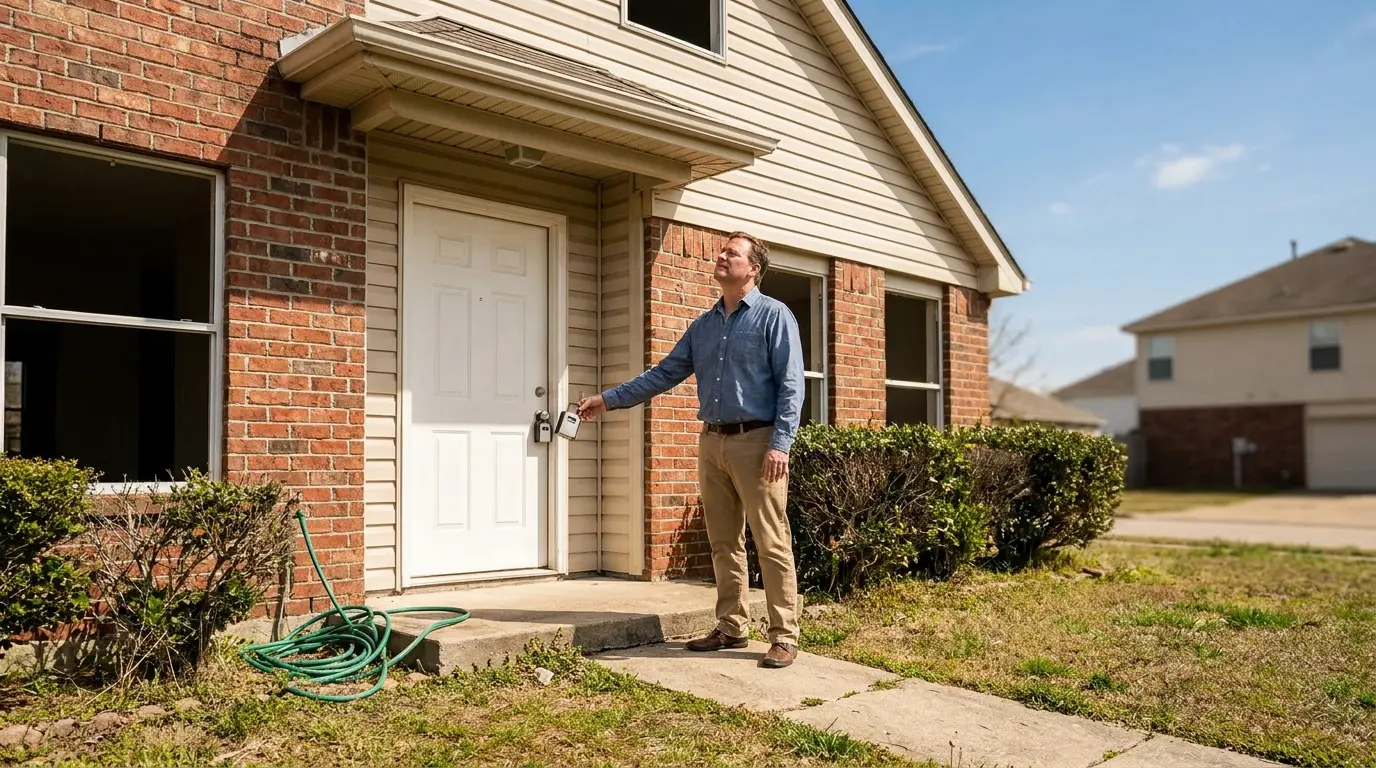
A bank-owned listing looks like every other listing on the MLS. That is the part most investors get wrong about it. Real estate owned, or REO, is what a lender holds after a foreclosure sale ended without a third-party buyer. The auction is the sale. REO is the inventory left over when that sale did not clear.
In the first half of 2026, lenders foreclosed on 27,983 US properties, up 33% from a year earlier (ATTOM, July 2026). Each one eventually becomes a listing with a corporate seller, a stamped settlement date, and a set of seller terms that outrank the purchase contract.
For an investor, the house is inventory. This is a business-purpose acquisition, not a consumer mortgage, and nothing below is written for someone who plans to live in the property.
Here is what actually changes: who you are negotiating with, when you are allowed to offer at all, and what the seller's addendum does to the terms you thought you agreed to.
> Key Takeaways
> - REO is lender-owned inventory: listed, walkable and generally financeable, unlike the sale that created it.
> - Lenders foreclosed on 27,983 US properties in H1 2026, up 33% year over year (ATTOM, July 2026).
> - The channel is thin. Distressed sales were 2% of July 2026 transactions (NAR, August 2026).
> - The seller's addendum prevails over the contract of sale where the two conflict (Freddie Mac HomeSteps).
> - Eos Loan is a direct lender offering business-purpose financing with flexible terms, subject to approval and eligibility.
Talk to our team about financing your next project
What is an REO property, and how does it differ from the auction?
REO stands for real estate owned. It is a property a lender took title to because the foreclosure sale produced no third-party buyer. In the first half of 2026, that happened 27,983 times across the US, up 33% year over year, out of 227,548 properties with foreclosure filings of any kind (ATTOM, July 2026).
The sale that came before it is a different transaction: bid at a published time, cash or certified funds, no walkthrough. That is the auction, a separate path with its own rules on how financing fits a courthouse-step purchase, and it is not what you are buying here.
By the time a property reaches you as REO, four things have changed.
- It is listed. An agent has it on the MLS with photos, a list price, and a showing process.
- You can walk it. You get a condition review before you commit, on the seller's clock rather than never.
- The lien picture is usually simpler. A completed foreclosure generally extinguishes junior liens, though what survives varies by state and is its own review.
- It is generally financeable. A normal settlement timeline means credit can be arranged, which is the single largest practical difference.
- Sold as-is. No repairs, no credits, no warranties. What you saw is what conveys, including whatever you did not see.
- A shorter due-diligence window than your state contract normally gives you. Your condition review has to be scheduled, not merely intended.
- A per-diem charge to the buyer for every day past the stated settlement date. The seller sets the date, and delay carries a price that runs daily until you fund.
- Utilities and de-winterization on the seller's terms, often at your cost, with a scheduled lead time. You cannot test a system that is off, and turning it on takes a request and a wait.
- Seller's choice of title and settlement provider, plus seller-set venue and dispute terms.
!A residential street of finished single-family homes with driveways and mature trees in daylight.
Treating REO as exotic is backwards. Procedurally it behaves like a normal purchase with an unusual seller, and that seller is where the friction lives.
How much bank-owned inventory is actually out there?
Less than the headlines suggest. Distressed sales, meaning foreclosures and short sales combined, were 2% of all existing-home transactions in July 2026, unchanged from the prior month and from a year earlier (NAR, August 2026).
Volume also concentrates. Texas led H1 2026 with 3,322 completed REOs, ahead of California, Florida, Pennsylvania and Illinois (ATTOM, July 2026). If you invest outside those markets, your local count is small enough to matter.
The government-sponsored enterprises give the cleanest reality check. Fannie Mae held 4,967 single-family REO properties nationwide at June 30, 2026, after acquiring 2,389 and disposing of 1,941 during the first six months of the year (Fannie Mae Form 10-Q, Q2 2026). That is the entire national holding of the largest single REO seller, distributed across fifty states.
Read those numbers together and the strategy writes itself. Bank-owned property is a channel you add to your search, not a channel you build a year around. Anyone selling REO as a wave is quoting filings, not completed repossessions.
Who is the seller, and why does that change the negotiation?
An asset manager working a disposition assignment, not a person who once lived in the house. That substitution replaces emotional variables with calendar variables. Your offer competes on certainty and settlement date, not on a letter about how much your family loves the place.
Four practical consequences follow.
No seller property disclosures, in most states. The seller never occupied the property and generally cannot speak to its history. The condition burden shifts entirely to you.
Response times run on an internal review cycle. A same-day counter is not on offer. Approvals may need more than one signature, and the calendar does not care that your offer expires Friday.
Offers are often routed through a platform. Fannie Mae will not accept offers submitted directly by buyers, and a registered agent must submit through HomePath Online Offers (Fannie Mae). If your agent is not registered, you are not in the running.
Multiple-offer rounds run on a stated deadline. "Highest and best" is an announced process with a clock, not a negotiation.
!Printed comparable-sales sheets, a laptop and a calculator laid out on a desk in daylight.
None of that is hostile. It is procurement. Your job is to be the file that moves through the process without stalling, which is a different skill from negotiating with a homeowner. The go/no-go screen before you commit still runs first.
What does the seller addendum actually change?
Nearly everything the contract said. In a Freddie Mac HomeSteps transaction, the purchaser acknowledges the seller acquired the property by foreclosure or a similar process, and where the contract of sale and the addendum conflict, the addendum prevails (Freddie Mac HomeSteps). Your state association form is the starting point, not the agreement.
!A contract and a pen on a bright office desk during a daylight signing meeting.
The provisions that move money are consistent across major REO sellers.
So price the addendum before you price the house. Every item on that list is a cost you absorb, and none of it shows up in the list price. The margin between purchase and resale gets consumed here, quietly, days at a time.
When can an investor actually make an offer?
Usually not on day one. Every major REO seller reserves an opening window for owner-occupants, nonprofits and government entities, and investors may only offer once it closes. This is published policy, and the day counts have moved recently enough that most guides still quote stale ones.
HUD runs an exclusive listing period of 15 days for FHA-insurable properties and 5 days for uninsured properties, with investors bidding only in the extended period that follows, per Mortgagee Letter 2025-13, effective for properties listed on or after May 30, 2025 (HUD). Fannie Mae's First Look period runs 20 days in most states and 30 days in Nevada (Fannie Mae). Freddie Mac does not allow investors to purchase HomeSteps properties during the first 30 days of listing (Freddie Mac HomeSteps).
The consequence is the real payload here. Properties an owner-occupant can finance tend to get taken during that window. What reaches the investor pool is disproportionately the inventory that fails FHA financeability, and financeability failures are condition failures. That is the problem an investor with an improvement budget is built to solve, which is why the edge and the risk are the same fact.
How does financing a bank-owned acquisition differ?
The channel is financeable, and that is the largest practical difference from the sale that created it. In Q1 2026, 38.9% of US flip purchases were financed and 61.1% were all cash (ATTOM, June 2026), so an REO acquisition does not force you into the cash lane the auction does.
!A single-family home mid-improvement with framing exposed and materials on site in daylight.
Mechanically it is the same structure you already use on a listed purchase. It is business-purpose credit on investment property rather than consumer credit. The loan is sized against after-repair value rather than the current condition. The improvement budget is released in stages against completed work. If you are weighing sources, how lender types compare on an investor deal sets out the trade-offs.
One sequencing difference is specific to this channel, and we see it on acquisition files constantly. On a normal purchase, you get accepted and then assemble the file. On a bank-owned purchase, the seller stamps the settlement date into the addendum, so the file has to be ready before you write the offer. Entity documents, proof of funds, and written confirmation from your lender that the property type is eligible all belong in hand at offer time, not after.
The investors who lose these deals rarely lose on price. They lose because the per-diem started running while a formation document or an eligibility question was still open.
Eos Loan is a direct lender. We originate, underwrite and service our own credit, so you are talking to the party making the decision. Terms are flexible and sized to the plan, Eos Loan charges no dealer fee, and every request is subject to approval and eligibility. Our page for business-purpose financing for real estate investors covers fix and flip, fix and keep and fix and hold, and the pillar guide explains how fix and flip financing is structured.
See how business-purpose financing fits your deal
What should you verify before you commit on a bank-owned house?
Condition, because the house has been empty a long time. Properties foreclosed in Q2 2026 had spent an average of 563 days in the foreclosure process, the lowest figure since 2013 and still more than eighteen months (ATTOM, July 2026). Nobody maintained anything during that time.
Work the condition review as a checklist, not a walkabout.
1. Systems that sat through a winter. Heat, plumbing, and electrical get judged by whether they ran, not by how they look.
2. Winterization done or skipped. A skipped winterization in a freeze market is a plumbing scope, not a plumbing repair.
3. Stripped fixtures and mechanicals. Copper, HVAC condensers and appliances leave these houses regularly.
4. Association arrears. In some states an association may still pursue amounts that predate the transfer.
5. Occupancy. Confirm nobody is still in the house, and confirm it the week you fund, not the week you offer.
6. Post-sale redemption rights. Some states allow a redemption period that outlives the transfer. Answer that one in writing.
The addendum's short window means you schedule the walkthrough for the day utilities come on, not the day after acceptance. Budget the carry accordingly, using how the carry gets budgeted as the frame.
The addendum is the deal
Three things to carry out of this. The channel is thinner than the headlines imply, so treat it as a supplement to your search. The seller is a corporation running a disposition process, so you compete on certainty rather than sentiment. And the addendum, not the contract, sets the terms that decide whether the acquisition works.
Everything else about a bank-owned purchase is ordinary. It is listed, you can walk it, and it can be financed like any other business-purpose acquisition, subject to approval and eligibility.
Ask about flexible terms for fix and flip projects
Or call +1 833-989-3737 to walk through a specific bank-owned listing. More common questions about applying are answered on our FAQ page.
---
{ question: "What is an REO property?", answer: "REO stands for real estate owned. It is a property a lender took title to after a foreclosure sale failed to produce a third-party buyer. Lenders foreclosed on 27,983 US properties in the first half of 2026, up 33% year over year (ATTOM, July 2026). REO is then sold as a normal listing." }, { question: "Can an investor finance a bank-owned house?", answer: "Generally yes. REO is a listed sale with a normal settlement timeline, so business-purpose credit can be arranged the way it would be on any investment purchase. In Q1 2026, 38.9% of US flip purchases were financed (ATTOM, June 2026). Any financing is subject to approval and eligibility." }, { question: "Why can't investors offer on some bank-owned listings right away?", answer: "Major sellers reserve an opening window for owner-occupants. HUD runs 15 days for insurable and 5 days for uninsured properties (Mortgagee Letter 2025-13). Fannie Mae First Look runs 20 days, 30 in Nevada. Freddie Mac bars investor purchases for the first 30 days of a HomeSteps listing." }, { question: "Are bank-owned homes actually cheaper?", answer: "Not automatically. They are priced as-is by an asset manager against a disposition timeline, and distressed sales were only 2% of July 2026 transactions (NAR, August 2026). Scarcity works against any blanket discount assumption, and the addendum adds costs the list price does not show." }, { question: "What is a seller addendum, and does it override my contract?", answer: "It is the seller's own set of terms attached to the purchase agreement. In a Freddie Mac HomeSteps transaction, the purchaser acknowledges the property was acquired by foreclosure, and where the contract of sale and the addendum conflict, the addendum prevails (Freddie Mac HomeSteps)." } ]} /> --- About the author: Eduardo Donadi is the CEO of Eos Loan, a US direct lender financing essential projects and business-purpose real estate projects including fix and flip, fix and keep and fix and hold. He works with investors on how acquisitions get structured, sized and funded. ---Sources
1. ATTOM Data Solutions. "Mid-Year 2026 US Foreclosure Market Report." July 16, 2026. Retrieved 2026-09-08. https://www.attomdata.com/news/market-trends/foreclosures/2026-mid-year-foreclosure-market-report/
2. National Association of Realtors. "Existing-Home Sales Report Shows 1.7% Decrease in July." August 2026. Retrieved 2026-09-08. https://www.nar.realtor/newsroom/nar-existing-home-sales-report-shows-1-7-decrease-in-july
3. Fannie Mae. "Form 10-Q for the Quarterly Period Ended June 30, 2026." SEC EDGAR. Retrieved 2026-09-08. https://www.sec.gov/Archives/edgar/data/0000310522/000031052226000064/fnm-20260630.htm
4. US Department of Housing and Urban Development. "Mortgagee Letter 2025-13." April 28, 2025. Retrieved 2026-09-08. https://www.hud.gov/sites/dfiles/OCHCO/documents/2025-13hsgml.pdf
5. Fannie Mae. "HomePath for Investors." Retrieved 2026-09-08. https://www.homepath.fanniemae.com/homepath-investors
6. Freddie Mac. "HomeSteps: About." Retrieved 2026-09-08. https://www.homesteps.com/about
7. Freddie Mac. "HomeSteps Frequently Asked Questions." Retrieved 2026-09-08. https://www.homesteps.com/docs/homesteps_faqs.pdf
8. ATTOM Data Solutions. "Q1 2026 US Home Flipping Report." June 2026. Retrieved 2026-09-08. https://www.attomdata.com/news/market-trends/flipping/q1-2026-home-flipping-report/