

Construction Draw Funding: How Money Reaches an Investor Project
Construction draw funding is how a business-purpose investor loan releases a build budget: in stages, against work that has already been done. This is about an investment property, whether you are running a fix and flip, a fix and keep, or a fix and hold. It is not about a place anyone lives in. In Q1 2026, 38.9% of flipped US homes were purchased with financing (ATTOM, June 2026).
So here is the moment most investors hit once. The loan closes. The property is yours. The construction budget is still sitting with the lender. Nothing is wrong with your file. That is simply how staged funding works, and most people learn it during the first project, usually the week a contractor expects to be paid.
This is the mechanism, plainly: what a draw schedule is, what goes into a draw request, what gets verified before money moves, what stalls a draw, and who carries the work between releases.
> Key Takeaways
> - Acquisition funds close at closing. The construction budget is held and released in stages against completed, verified work.
> - 38.9% of Q1 2026 US flip acquisitions used financing, up from 36.9% in 2024 (ATTOM, June 2026), so staged funding is the normal case.
> - Draws stall on paperwork mismatches far more often than on credit. Every request is subject to approval and eligibility.
> - Draw funding is reimbursement, which creates a real working capital need separate from your down payment.
See how business-purpose financing fits your deal
What is construction draw funding, and why is the money not released at closing?
Construction draw funding splits an investor loan into two buckets. Acquisition money funds at closing. The build budget is held and released in stages, each release paid against work already completed and verified. In Q1 2026, 38.9% of US flip purchases were financed and 61.1% were all cash (ATTOM, June 2026).
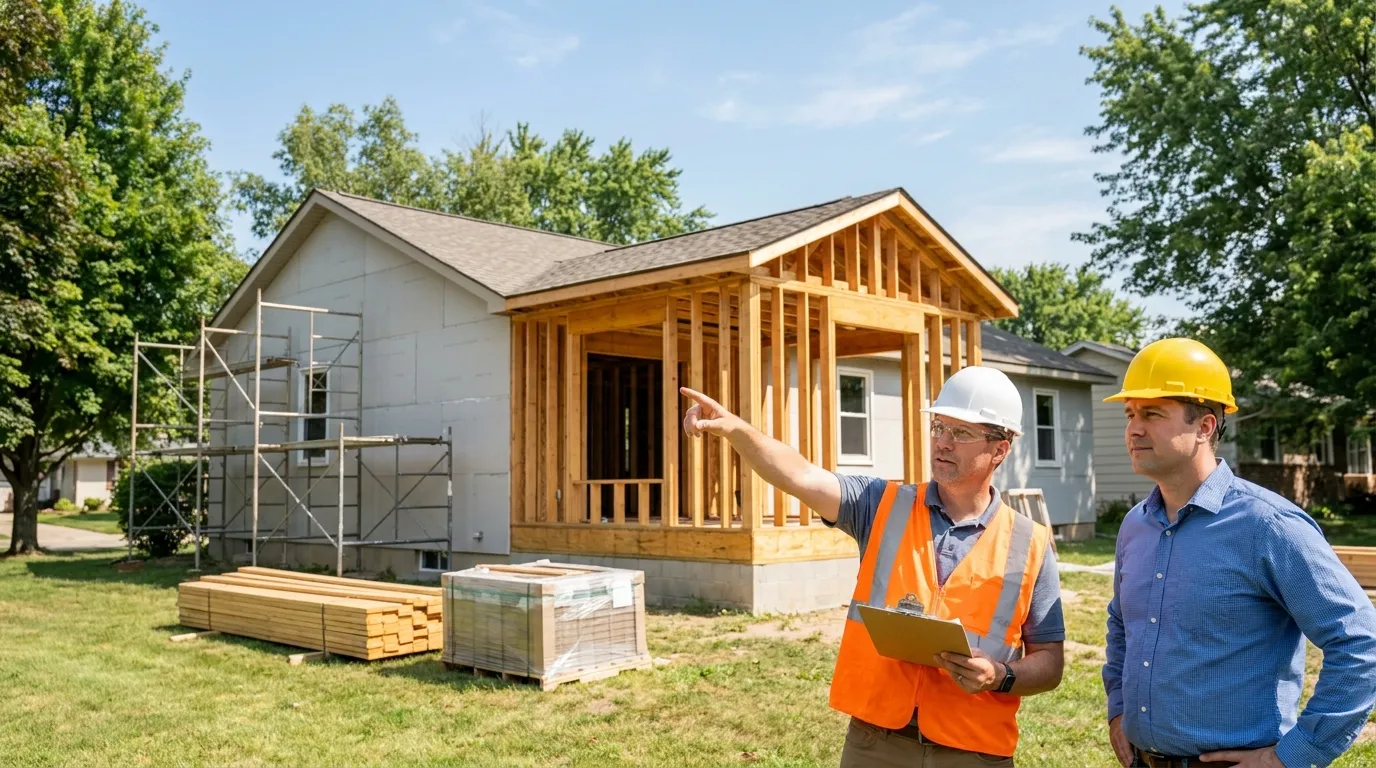
!A single-family house under construction in bright daylight with two people reviewing plans on site.
The two buckets behave differently because they are secured differently. At closing, the lender's security is a property that exists and has a value someone can appraise. The build budget is secured by a property that does not yet exist in the condition the numbers assume. Value gets created by the work, week by week. Releasing an unbuilt budget in one lump sum would put a large sum against collateral that has not changed, which is a bad position for the lender and a worse one for you if the project stops halfway.
By volume this is ordinary market activity, not an edge case. ATTOM counted 64,348 single-family homes and condos flipped in Q1 2026, about 8 percent of all US home sales (ATTOM, June 2026). Redfin put investors at 19% of homes sold that quarter, down from 20% a year earlier (Redfin, May 2026).
If you want the level above this one, we covered how business-purpose fix and flip financing works separately, and why this credit is classified as business purpose rather than as a consumer product. How much you can borrow is a different question from how it is released, and this page is about the release.
What does a draw schedule look like on an investor project?
A draw schedule maps the build budget to construction stages, so each release is tied to identifiable completed work instead of to a calendar date. It runs off the schedule of values, which is the line-item budget for the whole scope of work. Every draw request later gets checked against those lines.
Two structures dominate. Milestone-based schedules release a set amount when a defined stage is complete. Percent-complete schedules measure work in place against each line and release accordingly. Milestone schedules are simpler to administer. Percent-complete schedules track reality more closely on a job with overlapping trades.
A five-stage residential structure is common: demolition and site prep, rough mechanical, electrical and plumbing, insulation and drywall, finishes and fixtures, then punch list and final. Any percentage split you see attached to those stages is illustrative. Actual splits vary by lender, by scope, and by state.
Stages, not weeks, is the right unit. In 2024, single-family homes built for sale took about 7.6 months from permit to completion, and single-family homes overall averaged 9.1 months from authorization to completion (US Census Bureau Survey of Construction, via NAHB, September 2025). Those are ground-up construction timelines, not financing terms, and they are a reminder that a build is measured by what is finished rather than by dates anyone promised.
The schedule is negotiated before loan documents are signed. That is the cheapest moment to change it, and the only one where changing it costs nothing.
What actually happens when you request a draw?
A draw request is a package, not a phone call. Three things move it: a request that matches the schedule of values line for line, evidence that the work is physically in place, and lien waivers covering the work being paid for. Miss one and the request sits, whatever the balance of the loan says.
The sequence looks like this:
1. You or your general contractor assemble the request against specific budget lines, not against a lump sum or a stage nickname.
2. You attach supporting documentation. Invoices, receipts for materials, and dated photographs of the completed work, keyed to the lines being billed.
3. The work in place gets verified. That may be a third-party inspection, a site visit, or a documented remote review, depending on the lender and the stage.
4. Lien waivers are collected from the general contractor and from the subcontractors whose work sits inside that request.
5. The approved amount is released, less any retention held back until the project is complete.
None of this is exotic. It is bookkeeping with a site visit attached. What makes it feel hard the first time is that the request has to speak the schedule of values' language, and most people write their first one in the language of their bank account.
If you are working through a first deal end to end, the walkthrough of a first project covers the surrounding steps. For the product side without the essay, see business-purpose financing for residential real estate projects.
Ask about flexible terms for fix and flip projects
Why does a lender verify work before releasing funds?
Because the collateral is a property whose value is being created by the work itself. Verification confirms the collateral changed before the balance does. It is a checkpoint, not an audit, and on a well-documented job it is the least eventful part of the process.
!A residential construction site being walked with a clipboard and project paperwork in daylight.
An inspector is confirming three narrow things: that the billed work exists, that it matches the line item it was billed against, and that it matches the permitted scope of work. Photographs alone are usually enough on cosmetic stages and usually not enough on structural, mechanical, or anything that gets covered up. Once drywall is closed, nobody can confirm what is behind it.
Unpermitted work is a verification problem before it is a legal one. If the scope of work on site does not match the scope on the permit, the inspector has nothing to sign off against, and the draw waits while that gets reconciled.
Change orders are the other reconciliation point. A change order moves money between lines or adds a line, and the schedule of values has to be updated before the work happens. Documented after the fact, it becomes a billed line that does not exist in the budget, which is exactly the mismatch that holds a request. For what gets reviewed earlier in the process, see what a lender reviews before a project is approved.
What stalls a draw, and how do you prevent it?
Draws stall on mismatches, not on money. The usual causes are a request that does not match the schedule of values, billing ahead of the work, an undocumented change order, a missing or defective lien waiver, or a permit gap on a stage that needed one. Each has a prevention that costs less than the delay.
- The request does not match the schedule of values. A line that was never budgeted, or a line already drawn in full. Prevention: build the schedule of values from the real scope of work, line by line, before signing.
- Billing ahead of the work. Materials not yet delivered, or stored off site with no documentation. Prevention: agree in advance whether stored materials are drawable and what proof is required.
- Undocumented change orders. Prevention: a written change-order procedure agreed before demolition starts, with the schedule of values updated first.
- Missing or defective lien waivers. Several states prescribe the exact wording. California sets out statutory waiver forms in Civil Code sections 8132 to 8138, Texas in Property Code section 53.284, and Florida in Statutes section 713.20. A form that deviates from the required language can be ineffective. Prevention: use the statutory form for the state you are working in.
- Permit or inspection gaps. Prevention: confirm which stages require a municipal sign-off before they are billed.
- A contractor who will not produce paperwork. Prevention: this is a hiring decision, not a draw problem. Put the draw documentation duty, waivers included, in the contractor agreement.
Budgets drift too. In June 2026, the price index for inputs to new residential construction was up 6.2% year over year, and building material prices excluding energy were up 4.6% (NAHB analysis of the BLS Producer Price Index, July 2026). A line written in the spring can be short by the time the stage is billed, and a short line turns into a change order.
> What I see: draws almost never stall over the money. They stall over a mismatch. A line item that was never in the schedule of values. An invoice for work that has not happened yet. A change order everyone agreed to verbally and nobody wrote down. One subcontractor who has not signed a waiver. That is a pattern I have watched across files, not an approval rule, and every request is still subject to approval and eligibility.
Who pays for the work between draws?
Draw funding is reimbursement. Somebody pays for the work before the draw pays it back, and on most investor projects that somebody is you, your general contractor, or a split written into the contract. This is a real working capital line, and it sits on top of your down payment rather than inside it.
!An investor and a contractor reviewing project paperwork outside a residential job site in daylight.
Three arrangements are common. You pay for the work and get reimbursed at each release. The contractor carries labor and materials to the next draw, which usually shows up in the bid. Or a hybrid, with a deposit at the start of each stage and the balance at reimbursement. Fewer, larger draws mean less paperwork and a longer stretch of your own money in the job. More, smaller draws reverse that trade.
The margin explains why the trade matters. ATTOM put the typical Q1 2026 flip at a $66,000 gross profit and a 25.4% gross profit margin, with the median project taking 165 days from purchase to resale (ATTOM, June 2026). That 165 days is a market timeline for how long a project takes, not a financing term. Gross is also measured before the work is paid for, and interest accrues on drawn balances while the calendar runs, which is one reason the exit you plan changes the structure.
Retention is the second squeeze. It is a percentage held back from each release until the work is finished and accepted, so the last slice of every stage arrives late by design. State law is moving here. California's SB 61 added Civil Code section 8811, capping retention at 5 percent of a payment and 5 percent of the contract price on private works of improvement entered into on or after January 1, 2026 (California Legislative Information, 2026). Read the exceptions before assuming it covers you: the cap does not apply to residential projects that are not mixed use and do not exceed four stories, which describes most investor work. Retention rules vary by state, so check where you are building. The stock itself is old enough that scopes tend to run deep, which we looked at in the condition of the US housing stock investors are buying into.
How to build a draw schedule your lender and your contractor both accept
Settle these before you sign anything, while the schedule is still negotiable:
1. Build the schedule of values line by line from the actual scope of work, not from a square-foot estimate.
2. Tie draw stages to inspectable milestones rather than to calendar dates.
3. Confirm what evidence each release requires and who supplies it.
4. Confirm who orders and schedules verification, and what happens when a stage passes only partially.
5. Put the draw documentation duty, waivers included, in the contractor agreement.
6. Agree the change-order procedure in writing before demolition starts.
7. Confirm the retention percentage and when it releases, and check your state's rules.
8. Confirm whether stored materials are drawable and what proof is needed.
9. Size your own working capital against the longest expected gap between spending and reimbursement.
10. Keep one contingency line that belongs to you, not to the schedule.
Eos Loan is a direct lender. We originate, underwrite, and service the credit ourselves, so the people who set your draw schedule are the people who fund it. Terms are flexible and sized to the project, and every request is subject to approval and eligibility. Eos Loan charges no dealer fee. You can also read how Eos Loan lends directly before sending anything over.
Talk to our team about financing your next project
Or call +1 833-989-3737 to walk through a project with our team. More common questions about how our financing works are answered on our FAQ page.
---
{ question: "How does construction draw funding work?", answer: "The build budget is held by the lender and released in stages against completed work. You submit a draw request tied to the schedule of values, the work in place is verified, lien waivers are collected, and the approved amount is released less retention. Subject to approval and eligibility." }, { question: "Do you get the whole construction budget at closing?", answer: "No. Acquisition funds close at closing, and the construction budget releases in stages against work already completed and verified. In Q1 2026, 38.9% of US flip purchases were financed (ATTOM, June 2026), so most financed investor projects run on this staged structure rather than a lump sum." }, { question: "What documents go into a draw request?", answer: "A request keyed to specific schedule of values lines, invoices and receipts for the work and materials being billed, dated photographs of the completed work, and lien waivers from the general contractor and the subcontractors covering that period. Some states prescribe the exact waiver wording by statute." }, { question: "Why would a draw be delayed?", answer: "Usually a mismatch rather than a credit issue: a line that is not in the schedule of values, billing ahead of the work, an undocumented change order, a missing or defective lien waiver, or a permit gap on a stage that required a sign-off. Each one is preventable with paperwork agreed in advance." }, { question: "Who pays the contractor between draws?", answer: "Whoever the contract says. Either you pay for the work and get reimbursed at the next release, the contractor carries labor and materials until then, or a hybrid pays a deposit per stage. Draw funding is reimbursement, so somebody needs working capital in the gap." } ]} />The part you settle before demolition
A draw schedule is negotiated once and lived with for the whole project. It decides how often money moves, what has to be true before it does, and how much of your own cash sits in the job while you wait. None of that is negotiable after the loan documents are signed.
So spend the time on the schedule of values while it is still a draft. Match the stages to work an inspector can see. Write the contractor's documentation duties into the agreement instead of hoping. Size your working capital against the widest realistic gap between spending and reimbursement, not the narrowest. Ten careful minutes on the schedule buys back weeks in the middle of the job.
---
About the author: Eduardo Donadi is the CEO of Eos Loan, a US direct lender financing essential projects including business-purpose residential real estate, battery energy storage, EV chargers, water filtration, and truck fleets. He works directly with investors and operators on how acquisition and construction budgets get structured and funded.
---
Sources
1. ATTOM. "Q1 2026 US Home Flipping Report." June 2026. Retrieved 2026-08-27. https://www.attomdata.com/news/market-trends/flipping/q1-2026-home-flipping-report/
2. ATTOM. "2025 Year-End US Home Flipping Report." March 2026. Retrieved 2026-08-27. https://www.attomdata.com/news/market-trends/flipping/2025-year-end-home-flipping-report/
3. Redfin. "Investor Report, Q1 2026." May 2026. Retrieved 2026-08-27. https://www.redfin.com/news/investor-report-q1-2026/
4. US Census Bureau, Survey of Construction, via NAHB Eye on Housing. "Single-Family Homes Are Built Faster in 2024." September 2025. Retrieved 2026-08-27. https://eyeonhousing.org/2025/09/single-family-homes-are-built-faster-in-2024/
5. NAHB Eye on Housing analysis of the US Bureau of Labor Statistics Producer Price Index. "Building Material Prices Continue to Rise Despite Energy Price Declines." July 2026. Retrieved 2026-08-27. https://eyeonhousing.org/2026/07/building-material-prices-continue-to-rise-despite-energy-price-declines/
6. California Legislative Information. "Civil Code Section 8811" (added by SB 61, Stats. 2025, Ch. 49). Effective January 1, 2026. Retrieved 2026-08-27. https://leginfo.legislature.ca.gov/faces/codes_displaySection.xhtml?lawCode=CIV§ionNum=8811
7. California Legislative Information. "Civil Code Sections 8132 to 8138, Waiver and Release Forms." Retrieved 2026-08-27. https://leginfo.legislature.ca.gov/faces/codes_displayText.xhtml?lawCode=CIV&division=4.&title=3.&part=6.&chapter=4.&article=2.
8. Texas Legislature. "Texas Property Code Section 53.284, Waiver and Release Forms." Retrieved 2026-08-27. https://statutes.capitol.texas.gov/Docs/PR/htm/PR.53.htm
9. Florida Senate. "Florida Statutes Section 713.20, Waiver or Release of Liens." Retrieved 2026-08-27. https://www.flsenate.gov/Laws/Statutes/2025/713.20