

Hard Money vs a Business-Purpose Lender: What Actually Differs
Three investors describe how they are paying for a project. Two of them use different words for what turns out to be the same loan. The third borrows one of those words and means something else entirely. Nobody in that conversation is wrong, exactly. The vocabulary is doing less work than everyone assumes.
That gets expensive when you're choosing where to borrow. "Hard money" and "business-purpose lender" get placed in opposite columns of comparison charts, as though they were two products on a shelf competing for the same buyer. They are not two products. They are not even the same kind of noun, which is why so many of those charts quietly compare the wrong things.
Here is what each term actually names, the four differences that survive scrutiny once the labels stop helping, and the questions worth asking before you sign.
> Key Takeaways
> - "Hard money" describes a loan's structure: short, secured mainly by the asset, underwritten fast. "Business purpose" describes the borrower's intent, which is a legal classification rather than a product.
> - The two overlap constantly. Most hard money loans on investment property are business purpose. Not every business-purpose lender operates the hard money way.
> - The real comparison is not price. It is what gets underwritten, who funds and services the loan, and how the lender behaves when the schedule slips.
> - Flips took an average of 165 days in Q1 2026, and 61.1% were bought all cash (ATTOM, June 2026). The financed share is where lender choice decides the outcome.
> - Ask one question before you sign: does this lender fund with its own capital and service the loan, or route it somewhere else?
See how business-purpose financing fits your deal
Is a hard money loan the same as a business-purpose loan?
No, and they aren't opposites either. "Hard money" describes a loan's structure: short duration, secured mainly by real property, underwritten quickly against the asset. "Business purpose" describes why the borrower is taking the credit, which is a legal classification. Most hard money loans on investment property are business purpose. The reverse does not hold.
That asymmetry is the whole confusion in one line. One term answers "how is this loan built," the other answers "who is borrowing and why." Putting them in facing columns is a bit like comparing "convertible" to "commuter." Both words are useful. They describe different axes.
!A desk in daylight with printed comparable-sales sheets, a laptop and a calculator.
Why does the confusion persist? Because both live outside the consumer lending world, so investors file them in the same mental drawer. And neither is a consumer mortgage. Comparing either one to a 30-year consumer product is the wrong frame entirely: in the week ending August 27, 2026, the 30-year fixed rate averaged 6.66% (Freddie Mac Primary Mortgage Market Survey, 2026). That is a long-dated instrument for someone who lives in the house, priced against a completely different risk and time horizon. It is not a benchmark for investor credit, and it is not an Eos Loan rate.
The legal side of the classification question is worth reading on its own. We cover why business-purpose loans are not consumer mortgages, including the occupancy rule that decides the category, in a separate post. For this comparison, one sentence is enough: the classification tells you which rulebook applies, not which lender to pick.
Hard money vs a business-purpose lender: what actually differs?
The differences that survive scrutiny are structural, not promotional. What gets underwritten, who funds and services the loan, how money is released, and what happens when the calendar slips. In Q1 2026, 61.1% of US flips were all-cash purchases, leaving 38.9% financed (ATTOM, June 2026). For that financed share, the four items below decide more than the headline price does.
| What you are comparing | Typical hard money model | A lender that underwrites the whole deal |
|---|---|---|
| Primary underwriting basis | The asset, mainly as-is value | Asset plus operator record plus a documented exit |
| Speed driver | Thin file, fast asset opinion | Complete file assembled once, reused across deals |
| Construction budget | Often a separate conversation | Sized alongside the purchase from the start |
| Money release | Draws against completed work | Draws against completed work |
| Who holds the paper | Varies: a fund, a broker, a table funder | A direct lender funds with its own capital |
| Who you call at month five | Depends on who bought the loan | The lender that underwrote it |
| Relationship shape | Deal by deal | Built to repeat across projects |
Read that table one way and the right column looks better. That's not the point. The right column is a different set of tradeoffs, and plenty of lenders sit in both columns depending on the file in hand. A thin, fast, asset-only read is genuinely the correct tool for some deals. The mistake is assuming the two columns differ mainly on price, then discovering in month five that they differed on something else.
What does each lender actually underwrite?
Asset-based underwriting asks one question: if this goes sideways, what does the property cover? Whole-deal underwriting asks three, adding the operator's record and a written exit. The second file takes longer to assemble the first time and less time on every deal after that. In Q1 2026, FHA-backed sales made up 10.2% of flipped-home resales, down from 11.7% a year earlier (ATTOM, June 2026).
That last number is not trivia. Who is able to buy your finished house shapes how confident a lender is about the payoff, which is exactly why the exit belongs in the file rather than in your head.
Asset-based means the collateral carries the credit decision. As-is value sets what the lender is protected by today, and after-repair value sets what the project is worth if the scope is completed as written. Both numbers sit in the file, and after-repair value drives what you can borrow in ways worth understanding before you apply.
An operator record is the second layer. It usually means the entity, prior completed projects, the contractor relationships behind the scope, and liquidity to carry the deal if the schedule stretches. None of it replaces the asset. It changes how the asset gets read.
> What I see: the files that move fastest are not the ones with the best property. They're the ones where the scope, the budget, and the exit tell the same story, and where the operator can say plainly what happens if the house doesn't sell in the first few weeks. Every file is still subject to approval and eligibility. But a coherent story is the closest thing to a shortcut that exists.
The third layer is the exit itself. A lender wants the payoff written down, not implied. We make the case that a documented exit belongs before the loan rather than after the work starts.
Talk to our team about financing your next project
Who actually funds and services your loan?
Most comparison pages skip this, and it decides who answers the phone in month five. A direct lender funds with its own capital and keeps underwriting, disbursement, and servicing under one roof. Other models place a party between you and the money. Eos Loan has originated $4B+ to date and processed 30k+ proposals across its lending programs.
Servicing is the plainest word in this article and the least discussed. The servicer takes your payments, approves your draws, grants or declines an extension, and issues the payoff. If that role sits with someone who never read your file, the answers get slower and more conservative, because nobody in the chain has the authority or the context to say yes.
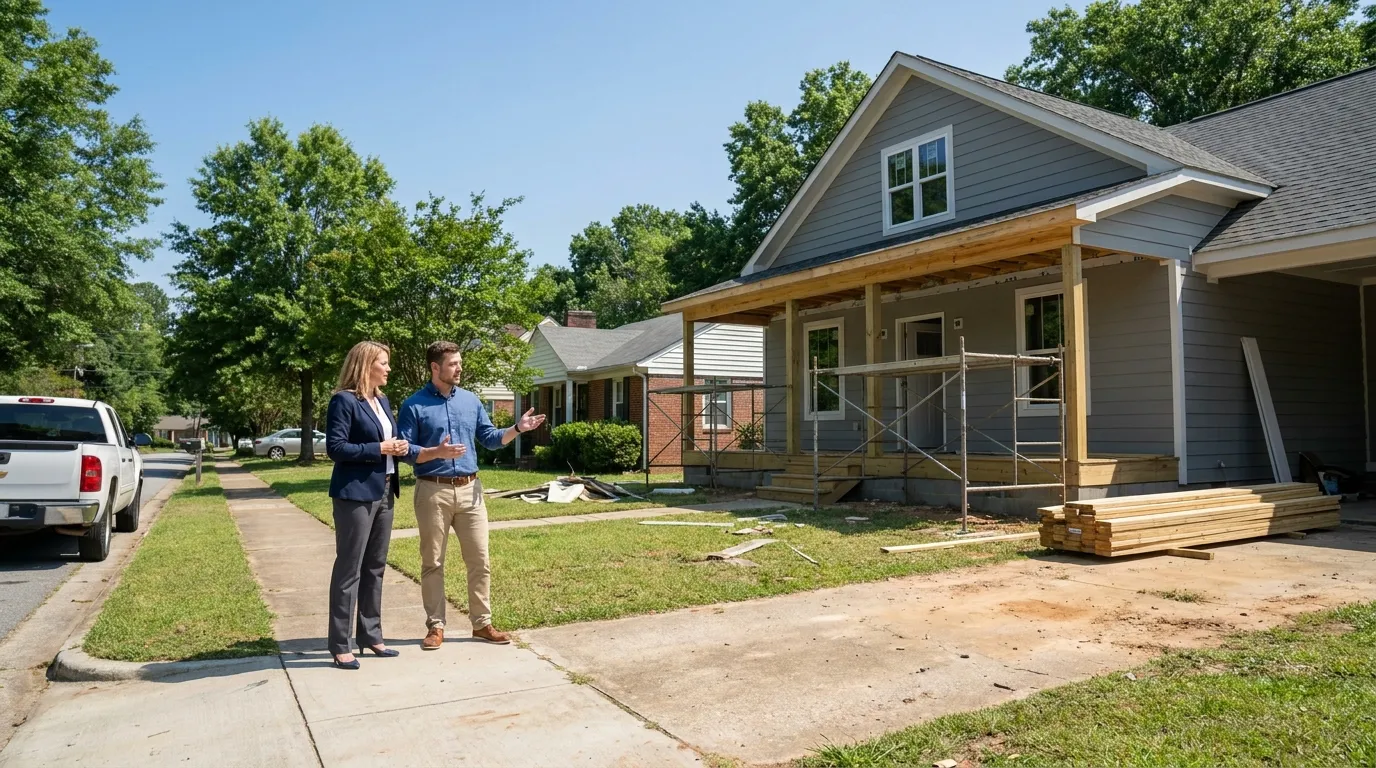
!A single-family house mid-improvement in daylight with building materials staged on site.
Table funding is the other term worth knowing. In a table-funded transaction, one party appears on the loan documents while another party's capital actually closes it, and the loan transfers essentially at closing. Nothing about that is improper. It just means the entity you built a relationship with may not be the entity you negotiate with later.
Eos Loan is a direct lender. We underwrite our own files, fund with our own capital, and service what we originate, so the team that read your deal is the team you deal with afterward. Eos Loan charges no dealer fee. All financing is subject to approval and eligibility. The product side sits on one page if you want it without the mechanics: Eos Loan real estate financing.
Draws are where funding structure becomes visible week to week. Money is released against completed work rather than handed over at closing, and how the money reaches the project is worth reading before your first inspection.
What happens when the project runs past the loan?
Flips took an average of 165 days from purchase to resale in Q1 2026, up from 160 in Q4 2025 (ATTOM, June 2026). That clock starts before the first day of work and stops only at closing. Short-dated credit meets that calendar constantly, and how a lender handles the overrun is a larger cost variable than the headline price.
Two words carry this section. A balloon is the single payoff of principal due at maturity, which is how most short investor credit ends. An extension is the agreement to move that maturity, usually on stated terms and usually for a charge.
Stack the public numbers and the exposure window gets uncomfortable. The average flip already runs 165 days, and the national median days on market was 29 in July 2026 with 4.6 months of supply (NAR, 2026). That 165 is an average, not a ceiling, and the listing period sits on top of the work rather than inside it. Existing-home sales ran at a 4.06 million annual pace that month, down 1.7% from June. Softer absorption stretches the tail of every project.
An overrun resolves three ways: an extension on agreed terms, a move into different credit, or a sale under time pressure. Which one you get depends almost entirely on who is holding the paper and whether they underwrote you in the first place. Interest carries through every extra week regardless of which lender you picked, so the question is never whether an overrun costs money. It's whether the conversation about it is easy or hard. If you want the stages that produce the overrun, we break down the stage-by-stage flip timeline separately.
Why will no honest lender publish one rate for this?
Because there isn't a single number to publish. Investor credit is priced against the specific asset, the market it sits in, the operator's record, the size of the construction budget, and the exit. Any page printing one confident range is publishing its own book and presenting it as market data. Notice who writes those pages: they are almost all lenders quoting themselves.
What you can compare is structure, and you can do it yourself across any two quotes. Ask each lender to total the same five items: interest carried across the entire hold rather than a monthly payment, origination charged at closing, extension terms if the schedule moves, exit or prepayment terms, and any per-draw administration. Then compare the totals against your own timeline, not against a published range.
The reason this works is that the items stay stable even when the numbers don't. A quote that looks cheaper on one line and quietly heavier on another shows itself immediately once everything sits on the same page. Terms at Eos Loan are flexible and set by underwriting, which is why you won't find a rate on this page or anywhere else on this site.
Which lender fits which deal?
Deal shape decides fit more than lender category does. A single distressed asset with a thin file and a fast close leans one way. A repeat operator running back-to-back projects with a real construction budget and a written exit leans the other. In Q1 2026 there were 64,348 US flips, 8% of all home sales (ATTOM, June 2026), and those deals do not all want the same lender.
Three rough shapes, and what each one should weigh:
- One asset, thin file, closing pressure. Speed is the binding constraint. Weigh how fast an asset opinion can be produced, and accept that a thin file gets priced for the uncertainty it leaves behind.
- A project with real construction scope. Weigh whether the budget is underwritten alongside the purchase or bolted on later, and how draws get approved. A lender who sized the scope with you is a different counterparty than one who funded the purchase and is seeing the budget for the first time.
- A second, third, or fourth deal in a row. Weigh servicing and relationship depth over per-deal speed. The file you build once is the asset that compounds, and the extension conversation gets easier when the lender already knows your record.
- Hard money names a structure. Business purpose names a classification. They overlap on most investment property without being the same thing.
- The differences that matter are underwriting basis, funding source, draw mechanics, and overrun behavior. Price follows from those.
- Compare structure across quotes, not published ranges, because no honest single rate exists for credit priced against asset, market, operator, and exit.
Most investors move from the first shape toward the third as their deal count rises, which is why the lender that fit deal one often isn't the one that fits deal four. The parent guide to the fix and flip financing pillar walks through the full structure if you're building that file now.
---
Ask about flexible terms for fix and flip projects
Or call +1 833-989-3737 to talk a project through with our team. All financing is subject to approval and eligibility, and more common financing questions are answered on our FAQ page.
---
question: "Is a hard money loan the same as a business-purpose loan?",
answer: "No. Hard money describes a loan's structure: short, secured mainly by the asset, underwritten fast. Business purpose describes the borrower's intent, which is a legal classification. Most hard money loans on investment property are business purpose, but the reverse does not hold."
},
{
question: "What does a hard money lender actually underwrite?",
answer: "Primarily the asset, using as-is value to set what the collateral covers if the project fails. Lenders that underwrite the whole deal add the operator's record and a documented exit to the file, which takes longer to assemble once and less time on every deal after."
},
{
question: "Who holds my loan after closing?",
answer: "It depends on the model. A direct lender funds with its own capital and services the loan it originated. Table-funded and brokered structures place another party between the borrower and the capital, which changes who has authority to approve a draw or an extension mid-project."
},
{
question: "What happens if my project runs past the loan term?",
answer: "It resolves as an extension on agreed terms, a move into different credit, or a sale under time pressure. With US flips averaging 165 days in Q1 2026 per ATTOM, plan the overrun conversation before you need it rather than in the week the balloon comes due."
},
{
question: "How do I tell a direct lender from a broker?",
answer: "Ask three questions: whose capital funds the loan, who approves the draws, and who do I call in month five. A direct lender answers all three with its own name. Vague or shifting answers to any of the three are themselves the answer."
}
]} />
The question worth asking before you sign
You are not choosing between two products. You are choosing what gets underwritten and who ends up holding the paper, and both of those decide far more than the number on the term sheet.
If your next deal has a scope, a budget, and an exit you can put on paper, that is the file worth bringing to a conversation about business-purpose financing for residential real estate projects.
---
About the author: Eduardo Donadi is the CEO of Eos Loan, a US direct lender financing essential projects including business-purpose residential real estate, truck fleet expansion, battery energy storage, EV chargers, and water filtration. He works directly with investors on how business-purpose deals get structured, funded, and serviced.
---
Sources
1. ATTOM Data Solutions. "Home Flipping Returns Edge Up After Seven Quarters of Decline." June 2026. Retrieved 2026-08-27. https://www.attomdata.com/news/market-trends/flipping/q1-2026-home-flipping-report/
2. National Association of Realtors. "Existing-Home Sales Report Shows 1.7% Decrease in July." 2026. Retrieved 2026-08-27. https://www.nar.realtor/newsroom/nar-existing-home-sales-report-shows-1-7-decrease-in-july
3. Freddie Mac. "Primary Mortgage Market Survey." Week of August 27, 2026. Retrieved 2026-08-27. https://www.freddiemac.com/pmms