

Budget Contingency and Holding Costs: The Line Items Flips Miss
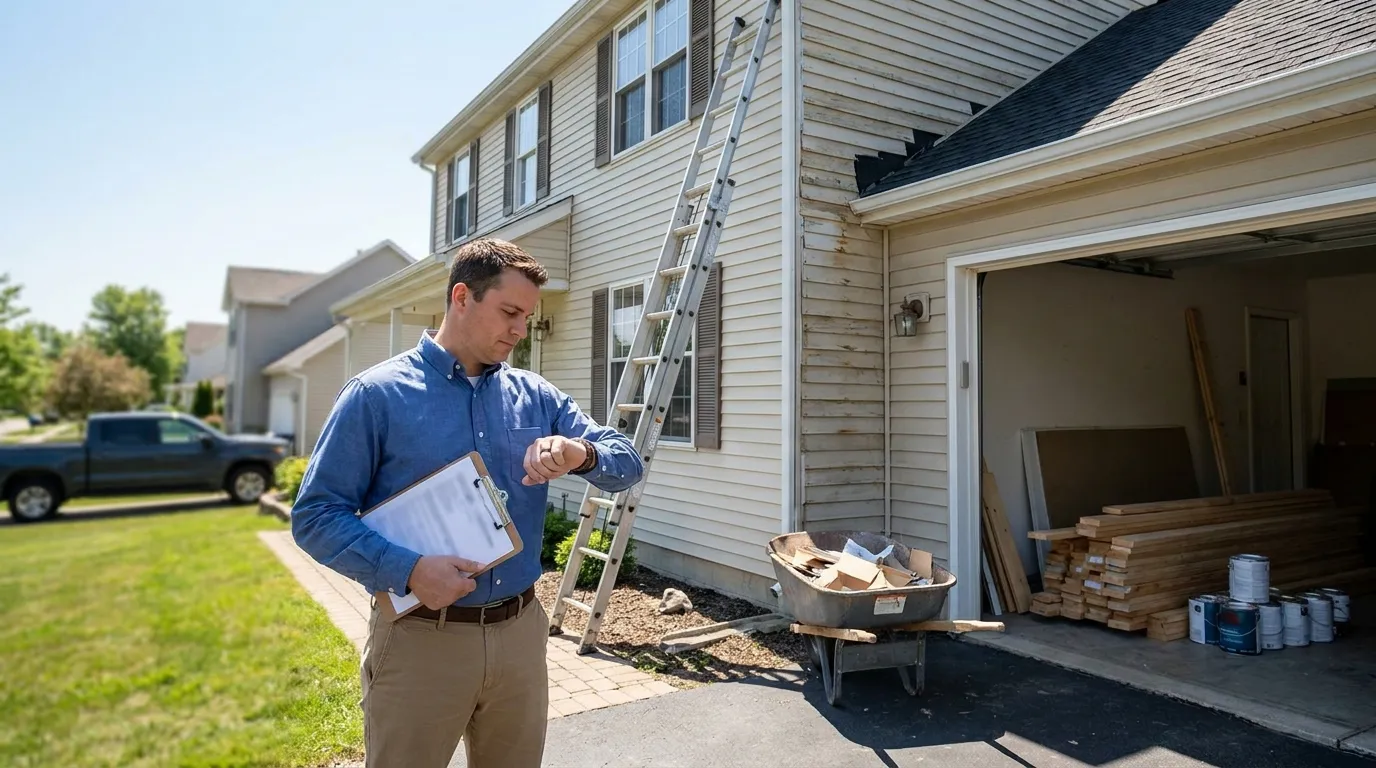
A flip is a business-purpose project on a property nobody lives in. You buy it as inventory, you work on it, and you sell it or keep it as a rental. Two budget lines on that project get filled in last and guessed at, and they are the two that decide whether the deal makes money.
The typical flip took 165 days from purchase to resale in Q1 2026, up from 160 days the quarter before, with a gross profit of about $66,000 (ATTOM, June 2026). Here is the part almost every article drops: that $66,000 is the spread between purchase and resale, and ATTOM says plainly that it excludes improvement costs.
So the two lines that eat it are the ones you are least likely to have priced. What it costs to own a property that earns nothing, and what you set aside for the work nobody quoted.
> Key Takeaways
> - Holding costs accrue on the calendar, not on the scope of work. They grow while nothing is happening on site.
> - ATTOM's widely quoted gross profit figure excludes improvement costs entirely (ATTOM, June 2026).
> - A contingency sized only against construction is undersized, because a surprise buys extra work and extra weeks of carry.
> - Input prices to new residential construction were up 6.2% year over year in June 2026 (NAHB analysis of BLS data, July 2026).
> - Eos Loan is a direct lender with flexible terms and no dealer fee, subject to approval and eligibility.
See how business-purpose financing fits your deal
What are holding costs on a flip?
Holding costs are everything you pay to own a property that produces no income between purchase and sale: the loan payment, property taxes, insurance, the power and water service, and any association dues. ATTOM put the typical hold at 165 days in Q1 2026 (ATTOM, June 2026). Call it five and a half months of bills against zero revenue.
If you have been searching for the difference between holding costs and carrying costs, stop. There isn't one. Investors, lenders and accountants use both names for the same line.
What makes this line different is what it responds to. Construction cost responds to the scope of work. Holding cost responds to the calendar. It bills on a permit delay, a slow inspection, a week of rain, and the fourteen days a buyer takes to close. It is the only budget line that grows while nobody is on site.
!A single-family house mid-improvement in daylight with building materials staged on site.
Here is the inventory. The columns are mechanics, not dollar amounts, because anyone publishing one national monthly figure for this is guessing.
| Line item | How it accrues | What makes it bigger | When it stops |
|---|---|---|---|
| Loan payment | Monthly | A longer hold, a larger drawn balance | At payoff, not at listing |
| Property taxes | Annual, prorated at closing | The assessed value, the local rate | Prorated to the closing date |
| Insurance | Monthly or annual | An unoccupied dwelling, coastal or wildfire exposure | At closing |
| Power and water service | Monthly | Winter heat, temporary power, dust control | Usually at closing |
| Association dues | Monthly or quarterly | Special assessments during the hold | At closing |
| Lawn, snow and site upkeep | Per event | Season, lot size, municipal code enforcement | At closing |
| Security and boarding | Monthly or one time | Vacancy, break-ins, an open structure | When the property is secured or sold |
| Permit and inspection fees | Per event | Re-inspections, revised drawings | When the final passes |
| Staging | Monthly, after the work | A slow listing | When it goes under contract |
Most of these are market-specific, so price them from your own quotes rather than a national average. Two of them do have real national numbers behind them, and those two are worth doing properly. All of it sits inside the same real estate project financing for a business-purpose deal.
How much do property taxes and insurance add while you hold?
These are the two holding lines with hard national data behind them. ATTOM measured the average single-family property tax bill at $4,427 in 2025, up 3% year over year, at an effective rate of 0.9% on an average estimated value of $494,231 (ATTOM, April 2026). On an average-valued property that is roughly $369 a month, before insurance.
Two things about that bill surprise first-time investors. It follows the assessment, not what you paid, so buying well under market can still leave you carrying an above-market bill until the assessment catches up. And it prorates at closing, so you owe for the days you held.
Insurance is the line investors underprice most often, and the reason is structural. A standard policy on a dwelling is written for an occupied home. A property with nobody living in it and active work going on is a different risk class, with different vacancy provisions. Ask your agent about that before the first invoice, not after a claim.
The direction matters more than any single number. Inflation-adjusted average premiums per policy rose 43% in the West and 18% in the Northeast between 2018 and 2024 (NAIC, August 2026). If your holding-cost assumption came from a deal you did five years ago, it is stale. Get a current quote for the specific property before you finalize the budget, and read the rest of the structure in our guide to business-purpose financing for a fix and flip project.
Why does the loan payment belong in the holding-cost line?
Because it accrues on the calendar exactly like the tax bill does. ATTOM found the share of flips acquired with financing rose from 36.9% in 2024 to 37.7% in 2025 (ATTOM, March 2026), and for that group the payment is usually the largest single monthly item in the whole holding line.
A payment sized against a planned hold is a different total against an actual hold. Same payment, more of them. That is why the useful exercise is to model the carry at a hold longer than your plan, not at the plan itself.
One structural note, then we move on. When money reaches a project in stages rather than all at closing, the balance you are paying on changes over the life of the job, so the carrying profile is not flat. If the vocabulary itself is new, start with how a monthly payment is put together.
> What I see: the budgets that hold up are the ones where the investor already knew their monthly carrying number as a single figure before we ever talked about financing. That number turns every schedule decision into a dollar decision. When the cabinet order slips three weeks, they know what three weeks costs, and they choose. The investors without it discover the number in month five. That is a pattern I have watched across applications, not a policy or an approval rule.
Ask about flexible terms for fix and flip projects
How much should you budget for contingency?
There is no universal percentage, and any page handing you one without a source is guessing. The defensible anchor is ATTOM's: improvement costs on a flip typically run between 20% and 33% of the property's after-repair value, and ATTOM's published gross profit excludes them (ATTOM, June 2026). Your contingency is a percentage of that construction budget, not of the purchase price.
Be strict about what the reserve is for. It covers the unpriced part of the scope of work: what is behind the wall, what the inspector requires, what the permit office asks for on the second pass. It does not cover an expanded layout or a finish upgrade. That is a budget increase, and naming it as one keeps the reserve honest.
Size it against uncertainty rather than against habit. A 1950s property with unknown systems and no as-builts carries more unknown than a cosmetic job on a house that was fully systems-updated eight years ago. Same construction budget, very different reserve.
!An investor and a contractor reviewing the scope of work outside a residential job site in daylight.
Now the part almost nobody writes down. A contingency sized only against the construction estimate is structurally undersized, because it funds the surprise but not the delay the surprise causes. Find failed cast iron under the slab and you pay twice: once for the plumbing, and again for the three weeks of holding cost that the plumbing bought. Holding cost and contingency are the same risk measured twice.
So build the reserve in two parts and add them:
1. The work component. Take the construction budget and apply a reserve percentage you can defend for that property's age and condition. Write down why you picked it.
2. The schedule component. Take your monthly carrying number and multiply it by the delay a genuinely bad surprise would cause on this property. Two weeks, four, six. That is your number, not a national one.
The second part is the one that goes missing, and it is what turns a manageable overrun into an emergency. That is a method rather than a percentage, and it survives contact with a specific property.
What is actually driving cost overruns in 2026?
Input prices, mostly, not bad estimating. The producer price index for inputs to new residential construction was up 6.2% year over year in June 2026, and building materials excluding energy were up 4.6% (NAHB analysis of BLS data, July 2026). A bid signed in the spring does not price a purchase made in the fall.
The movement is uneven, which is the useful part. Where your scope sits determines your exposure.
Roofing asphalt products were up 9.2% year over year in June 2026 and softwood lumber 7.0%, while gypsum products fell 1.1% (NAHB analysis of BLS data, July 2026). A roof-and-structure scope and a paint-and-drywall scope are not exposed to the same market, so a single blanket contingency percentage across both is lazy arithmetic.
!A contractor crew working on a residential rooftop in bright daylight.
Two habits follow. A quote with no stated expiration has one you did not get to negotiate, so ask for the date in writing. And price and lead time move together: the material that got expensive is often the back-ordered one, which pushes the overrun straight back into your holding line.
How does a longer hold change the whole budget?
It compounds, and 2026 margins leave less room to absorb it. Full-year 2025 gross profit came in at $65,981 on a 25.5% return, down from about $77,000 and 32.1% in 2024, on an average 163 days to flip (ATTOM, March 2026). Thinner margins mean carrying cost takes a bigger bite of whatever is left.
The resale half of the calendar is not fully yours to control either. NAR reported a 4.6-month supply of existing homes and a 29-day median time on market in July 2026 (NAR, August 2026). Those are real days, and every one of them bills at your monthly rate.
!A wide daylight view of an ordinary residential street with driveways and single-family houses.
This is where the two lines meet. A slow sale raises carrying cost, and how you plan the exit is its own subject. What belongs in the budget is simpler: know what a slipped month costs before the month slips. Then a delay is a decision you priced. Our common questions about applying page covers the rest.
How does financing the project change what you carry?
Eos Loan is a direct lender. We originate, underwrite and service the credit ourselves, so you work with one team from application through funding instead of getting handed between parties. To date we have originated $4B+ and processed 30k+ proposals across our lending programs.
We finance business-purpose residential real estate projects across fix and flip, fix and keep and fix and hold, with flexible terms and a straightforward digital application. Eos Loan charges no dealer fee. Every application is subject to approval and eligibility, and if the exit itself is still open, we compare how a keep and a hold change the loan separately.
What direct lending changes in practice, on this specific problem, is who answers when the schedule moves. One point of contact, decisions made in-house, no handoff at the moment a handoff hurts most.
And the honest framing: financing does not remove holding cost. It changes which account it comes out of, and keeps more of your own cash available for the reserve you just sized. That is not the same as making the line disappear.
---
Talk to our team about financing your next project
Prefer to talk it through? Call +1 833-989-3737.
---
question: "What are holding costs on a flip?",
answer: "Everything you pay to own a property that earns nothing between purchase and sale: the loan payment, property taxes, insurance, the power and water service, association dues and site upkeep. ATTOM put the typical hold at 165 days in Q1 2026, so budget roughly five and a half months of bills against no revenue."
},
{
question: "What is the difference between holding costs and carrying costs?",
answer: "Nothing. They are two names for the same budget line, and investors, lenders and accountants use them interchangeably. What defines the line is that it accrues on the calendar rather than on the scope of work, so it keeps billing on a permit delay or a rained-out week."
},
{
question: "How much should I budget for contingency on a flip?",
answer: "There is no universal percentage. Size it against the construction budget and the uncertainty in the scope of work, then add the carrying cost of the delay a bad surprise would cause. ATTOM notes improvement costs typically run 20% to 33% of after-repair value (ATTOM, June 2026)."
},
{
question: "Does the property tax bill follow what I paid for the property?",
answer: "Not immediately. It follows the assessed value, so a property bought under market can carry an above-market bill until the assessment catches up. ATTOM measured the average single-family bill at $4,427 in 2025 at a 0.9% effective rate (ATTOM, April 2026). It prorates at closing for the days you held."
},
{
question: "What happens to my budget if the project runs long?",
answer: "Both lines move at once. The extra work draws down the reserve, and the extra weeks bill at your monthly carrying rate. That is why the two should be sized together, and why a reserve built only against the construction estimate runs out earlier than investors expect."
}
]} />
The two lines that decide the deal
Most budgets are wrong in the same two places, and neither has anything to do with the quality of the construction estimate.
- Holding cost accrues on the calendar, so it grows on the days when nothing happens.
- Contingency covers the unpriced part of the scope of work, plus the carrying cost of the delay that part creates.
- Input prices are still climbing unevenly, so a single blanket reserve percentage across every scope is not a plan.
- Know your monthly carrying number as a single figure before you borrow, not in month five.
And keep the headline number in perspective. When you read that the typical flip produced a $66,000 gross profit, remember what ATTOM itself says: that figure excludes the improvement budget entirely. These two lines are what stands between that number and yours. Once they are sized, real estate project financing is a conversation rather than a scramble.
---
About the author: Eduardo Donadi is the CEO of Eos Loan, a US direct lender financing essential projects including business-purpose real estate, truck fleet expansion, battery energy storage, EV chargers, and water filtration. He works directly with investors on how fix and flip, fix and keep and fix and hold projects get structured and funded.
---
Sources
1. ATTOM. "Q1 2026 US Home Flipping Report." Published June 2026. Retrieved 2026-08-27. https://www.attomdata.com/news/market-trends/flipping/q1-2026-home-flipping-report/
2. ATTOM. "2025 Year-End US Home Flipping Report." Published March 2026. Retrieved 2026-08-27. https://www.attomdata.com/news/market-trends/flipping/2025-year-end-home-flipping-report/
3. ATTOM. "2025 Property Tax Analysis." Published April 2026. Retrieved 2026-08-27. https://www.attomdata.com/news/market-trends/home-sales-prices/2025-annual-tax-report/
4. NAIC. "NAIC Releases First-of-Its-Kind National Analysis of Homeowners Insurance Market Trends." Published August 2026. Retrieved 2026-08-27. https://content.naic.org/article/naic-releases-first-of-its-kind-national-analysis-homeowners-insurance-market-trends
5. NAHB Eye on Housing, analysis of BLS producer price index data. "Building Material Prices Continue to Rise Despite Energy Price Declines." Published July 2026. Retrieved 2026-08-27. https://eyeonhousing.org/2026/07/building-material-prices-continue-to-rise-despite-energy-price-declines/
6. National Association of Realtors. "Existing-Home Sales Report, July 2026." Published August 2026. Retrieved 2026-08-27. https://www.nar.realtor/newsroom/nar-existing-home-sales-report-shows-1-7-decrease-in-july