

After-Repair Value: How ARV Drives What You Can Borrow
You can be right about the house, right about the contractor, and right about the market, and still be told you can borrow $40,000 less than you planned. One number in the appraisal disagreed with the one in your spreadsheet.
This is a guide to business-purpose financing for an investor project, and to the number that sets the maximum a lender will advance on it: after-repair value. ARV drives loan sizing on fix and flip, fix and keep and fix and hold deals. It is not a consumer product concept.
Investors treat ARV as a profit estimate. Lenders treat it as a risk ceiling. Almost nobody explains the second job, and the second job is the one that decides your loan amount.
Here is how ARV is calculated, how it converts into dollars, why the appraised figure can differ from yours, and what to do when it lands low.
> Key Takeaways
> - ARV is the appraised value of the property assuming your scope of work is finished, and it is what a business-purpose lender underwrites, because the finished house is the collateral.
> - Published industry practice caps total financing near 70% to 75% of ARV, with newer investors often held to 65% to 70% (RCN Capital, 2026).
> - The typical 2025 flip returned 25.5% gross, the lowest since 2008 and down from 32.1% in 2024 (ATTOM, 2025).
> - Three tests run at the same time (ARV cap, purchase advance, total cost) and the lowest ceiling binds.
> - Eos Loan is a direct lender with flexible terms, subject to approval and eligibility.
Talk to our team about financing your next project
What is after-repair value, and why does a lender care?
After-repair value is the projected market value of a property once all the planned repairs and improvements are done (RCN Capital, 2026). A lender cares because the loan is secured by a house that does not exist yet. ARV is the collateral value actually being underwritten.
Two values sit on every one of these deals. As-is value is what the property is worth today, with the failed roof and the 1994 cabinets still in place. ARV is what it will be worth after your scope of work is executed. The gap between them is the reason the deal exists at all.
Here is the mechanical detail almost nobody writes down. An appraisal for a project like this is completed "subject to completion per plans and specifications on the basis of a hypothetical condition that the improvements have been completed." That language sits on Fannie Mae's Uniform Residential Appraisal Report, Form 1004 (Fannie Mae). It is not a figure of speech. The appraiser is formally valuing a condition that does not exist on the day of the inspection.
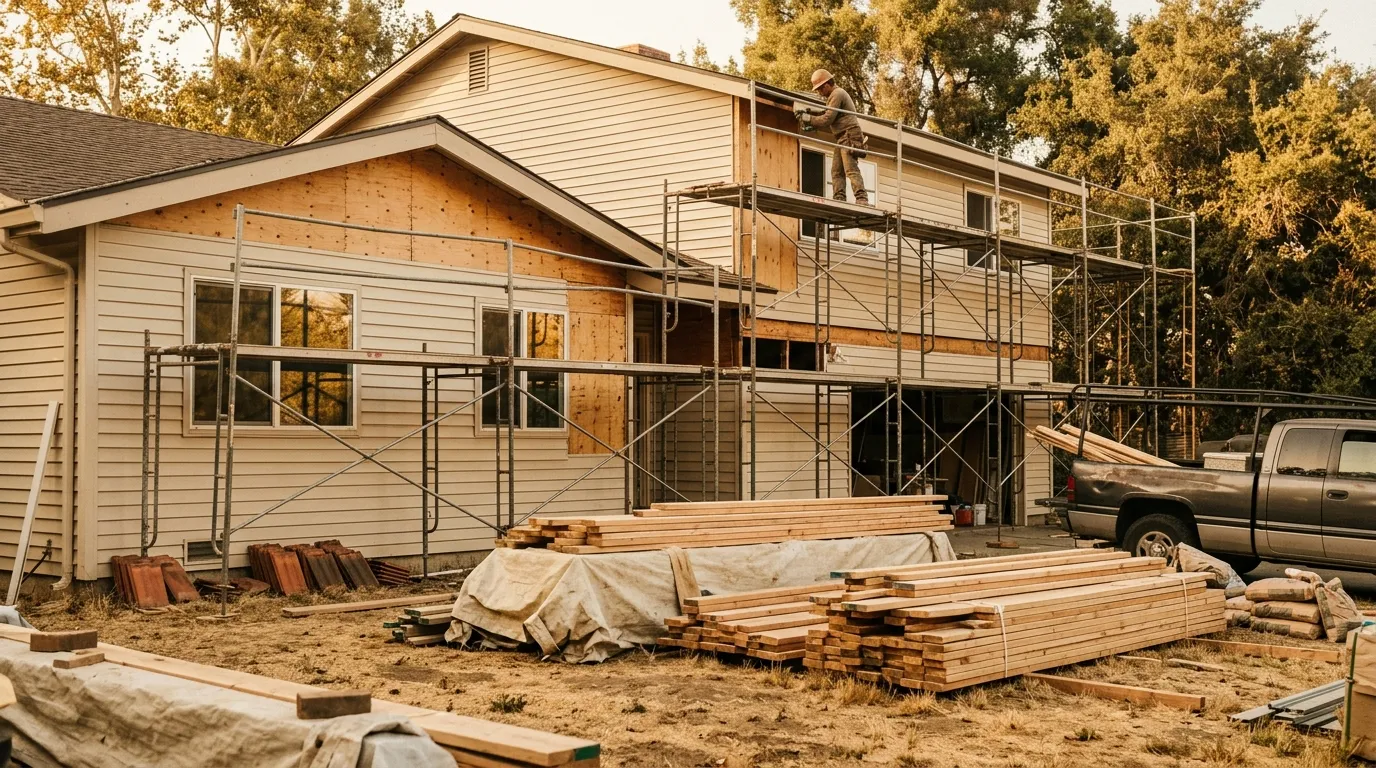
!A single-family house under construction in daylight, with two people on site reviewing plans.
Which means the appraiser is valuing your documented scope of work. Not your intentions, not your mood board, and not the finish level you have in your head. If the plans and specifications do not describe it, the hypothetical condition does not include it, and the appraised value does not reflect it.
So the same number does two different jobs. On your side of the table it estimates a resale price. On the lender's side it is a hard ceiling on the advance. If you want the product overview instead of the valuation math, our guide to how business-purpose fix and flip financing works end to end covers the structure.
How do you calculate ARV?
From comparable sales, not from cost. The accepted method is to find recent sales of similar homes in the same neighborhood, "sold in the last three to six months, if possible," matched on square footage and on bedroom and bathroom count, then adjusted for the differences (RCN Capital, 2026).
What you spent does not create value. Four rules do most of the work:
1. Sold, not listed. A listing is an asking price. A closing is evidence.
2. Same submarket. School boundary, block quality and street type matter more than a radius on a map.
3. Adjust, do not average. If your comp has one more bathroom, price the bathroom and subtract it. Averaging three unlike houses produces a number nobody can defend.
4. Respect the ceiling comp. The highest recent sale on the block is a cap, not a target. Adding square footage or a finish level the neighborhood has never paid for rarely converts into value.
Price per square foot is a sanity check, not a method. It is useful for catching a comp that is 40% too high. It is useless for pricing a specific finish package.
!A desk in daylight with printed comparable-sales sheets, a laptop and a calculator.
Market conditions decide how much room the comps leave you. In July 2026, the National Association of Realtors put the median existing-home price at $434,100, up 2.0% year over year, with 1.54 million units of inventory and a 4.6-month supply (NAR, 2026). A market carrying that much standing inventory is a market where comps set the price, not the seller.
How does ARV set the size of your loan?
Lenders convert ARV into a cap. Published industry practice limits total financing to roughly 70% to 75% of ARV, with up to 80% of the purchase price and up to 100% of the renovation costs available inside that ceiling (RCN Capital, 2026). Three tests run at once, and the lowest one wins.
The three tests, in plain English:
- Loan-to-ARV, sometimes written LTARV: total financing divided by the appraised after-repair value.
- Purchase advance: the share of the actual purchase price the lender will fund at closing.
- Loan-to-cost: total financing divided by purchase price plus renovation budget.
- Undocumented scope. You are paying for quartz counters and tile floors. The plans say "update the interior."
- Over-improvement. The finish level is real, but the block has never sold a house at that level.
- A borrowed comp set. The comps are genuine sales, taken from the submarket two streets over that trades 12% higher.
- A stale timeline. The ARV assumes today's market and the resale happens months from now.
- ARV comes from sold comps in the same market, not from what you spent.
- Three tests run at once, and the lowest ceiling decides your loan amount.
- The 70% rule screens offers. It does not underwrite them, and it is not the same 70% a lender applies.
- Document the scope and the comp set before the appraiser walks the property, because the appraisal is written on a hypothetical condition built from those documents.
- A low ARV is a cash problem, and with 2025 gross ROI at 25.5% there is less room to absorb one than there was three years ago.
Run them on real numbers. In 2025, ATTOM put the national medians at a $259,019 purchase price and a $325,000 resale price (2025 Year-End US Home Flipping Report). Treat $325,000 as the ARV and assume a $35,000 renovation budget, so total cost is $294,019.
At a 70% ARV ceiling, total financing tops out at $227,500. An 80% purchase advance plus the full renovation budget would come to $242,215, which is above that cap. The ARV test binds. You bring roughly $66,500 of the cost, before closing and carrying costs.
At a 75% ceiling, the cap rises to $243,750. Now the $242,215 fits underneath it, and the purchase advance becomes the binding test instead. Your cash drops to about $51,800. Nothing about the house changed. One percentage did.
Experience moves the ceiling too. Seasoned investors are described as reaching up to 75% of ARV, while newer investors are commonly held to 65% to 70% depending on project risk and credit history (RCN Capital, 2026). Financing is the normal path, not the exception: 37.7% of 2025 flips were purchased with financing, up from 36.9% in 2024 (ATTOM, 2025).
Every percentage in this section comes from RCN Capital's published description of industry practice. None of it is an Eos Loan advance rate, and no figure here is a rate, a fee or a promise. Terms are flexible and sized to the plan, subject to approval and eligibility.
See how business-purpose financing fits your deal
What is the 70% rule, and where does it break?
The 70% rule sets a maximum offer, not a loan amount. The formula is after-repair value multiplied by 70%, minus repair costs (New Silver). On a $350,000 ARV with $65,000 of repairs, that produces a $180,000 maximum purchase price. It takes ten seconds and it is worth running on every deal.
What it leaves out is longer than what it includes. By New Silver's own accounting, the rule ignores financing costs and loan repayments, origination fees and points, closing costs, carrying costs, property taxes, insurance, HOA dues, utility bills, agent commissions and transfer fees.
And here is where investors get hurt. The number 70 shows up twice in this business, in two unrelated places. It is an offer screen applied to what you bid, and it is a financing ceiling applied to what you borrow. Different denominators, different jobs. Treat the screen as if it were the ceiling and you will win a property at a price no lender will fund at the level you assumed.
New Silver is direct about the limits: the rule does not promise a profit if market conditions deteriorate or renovations run past budget. It is a filter for saying no quickly. It is not underwriting, and it is not a budget.
Why does the appraiser's ARV differ from yours?
Because the appraiser is valuing a documented scope against a defensible comp set, while the investor is often valuing an intention against a chosen one. In 2025, flippers reported paying an average of 66% of ARV at purchase, below the 70% to 75% financing ceiling (RCN Capital, 2026). That gap is what caution looks like in the data.
Four things cause most of the disagreement:
What should you hand the appraiser? A line-item scope of work with quantities, the plans, permits where relevant, and your comp set with the adjustments shown rather than implied. Providing your comps is normal and legitimate. Telling the appraiser what number you need is not, and it is the fastest way to lose credibility on a file.
> What I see: the deals that come apart late are rarely the ones with a bad renovation budget. They are the ones where the comp set was assembled to justify a price rather than to describe a market. Across the proposals we have processed at Eos Loan, more than 30,000 of them against $4B+ originated, that pattern shows up far more often than a contractor who ran over. It is an observation, not an approval rule. Every file is still subject to approval and eligibility.
What happens when ARV comes in low?
The ceiling drops and the gap becomes cash. That hurts more in 2026 than it did in 2021, because the margin has thinned: the typical 2025 flip returned 25.5% gross, the lowest since 2008 and down from 32.1% in 2024, with gross profit of $65,981 against $77,000 a year earlier (ATTOM, 2025).
You have four responses to a low appraisal, and only four. Bring the difference in cash. Renegotiate the purchase price with the seller. Cut the scope back to what the comps actually support. Or pass on the deal.
The arithmetic matters here, because a 5% ARV miss is not a 5% profit miss. On a $325,000 ARV at a 70% ceiling, a 5% shortfall takes $16,250 off the value and $11,375 off the maximum advance. Your costs did not move. The entire shortfall lands on the equity slice, which is the thinnest layer in the stack.
There is a market check worth running before you commit to an ARV. In April 2026, Redfin reported that 35.4% of US home sellers cut their asking price, by an average of 4% (Redfin, 2026). Your ARV is a bet on a resale price in a market where roughly a third of sellers are already discounting to get there.
How do you build an ARV you can defend?
A defensible ARV is a documented one. Build it from sold comps in the same neighborhood within the last three to six months, matched on square footage and bed and bath count, adjusted rather than averaged, and capped at what the block has actually paid (RCN Capital, 2026).
Five things go in the file before the appraiser arrives:
1. A comp package. Three to six sold comps, same submarket, last three to six months, with your adjustments written out line by line.
2. A line-item scope of work. Quantities and finish levels, not a lump sum. This is the document the hypothetical condition is built on.
3. A named contingency. A number you chose deliberately, not the rounding error left at the bottom of the budget.
4. A timeline. The average 2025 flip took 163 days from purchase to resale (ATTOM, 2025). Your ARV is not being tested today. It is being tested about five months from now.
5. An exit assumption. Flip, keep or hold changes which comps matter. A resale exit is priced off sold comps. A keep or hold exit is priced off rent comps and stabilized value.
Eos Loan is a direct lender. We originate, underwrite and service our own credit, so the ARV conversation happens with the party actually making the decision rather than with someone passing your file along. Terms are flexible and sized to the plan, and every request is subject to approval and eligibility. Eos Loan charges no dealer fee.
You can read more about a direct lender that originates, underwrites and services its own credit, or see the product side on our page for financing for fix and flip, fix and keep and fix and hold projects.
---
Ask about flexible terms for fix and flip projects
Or call +1 833-989-3737 to walk through the numbers on a specific property. More common questions about applying are answered on our FAQ page.
---
{ question: "What is after-repair value?", answer: "ARV is the projected market value of a property once the planned repairs and improvements are complete (RCN Capital, 2026). It is the value a business-purpose lender underwrites, because the finished house is the collateral securing the loan rather than the property in its current condition." }, { question: "How do you calculate ARV?", answer: "From comparable sales. Find recent sales of similar homes in the same neighborhood, preferably sold in the last three to six months, matched on square footage and bedroom and bathroom count, then adjust for the differences rather than averaging them (RCN Capital, 2026)." }, { question: "What percentage of ARV will a lender finance?", answer: "Published industry practice caps total financing near 70% to 75% of ARV, with newer investors often held closer to 65% to 70% depending on project risk and credit history (RCN Capital, 2026). Every lender sets its own limits, and any amount is subject to approval and eligibility." }, { question: "What is the 70% rule in house flipping?", answer: "Maximum offer price equals after-repair value multiplied by 70%, minus repair costs (New Silver). On a $350,000 ARV with $65,000 of repairs that is $180,000. It excludes financing, closing, carrying and selling costs, so it is a screen, not a budget." }, { question: "What if the ARV comes in lower than my estimate?", answer: "The loan ceiling drops and the difference becomes cash you bring, so the usual responses are renegotiating the purchase, cutting scope to what the comps support, funding the gap, or passing. With 2025 gross ROI at 25.5%, there is less margin to absorb a miss (ATTOM, 2025)." } ]} />The number your deal rests on
ARV is a constraint before it is a forecast. Get that order right and most of the rest follows.
Write your ARV down with the comps attached before you write your offer. If the number only works when you use the best sale on the block, it is not an ARV, it is a hope. More financing guides for essential projects cover the rest of the capital stack.
---
About the author: Eduardo Donadi is the CEO of Eos Loan, a US direct lender financing essential projects and business-purpose real estate projects including fix and flip, fix and keep and fix and hold. He works directly with investors on how deals get structured, sized and funded.
---
Sources
1. RCN Capital. "ARV Loans Explained: Fix and Flip Financing Based on After-Repair Value." 2026. Retrieved 2026-08-27. https://rcncapital.com/blog/arv-loans-explained-fix-and-flip-financing-based-on-after-repair-value
2. ATTOM. "2025 Year-End US Home Flipping Report." 2026. Retrieved 2026-08-27. https://www.attomdata.com/news/market-trends/flipping/2025-year-end-home-flipping-report/
3. New Silver. "What Is The 70% Rule In House Flipping?" Retrieved 2026-08-27. https://newsilver.com/the-lender/what-is-the-70-rule-in-house-flipping/
4. National Association of Realtors. "Existing-Home Sales Report Shows 1.7% Decrease in July." August 2026. Retrieved 2026-08-27. https://www.nar.realtor/newsroom/nar-existing-home-sales-report-shows-1-7-decrease-in-july
5. Redfin. "Price Drops, April 2026." 2026. Retrieved 2026-08-27. https://www.redfin.com/news/price-drops-april-2026/
6. Fannie Mae. "Uniform Residential Appraisal Report, Form 1004." Retrieved 2026-08-27. https://singlefamily.fanniemae.com/media/12371/display
7. Eos Loan. Company figures ($4B+ originated to date, 30k+ proposals processed). src/data/stats.ts.