

Vocational Truck Financing: Dump, Tow, and Mixer Trucks
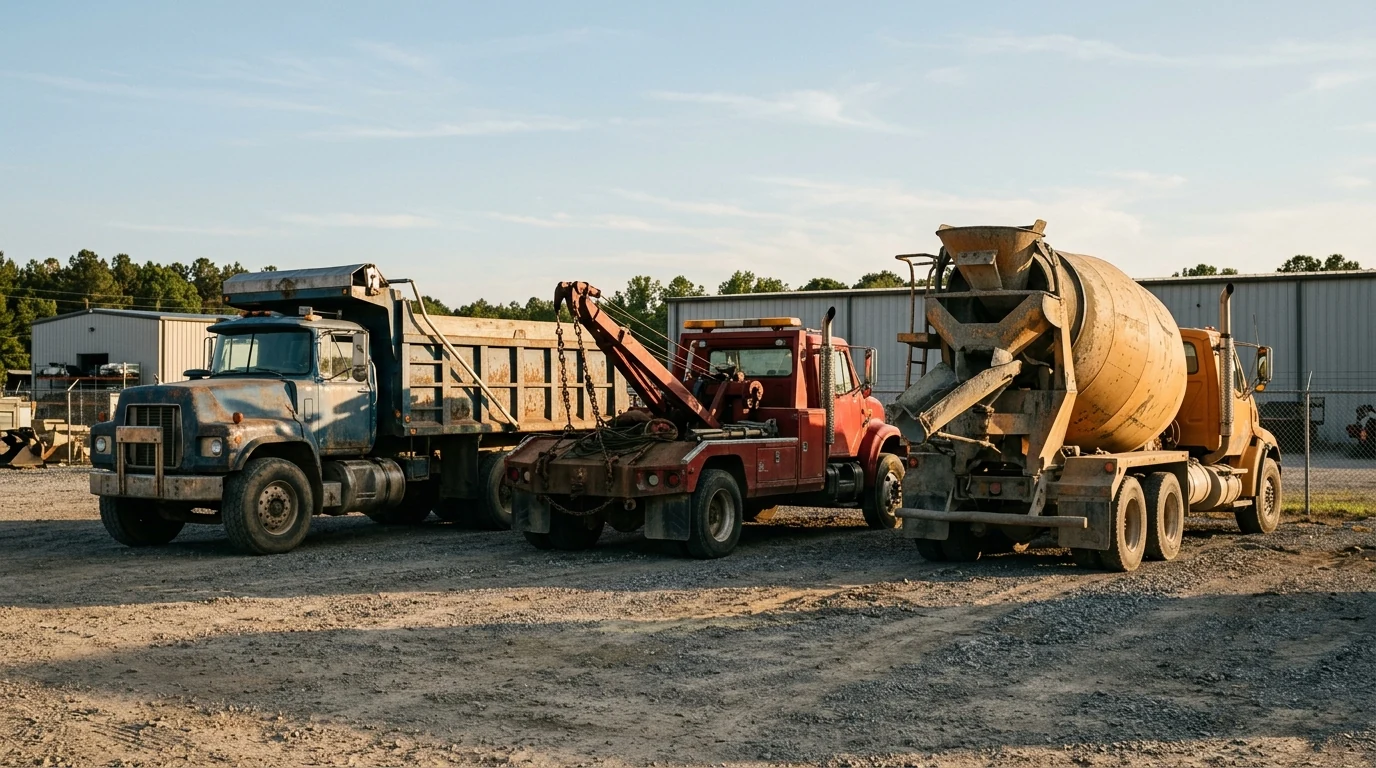
A vocational truck is a vehicle you buy twice. The chassis comes from a truck manufacturer. The body bolted to it, a dump bed, a wrecker, a mixer drum, comes from an upfitter who has never met your dealer. Two builders, two invoices, two lead times, one truck.
In July 2026, ACT Research counted 22,562 North American Class 8 net orders, up 71% year over year, but the two halves of that market moved at very different speeds: tractor orders rose 103% while vocational orders rose 18% (ACT Research data reported by Fleet Equipment, August 2026).
So a headline about a hot truck market may not be describing your truck. Here is how the body changes the financing file, why the upfit calendar sets the funding date, and what a lender reads when the work is billed by the job.
> Key Takeaways
> - A vocational truck is two purchases in one unit: a chassis from the truck manufacturer and a body from a separate upfitter, on two invoices.
> - Vocational Class 8 orders rose 18% year over year in July 2026 while tractor orders rose 103% (ACT Research, August 2026).
> - The Class 8 backlog stood at 182,817 units, roughly 8.9 months of production, and the body build starts only after the chassis lands.
> - Utilization is counted in jobs, drum hours and tow calls, not odometer miles.
> - Eos Loan is a direct lender with flexible terms, subject to approval and eligibility. No dealer fee.
See what financing a fleet expansion could look like
What counts as a vocational truck, and why is it financed differently?
A vocational truck is a chassis with a work body mounted on it, built to do a job rather than pull a load down an interstate. In July 2026, vocational Class 8 orders rose 18% year over year against 103% for tractors (ACT Research via Fleet Equipment, August 2026). Same market, two different engines driving it.
The span runs from Class 5 service bodies through Class 8 tandem dumps. The three most common heavy bodies are the dump bed, the tow and recovery body (light duty, heavy duty and rotator are separate assets), and the mixer drum. They share a split build: a truck manufacturer sells the chassis, a body company mounts the rest.
This is neither a tractor nor a towed asset. A tractor is one invoice from one builder, and on the towed side, specialty trailers are a separate financing question.
The order split matters more than most buyers realize. ACT tied vocational demand to longer-cycle spending on infrastructure, energy, construction and power generation, not the freight rate cycle that moves tractor orders. Read tractor headlines as a signal for your own calendar and they point you the wrong way. For the general mechanics, see how truck fleet financing works.
How much of the truck is the body, and why does that change the loan?
The body is a separately manufactured good with its own price index, and it has been climbing faster than the chassis. In July 2026, the BLS producer price index for Motor Vehicle Body and Trailer Manufacturing stood at 221.165, against 167.895 for Heavy Duty Truck Manufacturing (BLS via FRED, July 2026).
Run both series back five years and the gap is the story. Since July 2021 the body side has risen about 34%, the chassis side about 9%. A buyer repeating a build he priced in 2021 will find the surprise on the upfitter's invoice, not the dealer's.
For the loan, the practical point is documentation. A lender sizing the unit wants one delivered cost, which means both quotes: the chassis quote with its VIN or build spec, and the body builder's quote naming the upfitter.
> What I see: the most common reason a vocational request sits still is a chassis quote arriving with no body quote attached. The buyer has it, the upfitter emailed it weeks ago, and nobody thought the finance file needed it. Sending both together removes a round trip. That is a pattern I have watched, not an approval rule, and every request is subject to approval and eligibility.
If you already own the chassis and are financing only the body, say so early. That is a different collateral picture entirely.
Why does upfit lead time decide when the loan funds?
Because the body cannot be built until the chassis exists. In July 2026, ACT Research put the Class 8 backlog at 182,817 units, about 8.9 months of production seasonally adjusted and well above the historical average (ACT Research via Fleet Equipment, August 2026). The upfit clock starts after that.
The sequence runs: order the chassis, take delivery, ship it to the upfitter, build and mount the body, final inspection, in service. Every step after delivery is calendar the dealer does not control.
!Project paperwork, a clipboard and build specifications spread out on a work site in daylight.
Which date should the payment be planned against? The in-service date, not the order date. A truck that reaches the upfitter in November and rolls out in February is an asset with no revenue for a quarter.
There is a shortcut, though. ACT flagged in the same reporting that vocational dealer inventories remain well above historical norms, unlike tractor inventories. An in-stock chassis that only needs a body can cut months off the calendar, so ask the dealer what is on the ground before ordering to spec.
Ask about flexible terms on a truck purchase
What does a dump, tow or mixer body change about the file?
Three bodies, three demand curves. Construction spending ran at a $2,157.6 billion seasonally adjusted annual rate in July 2026, 0.5% below June and 3.8% below a year earlier (US Census Bureau, September 2026). Concrete follows that number closely. Towing barely notices it.
| | Dump | Tow and recovery | Mixer |
|---|---|---|---|
| Demand driver | Construction and site work | Incidents, police and motor club rotation | Concrete placement |
| Unit of work | Loads per day | Calls per week | Yards poured, drum hours |
| Seasonality | High in cold-weather states | Steady, weather spikes demand | Follows the pour calendar |
| Body vs chassis life | Hoist often outlives the chassis | Rotator boom is the long-life asset | Drum wears on its own clock |
| Resale depth | Deep regional market | Deep, tiered by duty class | Thin and specialized |
| Typical license | Class B or A by GVWR | Varies by combination weight | Class B on a single unit |
Tow is the counterweight in that table. IBISWorld estimates US automobile towing revenue at about $12.0 billion in 2026 (IBISWorld, 2026). Cars break down whether or not anyone is pouring footings, so an operator running both dump and tow assets holds two uncorrelated revenue lines.
Mixer sits at the other end: radius limited, with the thinnest resale market of the three. A lender reading a mixer purchase is reading the plant's contracted volume.
How do lenders read utilization when the work is billed by the job?
By hours and contracts, not odometer readings. Preliminary Classes 5-7 net orders reached about 18,300 units in July 2026, up 41% year over year (ACT Research via Fleet Equipment, August 2026). Almost none of those trucks will be judged on miles.
Here is the part almost no financing page states plainly: the odometer lies on a vocational unit. A mixer that never leaves a 20 mile radius can run more engine hours than a highway tractor with five times the miles, because the drum turns and the PTO pulls while the wheels sit still.
!Operator reviewing job records on a tablet inside a truck cab in daylight.
So the file leans on different numbers: hour meter readings, PTO and drum hours where the equipment logs them, service intervals scheduled by hours. If you think in cents per mile, that framing belongs to highway work, covered in truck financing for last-mile delivery.
Then come the contracts, which do here what a rate confirmation does on a freight file: an executed site work contract, a purchase order from a general contractor, a municipal bid award, a motor club or police rotation agreement.
Present the seasonality rather than hiding it. A dump operation in Minnesota with a flat winter is normal, and underwriters know the shape. A revenue line smoothed to look level raises questions.
What should be ready before you apply?
Both halves of the truck, documented. The missing half is almost always the body. A file with a chassis quote, a body quote, an upfitter name and an in-service date is ahead of most.
- Chassis quote with VIN or full build spec from the dealer.
- Body builder quote with the upfitter named and the build described.
- Expected in-service date, not just the chassis delivery date.
- Business formation documents and operating history.
- DOT or MC authority where required. See DOT authority and financing readiness.
- Insurance, including on-hook and garage keepers coverage if you are towing.
- Driver licensing. A single vehicle rated 26,001 pounds GVWR or more requires a Class B CDL under 49 CFR 383.91, and air brakes are a restriction to be removed rather than an endorsement to be added under 49 CFR 383.95.
- Maintenance and hour records on anything you are trading in.
- Two purchases in one unit, on two invoices, from two builders.
- The body price index has risen roughly 34% since 2021 against 9% for the chassis.
- Fund against the in-service date, because the body build starts after the chassis lands.
- Dump, tow and mixer sit on three demand curves, and tow holds up in a construction slowdown.
- Bring hours and contracts, not odometer readings.
We go deeper on what lenders look at on a carrier's credit rather than repeat it here.
How should the payment be structured around seasonal work?
Match the payment to the way the unit earns, then keep the structure simple. Two levers do most of the work: how down payment options change the structure and trading in an older unit.
Age works differently here, because the body and the chassis do not depreciate together. A twelve year old chassis under a three year old rotator is not a twelve year old asset. On a used build, how age and expected resale change the terms is worth reading first.
Eos Loan is a direct lender: one team from application to funding, no handoff to a third party, and no dealer fee charged by us. Terms are flexible and sized to the equipment and the operation, subject to approval and eligibility.
Talk to our team about financing your next truck
Or call +1 833-989-3737 to walk through a build. The product side lives on our page for truck fleet financing, and more common financing questions are on our FAQ page.
---
question: "Is a vocational truck financed differently from a highway tractor?",
answer: "It is a different file. A tractor is one invoice from one builder. A vocational truck is a chassis plus a body from a separate upfitter, so underwriting reads both quotes as one delivered cost. The segments also move separately: in July 2026 vocational Class 8 orders rose 18% year over year against 103% for tractors (ACT Research)."
},
{
question: "Can the truck body be included in the financing with the chassis?",
answer: "Normally yes, financed as one delivered unit even though it arrives on two invoices. A lender wants the chassis quote with VIN or build spec and the body builder's quote with the upfitter named. A chassis-only quote describes part of the asset and usually stalls the file until the body quote follows."
},
{
question: "Do you need a CDL to drive a dump truck or a mixer?",
answer: "Under 49 CFR 383.91, a single vehicle with a gross vehicle weight rating of 26,001 pounds or more requires a Group B (Class B) commercial driver's license. Most heavy dumps and mixers sit above that line. Air brakes are handled as a restriction removed under 49 CFR 383.95, not as an endorsement."
},
{
question: "How long does it take to get a vocational truck built?",
answer: "Plan against the in-service date rather than the order date. The Class 8 backlog stood at 182,817 units in July 2026, about 8.9 months of production (ACT Research, August 2026), and the body build begins only after the chassis is delivered to the upfitter. An in-stock chassis can shorten that considerably."
}
]} />
The chassis is the easy half
The chassis is a catalog item with a build sheet and a published order book. The body is where the money moves, where the calendar slips, and where the file goes quiet waiting on a document nobody thought to send.
Get both quotes into the same email and most of the friction disappears before it starts.
---
About the author: Eduardo Donadi is the CEO of Eos Loan, a US direct lender financing essential projects including truck fleet expansion, battery energy storage, EV chargers, and water filtration. He works directly with contractors, haulers and towing operators on how equipment purchases get structured and funded.
---
Sources
1. ACT Research data reported by Fleet Equipment. "July 2026 Class 8 Orders Rise 71% Y/Y." August 2026. Retrieved 2026-09-08. https://www.fleetequipmentmag.com/july-2026-class-8-orders-act/
2. US Census Bureau. "Monthly Construction Spending, July 2026." Released September 1, 2026. Retrieved 2026-09-08. https://www.census.gov/construction/c30/c30index.html
3. US Bureau of Labor Statistics. "Producer Price Index by Industry: Motor Vehicle Body and Trailer Manufacturing (PCU3362133621)." July 2026, via FRED. Retrieved 2026-09-08. https://fred.stlouisfed.org/series/PCU3362133621
4. US Bureau of Labor Statistics. "Producer Price Index by Industry: Heavy Duty Truck Manufacturing (PCU336120336120)." July 2026, via FRED. Retrieved 2026-09-08. https://fred.stlouisfed.org/series/PCU336120336120
5. IBISWorld. "Automobile Towing in the US: Market Size." 2026. Market-size estimate attributed to IBISWorld. Retrieved 2026-09-08. https://www.ibisworld.com/united-states/market-size/automobile-towing/1206/
6. Electronic Code of Federal Regulations. "49 CFR 383.91, Commercial motor vehicle groups." Retrieved 2026-09-08. https://www.ecfr.gov/current/title-49/section-383.91
7. Electronic Code of Federal Regulations. "49 CFR 383.95, Restrictions." Retrieved 2026-09-08. https://www.ecfr.gov/current/title-49/section-383.95