

Truck Financing Credit Requirements for Carriers and Owner-Operators
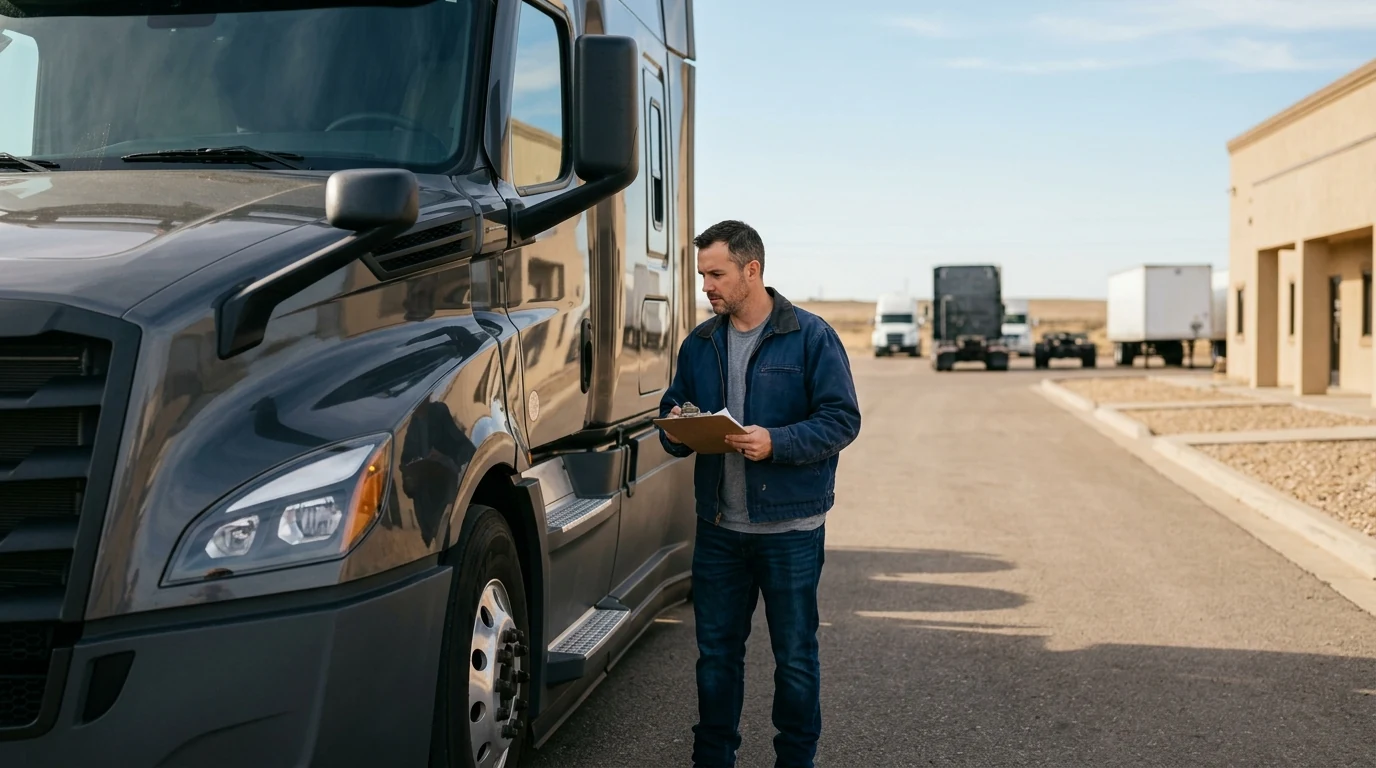
Truck financing credit requirements are the credit conditions a motor carrier or owner-operator has to meet to borrow against a Class 8 tractor or trailer purchase. This is about the vehicle, not about charging equipment. In June 2025, the American Trucking Associations counted almost 580,000 active US motor carriers, and 91.5% of them run 10 or fewer trucks (ATA, June 2025).
So the person asking this question is usually one owner with one file.
Most pages that answer it hand you a number. Six hundred. Six twenty. Six forty. Carriers read that number on a lender's landing page, decide they are short of it, and never apply. Others apply blind and get surprised by everything underwriting asks for that has nothing to do with a score.
Here is what actually gets pulled, how much your credit tier moves the odds, and what you can change before you send an application.
> Key Takeaways
> - There is no industry-wide credit score minimum for truck financing. Published floors belong to individual lenders, and they sit far apart: 575, 620 and 650 in three examples (Bankrate, April 2025).
> - Approval rates for US employer firms ran from 60% for low credit risk firms to 30% for high credit risk firms (Federal Reserve Small Business Credit Survey, 2026 report).
> - Secured equipment credit approves at a much higher rate. The industry-wide average was 77.4% in July 2026 (ELFA, August 2026).
> - Eos Loan is a direct lender, does not publish a credit score cutoff, and reads the whole carrier file. All financing is subject to approval and eligibility.
Ask about flexible terms on a truck purchase
Is there a minimum credit score for truck financing?
There is no industry-wide minimum. In April 2025, Bankrate's semi-truck financing requirements guide listed lender floors that sit nowhere near each other: National Funding at 575, Accion Opportunity Fund at 620, and SMB Compass at 650 (Bankrate, April 2025). Three companies, three different answers.
That is the part almost every competing article gets backwards. A published floor is one lender's internal policy, written into its own credit box, and it moves when that lender's funding costs or loss rates move. It is not a property of truck financing as a category. When a page tells you "you need a 640 to finance a semi," what it means is "we need a 640."
Context helps here too. In 2026, Experian reported the average US FICO score at 713 as 2025 closed, with 70% of consumers holding a score of 670 or higher (Experian, What Is the Average Credit Score in the U.S.?, updated March 2026). Most carriers reading this are not standing where they think they are standing.
Eos Loan does not publish a credit score cutoff. We read the carrier file as a whole, and every application is subject to approval and eligibility.
Whose credit gets pulled, yours or the company's?
Both, in most small-carrier files. Underwriting reads the owner's personal credit file and the business file side by side, and a personal guarantee is common at this size. Business credit does not replace personal credit until a carrier has years of reported trade lines behind it, which most one-truck and five-truck operations do not.
The scales are not comparable, and that trips people up. Personal FICO runs 300 to 850. Experian's Intelliscore Plus V2, still widely used, runs 1 to 100, where 51 to 75 reads as good and 76 and above reads as the strongest tier; the newer V3 runs 300 to 850 like a consumer score (Nav, 2026). The FICO SBSS score runs 0 to 300 (Nav, 2026). "My score is 640" means nothing until somebody names the scale.
A trade line, for a carrier, means a credit account that reports: a fuel card, a parts supplier on terms, insurance financing. Plenty of the accounts you actually pay every month never report anywhere, which is why a profitable carrier can still show a thin business file.
One policy change made this messier. Effective March 1, 2026, the SBA discontinued the requirement that lenders prescreen 7(a) Small Loan applicants with the FICO SBSS score, letting them apply the credit policies they use for comparable non-SBA commercial loans (Nav, 2026). Where a single benchmark used to sit, lenders now pick their own model. Chasing one target number makes even less sense than it did last year.
If you want the consumer-side mechanics of how a file gets read, we cover how credit history factors into an approval decision separately.
How much does credit risk actually change approval odds?
In the Federal Reserve's 2026 Report on Employer Firms, approval rates ran from 60% for low credit risk firms down to 30% for high credit risk firms (Federal Reserve Small Business Credit Survey, 2026 report, covering the 2025 survey). That 30 point spread is the honest answer to "does my credit matter." It moves the odds. It does not set a gate.
The same report found that 39% of US employer firms applied for new financing, and 52% of applicants were approved for at least some of what they sought. Read that second number carefully. Partial approval is the common outcome, not the exception, and it is what most carriers actually experience: approved, but for a different amount or a different structure than they asked for.
Now the counterweight, and it is the most useful paragraph on this page. Across the equipment finance industry, the average credit approval rate was 77.4% in July 2026 (ELFA CapEx Finance Index, August 2026). Secured equipment lending approves at a materially higher rate than general small business credit, because there is a titled asset standing behind the loan. A truck loan is not a general business loan wearing a hat.
See what financing a fleet expansion could look like
What sits next to the score on a carrier application?
The score is one input among several that get read together: time in operation, the age of your operating authority, current commercial insurance, business bank statements, and the equipment itself. In July 2026, ATRI reported truckload and refrigerated operating margins below 1.0% in 2025, with flatbed at negative 0.5% (ATRI, July 2026). At those margins, the operating picture gets read as carefully as the credit file.
Bankrate's requirements guide lists the practical stack for a semi purchase: a CDL where the owner drives, business registration, proof of commercial insurance including primary liability, physical damage, bobtail and cargo coverage, and details on the specific unit being bought (Bankrate, April 2025).
Think of that list as what fills a thin file. Documents are the substitute for credit history a newer carrier has not had time to build. A one-year-old authority with clean insurance, legible bank statements, and a signed freight commitment is a very different application from a one-year-old authority with none of that, even at the identical score.
The purchase math behind the application is a separate question, and the pillar handles it: how truck fleet financing works for owner-operators and carriers.
!A used Class 8 tractor parked on a dealer lot in bright daylight.
Why does the truck itself change the credit conversation?
Because the truck is collateral, its specifics enter the decision alongside your file. Bankrate notes that lenders ask about model, age, mileage and condition, and that some will not finance a tractor over 10 years old or past 700,000 miles (Bankrate, April 2025). The asset is being underwritten too.
This is exactly why equipment approval rates sit near 77% while general small business approval sits closer to half that. A documented asset with a known service history gives a lender something to work with besides three digits.
It also explains a pattern that surprises first-time buyers: the cheap undocumented unit can be a harder file than a well-kept older one with records. A bargain nobody can verify is not a bargain to underwriting.
What can a carrier fix before applying?
The fastest changes are mechanical, not strategic. Bring revolving balances down before the pull. Dispute and correct errors on your credit report. Keep commercial insurance current with no lapse. Separate the business bank account from the personal one so deposits are legible to a stranger reading them cold.
> What I see on carrier applications: at the same score, the files that move fastest are the ones where the story matches. Deposits line up with the freight the carrier described. Insurance is active, not "renewing next week." The business account is a business account, not a personal one with truck expenses running through it. That is a pattern I have watched across applications, not an approval rule, and every file is still subject to approval and eligibility.
A few more that cost nothing. Avoid opening new credit in the weeks before you apply. Gather your documents beforehand, because a file that stalls waiting on paperwork looks like a file with a problem. And understand the structure you are asking for: how term length changes a monthly payment is worth reading first. A larger down payment also shrinks the amount being underwritten, which is one more variable in your hands.
Can you finance a truck with damaged credit or a new authority?
Sometimes, and the terms reflect the risk. Bankrate's guide notes that borrowers with good credit may be asked for 10 to 15 percent down while borrowers with weak credit may be asked for 30 percent (Bankrate, April 2025). Weak credit tends to change the shape of the deal rather than automatically ending it. Every application is subject to approval and eligibility.
A brand-new operating authority is a question, not a wall. It means there is no operating history to read, so the documents carry the weight: current insurance, bank statements, and committed freight for the lane the truck will run.
If an application does get declined, the useful move is finding out which part of the file drove it, which is what what to do after a financing denial walks through. It also matters who is reading your file in the first place. A direct lender holds the credit decision itself instead of passing your application around, and the difference is worth understanding: what a direct lender is.
Eos Loan is a direct lender with flexible terms and no dealer fee, and one team stays on the file from application to funding.
Talk to our team about financing your next truck
Or call +1 833-989-3737 to talk through a truck purchase with our team.
See how truck fleet financing from Eos Loan is structured.
question: "Is there a minimum credit score for semi truck financing?",
answer: "No industry-wide minimum exists. Individual lenders publish their own floors, and third-party guides cite examples ranging from 575 to 650 (Bankrate, April 2025). Eos Loan does not publish a cutoff and reviews the whole carrier file, subject to approval and eligibility."
},
{
question: "Does truck financing check business credit or personal credit?",
answer: "For most small carriers, both. Underwriting reads the owner's personal file and the business file together, and a personal guarantee is common at this size. Business credit does not stand on its own until a carrier has years of reported trade lines behind it."
},
{
question: "How much does credit risk change my approval odds?",
answer: "Federal Reserve survey data puts approval at 60% for low credit risk employer firms and 30% for high credit risk firms (Federal Reserve Small Business Credit Survey, 2026 report). Secured equipment finance approved 77.4% of applications industry-wide in July 2026 (ELFA, August 2026)."
},
{
question: "Can I finance a truck with a brand-new operating authority?",
answer: "It is possible. Documentation carries more weight when there is little operating history to read: current commercial insurance, business bank statements, and committed freight for the lane the truck will run. Every application is subject to approval and eligibility."
},
{
question: "What is a good business credit score?",
answer: "It depends on the scale. On Experian's Intelliscore Plus V2, which runs 1 to 100, 51 to 75 reads as good and 76 and above as the strongest tier; the newer V3 runs 300 to 850 (Nav, 2026). FICO SBSS runs 0 to 300 on a separate scale entirely."
}
]} />
What the file actually decides
A credit score is a variable in a truck financing decision, not the door.
- No category-wide cutoff exists. Published floors are individual lenders' policies, and they sit far apart.
- Both files usually get read, on scales that are not comparable to each other.
- Credit risk moves approval odds by roughly 30 points in Federal Reserve data. It does not gate the outcome.
- Secured equipment credit approves at a much higher rate than general small business credit, because the truck is standing behind the loan.
- Documents substitute for the operating history a newer carrier does not have yet.
Eos Loan has originated $4B+ to date as a direct lender, with flexible terms and one team from application to funding. If you are sizing up a truck purchase and are not sure how your file reads, ask before you assume. Financing is subject to approval and eligibility. See how carrier approval patterns compare to battery storage, EV charger, water filtration, and real estate financing requests in how approval rates differ across project types.
---
About the author: Eduardo Donadi is the CEO of Eos Loan, a US direct lender financing essential projects including truck fleet expansion, battery energy storage, EV chargers, and water filtration. He works directly with carriers, owner-operators, and distributors on how equipment purchases get underwritten and funded.
---
Sources
1. American Trucking Associations. "Economics and Industry Data." June 2025. Retrieved 2026-08-27. https://www.trucking.org/economics-and-industry-data
2. Federal Reserve Banks. "2026 Report on Employer Firms: Findings from the 2025 Small Business Credit Survey." 2026. Retrieved 2026-08-27. https://www.fedsmallbusiness.org/reports/survey/2026/2026-report-on-employer-firms
3. Equipment Leasing and Finance Association. "CapEx Finance Index July 2026: Demand Surges on AI Investment." August 25, 2026. Retrieved 2026-08-27. https://www.globenewswire.com/news-release/2026/08/25/3350374/10413/en/capex-finance-index-july-2026-demand-surges-on-ai-investment.html
4. Bankrate. "Semi-Truck Financing Requirements." April 15, 2025. Retrieved 2026-08-27. https://www.bankrate.com/loans/small-business/semi-truck-financing-requirements/
5. Experian. "What Is the Average Credit Score in the U.S.?" Updated March 30, 2026. Retrieved 2026-08-27. https://www.experian.com/blogs/ask-experian/what-is-the-average-credit-score-in-the-u-s/
6. Nav. "Experian Business Credit Score: Intelliscore Plus." 2026. Retrieved 2026-08-27. https://www.nav.com/business-credit/experian-business-credit-score/
7. Nav. "FICO SBSS Score." 2026. Retrieved 2026-08-27. https://www.nav.com/business-credit/fico-sbss/
8. Nav. "SBA to Sunset FICO SBSS for Small Loans: What Does This Mean for Your Small Business?" 2026. Retrieved 2026-08-27. https://www.nav.com/blog/sba-to-sunset-fico-sbss-for-small-loans-what-does-this-mean-for-your-small-business/
9. American Transportation Research Institute. "New ATRI Report Details Accelerating Costs and Low Profitability Despite Cuts." July 2026. Retrieved 2026-08-27. https://truckingresearch.org/2026/07/new-atri-report-details-accelerating-costs-and-low-profitability-despite-cuts/