

Used vs New Truck Financing: How the Decision Changes Your Terms
Used truck financing is credit for buying the truck itself, the tractor or the trailer you are going to run, not charging equipment and not yard work. In June 2026, the average used Class 8 truck sold at retail went for $61,751 with 410,000 miles on the clock (ACT Research, June 2026).
That is a real working asset for a fraction of new money. It is also a very different piece of collateral.
So you end up holding two quotes, one new unit and one used, with the same credit behind both, and the structures come back different. Nothing's gone wrong. The lender is not pricing the sticker. It is pricing what that specific truck should be worth partway through the term.
Here is what actually changes when the equipment gets older, why expected resale drives it, and how to tell which side of the decision fits the way you run.
> Key Takeaways
> - The average used Class 8 truck sold at retail in June 2026 went for $61,751 with 410,000 miles (ACT Research, June 2026).
> - Repair and maintenance cost the industry 21.5 cents per mile in 2025, up 8.6% in a single year (ATRI, July 2026). Older equipment sits on the wrong side of that number.
> - Lenders price the collateral, not the sticker. What the unit is expected to be worth partway through the term is what moves the structure.
> - Eos Loan is a direct lender with flexible terms and one team from application to funding, subject to approval and eligibility. No dealer fee.
Talk to our team about financing your next truck
New or used: what actually changes when you finance?
The purchase price is the smallest difference. What changes is how a lender values the collateral over time. The average used Class 8 unit sold at retail in June 2026 carried 410,000 miles, up 2.2% year over year (ACT Research, June 2026). Miles and years change the asset, and the asset secures the loan.
Three things move together on a used unit: the down payment a lender expects, the length of the term, and the paperwork you have to produce. All three trace back to one input. Expected resale.
| What changes | Newer unit | Older, higher-mileage unit |
|---|---|---|
| Collateral value curve | Flatter and better documented | Steeper and more spec-dependent |
| Down payment expectation | Generally lighter | Generally heavier |
| Term length | Flexible | Typically shorter, tied to remaining useful life |
| Documentation a lender wants | VIN, spec, invoice | Adds service records, ECM report, inspection |
| Where your money goes after closing | More to the payment | More to repair and maintenance |
| Warranty position | Factory coverage in play | Usually out, or purchased separately |
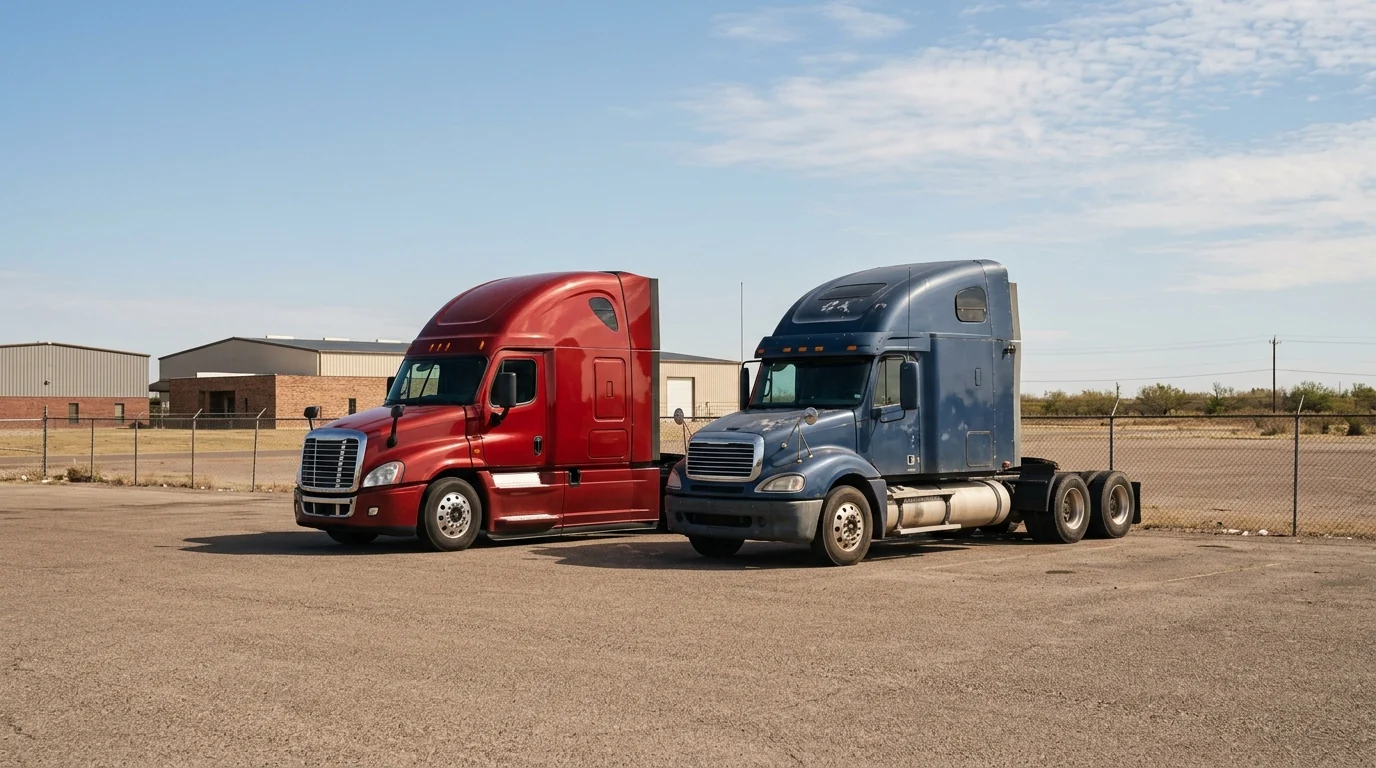
!A row of Class 8 sleeper tractors parked side by side under daylight.
There is a clean split worth saying out loud once, because it keeps two questions from getting tangled. A lender reviews you, and a lender reviews the truck. The borrower side, meaning time in operation, authority, credit history, and the freight behind the purchase, is covered in how truck fleet financing works for owner-operators and carriers. This page stays on the collateral side: year, miles, spec, condition, and what the unit is worth later.
What does a used Class 8 truck actually cost in 2026?
Used Class 8 retail prices averaged $61,751 in June 2026, up 2.0% from May and 1.5% from a year earlier, on 24,900 units sold, a volume 10.2% above June 2025 (ACT Research, June 2026). The used market is not soft right now, and that matters to a buyer.
Prices up and volume up at the same time means competition for the good units. You're not picking through leftovers. You are bidding against other operators for the trucks with records, a common spec, and a service history someone can actually read.
The mileage number is the tell. At 410,000 miles on average, up 3.3% from May, supply skews toward equipment that has already done most of a working life somewhere else. That is normal for this market. It just means the truck you're looking at is a known quantity only if somebody wrote things down. For the short version of what we fund on the vehicle side, here is what Eos Loan finances for truck fleets.
How do age and mileage change used truck financing terms?
Age and mileage are proxies for one thing: how much working life is left in the asset securing the loan. The average used Class 8 truck that actually sold in June 2026 had 410,000 miles (ACT Research, June 2026). High mileage is the market, not the exception. What separates two trucks at the same odometer reading is what those miles did.
As a general market pattern, lenders in this space set outer bands on model year and odometer reading, and units past those bands get looked at case by case instead of on a standard structure. Those bands are not published anywhere authoritative, they vary by lender, and none of them is an approval rule. Treat them as weather, not as law.
The odometer is a weaker signal than most operators expect. A well-documented 500,000 mile truck on a light regional duty cycle can present better than a 350,000 mile truck that lived on heavy haul. Idle hours, gross weight, terrain, and how the last owner handled service all sit behind the same number.
Spec matters for the same reason. A common engine, transmission, and axle configuration has a deep resale market. A rare build does not, and that thinness shows up in your structure.
!An owner-operator reviewing operating paperwork and financing documents at a desk in daylight.
> What I see: the operators who move cleanly through a used-truck purchase arrive with the service records, the ECM report, and a realistic number for what they expect to spend on the unit in year one. The ones who struggle arrive with a price and a hope. That is a pattern I notice, not a policy, and it is not an approval criterion.
So stop asking whether you are under the mileage limit. Start asking whether you can show what those miles did. Documentation converts an unknown asset into a known one, which is the whole game here. Your own file still counts, of course, though credit score is one input among several rather than the deciding factor on an equipment purchase.
Ask about flexible terms on a truck purchase
Why does expected resale set your terms more than the sticker price?
A lender is not lending against what the truck costs today. It is lending against what it should be worth partway through the term if the loan has to unwind. ACT Research names EPA 2027 as one of the most important planning variables in the Class 8 market and flags residual-value visibility as a live concern (ACT Research, 2026).
Picture two value curves. A newer unit declines on a flatter, better-documented path, because there is a deep record of what trucks like it sell for at each stage. An older unit's curve is steeper and leans much harder on spec and condition, so the range of plausible outcomes is wider.
Wider range means less certainty, and less certainty produces a heavier down payment expectation and a shorter term rather than a flat refusal. That mechanism sits behind almost every "why did they structure it that way" question we hear on used equipment.
2026 adds a wrinkle that almost nobody connects to the buyer's own loan. ACT Research reports that the size and timing of any prebuy ahead of EPA 2027 remain uncertain. A regulatory change landing after your purchase can move what your truck is worth during your term, in either direction. Nobody credible knows which way, and anyone who says otherwise is guessing.
What you can control is the spec you buy and the records you keep. Term length is the other lever, and how term length changes a monthly payment is worth understanding before you set two offers side by side.
Does a used truck really cost less to run?
Repair and maintenance cost the industry an average of 21.5 cents per mile in 2025, an 8.6% jump in a single year and one of the fastest-rising line items in the report (ATRI, July 2026). A lower purchase price moves money from the payment column to the shop column. It does not delete it.
The payment is predictable. The repair bill is not, and that asymmetry is the honest case against a cheap truck. ATRI also points to tariffs on imported parts and on steel, aluminum, and copper as a reason repair and maintenance is likely to keep climbing faster than it used to.
Margins leave very little room to absorb that. In 2025, operating margins ran below 1.0% for truckload and refrigerated carriers, 4.0% for tank, and negative 0.5% for flatbed (ATRI, July 2026). At those margins an unbudgeted engine repair is not an inconvenience. It is the quarter.
Here is the split that tells you the industry itself is divided on this. ATRI found small fleets spent less on truck and trailer procurement in 2025 than in 2024, while fleets of 1,000 trucks or more raised procurement spend 16.1%. Small carriers went used and held equipment longer. Large fleets bought new. Neither group is wrong. They are managing different risks with different balance sheets, and so are you.
When does new win, and when does used win?
There is no universal answer, only a fit test, and the margins make that test unforgiving: truckload and refrigerated carriers ran below 1.0% operating margin in 2025 (ATRI, July 2026). Used wins when the duty cycle is predictable and the maintenance budget is real. New wins when uptime is contractual.
Four questions settle it faster than any spreadsheet:
- What does a day of downtime cost you? If one missed load costs more than the monthly payment gap, the math has already moved toward new.
- Is your spec liquid? A common engine and drivetrain resells. A rare configuration does not, and that shows up in your terms, not just at trade-in.
- Do you have a repair reserve in cash that is not the down payment? If the down payment eats the reserve, the used truck is more expensive than it looks.
- What do the next two years of your lanes look like? Steady regional running and long irregular over-the-road miles do not point to the same answer.
- VIN and the full spec sheet
- Complete service records
- An engine ECM download
- DOT inspection history
- An independent pre-purchase inspection
- A written repair estimate for anything that inspection flags
!A carrier reviewing operating numbers on a tablet inside a truck cab in daylight.
If used passes the test, build the file before you negotiate, not after:
Whether to finance, lease, or pay cash is a separate decision, covered in the truck fleet financing guide rather than repeated here.
The number to check before you sign
You are not choosing between two prices. You are choosing between two value curves, and the lender is pricing the curve. Once you see it that way, a heavier down payment on an older unit stops feeling like a penalty and starts reading as what it is: the cost of a wider range of outcomes.
Eos Loan is a direct lender. One team from application to funding, flexible terms sized to the purchase, and no dealer fee. If you want the general picture of how lender fees get built into a financing program, that is worth a read, though none of it applies here, because we don't charge one. To date we have originated $4B+ and processed 30k+ proposals. Every application is subject to approval and eligibility.
See what financing a fleet expansion could look like
Prefer to talk it through? Call +1 833-989-3737, or read some common financing questions first.
Frequently Asked Questions
question: "Can you finance a used semi truck?",
answer: "Yes. Used Class 8 units traded at an average retail price of $61,751 in June 2026 on 24,900 sales (ACT Research), and used purchases are financed routinely. Terms are shaped by the unit's age, mileage, spec, and condition, subject to approval and eligibility."
},
{
question: "How many miles is too many for a used truck loan?",
answer: "There is no single industry cutoff. Many lenders set outer bands on odometer reading as a general practice, and units past those bands get reviewed case by case. The average used Class 8 truck sold at retail in June 2026 had 410,000 miles (ACT Research), so high-mileage units are the norm. Documentation matters more than the number alone."
},
{
question: "Do used trucks get shorter financing terms than new ones?",
answer: "Typically yes, because term length tends to track remaining useful life, and an older unit has less of it left. Eos Loan offers flexible terms on truck purchases, sized to the equipment and the operation, subject to approval and eligibility."
},
{
question: "Is a used truck actually cheaper to own?",
answer: "Not automatically. Repair and maintenance ran 21.5 cents per mile industry-wide in 2025, up 8.6% year over year (ATRI, July 2026). A lower purchase price moves cost from the payment column to the shop column, so the saving is real only if the maintenance budget is real."
},
{
question: "What should I have ready before financing a used truck?",
answer: "The VIN and spec sheet, complete service records, an engine ECM download, DOT inspection history, and an independent pre-purchase inspection. Those documents are what turn an unknown asset into a known one, and they are the difference between a fast review and a slow one."
}
]} />
---
About the author: Eduardo Donadi is the CEO of Eos Loan, a US direct lender financing essential projects including truck fleet expansion, battery energy storage, EV chargers, and water filtration. He works directly with carriers, owner-operators, and distributors on how equipment purchases get structured and funded.
---
Sources
1. ACT Research. "US Classes 3-8 Used Trucks." June 2026 data. Retrieved 2026-08-27. https://www.actresearch.net/resources/blog/us-classes3-8-used-trucks-blog
2. ACT Research. "Class 8 Truck Sales Forecast 2026." 2026. Retrieved 2026-08-27. https://www.actresearch.net/resources/blog/class-8-truck-sales-forecast-2026
3. American Transportation Research Institute. "New ATRI Report Details Accelerating Costs and Low Profitability Despite Cuts." July 2026. Retrieved 2026-08-27. https://truckingresearch.org/2026/07/new-atri-report-details-accelerating-costs-and-low-profitability-despite-cuts/
4. American Trucking Associations. "Economics and Industry Data." Retrieved 2026-08-27. https://www.trucking.org/economics-and-industry-data
5. DAT Freight and Analytics. "News and Press Releases." Retrieved 2026-08-27. https://www.dat.com/company/news-events/news-releases