

Truck Fleet Financing: How Owner-Operators and Carriers Fund Expansion
Truck fleet financing is credit used to buy the truck itself: the tractor, the trailer, and the hauling capacity that comes with them. This guide is about the vehicle, not about charging equipment or yard electrical work. In June 2025, the American Trucking Associations counted almost 580,000 active motor carriers registered with FMCSA, and 91.5% of them operate 10 or fewer trucks (ATA, June 2025).
So fleet expansion in this country is mostly a small-business decision, made by one person who also drives, dispatches, and chases invoices.
A new Class 8 tractor is a six-figure purchase. Operating costs just set a record. Paying cash pulls money out of the same account that covers fuel, payroll, and insurance while freight invoices age on 30 and 45 day terms.
Here is how the money actually works: what a lender evaluates, how to size a payment against what the truck earns, and how to tell whether the next truck is real capacity or an expensive guess.
> Key Takeaways
> - Almost 580,000 active US motor carriers are registered with FMCSA and 91.5% run 10 or fewer trucks (ATA, June 2025).
> - Average operating cost hit a record $2.336 per mile in 2025, up 3.4%, with non-fuel costs at $1.854 per mile (ATRI, July 2026).
> - The number that decides the purchase is the gap between revenue per mile and cost per mile, because the loan payment lands inside cost per mile next to fuel and maintenance.
> - Eos Loan is a direct lender with flexible terms and one team from application to funding, subject to approval and eligibility.
Talk to our team about financing your next truck
What is truck fleet financing, and who uses it?
Truck fleet financing is credit used to buy commercial vehicles, tractors and trailers, repaid over time out of what those vehicles earn. In June 2025, the American Trucking Associations reported almost 580,000 active motor carriers registered with FMCSA, with 91.5% operating 10 or fewer trucks (ATA, June 2025). Most borrowers are small operations, not national fleets.
That distribution matters more than it looks. The typical borrower is an owner-operator buying a second truck, a five-truck carrier going to eight, or a distributor adding a delivery vehicle it will run itself. "From one truck up" is the market here, not the edge case.
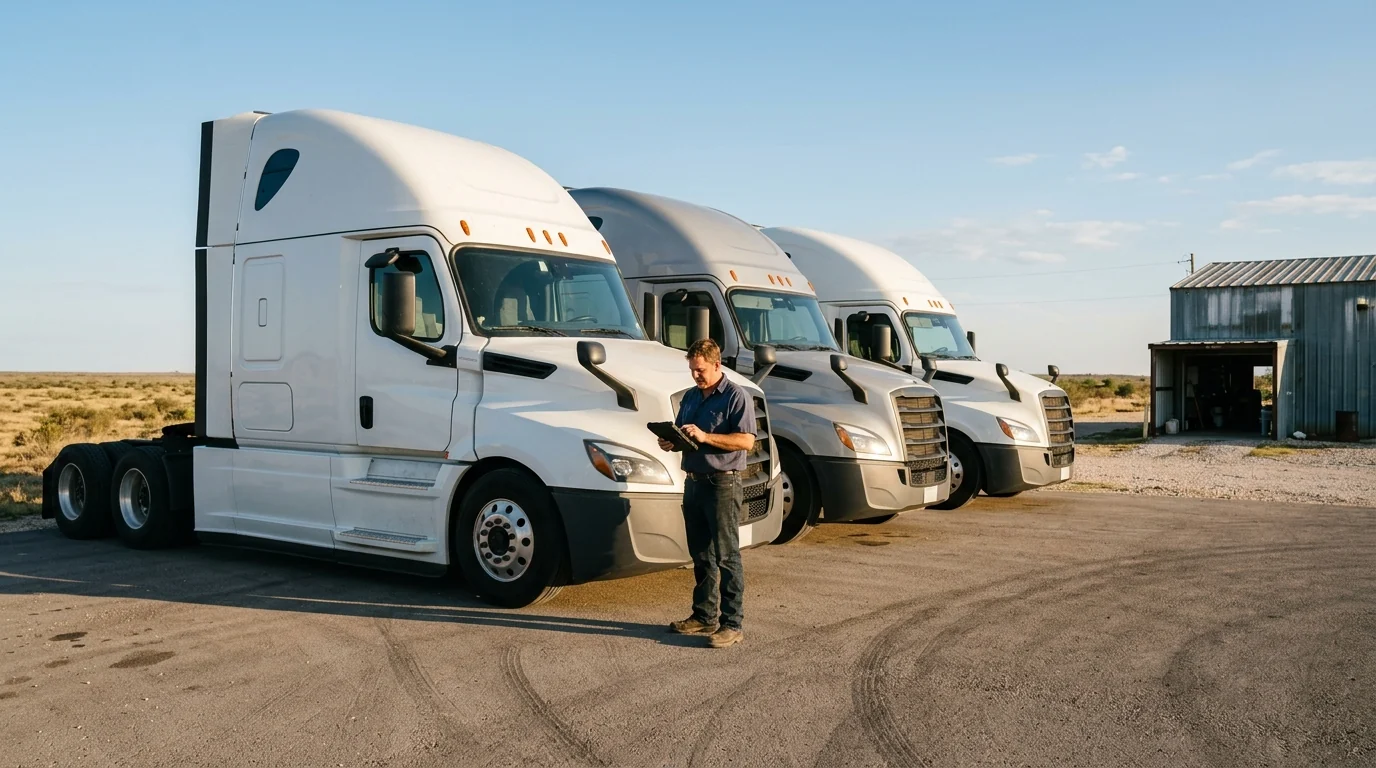
!A row of Class 8 sleeper tractors parked side by side in a carrier yard under daylight.
The industry those trucks serve is large. ATA put gross freight revenues from primary shipments at $906 billion and total tonnage at 11.27 billion tons in 2024 (ATA, 2024). The freight is there. The question is whether you own enough equipment to move your share of it, and whether buying that equipment leaves you solvent.
If you want the short version of what we fund and how, our page on financing for trucks and fleet expansion lays out the product side without the essay.
Why do carriers finance a truck instead of paying cash?
Because cash is working capital, and working capital is what keeps a truck moving. In 2025, the American Transportation Research Institute measured average operating cost at a record $2.336 per mile, up 3.4%, with non-fuel costs at $1.854 per mile, up 4.2% (ATRI, July 2026). Every dollar spent on a truck is a dollar not covering those miles.
The timing mismatch is the real problem. You pay for the truck today. You get paid on freight terms that can run 30 to 45 days after delivery, sometimes longer. Meanwhile fuel, driver pay, insurance, and the first surprise repair all come due on their own schedule, indifferent to when the broker cuts a check.
Financing spreads the equipment cost across the period the equipment is earning, and leaves the reserve intact. That reserve is not a nice-to-have. It is what covers a blown turbo in week three, before the truck has generated a single settlement.
What do lenders look at when financing a truck?
Underwriting looks at the business, not only at the buyer. Time in operation, authority status, credit history, the equipment being purchased, and whether the freight the truck will run is realistic. ATRI found most sector operating margins below 1.0% in 2025 (ATRI, July 2026), which is exactly why the freight plan gets read closely. Every application is subject to approval and eligibility.
For a small carrier, both business and personal credit usually get reviewed. That surprises people who assumed the entity shields them. It does not, at this size. If you want the mechanics of how credit history enters a decision, we wrote up how credit history factors into an approval decision separately.
The equipment matters on its own terms, because it is the collateral. Model year, mileage, spec, and maintenance records all affect how a lender values the asset it is lending against. A well-documented five-year-old tractor with a known service history is often an easier file than a bargain unit with no records.
!An owner-operator reviewing operating paperwork and financing documents at a desk in daylight.
New authority is not a wall, but it is a question. FMCSA authority granted last month with no operating history behind it means the lender has less to read. Bank statements, signed lane commitments, and insurance already in place all help fill that gap.
> What I see: the operators who move through underwriting cleanly are almost never the ones with the biggest down payment. They are the ones who can state their cost per mile and name their committed freight before anyone asks. That is a pattern I have watched across applications, not an approval rule, and every file is still subject to approval and eligibility.
Have the paperwork ready before you apply: operating authority, current insurance, recent bank statements, and a revenue plan that ties to real lanes rather than to averages you read somewhere.
See what financing a fleet expansion could look like
How do you size a truck payment against what the truck earns?
Not by the sticker price. In 2025, ATRI put total operating cost at a record $2.336 per mile (ATRI, July 2026). In mid-June 2026, DAT reported spot rates on its top 50 lanes averaging about $2.36 per mile (DAT, 2026). The gap between those two numbers is the entire decision.
Here is the part most truck financing articles skip. They frame the question as price versus down payment versus credit score. But the loan payment does not sit outside the operation looking in. It sits inside cost per mile, in the same band as fuel, tires, and driver pay, competing with them for the same cents. So the honest question is not "can I afford the down payment." It is "does this truck's margin cover its payment."
Annual miles change the math as much as the payment does. A fixed monthly payment spread over 120,000 miles a year weighs half as much per mile as the same payment spread over 60,000. Before you compare offers, decide honestly how many miles the truck will run, including the empty ones.
Term length is the other lever. A longer term lowers the monthly and raises total cost. A shorter term does the reverse. Which one is right depends on your freight, not on a rule of thumb. We describe our terms as flexible for that reason, and we size them to the truck and the operation. If the vocabulary is unfamiliar, start with how term length and monthly payment relate.
With most sector margins under 1.0%, there is very little room to fix a payment you sized wrong. Get it right the first time.
When is the right time to add a truck?
Order data says operators are buying again. In June 2026, ACT Research reported North American Class 8 net orders of 31,751 units, more than triple the prior year, with backlogs at a 38-month high, followed by 22,562 units in July 2026, up 71% year over year (ACT Research, 2026). Backlogs that long mean the decision gets made well before the capacity arrives.
!New Class 8 tractors lined up on a dealer lot in bright daylight.
Read your own demand signal before you read the order data, though. Committed freight, lanes you are turning down, and volume that has held for more than one quarter are signals. A good month is not. ACT itself notes that stronger orders reflect replacement need and equipment timing as much as genuine expansion, which is a useful caution against reading the headline as a green light for everyone.
There is an honest counter-case for waiting. In 2025 carriers cut truck counts by 2.4% and left roughly 10% of fleet capacity unseated (ATRI, July 2026). Some of those trucks were parked for lack of a driver, not for lack of freight.
Which raises the constraint people underestimate. BLS projects about 237,600 annual openings for heavy and tractor-trailer truck drivers over the 2024 to 2034 decade, against 2,235,100 jobs held in 2024 (BLS, 2024-34 projections). A financed truck without a seated driver is the most expensive object in your yard.
Financing, leasing, or cash: which one fits?
Each path costs something real. Financing builds equity in an asset you keep and adds a fixed payment to cost per mile. Leasing lowers the monthly and hands residual risk to someone else, usually in exchange for mileage caps and less freedom over the equipment. Cash costs nothing to borrow and consumes the reserve that keeps you running when a truck goes down.
| Path | What you get | What it costs you |
|---|---|---|
| Financing | Ownership and equity, no mileage cap, the truck is yours at payoff | A fixed payment inside cost per mile, plus the resale risk you carry |
| Leasing | Lower monthly outlay, residual risk sits elsewhere, easier equipment refresh | Mileage and modification limits, no equity built, terms end and you start over |
| Cash | No payment, no underwriting, full flexibility | Working capital gone on day one, and the reserve is what covers the first breakdown |
There is no universally correct answer, and anyone who tells you otherwise is selling one of the three. A carrier that runs equipment past 900,000 miles and does its own maintenance leans one way. An operation that wants a newer truck every few years and dislikes resale risk leans another. Match the path to how long you intend to hold the truck and how many miles you will put on it.
How does financing with a direct lender work?
Eos Loan is a direct lender. We originate, underwrite, and service the credit ourselves, so you work with one team from application to funding instead of getting handed between a broker and whoever ends up holding the paper. To date we have originated $4B+ and processed 30k+ proposals across our lending programs.
What that changes day to day is simple. One point of contact. Decisions made in-house rather than shopped out. A digital application that does not ask you to re-enter the same information for four different funders. And Eos Loan charges no dealer fee.
If the distinction between lender types is fuzzy, we broke down the difference between a direct lender and a marketplace in detail. You can also read who we are before you send anything over.
One clarification is worth making, since the word "fleet" gets used two ways. This page is about buying the vehicle. If your operation is also adding charging equipment at a yard, financing charging equipment for a depot is a separate project with its own structure and timeline.
Terms are flexible and sized to the truck and the operation, subject to approval and eligibility.
---
Ask about flexible terms on a truck purchase
Or call +1 833-989-3737 to talk through a truck purchase with our team. More common financing questions are answered on our FAQ page.
---
{ question: "How do you finance a commercial truck?", answer: "You apply with a lender, the lender underwrites your business and the equipment, and on approval the purchase is funded and repaid over a set term out of what the truck earns. Terms are flexible and sized to the operation. Every application is subject to approval and eligibility." }, { question: "Can an owner-operator get financing for a second truck?", answer: "Yes, and it is the most common expansion step in the industry, since 91.5% of the almost 580,000 active US carriers run 10 or fewer trucks (ATA, June 2025). Underwriting looks closely at the operating history of the first truck, subject to approval and eligibility." }, { question: "What do lenders look at when financing a truck?", answer: "Time in operation, authority status, business and personal credit history, the equipment being purchased as collateral, and whether the freight plan behind the purchase is realistic. Approval is never automatic, and every file is subject to approval and eligibility." }, { question: "Is it better to finance or lease a commercial truck?", answer: "It depends on how long you plan to keep the truck and how many miles it will run. Financing builds equity and leaves no mileage cap, but you carry the resale risk. Leasing lowers the monthly outlay and moves residual risk elsewhere, at the cost of flexibility." }, { question: "How much does it cost to operate a truck per mile?", answer: "ATRI measured the industry average at a record $2.336 per mile in 2025, up 3.4%, with non-fuel costs at $1.854 per mile, up 4.2% (ATRI, July 2026). Driver wages alone accounted for 81.8 cents per mile, and repair and maintenance for 21.5 cents." } ]} />The number that decides it
Fleet expansion in the US is a small-business decision, made mostly by carriers running 10 or fewer trucks, at a moment when it costs more per mile to run a truck than it ever has. That combination is why sizing matters more than shopping.
- The industry is overwhelmingly small operators, so "from one truck up" is the normal case.
- Record operating costs make the cash reserve worth more than the interest you avoid by draining it.
- Underwriting reads the business and the freight plan, not only the buyer.
- Size the payment against margin per mile, not against the sticker price.
- Financing, leasing, and cash each carry a real cost, and the right one depends on your hold period and your miles.
Before you sign anything, write down your cost per mile and the rate on the lanes the truck will actually run. If the gap does not cover the payment with room left over, the truck is not ready yet, whatever the order data says. When it does, financing for trucks and fleet expansion is a conversation, not a form.
---
About the author: Eduardo Donadi is the CEO of Eos Loan, a US direct lender financing essential projects including truck fleet expansion, battery energy storage, EV chargers, and water filtration. He works directly with carriers, owner-operators, and distributors on how equipment purchases get structured and funded.
---
Sources
1. American Trucking Associations. "Economics and Industry Data." Retrieved 2026-08-27. https://www.trucking.org/economics-and-industry-data
2. American Transportation Research Institute. "New ATRI Report Details Accelerating Costs and Low Profitability Despite Cuts." July 2026. Retrieved 2026-08-27. https://truckingresearch.org/2026/07/new-atri-report-details-accelerating-costs-and-low-profitability-despite-cuts/
3. ACT Research. "Class 8 Truck Orders." 2026. Retrieved 2026-08-27. https://www.actresearch.net/resources/data-tracking/class-8-truck-orders
4. DAT Freight and Analytics. "DAT Dry Van Spot Rates Top Contract for First Time Since February 2022; Flatbed Rates Hit Record High." 2026. Retrieved 2026-08-27. https://www.dat.com/company/news-events/news-releases/dat-dry-van-spot-rates-top-contract-for-first-time-since-february-2022-flatbed-rates-hit-record-high
5. US Bureau of Labor Statistics. "Heavy and Tractor-Trailer Truck Drivers, Occupational Outlook Handbook." 2024-34 projections. Retrieved 2026-08-27. https://www.bls.gov/ooh/transportation-and-material-moving/heavy-and-tractor-trailer-truck-drivers.htm