

Trade-Ins and Collateral: How Your Current Trucks Affect New Financing
The truck already parked in your yard is a number in your next deal, whether you hand it over or keep it. This is about financing the vehicle: the tractor or trailer you own today, and the one you want to buy next. Charging equipment is a different subject. In June 2026, used Class 8 trucks sold at an average retail price of $61,751, carrying an average 410,000 miles (ACT Research, reported by Transport Topics, June 2026).
Most operators treat trade-in value as one number. It is at least three: retail, wholesale, and auction. None of those three is what reaches the new deal, because the payoff on your current loan comes out first.
So here is the order of operations. Value the truck, get the payoff in writing, subtract, sort the title, then decide whether to trade, sell, or keep running it.
> Key Takeaways
> - Used Class 8 trucks sold at an average $61,751 and 410,000 miles in June 2026 (ACT Research via Transport Topics).
> - Allowance and equity are different numbers. Equity is the allowance minus your payoff, and only equity moves value into the new deal.
> - Truck and trailer payments hit 40.4 cents per mile in 2025 (ATRI, July 2026), so what you carry forward lands inside cost per mile.
> - In Texas, motor vehicle tax is calculated on the trade difference, and the deduction is the value of the vehicle traded in, "not the equity" (Texas Comptroller).
> - Eos Loan is a direct lender with flexible terms and no dealer fee, subject to approval and eligibility.
See what financing a fleet expansion could look like
What does a truck trade-in actually mean in financing?
A trade-in is your current truck transferred directly to the seller as part of the same purchase transaction. The Texas Comptroller states the requirement plainly: the vehicle has to go to the seller in the same sales transaction, and only a motor vehicle counts, not a boat, livestock, or other property (Texas Comptroller).
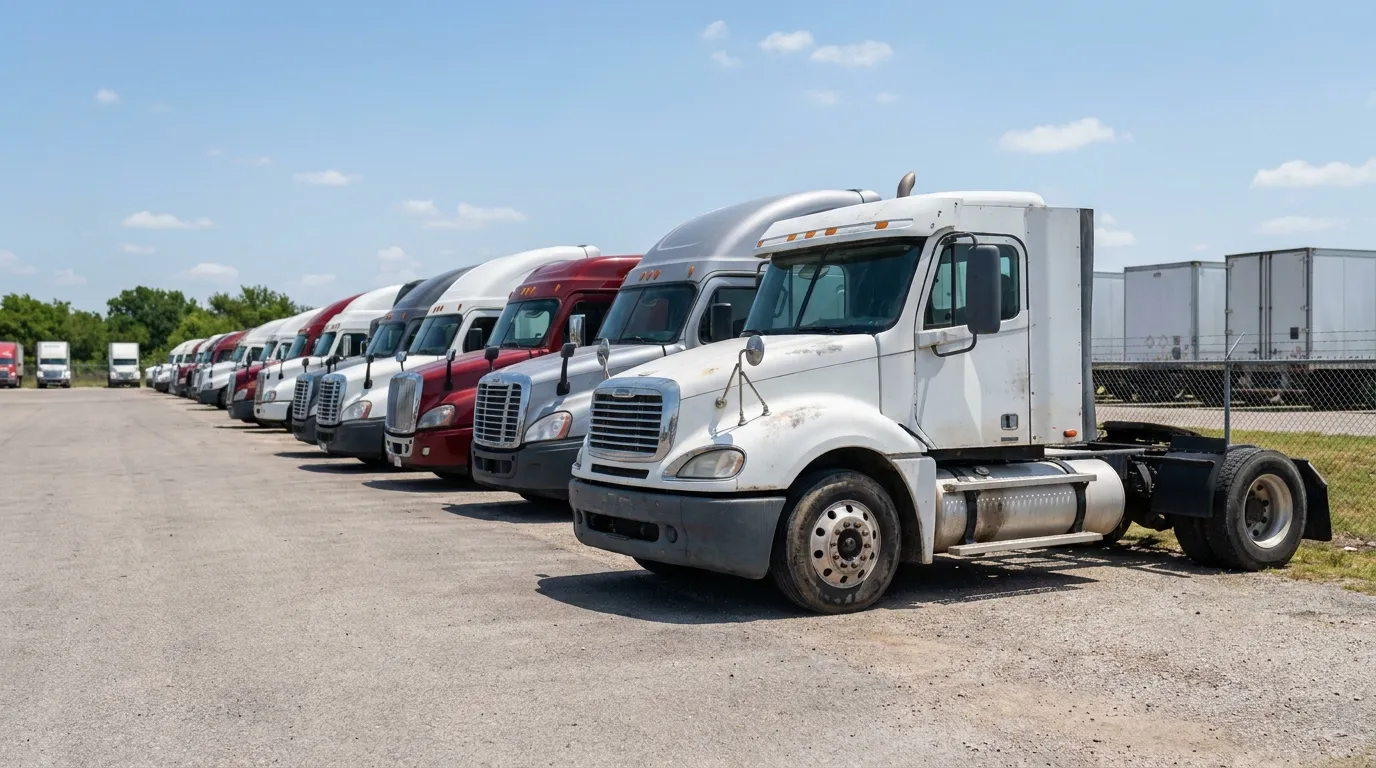
!A used Class 8 sleeper tractor parked beside newer tractors on a daylit dealer lot.
That leaves three dispositions: hand the truck to the seller as a trade, sell it yourself, or keep it and run it alongside the new unit. Each produces a different amount of money on a different timeline.
Now the distinction that carries the rest of this article. Allowance is the value the seller credits your truck on the purchase paperwork. Equity is that allowance minus what you still owe. Most trade-in articles collapse both into "trade-in value," and that is where operators get surprised. The allowance sets the paper price and, in Texas, the tax base. Equity sets what reaches the new deal.
For the purchase itself, our guide to how truck fleet financing works end to end covers underwriting, sizing, and funding.
How much is your current truck actually worth?
In June 2026, the average retail price of a used Class 8 truck was $61,751, up 2.0% from May and 1.5% year over year, at an average 410,000 miles (ACT Research, reported by Transport Topics, June 2026). That is the retail number, and retail is one of three prices your truck can carry.
Retail is what a dealer charges a buyer after reconditioning. Wholesale is roughly what a dealer pays to acquire the unit. Auction is what the truck brings that day, before whoever turned up to bid. A dealer taking your truck in trade buys nearer wholesale, because they now own the reconditioning, the lot time, and the resale risk. That gap is the cost of not doing that work yourself.
What moves the number on your unit: model year, odometer, spec (engine, transmission, axle ratio, sleeper or day cab), tire and brake condition, accident history, and documented maintenance. The last one is the cheapest to improve and the most often ignored.
The number also ages. ACT Research describes Class 8 depreciation tracking at just over 1% per month (ACT Research). A valuation from the spring is not the valuation you hold in the fall.
How do you calculate trade-in equity, and what if it is negative?
Equity is the allowance minus the payoff on your existing loan. That subtraction decides whether your current truck adds to the new deal or drags on it. In 2025, truck and trailer payments averaged 40.4 cents per mile, up from 39.0 cents in 2024 (ATRI, July 2026), inside an average marginal operating cost of $2.336 per mile.
Four steps, in order:
1. Get a written payoff quote with a good-through date. A payoff is not last month's statement balance. It is the exact amount to close the loan on a stated day.
2. Get the allowance in writing, as its own line item, not folded into the price of the new truck.
3. Subtract. Allowance minus payoff equals equity.
4. Confirm who pays the lienholder and when. In a trade, the seller usually pays your lender out of the allowance. Get that in the deal documents.
Negative equity means the payoff is larger than the allowance, and it shows up often on a truck bought near the top of a used market and run hard since. Three honest options: pay the difference in cash, roll the shortfall into the new amount financed, or keep the truck until the payoff and the market meet.
Rolling it in is not free. It raises the amount financed, which raises the payment, which lands in the same cents-per-mile band as fuel and tires. We cover how term length changes a monthly payment separately.
Ask about flexible terms on a truck purchase
How do lenders treat your trucks as collateral?
The truck being financed is the collateral, and the lender's interest is recorded on the certificate of title. Under UCC Article 9, a security interest in a titled vehicle is perfected by compliance with the state certificate-of-title statute, not by a UCC-1 financing statement, with an exception for dealer inventory (see, for example, Kansas 84-9-311).
!Maintenance and service records spread across a desk beside financing paperwork in daylight.
So the lien sits on the title, and the title is the document that has to move for anything to close. A truck you own free and clear is a different conversation from one carrying an open lien, because the second has a third party who must be paid and must then release.
Documentation is part of collateral value, not separate from it. A ten-year-old tractor with complete service records and a clean inspection history can present better than a newer unit nobody can account for. Whether other assets enter the conversation as additional collateral is case by case, subject to approval and eligibility.
> What I keep seeing: the files that stall are rarely the ones with a low trade-in value. They are the ones where the payoff letter expired two weeks ago, the title sits in a lienholder's office in another state, or last year's lien release was never filed. That is a pattern across applications, not an approval rule, and every file is subject to approval and eligibility.
Does trading in a truck change what you owe in tax?
In Texas, motor vehicle tax is calculated on the trade difference, and the Comptroller is explicit that the deduction is the value of the vehicle traded in, "not the equity" (Texas Comptroller). The Comptroller's own example: a $25,000 purchase with a $10,000 trade-in is taxed on the $15,000 difference.
Read that twice. If you owe $9,000 on that $10,000 truck, your equity is $1,000, but the taxable difference is still computed on the $10,000 vehicle value.
Two conditions attach. The trade has to be a motor vehicle for a motor vehicle, transferred directly to the seller in the same sales transaction. Selling to a neighbor the week before and bringing cash does not qualify.
That is also why the bill of sale should show the trade as its own line. Rules vary by state, and this is general information, not tax advice. Confirm the treatment with your tax professional and your state tax authority before you sign anything.
What paperwork does a trade-in need?
A trade-in is a title transfer, so the documents set the timeline, and the timeline has a price. With Class 8 depreciation running at just over 1% per month (ACT Research), three weeks lost chasing a lien release is not a neutral delay. Gather these in advance:
- Certificate of title, plus confirmation of who physically holds it if there is a lienholder.
- Written payoff quote with a good-through date, dated as close to closing as possible.
- Lien release from the current lender once the payoff clears.
- Odometer or mileage disclosure, signed as required.
- VIN and unit number, matching the title exactly, including any typo you have been ignoring.
- Maintenance and service records, organized by unit rather than by shoebox.
- Insurance, registration, and DOT records updated for both units on the same day.
- Bill of sale showing the trade as a separate line item.
- Allowance is what the seller credits the truck. Equity is that allowance minus your payoff.
- Get both numbers in writing on the same day, because valuations age at about 1% a month.
- The title and the lien release control the closing timeline more than the price does.
- Tax treatment follows the trade line on the bill of sale, and the rule is state specific.
- Whatever you carry forward lands inside cost per mile, next to fuel and tires.
Print that list. It is the part of this post most likely to save you a week.
Trade it in, sell it, or keep it?
Where you send the truck is a pricing decision, not an administrative one. In June 2026, same-dealer retail sales rose 9.6% month over month while auction volumes fell 22% and wholesale fell 4.8% (ACT Research, reported by Transport Topics). Three channels, three directions, one month.
!Class 8 sleeper tractors parked side by side in a carrier yard under daylight.
| Path | What you get | What it costs you |
|---|---|---|
| Trade in to the seller | One transaction, the allowance applies against the purchase price, the seller handles the lien payoff | The allowance usually sits below a private retail price |
| Sell privately | Usually the highest gross price | You carry the listing, the buyer risk, the lien payoff, and the gap where you own two trucks or none |
| Keep and run it | The truck keeps earning, with no disposal timing pressure | You add a payment on top of an existing one, and both land in cost per mile |
There is no universally right answer. It turns on your payoff position, the earning miles left in the old truck, and whether you have the freight and the driver to run both.
What we fund and how is laid out on our page for truck fleet financing from Eos Loan. And Eos Loan is a direct lender: we originate, underwrite, and service the credit ourselves, with no dealer fee, subject to approval and eligibility.
---
Talk to our team about financing your next truck
Or call +1 833-989-3737 and we will walk the numbers on the truck you own now. More of the financing questions we get asked most sit on our FAQ page.
---
{ question: "Can you trade in a truck you still owe money on?", answer: "Yes. The seller typically pays your existing lienholder from the allowance, and the difference is either equity credited to you or a shortfall you cover. Get a written payoff quote with a good-through date before you agree to an allowance, because the payoff is not the same as last month's balance." }, { question: "What is negative equity on a truck loan?", answer: "Negative equity means the payoff on your current truck exceeds the trade-in allowance. You can pay the difference, roll it into the new amount financed, which raises the payment sitting inside your cost per mile, or keep the truck longer. Truck and trailer payments averaged 40.4 cents per mile in 2025 (ATRI, July 2026)." }, { question: "How do lenders value a used truck as collateral?", answer: "By model year, mileage, spec, condition, and documented service history, benchmarked against market data. Used Class 8 trucks sold at an average $61,751 with an average 410,000 miles in June 2026 (ACT Research, reported by Transport Topics). The lender's lien is recorded on the certificate of title." }, { question: "Does a trade-in reduce sales tax on the new truck?", answer: "In Texas, motor vehicle tax is calculated on the trade difference, and the Comptroller specifies the deduction is the value of the vehicle traded in, not the equity. A $25,000 purchase with a $10,000 trade-in is taxed on $15,000. Rules vary by state, so confirm with your tax professional." }, { question: "Does Eos Loan charge a dealer fee on truck financing?", answer: "No. Eos Loan has no dealer fee. Eos Loan is a direct lender that originates, underwrites, and services the credit in house, with flexible terms sized to the operation. Every application is subject to approval and eligibility." } ]} />Two numbers, not one
The truck in your yard carries an allowance and it carries equity, and only one of them reaches your next deal.
Eos Loan is a direct lender with flexible terms and no dealer fee, subject to approval and eligibility. Get the payoff letter first. The rest moves faster once that number exists.
---
About the author: Eduardo Donadi is the CEO of Eos Loan, a US direct lender financing essential projects including truck fleet expansion, battery energy storage, EV chargers, and water filtration. He works directly with carriers, owner-operators, and distributors on how equipment purchases get structured and funded.
---
Sources
1. ACT Research, reported by Transport Topics. "Used Class 8 Sales, June 2026." June 2026. Retrieved 2026-08-27. https://www.ttnews.com/articles/used-class-8-sales-0626
2. ACT Research. "US Classes 3-8 Used Trucks." 2026. Retrieved 2026-08-27. https://www.actresearch.net/resources/blog/us-classes3-8-used-trucks-blog
3. American Transportation Research Institute. "New ATRI Report Details Accelerating Costs and Low Profitability Despite Cuts." July 2026. Retrieved 2026-08-27. https://truckingresearch.org/2026/07/new-atri-report-details-accelerating-costs-and-low-profitability-despite-cuts/
4. Texas Comptroller of Public Accounts. "Motor Vehicle Tax Guidebook: Trade-Ins." Retrieved 2026-08-27. https://comptroller.texas.gov/taxes/publications/96-254/trade-ins.php
5. Kansas Office of Revisor of Statutes. "K.S.A. 84-9-311: Perfection of security interests in property subject to certain statutes." Retrieved 2026-08-27. https://ksrevisor.gov/statutes/chapters/ch84/084_009_0311.html