

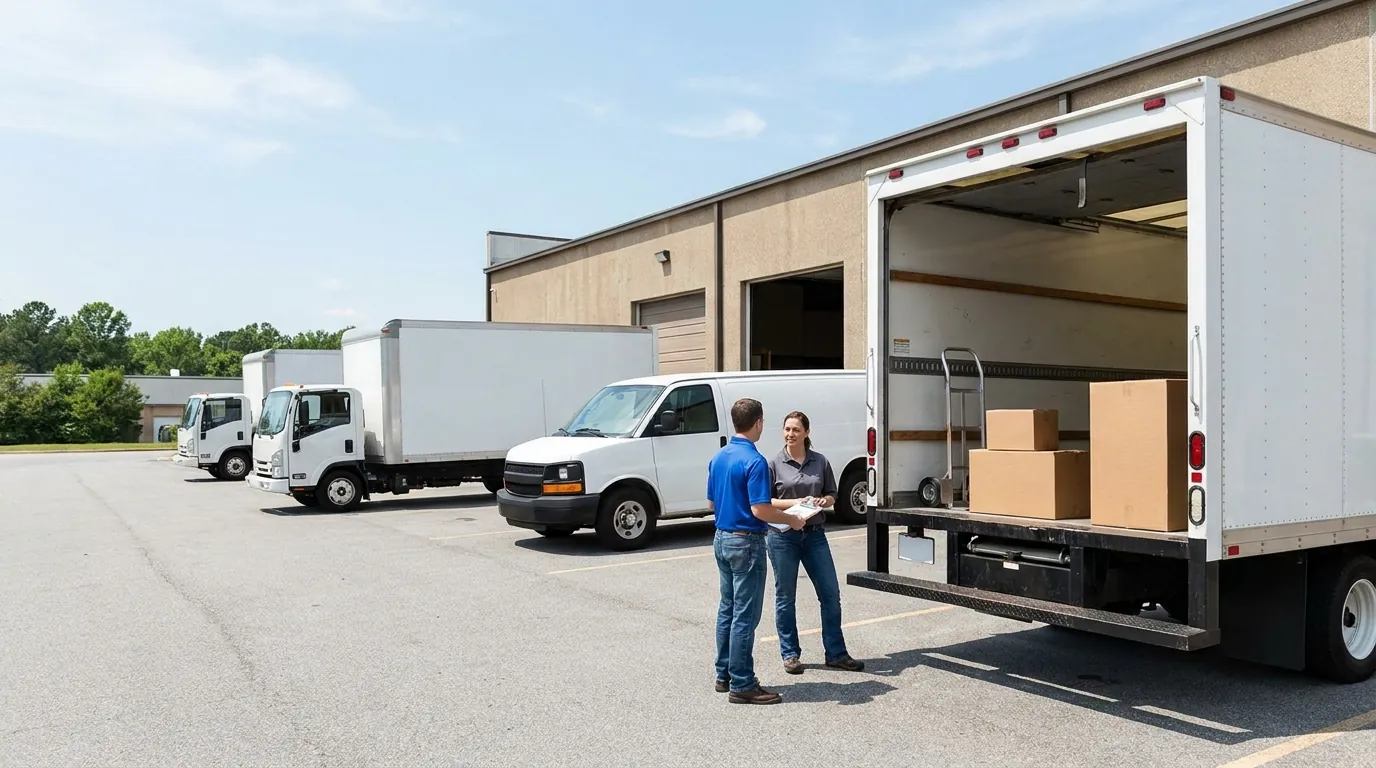
Last-mile delivery truck financing is credit used to buy the vehicle that finishes the trip: the cargo van, the step van, the Class 3 to Class 6 box truck. This guide is about the vehicle itself, not charging equipment or warehouse electrical work. In Q2 2026, US retail e-commerce sales reached $340.2 billion, 17.1% of total retail and up 12.2% year over year against 6.7% for retail overall (US Census Bureau, Quarterly Retail E-Commerce Sales, August 2026).
Every one of those orders ends at somebody's door.
Operators often assume the decision is simpler than a Class 8 purchase because the price tag is smaller. It isn't. Weight class decides who can legally drive. The used medium-duty market moved hard in 2026. And route revenue behaves nothing like freight revenue, which is why payment math copied from long-haul misses.
So: which class fits the work, what a lender reads on a route-based business, and how to size the payment against routes instead of miles.
> Key Takeaways
> - In Q2 2026, e-commerce grew 12.2% year over year while total US retail grew 6.7% (US Census Bureau, August 2026).
> - The 26,001 lbs GVWR line decides whether your driver needs a CDL, so it shapes the spec before it shapes the financing (FMCSA).
> - Class 3 trucks are 37% of trucks over 10,000 lbs but only 18% of truck miles, so cost per mile is the wrong denominator here (US DOE, from the 2021 VIUS, May 2024).
> - Eos Loan is a direct lender for delivery vehicles, with flexible terms, subject to approval and eligibility.
See what financing a fleet expansion could look like
What counts as a last-mile delivery vehicle, and why does weight class decide your options?
Last-mile work runs on cargo vans, step vans, and Class 3 to Class 6 box trucks. The line that decides everything else is 26,001 lbs gross vehicle weight rating. At or above it, the driver needs a commercial driver's license under federal rules (FMCSA). Below it, your hiring pool is far larger.
!A white box truck parked beside a small commercial building in flat daylight, roll door closed.
The practical ladder goes cargo van, step van, Class 3 to Class 5 box truck, then Class 6 and up. Plenty of delivery businesses deliberately spec under 26,001 lbs so they can hire from the general labor market instead of competing for CDL holders. That choice arrives before any lender does, because the spec sets purchase price, insurance, driver pay, and resale pool at once.
One caution, because it catches people. Sitting below the CDL line does not put you outside federal oversight: a vehicle at or above 10,001 lbs GVWR in interstate commerce still carries commercial motor vehicle obligations. Cheaper to drive is not the same as unregulated.
For the product side without the essay, we lay out financing for truck and delivery fleets on one page.
Why does cost per mile describe long-haul and not your route?
In 2025, the American Transportation Research Institute measured average marginal operating cost at a record $2.336 per mile, up 3.4%, with non-fuel costs at $1.854 (ATRI, July 2026). That figure is built from truckload, refrigerated, tank, LTL, and flatbed fleets. It is not a last-mile number, and no one should price a delivery route with it.
The evidence that these are different assets sits in federal vehicle data. In the 2021 Vehicle Inventory and Use Survey, Class 3 trucks were 37% of all trucks over 10,000 lbs but only 18% of truck miles, while Class 8 was about a third of the trucks and close to two-thirds of the miles (US DOE Fact of the Week #1341, May 2024). Lots of vehicles, few miles. That is the shape of last-mile.
A van that covers 60 to 120 miles a day across 90 stops is not priced by the mile. It is priced by the route. The metrics that describe it are revenue per route, stops per route, cost per stop, and days per week the vehicle is genuinely assigned.
If you also run tractors, the wider guide to truck fleet financing covers the per-mile version of this decision.
How fast is last-mile volume actually growing?
In Q2 2026, US retail e-commerce sales hit $340.2 billion, 17.1% of total retail and up 12.2% from a year earlier, while total retail grew 6.7% (US Census Bureau, Quarterly Retail E-Commerce Sales, released August 18, 2026). Delivery volume is compounding faster than the retail base underneath it, and that gap is the business case.
!A delivery driver in plain workwear carrying cardboard parcels on a residential street in daylight.
A separate agency confirms it from the labor side. The Bureau of Labor Statistics projects employment of delivery truck drivers and driver/sales workers to grow 8% from 2024 to 2034, about 171,400 openings a year (BLS Occupational Outlook Handbook, 2024-34 projections). Heavy and tractor-trailer driver employment is projected to grow 4% (BLS). Double the rate, different vehicle, different job.
None of this is a new shape. Back in 2021, 87% of US truck freight tonnage moved less than 250 miles and 44% moved under 100 (US DOE Fact of the Week #1302, from FHWA Freight Analysis Framework, August 2023). Short-haul was always the majority of US trucking. E-commerce made it visible.
What does a lender want to see from a delivery operation?
For a route-based business, the review leans less on the vehicle and more on the work attached to it. How many routes do you run, who are they for, how long have you run them, and what happens if your largest customer walks. The vehicle is collateral. The routes are the repayment story, and every file is subject to approval and eligibility.
Delivery-specific items that carry weight:
- Route or service agreements, and how much revenue sits with a single shipper. Customer concentration is the first question.
- Time in operation. Three years into the same contracts reads differently from three months in.
- Driver structure. Employees or subcontractors changes the cost base, the insurance, and how predictable the margin looks.
- Vehicle spec, age, and mileage, since the asset has to hold value over the loan.
- Business credit, and usually a personal guarantee at this size. Every lender sets its own bar.
- Weight class comes first, because 26,001 lbs GVWR decides who can legally drive.
- Cost per mile is a long-haul benchmark and does not describe a 90-stop day.
- Underwriting reads the contracted work more than the vehicle.
- Thin used supply and softer values pull against each other in 2026, so start the search early.
- Utilization decides affordability. Purchase price only sets the starting point.
> What I see: the delivery operators who move through underwriting cleanly are rarely the ones with the biggest deposit. They can state route count, stops per route, and how many days a week each vehicle runs, before anyone asks. Utilization is the story. That's a pattern I have watched, not an approval rule.
We don't publish credit cutoffs, because the file gets read as a whole. For the mechanics, we wrote up how credit history factors into an approval decision separately.
Ask about flexible terms on a truck purchase
New or used: what the 2026 box truck market looks like
In July 2026, used medium-duty inventory fell 37.39% year over year, an eleventh consecutive monthly decline, while asking values slipped 6.85% and auction values 7.65% (Sandhills Global, August 10, 2026). Fewer units on the lot, softer prices on the ones that are there.
Those two facts pull against each other. Softer values help the buyer. Thin supply means the configuration you wanted (box length, liftgate, GVWR under the CDL line) may not exist nearby this month, which is where operators talk themselves into an older unit than they meant to buy. Sometimes that's right. But once a contracted route depends on the vehicle, a cheap truck that spends three days in a shop costs more than the price gap saved.
The new-vehicle side is not booming either. ACT Research describes medium-duty demand as more cautious than Class 8, with uneven support from consumer confidence, housing, and small-business investment (ACT Research, July 2026). Both are firm estimates, not official statistics.
How many routes does the next van have to cover to carry its payment?
Size the payment against what the vehicle is contracted to run, not what it could theoretically run. The three numbers that matter are revenue per route, routes assigned per week, and the share of weeks the vehicle is genuinely on the schedule. A van assigned five days a week is a different asset from the same van assigned three.
Write your own numbers down before you shop.
1. R = net revenue per route.
2. N = routes the vehicle is assigned per week.
3. W = weeks per year it is actually assigned, not the weeks it exists.
Annual revenue is R multiplied by N multiplied by W. Subtract what rides alongside the vehicle whether or not it moves: insurance, driver pay, fuel, maintenance, parking. What's left is the ceiling on a payment, and a ceiling is not a target.
Notice what that arithmetic does. Purchase price never appears until the end. Two operators buying the identical box truck can be looking at different deals, because one has it on a five-day contracted route and the other is hoping for volume. On peak volume, one sentence: plan around the weeks the vehicle is committed year-round and treat the busy stretch as upside.
Term length is the other lever, and it moves the monthly figure one way while moving total cost the other. Our terms are flexible and sized to the vehicle and the business. If the vocabulary is new, start with how term length changes a monthly payment.
Owned vans or subcontracted capacity: which one do you finance?
Most delivery businesses run a mix: some vehicles owned, some capacity bought from subcontractors. The question isn't whether owning is better. It's which part of your book is stable enough to sit under an owned asset, since owning converts a variable cost into a fixed payment.
!A row of white cargo vans of mixed makes parked outside a small warehouse in daylight.
That conversion helps on committed volume and hurts on volume that moves. Subcontracted capacity flexes down when a customer cuts frequency. A financed van does not. So the routes worth owning first are the oldest and most contracted ones, the volume that has survived a renewal.
The case for ownership is not only about cost, though. You control service quality, driver consistency, and what shows up at the door. An owned van also carries residual value you can sell, and subcontracted capacity leaves nothing behind.
Eos Loan is a direct lender. We originate, underwrite, and service the credit ourselves, so you deal with one team from application to funding. To date we have originated $4B+ and processed 30k+ proposals, and Eos Loan charges no dealer fee. If the categories blur, we explain what a direct lender does differently in detail.
One clarification, since "fleet" gets used two ways. This page is about buying the vehicle. If you're also electrifying, financing charging equipment for a delivery yard is a separate project. Terms are flexible, subject to approval and eligibility.
---
Talk to our team about financing your next truck
Or call +1 833-989-3737 to walk through a purchase with our team. More common financing questions are on our FAQ page.
---
{ question: "Do you need a CDL to drive a box truck?", answer: "Only at or above 26,001 lbs gross vehicle weight rating, where federal rules require a commercial driver's license (FMCSA). Most last-mile box trucks are specced below that line. A vehicle can sit under the CDL threshold and still carry federal safety obligations in interstate commerce at 10,001 lbs and above." }, { question: "Can a delivery business finance a used cargo van or box truck?", answer: "Yes, subject to approval and eligibility. Age and mileage affect how a lender values the collateral, so expect more questions on an older unit. Supply is tight: used medium-duty inventory fell 37.39% year over year in July 2026, an eleventh straight monthly decline (Sandhills Global, August 2026)." }, { question: "How is financing a delivery van different from financing a semi truck?", answer: "Lower purchase price, far lower annual mileage, and a different revenue unit. Class 3 trucks are 37% of US trucks over 10,000 lbs but only 18% of truck miles (US DOE, 2021 VIUS data). A delivery vehicle earns per route, so the payment gets sized against routes rather than miles." }, { question: "What do lenders review for a last-mile delivery company?", answer: "Route or service agreements, how much revenue depends on one customer, time in operation, driver structure, vehicle spec and mileage, and business credit with a personal guarantee at most sizes. There are no published score cutoffs, and every application is subject to approval and eligibility." }, { question: "How long are the terms on a delivery vehicle loan?", answer: "Flexible terms, structured around the vehicle and the business rather than a fixed schedule. What drives the structure is the vehicle's expected service life and the revenue attached to it. Terms are set case by case with our team, subject to approval and eligibility." } ]} />What the route has to prove
Last-mile vehicles are cheaper per unit than a Class 8 tractor and easier to staff below the CDL line, which is exactly why the payment math gets treated casually. These assets earn per route, and the route is what has to carry the loan.
So write down the routes the vehicle is contracted to run and what they produce. If that number holds up with the payment inside it, the van is real capacity. If it depends on volume you hope to win, it isn't yet. When it is, financing for truck and delivery fleets is a conversation.
---
About the author: Eduardo Donadi is the CEO of Eos Loan, a US direct lender financing essential projects including truck fleet expansion, battery energy storage, EV chargers, and water filtration. He works directly with carriers, distributors, and delivery operators on how vehicle purchases get funded.
---
Sources
1. US Census Bureau. "Quarterly Retail E-Commerce Sales, 2nd Quarter 2026." Released August 18, 2026. Retrieved 2026-08-27. https://www.census.gov/retail/ecommerce.html
2. US Department of Energy, Vehicle Technologies Office. "FOTW #1341: In 2021 Class 8 Trucks Represented One-Third of All Trucks." May 6, 2024, drawn from the 2021 Vehicle Inventory and Use Survey. Retrieved 2026-08-27. https://www.energy.gov/cmei/vehicles/articles/fotw-1341-may-6-2024-2021-class-8-trucks-represented-one-third-all-trucks
3. American Transportation Research Institute. "New ATRI Report Details Accelerating Costs and Low Profitability Despite Cuts." July 2026. Retrieved 2026-08-27. https://truckingresearch.org/2026/07/new-atri-report-details-accelerating-costs-and-low-profitability-despite-cuts/
4. US Bureau of Labor Statistics. "Delivery Truck Drivers and Driver/Sales Workers, Occupational Outlook Handbook." 2024-34 projections. Retrieved 2026-08-27. https://www.bls.gov/ooh/transportation-and-material-moving/delivery-truck-drivers-and-driver-sales-workers.htm
5. US Bureau of Labor Statistics. "Heavy and Tractor-Trailer Truck Drivers, Occupational Outlook Handbook." 2024-34 projections. Retrieved 2026-08-27. https://www.bls.gov/ooh/transportation-and-material-moving/heavy-and-tractor-trailer-truck-drivers.htm
6. US Department of Energy. "FOTW #1302: 87% of Truck Freight Tonnage Moved Less Than 250 Miles in 2021." August 2023, from FHWA Freight Analysis Framework. Retrieved 2026-08-27. https://www.energy.gov/node/4831871
7. Sandhills Global. "US Market Reports, July 2026." August 10, 2026. Retrieved 2026-08-27. https://www.sandhills.com/news/article/250047909
8. ACT Research. "Trucking Industry Forecast for 2026." Updated July 31, 2026. Retrieved 2026-08-27. https://www.actresearch.net/resources/blog/trucking-industry-forecast-for-2026
9. Federal Motor Carrier Safety Administration. "Commercial Driver's License." Retrieved 2026-08-27. https://www.fmcsa.dot.gov/registration/commercial-drivers-license/drivers