

Electrical Panel Upgrades in Financed Battery Projects
A 2021 Pecan Street analysis estimated that up to 48 million US single-family homes, roughly a third of the housing stock, would need a larger service panel before they could fully electrify, an obstacle sized at close to $100 billion (Pecan Street, 2021, as covered by Utility Dive). That figure is a few years old now. The field problem it describes still lands on battery jobs every week.
The pattern is familiar. The site survey comes back, the customer's 100 amp or 150 amp service won't carry the battery inverter, and there's suddenly a second number nobody budgeted for. Sometimes it arrives after the contract is signed, which is worse.
This guide covers what triggers the upgrade, what it costs in 2026, when it's genuinely avoidable, and how to carry it as one financed amount instead of a change order.
> Key Takeaways
> - A 200 amp panel upgrade averages about $2,150 installed, with most jobs landing between $1,300 and $3,000 (This Old House, updated March 2026).
> - Under NEC 705.12, an AC-coupled battery inverter counts as a second power source on the busbar, so the battery itself triggers the upgrade, not just the customer's old wiring (GreenLancer, 2026).
> - The federal credit that used to offset panelboard cost expired for property placed in service after December 31, 2025 (IRS), so the full amount now lands on the customer.
> - Quoting the upgrade as a separate line is what loses the deal. One financed amount, with terms from 6 to 240 months, keeps it a single decision.
See how Eos Loan financing helps you close more projects
Why does a battery storage job trigger a panel upgrade?
Under NEC 705.12, 125% of the inverter output current plus the main breaker rating must stay at or below 120% of the busbar rating (GreenLancer, 2026). On a 200 amp busbar with a 200 amp main, that leaves room for a 40 amp backfed breaker, 32 amps continuous. The battery inverter has to fit inside that.
The busbar is the metal spine inside the panel that every breaker clamps onto. It has a stamped current rating, and code caps how much power can be pushed onto it from sources other than the meter. That cap is arithmetic, not opinion.
Here's the part most cost guides skip. An AC-coupled battery inverter is evaluated as a second interactive power source alongside the PV inverter, not as an appliance load (GreenLancer, 2026). So a home that passed the calculation with solar alone can fail it the moment a battery is added. The panel didn't get older. The math changed. That's exactly why the upgrade belongs inside the battery project's scope rather than on a separate electrician's invoice.
That leaves three outcomes at survey. The battery fits under the existing ceiling. The main breaker gets derated to open headroom. Or the service panel gets replaced. Retrofit jobs onto existing solar hit the ceiling most often, because a PV inverter is already consuming the allowance. For those, the sequencing in our guide to AC-coupled retrofits onto existing solar is worth reading alongside this one.
How much does an electrical panel upgrade cost in 2026?
A panel upgrade averages about $2,150 installed nationally, with most jobs running $1,300 to $3,000 and the full range spanning $800 to $4,000 (This Old House, updated March 2026). Amperage drives the band: 100 amp swaps run $800 to $1,500, 200 amp upgrades $1,300 to $3,000, and 400 amp services $2,000 to $4,000.
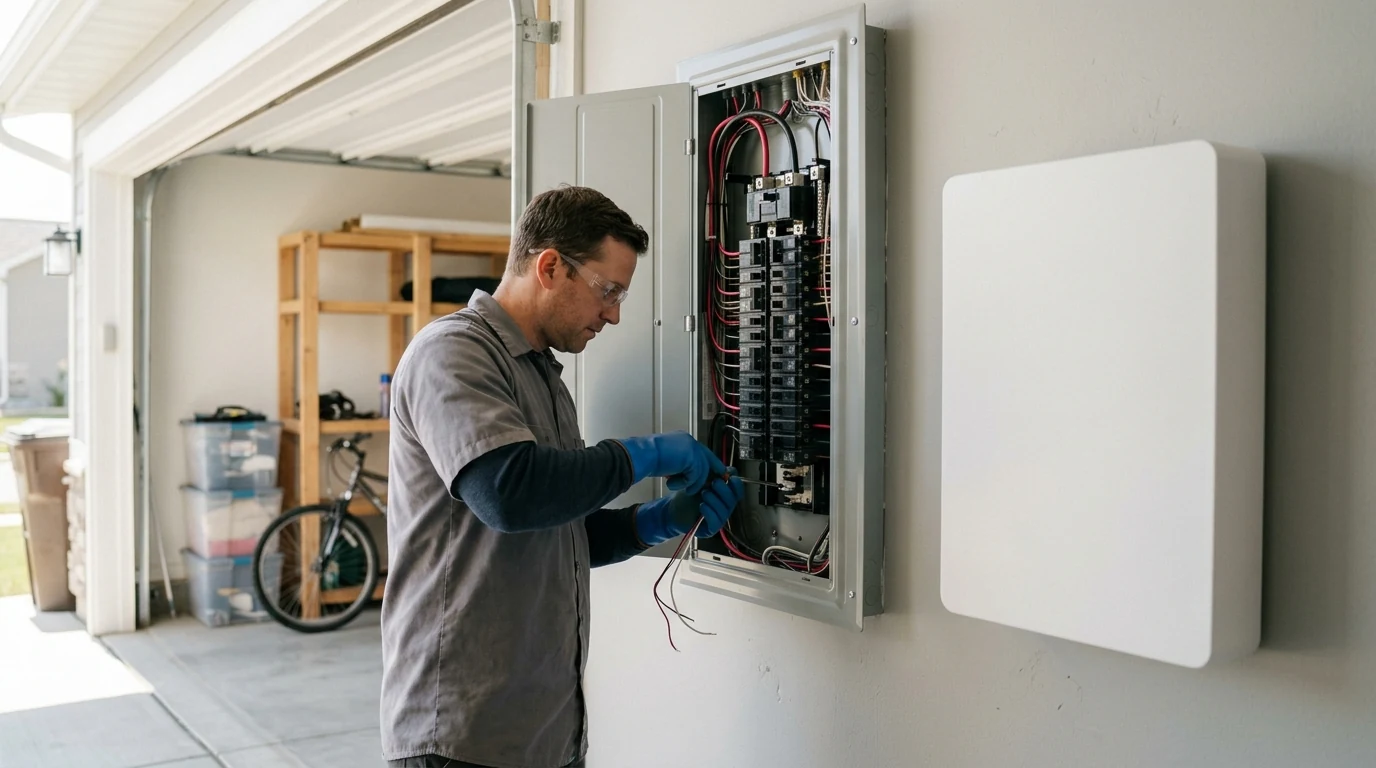
!A licensed electrician working on an open residential electrical panel in a bright garage.
One distinction is buried in that spread: a panel swap is not the same job as a full service upgrade. Replacing the panelboard while the incoming service stays put is the cheaper version. Once the meter base, the service entrance cable, the mast, and the grounding electrode system also have to be replaced, the job moves to the top of the range and sometimes past it. Permits add another $50 to $300 (This Old House, 2026).
Why does the same nominal upgrade vary by thousands? Labor, not hardware. The panelboard is a small share of the invoice. Crew hours, coordination with the local electric provider for a service disconnect, conduit work, and regional rates drive most of the movement.
For sizing, a home battery typically runs $10,000 to $18,000 before incentives (EnergySage, 2026), which puts a $2,150 upgrade at roughly a 12% to 20% adder on the project. If you want the full ten-year picture, we broke it down in battery storage total cost of ownership, financed versus cash.
Can you install a home battery without upgrading the panel?
Often, yes. Peninsula Clean Energy found that 99% of the 700-plus all-electric single-family homes it analyzed never exceeded 100 amps across a full year, with a most-common annual peak of 29 amps, and 95% of its completed retrofits required no service upgrade at all (Canary Media, 2024).
That's one California community energy provider's sample, so treat it as directional rather than national. It still flips the default assumption. Most panels are sized well above what the home actually draws, and cost guides written by electricians have a commercial reason not to say so. Four code-compliant alternatives are worth checking before you quote a replacement, cheapest first:
1. Derate the main breaker. Swapping a 200 amp main for a 175 amp or 150 amp device opens busbar headroom, where the load calculation supports it.
2. Use the NEC 705.13 energy management path. Power control systems are a separate compliance route that uses monitored, actively limited current instead of static busbar arithmetic (GreenLancer, 2026).
3. Add a UL-listed load management device. These commonly run $400 to $800 based on vendor pricing from Emporia and NeoCharge, which is vendor-published, not independent research.
4. Consider a supply-side connection under NEC 705.11, where the local electric provider and the authority having jurisdiction both allow it.
Smart panels are a fifth path and a bigger budget conversation; we cover them, along with smart panels and critical load panels, in a separate guide.
One caveat travels with all of this. The authority having jurisdiction, meaning the local inspector or building department, decides what passes, adopted code editions vary, and a measured-load argument only works where your inspector accepts one. Never tell a customer a load management device is guaranteed to be approved. Eos Loan doesn't perform load calculations or decide whether an upgrade is required; your licensed electrician and the local inspector do.
Who pays for the panel upgrade now that the federal credit is gone?
The customer, in full. The Energy Efficient Home Improvement Credit (Section 25C) covered panelboards rated 200 amps or greater that meet the National Electric Code, at a limit of $600 per item, and applies only to property placed in service before December 31, 2025 (IRS).
The residential clean energy credit under Section 25D is closed as well. The IRS states plainly that the credit "is not available for any property placed in service after December 31, 2025" (IRS). For installers working commercial battery storage projects, the 48E path generally remains available through 2032 per IRS guidance and statute, which is a different conversation with a different customer.
The practical change is simple. Through 2025, part of the panelboard cost could come back to the homeowner at filing. From 2026 forward, the entire amount is out of pocket on day one unless it's financed. That's why this line item became a deal-stopper this year rather than a footnote.
This is general information, not tax advice. Consult a qualified tax professional.
Add financing to your installs, talk to our team
How do you fold the panel upgrade into one financed amount?
The upgrade is electrical scope inside the battery storage project, so it belongs in the same financed amount as the battery: one proposal, one monthly payment. A second invoice is a second decision the customer can decline, and declining it usually means the battery goes with it.
Six steps, in order:
1. Run the load calculation and the 705.12 check at site survey, before the proposal. This is the single biggest change on this list. An upgrade discovered after signature becomes a change order, and change orders stall.
2. Price the electrical scope as a line inside the project total. Not as a separate electrician bid the customer receives on separate letterhead.
3. Quote one monthly payment for the whole project. Eos Loan's battery energy storage terms run 6 to 240 months, so a longer term absorbs a $2,000 to $3,000 upgrade with a smaller change to the monthly figure than most customers expect. All financing is subject to approval and eligibility. Never state or imply a rate or an approval outcome. If you want the mechanics, see how term length changes the monthly payment.
4. Present the alternatives you already checked. Walk through the derate, the energy management path, and the load management option, and say why each was ruled out. The upgrade then reads as necessary rather than padded.
5. Sequence the financing conversation before the number, not after it. Customers who hear a payment first evaluate a payment. Customers who hear a total first evaluate a total, which is a harder sale on scope they didn't expect.
6. Say plainly that Eos Loan charges no dealer fee. Some lenders take a dealer fee out of the funded amount, which pushes contractors to pad the job to cover it. That pressure doesn't exist here, so the electrical scope stays priced at cost.
> What installers keep telling us: the deals that die aren't the ones with expensive panel upgrades. They're the ones where the upgrade showed up in week three as a surprise. Same dollar amount, completely different conversation. I'm describing a pattern partners report to us, not a guaranteed outcome for any one shop.
Carrying full scope on one financed amount is also how ticket size grows without discounting, covered in raising average ticket size with financing. Eos Loan is a direct lender for essential projects, so the battery and the electrical work behind it sit on the same paper.
How do you present the upgrade without losing the deal?
Lead with what the upgrade buys, not what it costs. A 200 amp service carries the battery, an EV charger later, and whatever the household adds after that. Framed that way, a $1,300 to $3,000 line (This Old House, 2026) reads as capacity, not repair.
"Your panel is old" is the wrong script. It sounds like blame, and the panel may be perfectly healthy. The accurate version sells better anyway: the battery adds a second power source to a busbar that code says can only carry so much. Rules argue better than opinions.
Timing matters as much as wording. Raise it at the survey debrief, while the customer is still evaluating the project, never at the signing table. Be straight about the credit too: the federal offset that used to help with panelboards ended for property placed in service after December 31, 2025, so the number they're seeing is the number.
For the objection itself, our guide on how to pitch a home battery when customers ask about cost has the script. Panel work also affects inspection sequencing, which we cover in permit and inspection sequencing on a financed battery job.
Offer your customers flexible financing on essential projects
Or call +1 833-989-3737 to talk through a financing program for your business.
Frequently Asked Questions
{ question: "Does a home battery require a 200 amp panel?", answer: "There is no universal requirement. What matters is the NEC 705.12 calculation: 125% of combined inverter output current plus the main breaker rating must stay at or below 120% of the busbar rating. A 200 amp busbar with a 200 amp main leaves a 40 amp backfed breaker (GreenLancer, 2026)." }, { question: "How much does a 200 amp panel upgrade cost?", answer: "Typically $1,300 to $3,000 installed, averaging about $2,150, with permits adding $50 to $300 (This Old House, updated March 2026). A full service upgrade that also replaces the meter base, mast, and service entrance cable sits at the higher end of that range." }, { question: "Can the panel upgrade be included in battery storage financing?", answer: "Yes. It is electrical scope inside the battery storage project, so it can sit on the same proposal and the same financed amount rather than arriving as a separate invoice. Eos Loan battery energy storage terms run 6 to 240 months, subject to approval and eligibility." }, { question: "Is there still a tax credit for an electrical panel upgrade?", answer: "Not for residential property placed in service after December 31, 2025. The 25C credit covering 200-amp-or-greater panelboards, capped at $600 per item, ended, and the 25D residential clean energy credit is closed for property placed in service after that date (IRS). This is general information, not tax advice. Consult a qualified tax professional." } ]} />The bottom line on panel upgrades in financed battery projects
Four things to carry into your next survey:
- The battery is what triggers the busbar arithmetic, so stop framing it as the customer's old wiring.
- $1,300 to $3,000 is the realistic 200 amp range, averaging around $2,150 (This Old House, 2026).
- Check the derate, energy management, and load management options before quoting a replacement. Most homes measure far below their panel rating.
- The federal offset is gone as of 2026, and one financed amount is what keeps the whole project a single decision.
- Pecan Street, Panel Size analysis (up to 48 million US single-family homes, roughly one third of the housing stock, may need a service panel upgrade before full electrification), retrieved 2026-05-08, https://www.pecanstreet.org/2021/08/panel-size/
- Utility Dive, Residential electric panels represent a nearly $100B roadblock to full electrification, retrieved 2026-05-08, https://www.utilitydive.com/news/residential-electric-panels-represent-a-nearly-100b-roadblock-to-full-el/605829/
- GreenLancer, The 120% Rule for Solar (NEC 705.12 busbar calculation; AC-coupled battery inverters evaluated as a second interactive power source; NEC 705.13 energy management alternative), retrieved 2026-05-08, https://www.greenlancer.com/post/120-rule-for-solar
- This Old House, Cost to Upgrade an Electrical Panel (about $2,150 average, $1,300-$3,000 typical, $800-$4,000 full range, permits $50-$300), updated March 2026, retrieved 2026-05-08, https://www.thisoldhouse.com/electrical/cost-to-upgrade-electrical-panel
- EnergySage, How Much Do Home Batteries Cost (typically $10,000-$18,000 before incentives), retrieved 2026-05-08, https://www.energysage.com/energy-storage/how-much-do-batteries-cost/
- Canary Media, Many homes already have the power to electrify (Peninsula Clean Energy: 99% of 700-plus all-electric single-family homes never exceeded 100 amps annually, most common annual peak 29 amps, 95% of retrofits needed no service upgrade), 2024, retrieved 2026-05-08, https://www.canarymedia.com/articles/electrification/many-homes-have-power-to-electrify
- IRS, Energy Efficient Home Improvement Credit (Section 25C panelboard credit, $600 per item limit, property placed in service before December 31, 2025), retrieved 2026-05-08, https://www.irs.gov/credits-deductions/energy-efficient-home-improvement-credit
- IRS, Residential Clean Energy Credit (not available for any property placed in service after December 31, 2025), retrieved 2026-05-08, https://www.irs.gov/credits-deductions/residential-clean-energy-credit
If you're building out a financing program around battery work, start with how battery storage financing works end to end, then talk to us about carrying full project scope, battery plus electrical, on one financed amount.
---
Sources
About the author: Eduardo Donadi is the CEO of Eos Loan, the fintech built to finance essential projects (battery energy storage, EV chargers, and water filtration) for installers, contractors, and resellers across the United States. Code and load-calculation specifics in this article are attributed to the cited electrical and industry sources; Eos Loan does not perform load calculations or determine whether a service upgrade is required.