
How to Pitch a Home Battery When Customers Ask About Cost
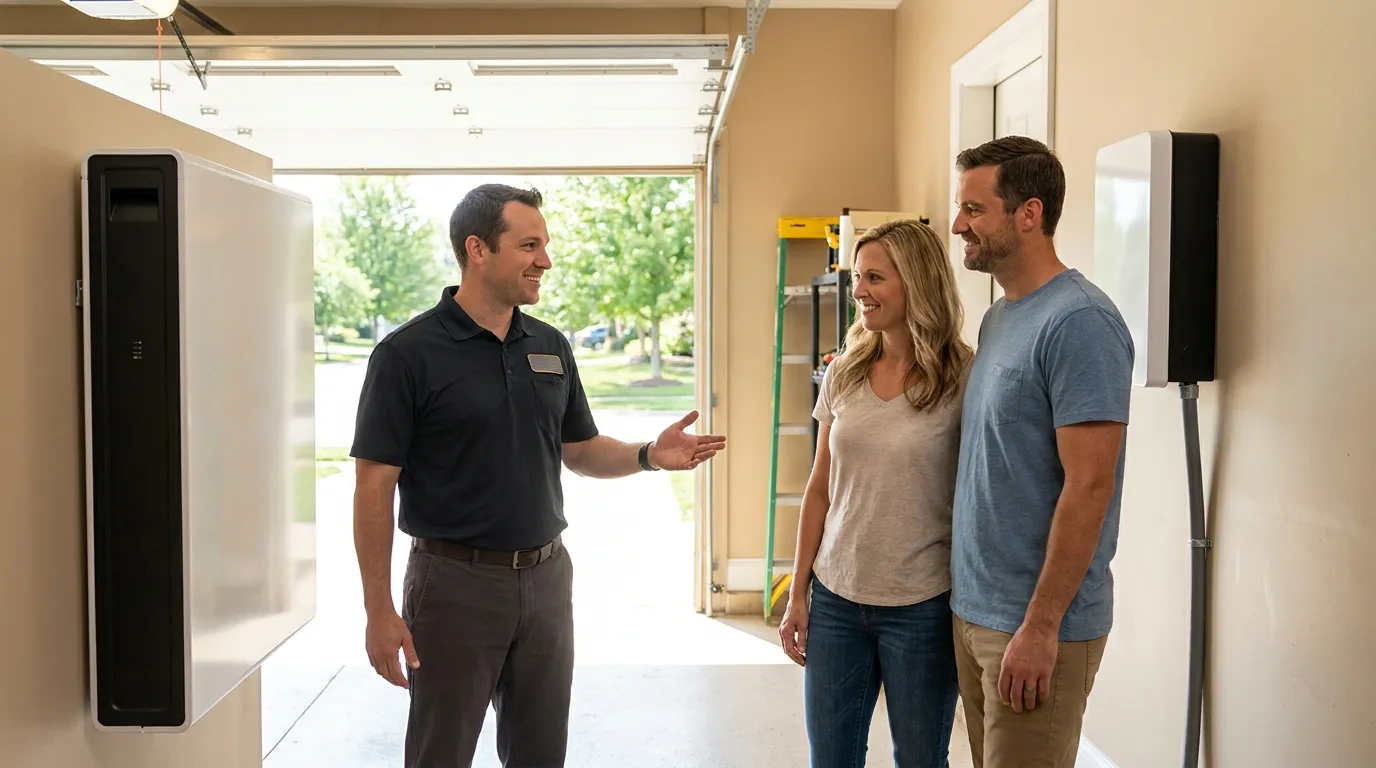
US residential battery storage grew 92% year over year in 2025 (Wood Mackenzie, US Energy Storage Monitor, 2025). Demand is not the problem. The most common deal-killing moment is still the same one: the customer asks what a home battery costs, sees the total, and goes quiet.
Most installers answer the cost question with a lump sum. That puts the customer in "can I afford this" math mode, and that is the hardest mode to sell from. The residential clean-energy credit (Section 25D) ended December 31, 2025 (IRS, 2025), so the discount that used to soften the number is gone. What replaces it is a monthly payment, but only if you know how to introduce it before the sticker shock takes hold.
This post gives you a phrase-by-phrase method for handling the cost question: how to open the pitch, what to say when they ask about price, how to work through the four most common objections, and how to adjust the term when the payment needs to come down.
> Key Takeaways
> - In 2025, US residential storage grew 92% year over year (Wood Mackenzie, 2025). Demand is there; the pitch structure is what breaks deals.
> - The residential clean-energy credit (Section 25D) ended December 31, 2025 (IRS). Financing is now the affordability lever.
> - Contractors who present financing on every job finance 35% of their sales versus 17% for those who offer it only when a customer flinches (ACCA, 2025).
> - Treat cost objections as a signal that the monthly payment has not been shown yet, not that the customer cannot afford the system.
See how Eos Loan financing helps you close more projects
Why does the cost question kill battery deals?
The cost question kills battery deals because installers answer it with a lump sum, which forces the customer into affordability math they cannot win. In 2025, US residential storage hit 2.7 GW, up 92% year over year, and total US storage reached 18.9 GW, up 52% (Wood Mackenzie, US Energy Storage Monitor, 2025). That is a strong market. Yet the sticker shock moment still kills deals at the kitchen table.
Here is why lump-sum answers backfire. When a customer hears a five-figure number, their brain immediately calculates affordability: do I have this? Can I free it up? That calculation almost always lands on "no" before you have a chance to explain financing. The number becomes an anchor, and once anchored, it is hard to shift.
The residential clean-energy credit used to soften that anchor. It shrank the effective out-of-pocket cost, which made a large system feel reachable. Now that the Section 25D credit ended December 31, 2025 (IRS, 2025), the number is no longer softened by an incentive. The system price did not fall. The affordability gap got wider. This is general information, not tax advice. Consult a qualified tax professional.
The non-obvious point here: cost objections are not proof that the customer cannot afford the system. They are almost always a signal that the payment has not been shown yet. The problem is not price; it is pitch structure.
According to a 2025 ACCA study of over 1,000 contractors, contractors who present financing on every job finance 35% of their sales, while those who offer it only when a customer hesitates finance just 17% (ACCA, Contractor of the Future Study, 2025). The gap is entirely a presentation choice.
For the broader playbook on close-rate impact, see how financing lifts contractor close rates.
How do you open the battery pitch before the customer asks about cost?
Lead with the monthly payment, not the system price. In 2025, ACCA found that contractors who present financing on every job close 11% more deals than those who wait for a price objection to introduce it (ACCA, Contractor of the Future Study, 2025). The difference is entirely in when the payment shows up in the conversation.
The standard approach: quote the system, wait for the customer to ask about cost, then scramble to introduce financing as a rescue. That sequence is backwards. By the time you introduce the monthly number, the customer has already anchored on the lump sum and every payment you show feels like a concession you are negotiating.
The better sequence is to put the payment on the table before the customer has a chance to anchor. When you walk through the proposal, present two numbers side by side: the cash price and a monthly payment. Do not hide the cash price; show it plainly. Just make sure the monthly payment is there at the same moment so the customer evaluates both simultaneously.
A phrase that works: "Most customers who do a project this size pay a monthly amount that fits their budget, subject to approval, rather than putting it all out up front. Want me to show you what that looks like for this system?"
This is about preventing the price anchor from forming, not recovering from it. Once a customer has mentally locked onto the total, shifting them to a payment frame takes three times the effort. Showing both numbers first costs nothing and eliminates that recovery problem entirely.
For the full contractor financing program setup, see the full contractor financing guide.
What do you say when the customer asks how much a home battery costs?
Answer the cost question with a payment, not a price. When a customer asks "so what does something like this actually cost?", the response that keeps the deal alive acknowledges the cash price briefly and then redirects to the monthly payment immediately. Point-of-sale financing lifts checkout conversion by 20 to 30%, and customers spend roughly 20% more per visit when embedded lending is available (McKinsey, Buy Now Pay Later: Five Business Models, 2024). The payment frame is doing real work on the conversion rate.
Here is a sample dialogue framework:
Customer: "So what does something like this actually cost?"
Installer: "Great question. A system this size runs a few thousand dollars depending on capacity and installation. Most customers who finance it pay a comfortable monthly amount that we size to their budget, subject to approval. Want to see what that looks like for your situation?"
The structure: acknowledge the cash price without making it the center of gravity, then shift to "want to see the payment?" before the customer can do their own math. The question at the end is key. You are asking permission to show the payment, which moves the conversation forward instead of letting it stall.
What NOT to say: do not quote a specific APR or rate as Eos Loan's rate; rates come from underwriting and vary by applicant. Do not describe the financing as zero-cost or no-cost unless you have confirmed that specifically. Do not imply guaranteed approval. Frame it as "subject to approval."
For more on financing a home battery after the credit ended, see financing a home battery after the tax credit.
How do you handle the four most common cost objections?
Four responses cover nearly every version of the cost objection. In 2024, McKinsey found that point-of-sale financing lifts checkout conversion by 20 to 30% and that customers spend roughly 20% more per visit when embedded lending is available (McKinsey, 2024). That lift only materializes if you know what to say when the customer pushes back.
Here is the cost-question response matrix: four customer statements and the installer pivot that works for each one.
| Customer statement | Installer pivot |
|---|---|
| "That's expensive." | "Compared to what you will pay in outage-related costs and high peak rates over the next ten years, most customers find the monthly payment is the more manageable option. Can I show you the math?" |
| "I need to think about it." | "That's fair. Can I leave you with the monthly payment number instead of the total? That way you have something concrete to think about. Subject to approval, here is what it looks like." |
| "I can't afford that right now." | "That is exactly why financing exists. The system does not have to be a lump sum. Want me to walk you through what a monthly payment looks like? Subject to approval." |
| "I thought the tax credit would help." | "The residential credit (Section 25D) ended December 31, 2025. Financing is separate from the credit and it still makes the payment reachable. Here is how." |
For the last objection, add: the Section 25D credit ended December 31, 2025 (IRS, 2025). This is general information, not tax advice. Consult a qualified tax professional.
Notice that three of the four pivots end with a question. You are asking the customer to say yes to seeing the payment, not yes to buying the system. That smaller commitment is much easier to get, and it moves the conversation forward.
For more on the post-credit selling environment, see the post-tax-credit pitch playbook.
How do you present the term length to close the deal?
When a customer hesitates on the monthly payment, the answer is a longer term, not a discount. Eos Loan finances battery energy storage with terms from 6 to 240 months (Eos Loan product data, 2026), subject to approval and eligibility. Moving to a longer term lowers each monthly payment without changing the system price or the installer's margin.
The term pivot keeps your margin intact. A price discount gives away money permanently. A longer term adjusts the structure of the payment without reducing what you earn on the install. For a price-sensitive buyer, that difference is the deal.
How to frame the pivot:
Customer: "I like it, but that monthly amount is still a stretch."
Installer: "No problem. I can look at a longer term and bring that number down. I cannot quote you a specific rate, because that comes from underwriting based on your profile, but I can show you how different term lengths change the monthly payment. Subject to approval."
The key phrase: "I cannot quote you a specific rate." That keeps you accurate and compliant. You are not making a rate promise; you are offering to show how term length moves the payment.
Longer terms also open the door to a larger system. When the monthly number comes down, some customers find they can absorb a higher-capacity battery for a similar payment to what they had in mind for a smaller one. The term adjustment quietly raises your average ticket without a pitch around it.
For the full financing mechanics, see the complete battery storage financing guide.
How do you make the financing offer feel natural in the pitch?
The financing offer feels natural when it is built into the proposal from the start, not added as an afterthought when the customer balks. In 2025, ACCA found that contractors who offer financing on every job report an 11% higher close rate than those who offer it selectively (ACCA, Contractor of the Future Study, 2025). The difference is structural: one group treats the monthly payment as a standard proposal line item, the other treats it as a rescue move.
Two practical steps to make it default:
Build the payment into the proposal template. Your quote should show the cash price and a sample monthly payment side by side, clearly labeled as subject to approval and not a rate quote. When both numbers are on the page at the same time, there is no awkward moment where you have to introduce financing. It is already there.
Mention it early in the conversation. Something like: "By the way, most of our customers finance this, and we work with a direct lender, so there's no dealer fee and no middleman." That one sentence does a lot of work. It normalizes financing before any dollar amount has landed. It differentiates Eos Loan as a direct lender. And it removes the "I don't want to deal with a broker" friction some customers carry.
> What I see across the Eos Loan partner base: The reps who describe the monthly payment as a standard part of the quote, not a rescue option, consistently report fewer deals lost to price hesitation. I frame this as a pattern we see across our installer network, not a guarantee of individual results. The structural habit, presenting payment alongside price from the start, is the common factor.
Add financing to your installs, talk to our team
Putting it all together: the pitch structure that closes
The cost question does not have to kill the deal. The structure that works looks like this: lead with the monthly payment before the customer can anchor on the total; answer the cash-price question briefly and redirect to the payment immediately; use the four-objection response matrix to handle every variation of "too expensive" or "I need to think"; adjust the term when the payment needs to come down, protecting your margin rather than cutting your price; and make financing a default line item on every proposal so the conversation never needs a rescue.
What makes this work at scale is the habit, not the individual phrase. When every quote includes a payment, you stop needing to improvise at the kitchen table. The conversation becomes predictable, and predictable conversations close at higher rates.
Offer your customers flexible financing on essential projects
Or call +1 833-989-3737 to talk through a financing program for your business.
Frequently Asked Questions
question: "What do you say when a customer asks how much a home battery costs?",
answer: "Answer with a payment, not a lump sum. Acknowledge the cash price briefly, then redirect: 'Most customers finance this and pay a monthly amount that fits their budget, subject to approval.' Lead with the payment number, not the total. This prevents the sticker-shock anchor from forming before you have shown the financing option."
},
{
question: "How do you overcome the price objection on battery storage?",
answer: "Treat the price objection as a signal that the payment has not been shown yet, not that the customer cannot afford the system. Pivot to a monthly payment immediately and offer a longer term if the payment is still a stretch. A term adjustment protects your margin; a discount does not. ACCA 2025 data shows an 11% close-rate lift when installers present financing on every job."
},
{
question: "Can you still pitch a home battery without the tax credit?",
answer: "Yes. The residential clean-energy credit (Section 25D) ended December 31, 2025 (IRS, 2025), but financing is independent of the credit. Financing spreads the cost over time regardless of the credit status. Eos Loan offers battery storage terms from 6 to 240 months, subject to approval and eligibility. This is general information, not tax advice. Consult a qualified tax professional."
},
{
question: "What financing terms are available for a home battery through Eos Loan?",
answer: "Eos Loan offers battery energy storage terms from 6 to 240 months, subject to approval and eligibility (Eos Loan product data, 2026). Longer terms lower the monthly payment without reducing the system price or the installer's margin. Eos Loan is a direct lender with no dealer fee, which means no middleman between the installer and the financing offer."
}
]} />
Conclusion
The cost question does not kill deals on its own. It kills deals when installers answer it with a lump sum before the customer has seen a payment. The fix is structural: put the monthly payment on the proposal before the customer anchors on the total, redirect cost questions from price to payment, handle each of the four common objections with a specific pivot, and use term length to adjust the payment without touching your margin.
Key points to carry into your next install:
- The cost question is almost always a signal that the payment has not been shown yet.
- Lead with both numbers (cash price and monthly payment) on the first proposal visit.
- Use the four-objection matrix as a reference, not a script.
- When the payment needs to come down, adjust the term, not the price.
- Make financing a default line item so you never need a rescue conversation.
- Wood Mackenzie. US Energy Storage Monitor, Q4 2025. https://www.woodmac.com/press-releases/us-energy-storage-monitor/. Retrieved 2026-06-18.
- ACCA. Contractor of the Future Study: Key Findings from 1,000 Contractors, 2025. https://hvac-blog.acca.org/inside-the-contractor-of-the-future-study-key-findings-from-1000-contractors/. Retrieved 2026-06-18.
- McKinsey & Company. Buy Now Pay Later: Five Business Models to Compete, 2024. https://www.mckinsey.com/industries/financial-services/our-insights/buy-now-pay-later-five-business-models-to-compete. Retrieved 2026-06-18.
- IRS. Residential Clean Energy Credit. https://www.irs.gov/credits-deductions/residential-clean-energy-credit. Retrieved 2026-06-18.
To set up Eos Loan financing for your battery installs, see battery storage loan terms explained or become an Eos Loan financing partner.
---
Sources
---
About the author: Eduardo Donadi is the CEO of Eos Loan, a direct lender that finances essential projects, including battery energy storage, EV chargers, and water filtration systems, for installers, contractors, and resellers across the United States. Eduardo works directly with installer partners to develop financing programs that help them close more projects and raise average ticket size.