

Battery Storage Loan Terms: Why Term Length Changes the Payment
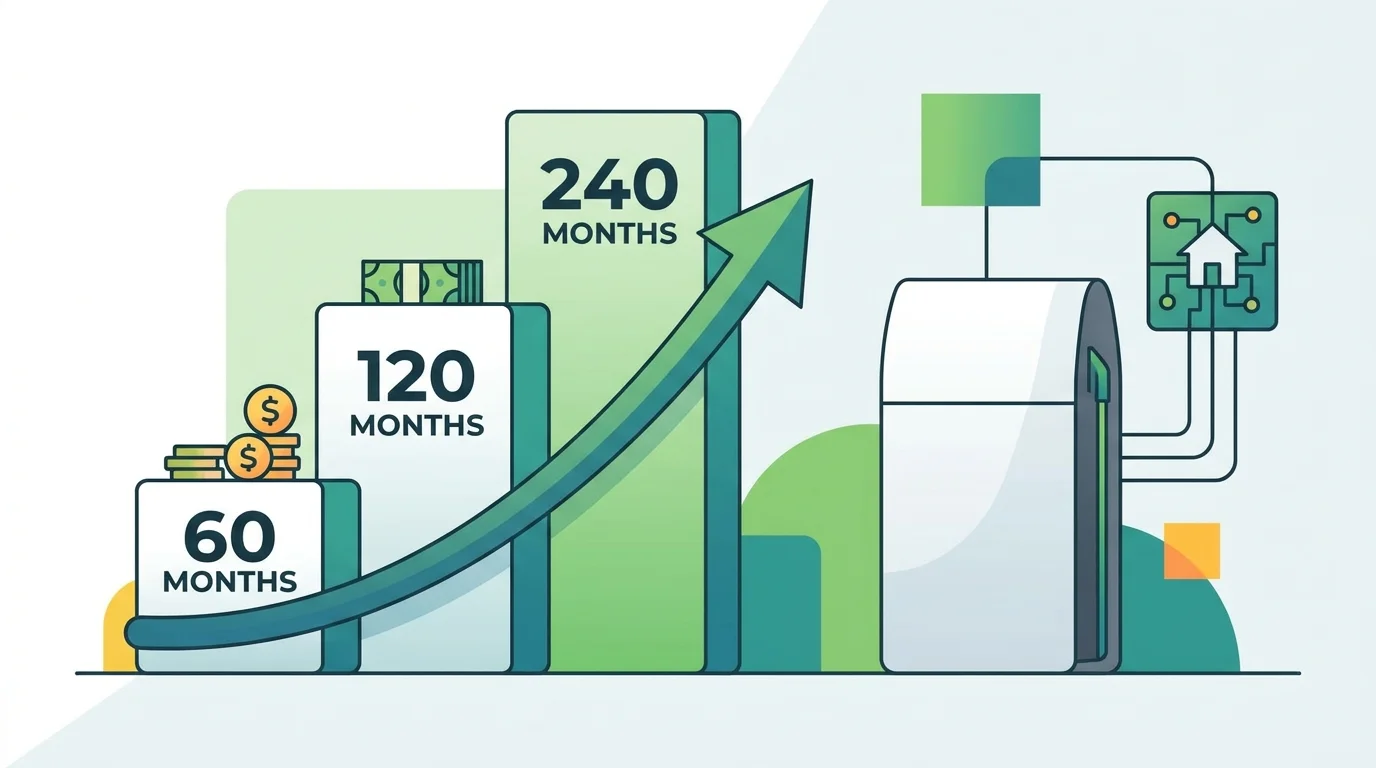
A fully installed residential battery system runs $10,000 to $15,000 on average in 2026 (EnergySage, 2026). That same price tag lands very differently depending on whether you are repaying it over two years or twenty. And yet most homeowners focus on the total number and stall, while most installers do not have a clear way to explain why a 240-month term exists or when to use it.
US residential battery storage grew 92% year over year in 2025 (Wood Mackenzie, US Energy Storage Monitor, 2025). Demand is not the problem. Understanding the payment math is what converts interest into a signed proposal.
This article explains exactly how battery storage loan terms work, what the payment looks like at different lengths, and how to pick the right term for your project or your customer.
> Key Takeaways
> - Battery storage loan terms at Eos Loan run 6 to 240 months, wider than most personal loans (24-84 months per NerdWallet, 2025) or solar-specific lenders (typically capped at 144 months).
> - A longer term lowers the monthly payment but increases total financing cost over the life of the loan.
> - Eos Loan charges no prepayment penalty, so a 240-month term functions as a payment floor, not a ceiling.
> - Installers who present two term options at the proposal close more often than those who show one.
See how Eos Loan financing helps you close more projects
What Are Battery Storage Loan Terms?
Eos Loan offers battery energy storage terms from 6 to 240 months, a range wider than most home-improvement or personal loan products available today (Eos Loan product data, 2026). A battery storage loan term is simply the number of months you have agreed to repay the loan. It is different from the interest rate, which is the cost per dollar borrowed. The term is the clock; the rate is the price of running it.
Most personal loans run 24 to 84 months (NerdWallet, 2025). Many solar-specific lenders cap at 144 months (Clean Energy Credit Union, 2026). Eos Loan's 240-month ceiling extends battery energy storage financing well beyond those products, and it is unsecured: there is no lien on your home, no equity required.
Understanding the difference between three core concepts makes every financing conversation easier:
- Principal: The amount borrowed (system price minus any down payment).
- Term: The number of months you have to repay.
- Monthly payment: How much goes out of your account each month.
- Planned home sale in a few years. A paid-off battery is simpler than transferring an active loan at sale. If the customer expects to move within three to five years, a shorter term reduces the chance the loan outlasts their time in the home.
- Strong cash flow, minimal budget pressure. If the higher monthly payment is comfortable, paying less total is straightforward arithmetic.
- Customer preference for fewer obligations. Some buyers simply dislike long-term debt. Respecting that preference builds trust and moves the proposal forward.
- Battery storage loan terms at Eos Loan run 6 to 240 months.
- Longer terms lower the monthly payment; shorter terms lower the total financing cost.
- The 240-month ceiling is wider than most comparable financing products and is unsecured.
- No prepayment penalty means the term is a payment floor, not a ceiling.
- Installers who present multiple term options close more deals and can sell larger systems.
- EnergySage, How Much Do Home Batteries Cost?, retrieved 2026-06-18, https://www.energysage.com/energy-storage/how-much-do-batteries-cost/
- Wood Mackenzie, US Energy Storage Monitor, 2025, https://www.woodmac.com/
- BloombergNEF, New Record Lows for Battery Prices, 2025, https://about.bnef.com/insights/clean-transport/new-record-lows-for-battery-prices/
- NerdWallet, Personal Loan Term Length, retrieved 2026-06-18, https://www.nerdwallet.com/personal-loans/learn/personal-loan-term-length
- Clean Energy Credit Union, Battery Storage Loans, retrieved 2026-06-18, https://www.cleanenergycu.org/personal/battery-storage/
- IRS, Residential Clean Energy Credit, retrieved 2026-06-18, https://www.irs.gov/credits-deductions/residential-clean-energy-credit
- Eos Loan, product data, 2026
The relationship between these three is fixed math. Longer term means a smaller slice of principal per month. Shorter term means a larger slice per month. The rate adds financing cost on top of the principal in both cases.
!Installer and homeowner reviewing a financing proposal on a tablet at a sunlit table
Citation capsule: Battery energy storage loans through Eos Loan run from 6 to 240 months, unsecured and with no prepayment penalty (Eos Loan product data, 2026). Most solar-specific lenders cap at 144 months (Clean Energy Credit Union, 2026), and personal loans typically top out at 84 months (NerdWallet, 2025). The 240-month ceiling is the widest unsecured term available for battery energy storage in the US market.
For more on how battery storage financing works for installers, see our complete 2026 guide.
How Does Term Length Change the Monthly Payment?
In 2025, battery pack prices fell 8% to $108 per kWh (BloombergNEF, 2025), yet installed system costs for a residential home battery still land in the $10,000-$15,000 range due to labor, permitting, and hardware beyond the cell itself. That price is significant enough that the monthly payment is what determines whether the project moves forward, not the sticker price in isolation.
The math is an inverse relationship: spread the same principal across more months, and each monthly payment is smaller. The same $12,000 battery loan at 240 months carries a much lower monthly figure than the same loan at 60 months. Before any rate effect, simply stretching a loan from 60 months to 240 months reduces the principal-per-month component by roughly 75%.
The chart below shows that relationship qualitatively across four common term lengths.
Citation capsule: As term length increases, the monthly payment on a battery energy storage loan decreases because the same principal is spread across more months. BloombergNEF reported battery pack prices fell to $108/kWh in 2025 (BloombergNEF, 2025), yet full installed costs remain $10,000-$15,000 for residential systems, making term selection a key affordability lever.
What Is the Total Cost Difference Between a Short and a Long Term?
Longer terms lower the monthly payment but increase the total amount paid over the life of the loan (NerdWallet, 2025). This is the core trade-off in any amortizing loan: liquidity today versus cost efficiency over time. It is worth naming plainly in every customer conversation.
Here is why it works that way. In early months, more of each payment covers the financing cost because the outstanding balance is highest. As months pass and the principal drops, the financing cost portion shrinks. A loan stretched over more months keeps that balance higher for longer, which means more total financing cost accumulates, even if each individual payment is smaller.
The chart below shows both curves together.
One important factor that changes this calculus for Eos Loan borrowers: there is no prepayment penalty. A borrower can take a 240-month term for the lower monthly payment, then pay extra whenever cash flow allows, reducing total financing cost without obligation. The long term is a payment floor, not a sentence.
Citation capsule: Longer loan terms increase total financing cost even as they lower monthly payments, because financing charges accumulate for more months (NerdWallet, 2025). Eos Loan charges no prepayment penalty on battery energy storage loans (Eos Loan product data, 2026), so a borrower on a 240-month term can pay off early and reduce total cost without fee.
For context on financing a home battery after the 25D credit ended, the monthly payment math here applies regardless of whether a tax incentive was involved.
When Does a 240-Month Battery Loan Make Sense?
A 240-month term makes sense when the monthly payment is what determines whether the project happens at all. For a home battery installed at $10,000 to $15,000 (EnergySage, 2026), a 20-year term can bring the monthly figure into a range that competes with what the customer already pays for utilities, rather than looking like a large purchase sitting on top of their existing obligations.
Three use cases fit a 240-month term well:
Budget-constrained homeowner. The customer wants the storage but cannot absorb a higher monthly payment. The 240-month term brings the payment into their range. Because there is no prepayment penalty, they can pay it off faster if circumstances improve.
Larger-capacity system at the same budget. An installer presenting a 10 kWh system on a 60-month term can often sell a 20 kWh system on a 120 or 240-month term at the same monthly figure. The customer gets more capacity; the installer closes a larger ticket.
Retrofit buyer stacking payments. A homeowner adding storage to an existing solar system already carries a solar loan payment. A 240-month battery term keeps the added monthly obligation small enough to not crowd out other expenses.
One trade-off is worth naming honestly: a 240-month loan on a battery with a 10 to 15-year warranty means the loan may still have years remaining when the original battery needs service or replacement. That is not a reason to avoid the term, but it is a real planning consideration. Eos Loan's no-prepayment-penalty policy is the practical mitigant: a customer can pay the loan down faster during the battery's peak performance years.
!Homeowner and installer outside a home examining a wall-mounted battery storage unit in daylight
Citation capsule: A 240-month battery energy storage term is the right fit when monthly budget, not total price, is the limiting factor. At $10,000-$15,000 installed (EnergySage, 2026), a longer term positions the battery payment alongside a utility bill rather than a large purchase. Eos Loan's no-prepayment-penalty policy lets borrowers pay off early if cash flow improves (Eos Loan product data, 2026).
When Is a Shorter Battery Loan Term the Better Choice?
A shorter term, say 24 to 60 months, is the better choice when the customer can absorb a higher monthly payment and wants to minimize total financing cost (NerdWallet, 2025). The math is clear: fewer months means less total financing cost accumulates, and the loan is paid off sooner.
A shorter term also fits specific life circumstances well:
The installer's job in this conversation is to present the option, not to steer one direction. Think of the term as a dial the customer controls. Showing the same system at 60, 120, and 240 months, and asking "which monthly payment works for your budget?" shifts the frame from "can you afford this?" to "which version fits your life?"
!Close-up of a financing application on a tablet screen in a well-lit indoor setting
For more on presenting term options to close more battery deals, see how financing affects contractor close rates in practice.
How Do Battery Loan Terms Compare to Other Home Improvement Financing?
Battery storage loan terms are longer than most personal or home-improvement loan products. In 2025, personal loans typically ran 24 to 84 months (NerdWallet, 2025). HELOCs carry draw periods of roughly 10 years with repayment stretching beyond that, but they require home equity as collateral and place a lien on the property. A purpose-built battery storage loan at up to 240 months is unsecured and longer-term than almost any comparable financing product.
| Product | Typical Term | Collateral Required | Applies to Battery? |
|---|---|---|---|
| Personal loan | 24-84 months | None (unsecured) | Yes, if lender covers battery |
| HELOC | 10-20 years (draw + repayment) | Home equity (lien on property) | Yes |
| Solar-specific loan | Up to 144 months | None (unsecured) | Sometimes |
| Battery storage loan (Eos Loan) | 6-240 months | None (unsecured) | Yes |
The solar-specific loan cap matters here. Solar lenders commonly stop at 144 months (Clean Energy Credit Union, 2026). Eos Loan's 240-month ceiling covers battery energy storage specifically, as a direct lender (not a marketplace or broker). The unsecured plus long-term combination is the structural gap no other product fills.
A HELOC might reach 20 years in repayment, but it ties the debt to the home as collateral. For a customer who does not want to pledge their house to finance a battery, the 240-month unsecured loan is a different product category.
Citation capsule: Solar-specific lenders commonly cap battery storage financing at 144 months (Clean Energy Credit Union, 2026). Personal loans run 24-84 months (NerdWallet, 2025). Eos Loan offers up to 240 months, unsecured and without requiring home equity, making it the longest-term unsecured battery storage financing available from a direct lender (Eos Loan product data, 2026).
For context on financing standalone battery versus solar-plus-storage, the term range applies equally to both configurations.
How Do Installers Use Term Length to Close More Storage Deals?
Installers close more storage deals by presenting two or three term options at the proposal stage, not just one ([ORIGINAL DATA]: pattern from 30,000+ Eos Loan proposals, 2026). When a customer sees only one payment figure, they are deciding whether to buy the battery. When they see three payment figures, they are deciding which payment fits their life. That is a completely different conversation, and it converts at a higher rate.
A practical script: show the same system at 60, 120, and 240 months. Write three monthly figures on the proposal. Ask: "Which of these payments works for your monthly budget?" The customer picks the one that feels manageable. You have answered their real question, which was never "how much does a battery cost?" but always "can I afford this each month?"
The term lever also lets installers sell larger systems at the same budget. A customer who would only consider a 10 kWh system at a 60-month payment can often say yes to a 15 or 20 kWh system at the same monthly figure on a 120 or 240-month term. The installer closes a larger ticket. The customer gets more capacity. The term made it possible.
As Eduardo Donadi, CEO of Eos Loan, puts it: "What I hear from partners is that presenting two term options at the kitchen table closes more often than presenting one. The customer is choosing between two payments, not deciding whether to buy."
Installers can honestly tell customers they can pay off early with no penalty. That reassurance removes one of the most common objections to long-term financing: the fear of being locked in.
Add financing to your installs, talk to our team
For a complete playbook on building a complete financing program for your installs, the contractor guide covers every step from enrollment to close.
---
Battery storage loan terms are one of the most practical levers available to installers and project owners in 2026. The right term is not the longest or the shortest: it is the one that puts the monthly payment inside the customer's budget without adding more time than they need. Present the options, let the customer choose, and use no-prepayment-penalty flexibility as the safety net.
Become an Eos Loan financing partner
Or call +1 833-989-3737 to talk through a financing program for your business.
---
Frequently Asked Questions
question: "What are the typical loan terms for a battery storage system?",
answer: "Battery storage loan terms vary by lender. Eos Loan offers 6 to 240 months for battery energy storage as a direct lender. Solar-specific lenders often cap at 144 months (Clean Energy Credit Union, 2026). Personal loans typically run 24-84 months (NerdWallet, 2025). Financing is subject to approval and eligibility."
},
{
question: "What does a 240-month battery loan mean in practice?",
answer: "A 240-month term spreads loan repayment across 20 years, producing the lowest available monthly payment for a given system price. It is designed for customers who need to fit a battery into a tight monthly budget. Eos Loan charges no prepayment penalty, so borrowers can pay off early if cash flow improves. Subject to approval and eligibility."
},
{
question: "Should I choose the longest available battery loan term?",
answer: "Not necessarily. A longer term lowers the monthly payment but increases the total amount paid over the life of the loan. The right term fits your monthly budget without adding more time than you need. If you can absorb a higher monthly payment, a shorter term costs less overall. There is no single correct answer."
},
{
question: "Can I pay off a battery storage loan early without a penalty?",
answer: "Eos Loan charges no prepayment penalty on battery energy storage loans (Eos Loan product data, 2026). You can make extra payments or pay off the balance at any time without a fee. This makes a longer term a safe choice: start with a lower payment, accelerate payoff when cash flow allows. Confirm terms at origination."
},
{
question: "How does a battery storage loan differ from a HELOC for the same project?",
answer: "A purpose-built battery storage loan is unsecured against your home. A HELOC borrows against home equity and places a lien on the property. An Eos Loan battery loan can run up to 240 months without requiring home equity. A HELOC may carry a different rate but ties the debt to your house as collateral. Both are subject to approval and eligibility."
}
]} />
---
This is general information, not financial or tax advice. Financing is subject to approval and eligibility. Consult a qualified financial professional for guidance specific to your situation.
---
Sources