

Battery Storage Permitting: Timelines and Financing Milestones
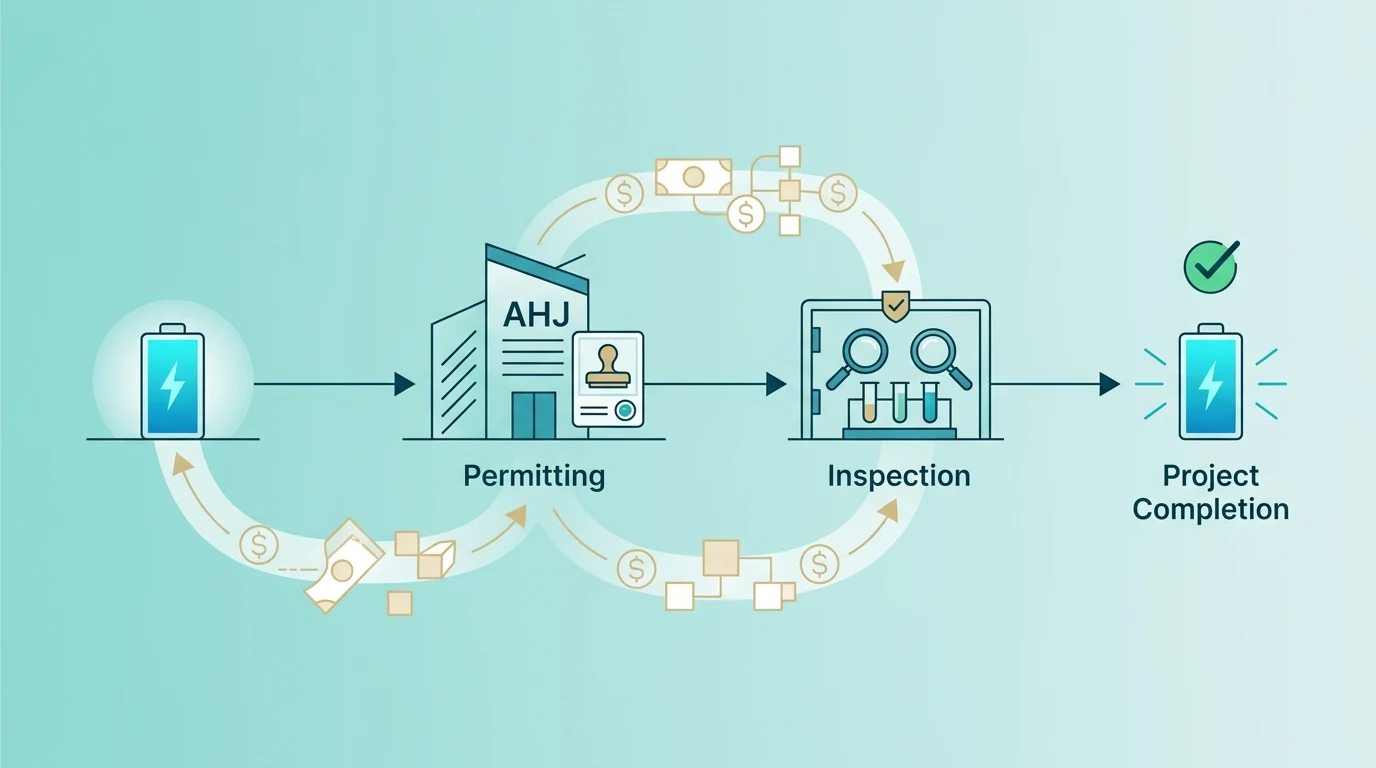
A combined residential solar-plus-storage permit typically clears in 2 to 6 weeks. A standalone energy storage system (ESS) permit, required by some jurisdictions on top of that, adds another 1 to 3 weeks (GreenLancer, "Solar Battery Storage Permits: ESS Requirements for Installers," 2026). Commercial jobs are different, though: once fire department review gets triggered, the timeline can stretch to 6 to 16 weeks or longer.
Installers and their customers rarely know whether a wait like that is normal. Worse, most financing programs never explain how disbursement should track it. This guide breaks down real permit and inspection timelines by project type. It also covers what drives the gap between a 2-week approval and a 6-month one, and lays out a concrete way to structure financing disbursement around permit-approval and final-inspection milestones instead of guessing.
> Key Takeaways
> - A combined residential solar-plus-storage permit typically clears in 2-6 weeks; a standalone ESS permit adds 1-3 more weeks (GreenLancer, 2026).
> - Commercial battery storage jobs needing fire department review run 6-16 weeks or longer, and large commercial or utility-scale projects can take 3-6 months or more (GreenLancer, 2026).
> - Financing approval does not wait on the permit clock. Eos Loan applications are fully digital, with most credit decisions returned in minutes, subject to approval (Eos Loan FAQ data, 2026).
> - Disbursement can be structured around permit-approval and final-inspection milestones instead of 100% at signing, which limits an installer's carrying-cost exposure during a slow AHJ review.
See how Eos Loan financing helps you close more projects
How long does battery storage permitting actually take?
A combined residential solar-plus-storage permit typically clears in 2 to 6 weeks. An AHJ, short for authority having jurisdiction, is the local building or fire department office that reviews and approves the permit. Where the AHJ requires a separate standalone ESS permit, add another 1 to 3 weeks on top of that range (GreenLancer, "Solar Battery Storage Permits: ESS Requirements for Installers," 2026). Initial plan review alone usually runs 1 to 3 weeks, stretching to 4 if the department raises code questions.
Whether a project needs one combined permit or two separate ones depends entirely on the AHJ. There is no universal rule here, not across states and often not even between neighboring counties. Some departments treat a solar-plus-storage system as a single electrical and structural package. Others classify the battery as its own hazard category, so they require a distinct application, review cycle, and inspection.
That variance is exactly why "how long will my permit take" almost never has a single answer. Instead, it is a range built from a jurisdiction's staffing, its familiarity with battery storage, and whether the project needs one review track or two. So ask the AHJ directly, and ask early, which path applies to your specific project. Do not assume last quarter's timeline still holds.
What determines whether a jurisdiction requires a separate ESS permit?
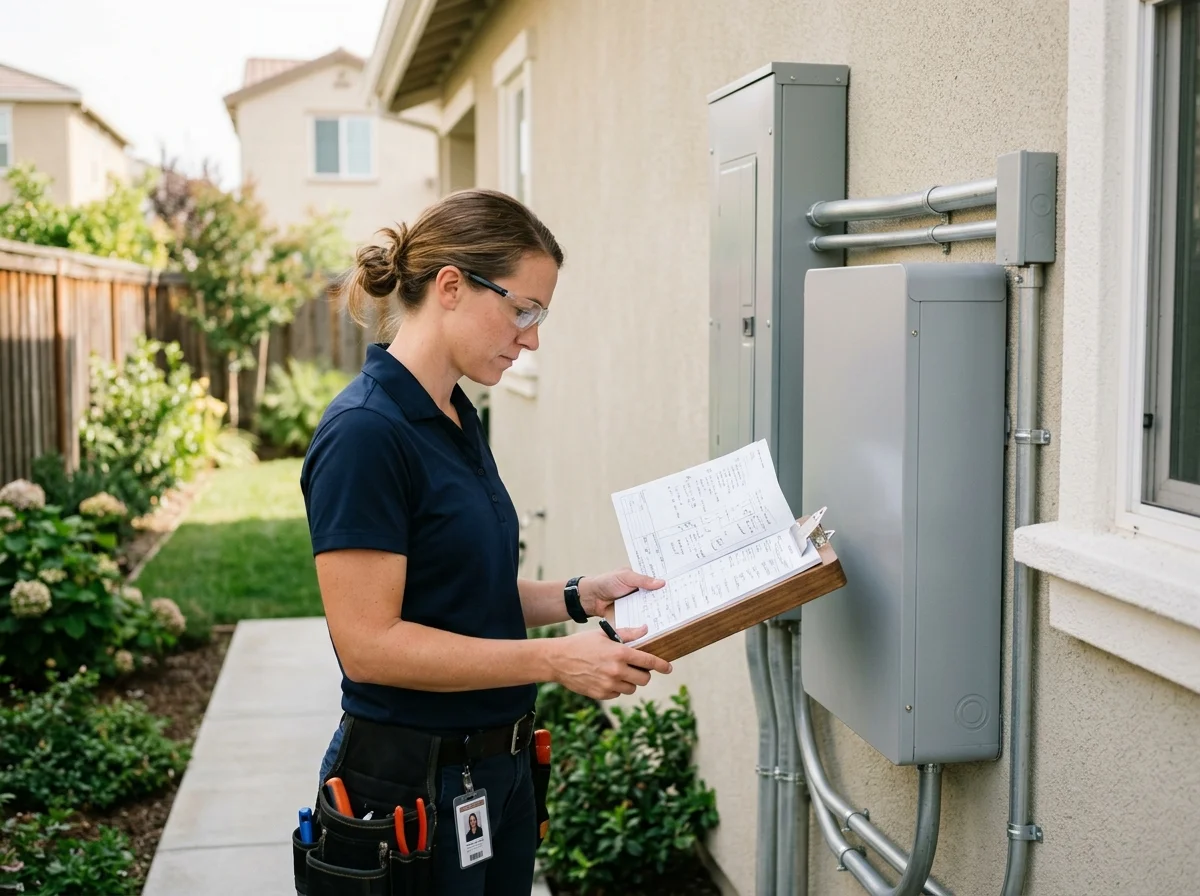
There is no universal rule for when a jurisdiction requires a standalone ESS permit rather than folding storage into a combined solar-plus-storage application (GreenLancer, 2026). In practice, the determining chain usually runs from battery chemistry and OEM equipment selection, to the fire code envelope that chemistry falls under, and finally to the specific site plan the AHJ reviews.
UL 9540 is the safety standard for energy storage systems, and UL 9540A is the companion test that measures how a battery's chemistry behaves in a thermal runaway event. Listing confirmation for both typically has to be settled before permit drawings are finalized. Why? Because the AHJ's fire and building reviewers check the submitted equipment against a certified listing, not a generic product category. That is one reason chemistry and OEM selection happens well before permit design starts, not after.
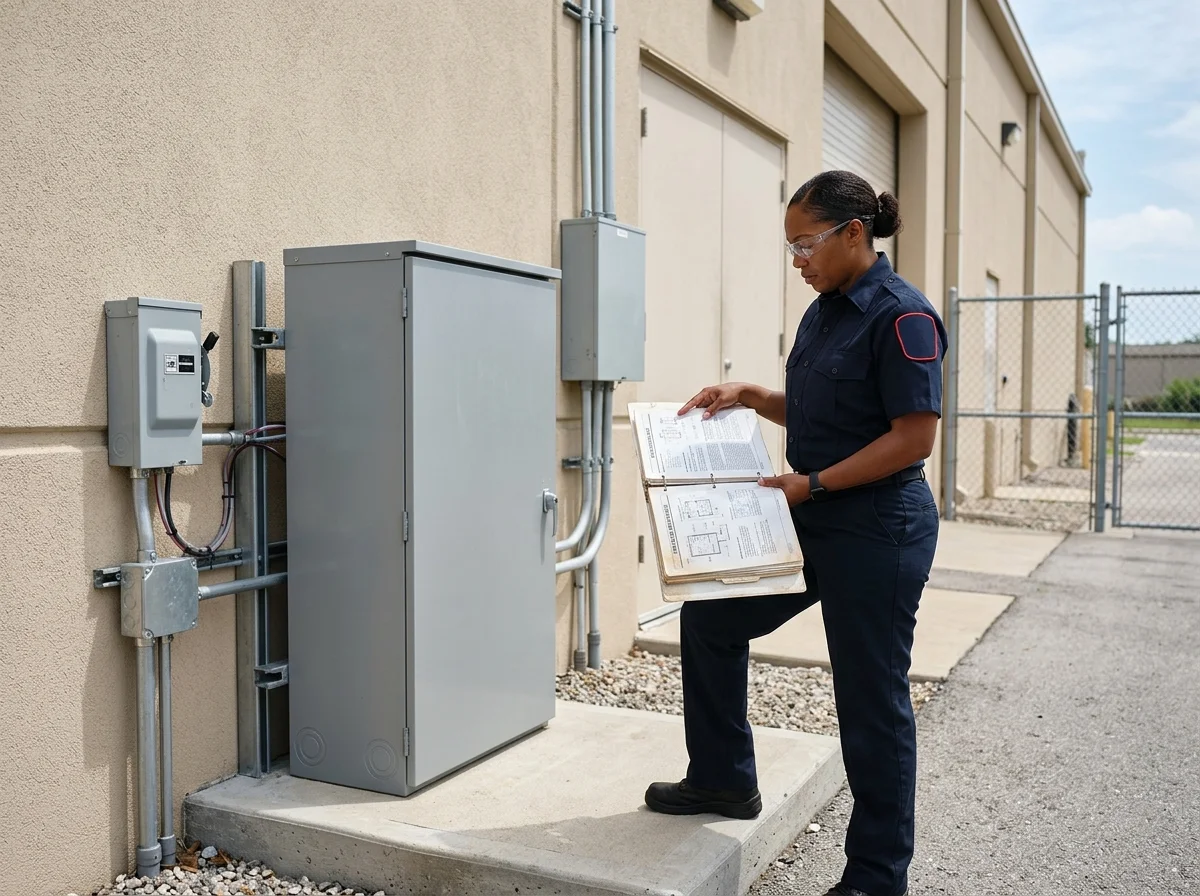
Commercial ESS projects add real time once fire department review gets triggered. Standard commercial review runs 4 to 10 weeks, and once the fire marshal's office gets involved, that range extends to 6 to 16 weeks or longer (GreenLancer, 2026). Large commercial or utility-scale projects can run 3 to 6 months or more. The chart and table below lay out the full range by project type.
| Project type | Permit timeline | Fire department review triggered? |
|---|---|---|
| Residential, combined solar + storage | 2-6 weeks | Rarely |
| Residential, standalone ESS permit | 3-9 weeks | Sometimes |
| Commercial, standard review | 4-10 weeks | No |
| Commercial, fire department review | 6-16 weeks or longer | Yes |
| Large commercial / utility-scale | 3-6 months or more | Yes |
Source: GreenLancer, "Solar Battery Storage Permits: ESS Requirements for Installers," 2026.
What changed in the 2026 NFPA 855 code cycle for permits?
Under NFPA 855's 2026 edition, a Hazard Mitigation Analysis (HMA) is a formal risk assessment that documents how a specific battery chemistry and installation could fail, and what safeguards limit that risk. It has become the default expectation for most energy storage system installations (Energy-Storage.News, "NFPA 855: 2026 edition updates and what they mean for energy storage projects," 2026). Named exceptions still apply for established chemistries such as lead-acid and aqueous nickel-based systems. In other words, the HMA adds a documentation step most installers were not submitting a code cycle ago.
The 2026 edition also introduces a formal Emergency Response Plan requirement, plus an annual training and AHJ-notification obligation for qualifying installations. Reviewers now check for both. As a result, a first-pass submission that anticipates the HMA and response plan moves faster than one that gets sent back for revisions.
Here is the caveat installers need most: many AHJs still enforce fire codes aligned with earlier NFPA 855 editions, often tied to older adopted versions of the International Fire Code. That means a jurisdiction's actual review checklist can lag the newest published edition by a code cycle or more (Energy-Storage.News, 2026). So confirm which edition your local AHJ has adopted before you assume the newest requirements apply.
Do digital permitting platforms actually shorten the timeline?
A typical project reviewed through NREL's SolarApp+ platform clears permitting roughly 13 business days sooner than one that goes through manual review, based on NREL and DOE's most recently published SolarApp+ program data (solarapp.nrel.gov). That is a meaningful head start, but only for the projects the platform actually covers.
The scope limitation matters as much as the speedup. SolarApp+ is built for standard rooftop residential systems, typically under 38.4 kW, and it reviews them against a standardized code checklist. Ground-mount systems, carports, and most commercial rooftop installations still need manual AHJ review. So the platform helps a meaningful share of residential jobs, but not most commercial or complex storage projects.
For setting customer expectations, that distinction is the whole point. Tell a residential customer in a SolarApp+ jurisdiction their permit will likely move faster than average. But do not promise the same speedup to a commercial customer or a standalone-ESS project outside the platform's scope. Neither one benefits from it.
Add financing to your installs, talk to our team
How should installers structure financing around permit milestones?
Financing approval and AHJ permit review are independent processes. That means disbursement timing is a program-design choice, not a fixed rule. Structuring disbursement around milestones, such as signed contract, permit issued, and final inspection passed, instead of releasing 100% of funds at signing, limits an installer's carrying-cost exposure during a slow AHJ review.
Most installers treat permit-timeline variance as a scheduling annoyance. In our experience, it is actually a financing-structure problem. A program that disburses everything at signing exposes the installer to full carrying-cost risk for however long the AHJ takes, whether that is 2 weeks or 6 months. A milestone-based structure does not carry that same exposure. Instead, funds track the work the installer has actually completed at each stage.
A milestone-based draw structure commonly works like this, as installers typically describe it:
1. Treat permit issuance and final inspection as scheduling checkpoints when quoting a project, not just compliance steps buried in the contract's fine print.
2. Structure draws around those checkpoints. For example: a deposit at signing, a draw at permit issuance, and a final draw once the inspection passes, rather than one lump disbursement at signing.
3. Weight this more heavily on longer jobs. Standalone ESS permits, fire-department-reviewed commercial work, and jurisdictions still enforcing older NFPA 855 editions are exactly where carrying-cost exposure compounds.
4. Confirm financing is not the bottleneck. Eos Loan applications are fully digital, and most credit decisions return in minutes, subject to approval. As a result, the financing side of the timeline rarely holds up a project (Eos Loan FAQ data, 2026).
> What I'm seeing from installer partners: In our experience, the dealers who manage cash flow best on longer permit jobs use a version of the same structure. Roughly a third at signing, a third at permit issuance, and the balance once the final inspection passes. From what we've seen across partners managing standalone ESS and commercial jobs, this is a pattern, not a structure Eos Loan sets or requires. Draw timing is a program design choice the installer and their financing partner work out together.
Eos Loan tracks the aggregated, anonymized gap between "financing approved" and "first disbursement request" across financed battery storage jobs on our platform. We've found that even a rough internal range is useful context: financing approval routinely happens well before the permit clears. This confirms that the credit decision itself is rarely what determines when the first draw request comes in.
Separately, financed battery storage terms range 6 to 240 months, flexible and underwriting-based. For the full mechanics of how term length and structure work once a deal is approved, see battery storage loan terms explained.
How is a permitting delay different from an interconnection delay?
Permitting is the local AHJ, building department, or fire marshal reviewing the installation itself before or during construction. Interconnection is a different process: the utility reviewing the completed system afterward. It is often called Permission to Operate, or PTO, the utility's formal sign-off that a finished system can connect to the grid. That review is separate and later, and it only starts once the system is built and inspected.
In some jurisdictions, permitting and the utility's interconnection paperwork can move in parallel. In others, the utility will not open its review until the local permit and inspection are fully closed out. Either way, the practical instruction is the same: ask both the AHJ and the utility for a timeline directly. Do not assume one process implies anything about the other.
For the utility-side clock specifically, storage-paired Permission to Operate runs longer than solar-only interconnection on average. See how interconnection delays affect financed battery storage jobs for that timeline and how it interacts with a financed deal.
Offer your customers flexible financing on essential projects
Or call +1 833-989-3737 to talk through a financing program for your business.
Frequently Asked Questions
Does battery storage need its own permit, separate from solar?
It depends on the AHJ. Many jurisdictions require a standalone energy storage system permit that adds 1-3 weeks beyond a combined solar-plus-storage application, while others allow a single combined permit to cover both systems (GreenLancer, 2026). Confirm the local requirement before quoting a customer a single-permit timeline.
How long does a commercial battery storage permit take?
Standard commercial review typically runs 4-10 weeks. Add fire department review and the range extends to 6-16 weeks or longer, and large commercial or utility-scale projects can take 3-6 months or more (GreenLancer, 2026). Ask the AHJ early which review track applies to your project size.
Does a battery storage permit delay financing approval?
No. Financing approval and AHJ permit review are independent processes. Eos Loan applications are fully digital, and most credit decisions return in minutes, subject to approval (Eos Loan FAQ data, 2026). A permit sitting in review is not a reason a financed deal has to stall.
What is the most common cause of a permit resubmission?
Incomplete documentation, a missing UL 9540 equipment listing confirmation, or fire department review started too late in the process are the most common causes (GreenLancer, 2026). Each resubmission cycle restarts part of the AHJ's clock, so getting the first submission right matters more than almost any other variable an installer controls.
The bottom line for installers
Permit timelines are not a mystery once you separate them by project type. As the table above shows, the range runs from 2-6 weeks for a combined residential permit up to 3-6 months or more for large commercial and utility-scale work.
Carry three things into every financed storage conversation:
- The 2026 NFPA 855 edition made Hazard Mitigation Analysis the default expectation for most ESS installs. Many AHJs still enforce older adopted editions, though, so confirm which one applies locally.
- Financing approval and the AHJ permit clock are independent. A slow permit review is not a reason a financed deal needs to sit idle.
- Structuring disbursement around permit-approval and final-inspection milestones, instead of 100% at signing, limits carrying-cost exposure on the longer end of the timeline range.
- GreenLancer, Solar Battery Storage Permits: ESS Requirements for Installers, retrieved 2026-08-10, https://www.greenlancer.com/post/solar-battery-storage-permit
- Energy-Storage.News, NFPA 855: 2026 edition updates and what they mean for energy storage projects, retrieved 2026-08-10, https://www.energy-storage.news
- NREL/DOE, Solar Permitting, Inspection, and Interconnection Timelines (SolarApp+ program data), retrieved 2026-08-10, https://solarapp.nrel.gov
- Eos Loan, FAQ, product and process data, 2026
Talk to Eos Loan about structuring a financing program around real project milestones rather than a single lump disbursement. This is general information, not tax advice. Consult a qualified tax professional.
For the full mechanics of how battery storage financing works from application to funded, see how battery storage financing works from application to funded. To qualify customers before that first conversation, see battery storage financing credit requirements. And if you finance more than one essential project type, which essential project to finance first breaks down how to prioritize.
About the author: Eduardo Donadi is CEO of Eos Loan, a US fintech direct lender that helps installers and contractors offer point-of-sale financing on essential projects, including battery storage, EV chargers, and water filtration.
---
Sources