

Battery Storage Total Cost of Ownership: Financed vs Cash Over 10 Years
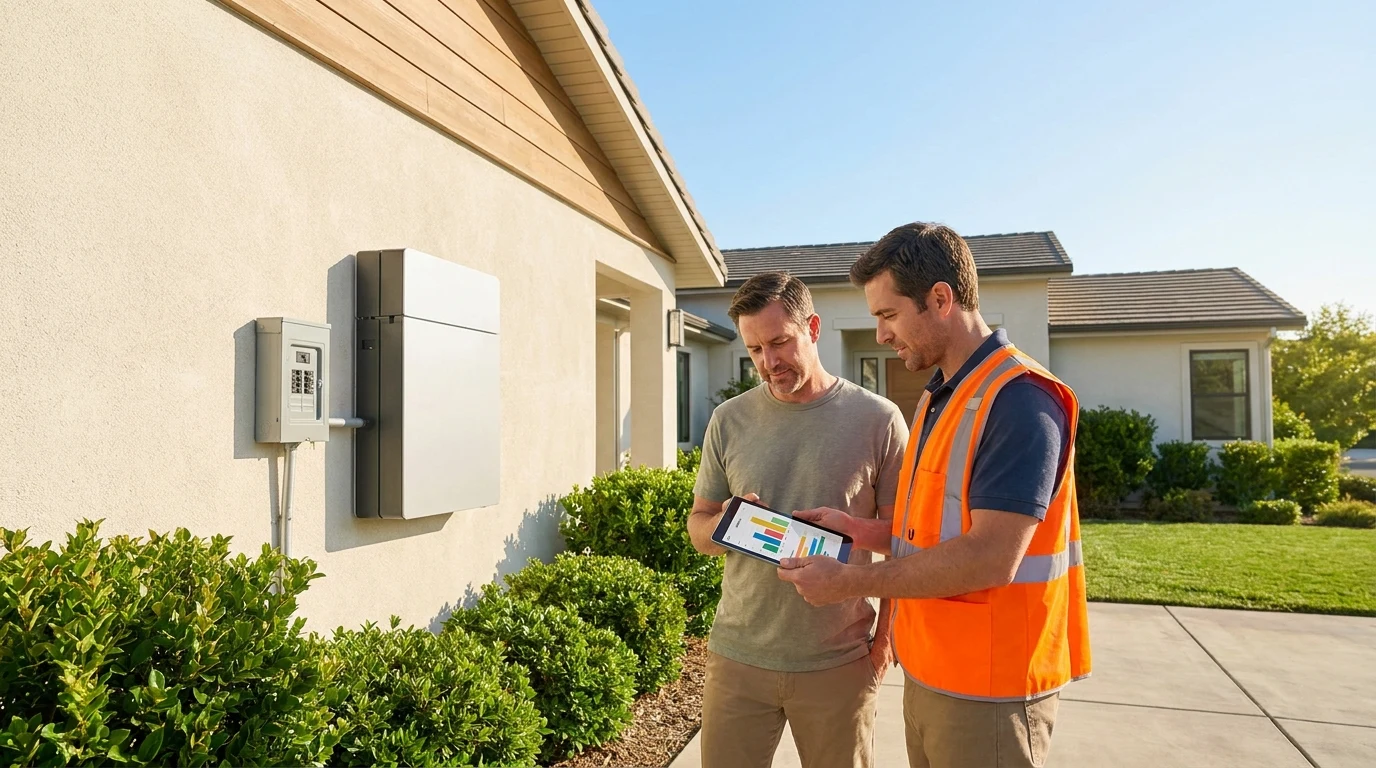
Home battery storage averages roughly $1,000 per installed kWh, which puts a typical whole-home system at $9,000 to $18,000 before incentives (EnergySage, 2026). Every proposal eventually reaches the same question: does financing that number actually cost more over the system's life, or does it just feel that way because the cash price arrives all at once?
Installers ask this because it decides whether a customer walks or signs. Homeowners ask it because a battery is a 10-year-plus purchase, and the sticker price is only half the story. This post models both paths over a full 10-year window using cited third-party cost, warranty, and rate data, plus a disclosed, labeled illustrative example. It is not an Eos Loan rate quote.
> Key Takeaways
> - A whole-home battery system runs $9,000 to $18,000 installed before incentives (EnergySage, 2026).
> - Cash buyers avoid finance charges but commit 100% of the capital on day one; financed buyers spread that cost into a monthly payment, subject to approval.
> - The residential clean-energy credit (Section 25D) ended December 31, 2025, removing a discount that used to lower the cash price specifically (IRS, 2025).
> - Degradation and warranty coverage affect cash and financed buyers identically; it is a hardware cost, not a financing-structure cost.
> - Contractors who proactively offer financing close 35% of proposals versus 17% for those who wait for a customer to object to price (ACCA, 2025).
See how Eos Loan financing helps you close more projects
How Much Does a Home Battery Storage System Cost at Installation?
Home battery storage averages about $1,000 per installed kWh, putting a typical whole-home system at $9,000 to $18,000 before incentives (EnergySage, 2026). That range is the starting point for any total cost of ownership question, cash or financed, because everything downstream (finance charges, degradation, bill savings) is measured against it.
Price spread inside that range comes down to a few variables. A Tesla Powerwall 3 typically installs for $11,500 to $16,779 depending on region and inverter configuration (EnergySage, 2026). Capacity is the biggest lever: a 10 kWh unit costs less than a 20 kWh unit, roughly in proportion to size. Inverter type (AC-coupled versus DC-coupled), panel upgrades, and install complexity (trenching, permitting, a detached garage run) add the rest of the variation.
Citation capsule: A whole-home battery storage system costs $9,000 to $18,000 installed before incentives, averaging about $1,000 per kWh (EnergySage, 2026). A Tesla Powerwall 3 typically lands at $11,500 to $16,779 depending on region and configuration. This installed-cost number is the baseline every cash-versus-financed comparison starts from.
For the full financing picture, see the battery storage financing pillar guide.
What Does Paying Cash for a Battery Actually Cost Over 10 Years?
A cash buyer's 10-year cost sits close to the sticker price itself, since there is no finance charge added on top. That simplicity carries a real, if unstated, cost: the full $9,000 to $18,000 leaves savings or investment accounts on day one, all at once, rather than in installments.
This piece does not assign a specific dollar figure to that lost opportunity, because it depends entirely on what the customer would otherwise have done with the money, an assumption we won't fabricate. What is factual and dated: the residential clean-energy credit (Section 25D) ended December 31, 2025 (IRS, 2025). That credit used to offset the cash price specifically, since claiming it required paying (or financing through a qualifying structure) and filing for the credit the same tax year. With the credit gone, the cash price a buyer pays today is the full price, with no federal offset behind it. This is general information, not tax advice; consult a qualified tax professional.
Citation capsule: Cash buyers pay the full installed price with no finance charge, but that capital leaves savings in a single lump sum at install. The residential clean-energy credit (Section 25D) ended December 31, 2025 (IRS, 2025), removing a discount that previously reduced the cash price. This is general information, not tax advice.
What Does Financing a Battery Cost Over 10 Years?
Financing spreads the same equipment cost into a monthly payment, and total repayment exceeds the cash price by the amount of finance charges. Those charges vary entirely by the rate and term a customer is approved for; Eos Loan never states a fixed rate, since financing decisions are underwriting-based, subject to approval and eligibility.
Eos Loan finances battery energy storage on terms from 6 to 240 months (Eos Loan product data, 2026), and, as a direct lender, charges no dealer fee. To illustrate how rate and term interact with total cost (not to quote Eos Loan's own rate), NerdWallet reports home-improvement and solar loan APRs spanning roughly 6% to 36% depending on credit profile, with well-qualified borrowers (a 720+ FICO score) more often landing in the 6%-10% band (NerdWallet, 2026).
Illustrative example, not an Eos Loan rate quote: a $13,500 system financed at a third-party-reported 7% APR over 120 months repays roughly $18,850 total, compared with $13,500 cash. A shorter term or a lower approved rate would narrow that gap; a longer term or higher rate widens it. Actual payment and total cost depend entirely on the rate, term, and creditworthiness a customer is approved for.
Citation capsule: Financed buyers spread the same equipment cost into monthly payments, and total repayment rises above the cash price by the finance charge. NerdWallet reports home-improvement and solar loan APRs of roughly 6% to 36% depending on credit profile (NerdWallet, 2026), a third-party range, not an Eos Loan rate.
For the full mechanics of how rate and term interact, see how APR and term length affect a payment.
How Do Financed and Cash Costs Compare Side by Side Over 10 Years?
Financed total cost is higher in raw dollars, by exactly the finance charge; cash total cost concentrates 100% of the cost in month one. That second fact, not the finance charge itself, is the actual reason installers watch cash-price sticker shock kill deals at the kitchen table.
The chart below uses the labeled illustrative figures from the prior section, a $13,500 system at a third-party-reported 7% APR over 120 months, set against the same $13,500 paid in cash. These are disclosed, illustrative numbers, not a promise of Eos Loan's rate or terms for any specific customer.
Read the two charts together and the trade-off is plain: cash draws one vertical line at month zero, financed draws a slope. The finance charge is, functionally, the price of accessing the system now instead of saving toward it over years.
Citation capsule: In this disclosed illustrative example, a $13,500 battery financed at a third-party-reported 7% APR over 120 months repays roughly $18,850 total, a $5,350 gap against the $13,500 cash price. That gap is the cost of spreading the same purchase over time rather than paying it in full immediately.
How Does Battery Degradation Change the Real 10-Year Cost?
Most lithium-ion home batteries carry 10-year warranties guaranteeing 70% to 80% capacity retention at the end of that period (EnergySage, 2026). That capacity curve determines how much value the system still delivers in year 10, and it applies identically no matter how the system was purchased.
NREL's Annual Technology Baseline models a representative 5 kW/12.5 kWh residential battery system with technology-driven cost reductions of 17% to 52% projected through 2035 (NREL ATB, 2024). That is useful context for why today's installed cost, not some future lower price, is the right baseline for a TCO model started today: prices are expected to keep falling, but a system bought now locks in today's cost and today's capacity curve.
!Close-up of a wall-mounted residential battery storage unit in daylight
Degradation is a property of the battery's cells and its warranty terms, full stop. It does not shift based on whether the customer paid cash or financed the purchase. A financed buyer and a cash buyer holding the identical system see the identical capacity retention curve over the same 10 years.
Citation capsule: Warranties on most lithium-ion home batteries guarantee 70% to 80% capacity retention at year 10 (EnergySage, 2026). This degradation curve is a hardware and warranty characteristic, identical for cash and financed buyers of the same system, and it is a separate variable from the cost of financing itself.
For full coverage of what warranties guarantee and how they interact with financing, see the battery storage warranty coverage guide, and for how loan length itself is structured, see battery storage loan terms.
How Do Rising Electricity Rates Offset Battery TCO Either Way?
US average residential electricity prices reached 17.29 cents per kWh in 2025, with the EIA forecasting 18.02 cents per kWh in 2026 (EIA, 2026). Rising rates raise the value of the bill savings and outage protection a battery delivers over the same 10-year window, regardless of how the customer paid for the system.
This is a demand-side factor, not a financing-cost factor, and it should not be read as implying a specific payback period. A customer's own utility rate schedule, usage pattern, and local time-of-use structure determine actual bill savings; this piece does not model a payback timeline because that number is household-specific.
What is fair to say generally: as electricity gets more expensive, the bill-offset side of the TCO equation improves for both cash and financed buyers at the same rate. The financing structure changes only how the equipment cost is paid, not how much the battery saves on the utility bill.
Add financing to your installs, talk to our team
Citation capsule: US average residential electricity prices rose to 17.29 cents per kWh in 2025 and are forecast to reach 18.02 cents per kWh in 2026 (EIA, 2026). Rising rates increase the value of battery bill savings for cash and financed buyers equally, since the rate environment is independent of how the system was purchased.
Should a Customer Pay Cash or Finance Their Battery Storage System?
Cash suits a customer with idle capital who wants the lowest total dollar outlay and is indifferent to liquidity. Financing suits a customer who wants to preserve cash reserves, or who could not otherwise add the project without a large one-time expense, subject to approval and eligibility. Neither answer is universally correct; it depends on what the customer values more, total dollars or preserved liquidity.
For installers, the practical lesson is in the data, not the philosophy. Contractors who proactively present financing on every proposal, rather than waiting for a customer to flinch at the cash number, finance 35% of jobs versus 17% for those who only offer it reactively (ACCA, 2025). That gap is not about persuading reluctant customers; it is about surfacing an option that a meaningful share of customers would have taken anyway, had it been on the table from the start.
As a direct lender, Eos Loan finances battery energy storage on terms from 6 to 240 months and charges no dealer fee, subject to approval and eligibility. That is a factual statement about product structure, not a promise of any specific customer's rate or approval outcome.
Become an Eos Loan financing partner
Or call +1 833-989-3737 to talk through a financing program for your business.
Citation capsule: Contractors who proactively offer financing on every proposal finance 35% of jobs, compared with 17% for contractors who only offer it after a customer objects to price (ACCA, 2025). Presenting both cash and financed numbers from the start surfaces demand that a reactive approach misses entirely.
---
Battery storage total cost of ownership is not a single number; it is two paths that arrive at different totals for different reasons. Cash keeps raw dollars lower by skipping finance charges, but concentrates every dollar into month one. Financing adds a disclosed, rate-dependent charge on top of the equipment cost, in exchange for spreading that cost across the years the battery is actually in service.
- A whole-home battery costs $9,000 to $18,000 installed before incentives.
- Cash avoids finance charges but ties up capital at install; financing spreads cost, subject to approval.
- Section 25D ended December 31, 2025, removing a credit that used to discount the cash price.
- Degradation and warranty coverage are identical for cash and financed buyers of the same system.
- Rising electricity rates raise the value of a battery's bill savings for both payment paths equally.
- Proactively offering financing on every proposal nearly doubles close rates versus waiting for an objection.
- EnergySage, How Much Do Home Batteries Cost?, retrieved 2026-07-30, https://www.energysage.com/energy-storage/how-much-do-batteries-cost/
- Wood Mackenzie, 2025 U.S. Energy Storage Installations Set New Record, Surpass 2024 by 52%, 2025, https://www.woodmac.com/press-releases/2025-u.s.-energy-storage-installations-set-new-record-surpass-2024-by-52/
- IRS, Residential Clean Energy Credit, retrieved 2026-07-30, https://www.irs.gov/credits-deductions/residential-clean-energy-credit
- NerdWallet, Best Solar Loans: Solar Panel System Financing Options, retrieved 2026-07-30, https://www.nerdwallet.com/best/loans/personal-loans/solar-loans-solar-panel-system-financing-options
- NREL, 2024 Annual Technology Baseline, Residential Battery Storage, 2024, https://atb.nrel.gov/electricity/2024/residential_battery_storage
- EIA, Electric Power Monthly, Table 5.6.A, retrieved 2026-07-30, https://www.eia.gov/electricity/monthly/epm_table_grapher.php?t=epmt_5_6_a
- ACCA, Inside the Contractor of the Future Study: Key Findings from 1,000 Contractors, 2025, https://hvac-blog.acca.org/inside-the-contractor-of-the-future-study-key-findings-from-1000-contractors/
- Eos Loan, product data, 2026
For deeper context on what 2026 demand looks like for installers building these proposals, see what battery storage really costs over time and handling the cost objection at the proposal stage.
---
Frequently Asked Questions
question: "Is it cheaper to pay cash or finance a home battery?",
answer: "Cash avoids finance charges, so its raw 10-year dollar total is lower. Financing spreads the same cost into a monthly payment and adds a finance charge that depends entirely on the approved rate and term, subject to approval. Which is 'cheaper' depends on whether you value the lowest total dollar figure or preserved cash liquidity."
},
{
question: "What is the total cost of ownership of a home battery over 10 years?",
answer: "It includes the installed equipment and labor cost, any finance charge if financed, and is affected by degradation and warranty coverage over the period. EnergySage puts typical installed cost at $9,000 to $18,000 before incentives (EnergySage, 2026), before any financing charge is added."
},
{
question: "Does battery degradation affect financed and cash buyers differently?",
answer: "No. Degradation is a property of the battery hardware and its warranty, not the payment method. A cash buyer and a financed buyer holding the identical battery system see the identical capacity retention curve over the same 10 years, typically 70%-80% at year 10 (EnergySage, 2026)."
},
{
question: "Did the end of the federal tax credit change the cash vs financed math?",
answer: "Yes. The residential clean-energy credit (Section 25D) ended December 31, 2025 (IRS), removing a discount that used to lower the cash price specifically. This is general information, not tax advice; consult a qualified tax professional for guidance on your specific situation."
},
{
question: "What loan terms does Eos Loan offer for battery storage?",
answer: "Eos Loan finances battery energy storage on terms from 6 to 240 months, subject to approval and eligibility. Eos Loan is a direct lender, not a marketplace or broker, and charges no dealer fee. Actual rate and payment depend on underwriting."
}
]} />
---
This is general information, not financial or tax advice. Financing is subject to approval and eligibility. Consult a qualified tax or financial professional for guidance specific to your situation.
---
Sources