

How to Add Financed Battery Storage to Existing Solar
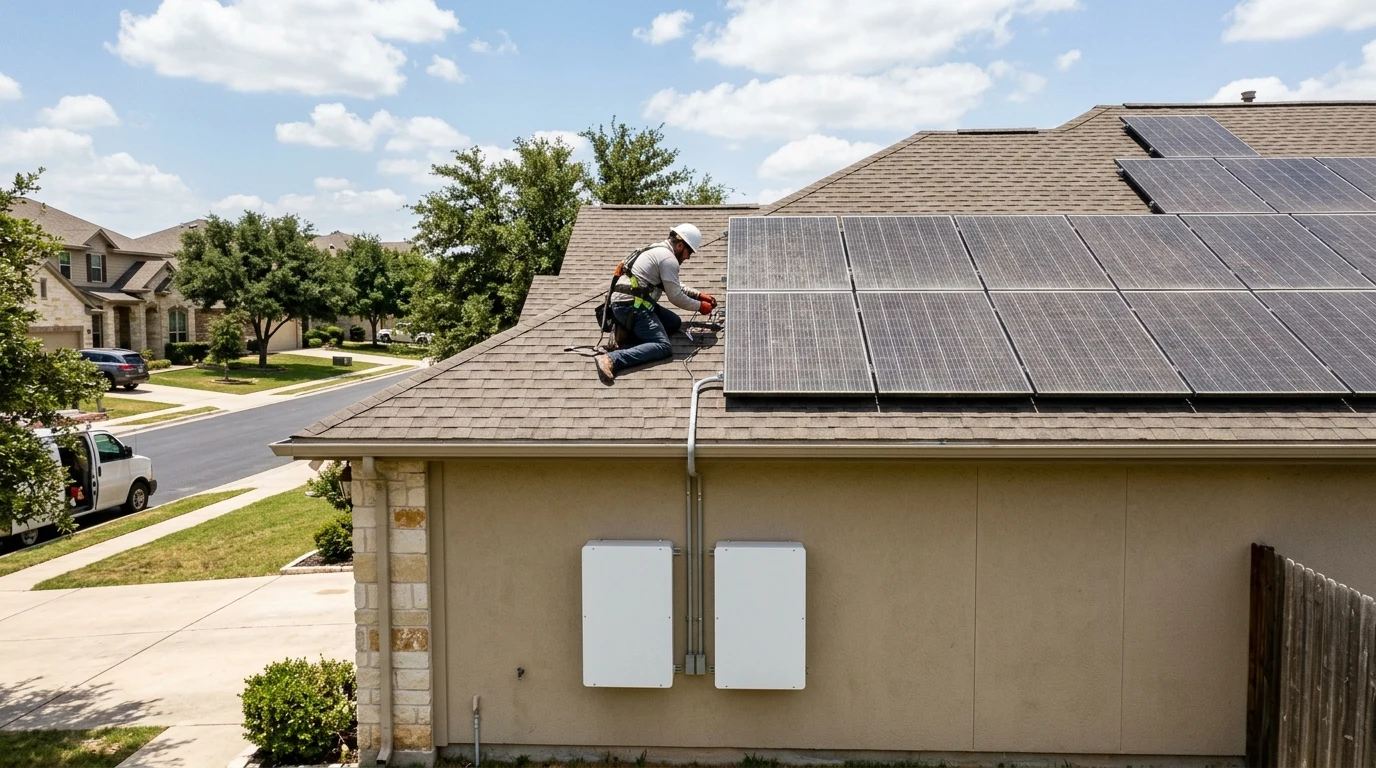
US residential storage grew 92% year over year in 2025, reaching 2.7 GW (Wood Mackenzie, 2025), while the country crossed 6 million cumulative solar installations in 2026 (SEIA, 2026). Most of those 6 million systems went in before today's attach rates, which means a large installed base of solar-only homes is sitting without a battery.
Most homeowners in that position assume adding storage means ripping out the existing system. It doesn't. This guide covers what makes a system retrofit-ready, the AC-coupled versus DC-coupled decision, realistic costs, and how the financing is structured separately from the original solar loan.
> Key Takeaways
> - Most existing solar systems can accept a battery retrofit through AC coupling, which skips replacing the solar inverter (EnergySage, 2026).
> - Residential solar-plus-storage attach rate hit 45% in Q1 2026, up from 38% a year earlier, meaning the majority of older installs still lack storage (Wood Mackenzie, 2026).
> - A single retrofit battery typically installs for $12,000-$18,000 before financing (Boston Solar, 2026).
> - A storage retrofit finances as its own product; Eos Loan's battery energy storage terms run 6 to 240 months, subject to approval and eligibility.
See how Eos Loan financing helps you close more projects
Can you add a battery to an existing solar system?
Yes. Most existing solar systems can accept a battery retrofit, most commonly through an AC-coupled configuration that does not require replacing the existing solar inverter (EnergySage, Adding a Solar Battery As a Retrofit Installation, 2026). The battery gets its own inverter that talks to the existing solar equipment rather than swapping it out.
AC coupling became the default retrofit path because it works with almost any existing solar inverter, string or micro, regardless of brand or age. That flexibility matters given the size of the opportunity: residential solar-plus-storage attach rate reached 45% in Q1 2026, up from 38% in Q1 2025 (Wood Mackenzie, Q1 2026 U.S. Energy Storage Monitor). Read that the other way: even with attach rates climbing, the majority of solar-only homes installed in prior years still don't have storage.
That gap is a pipeline, not a dead end. Every solar-only customer an installer has ever sold to is a candidate for a retrofit conversation, and the technical case for saying yes is stronger now than it was even two years ago.
Is your solar system a good candidate for a storage retrofit?
Three things determine retrofit-readiness: inverter type and age, panel and array condition, and available electrical panel capacity. A site visit, not a guess, should confirm all three before a quote goes out.
Inverter type rarely disqualifies a system. Both string inverters and microinverter setups are AC-coupling compatible, since the battery adds its own inverter alongside whatever is already on the wall. What matters more is condition: an inverter nearing the end of its 10-15 year warranty window is worth flagging to the homeowner as a near-term replacement anyway, which can shift the conversation toward a DC-coupled hybrid unit instead.
!Closeup of an electrical panel and inverter being inspected by an installer.
Panel degradation is the second check. Most solar panels installed a decade ago still produce close to their rated output, but any visible cracking, delamination, or a warranty that's already lapsed changes the retrofit math. The third variable, electrical panel capacity, decides whether the crew can add a battery disconnect directly or needs a subpanel first. Critical load and subpanel work runs $500-$1,500 installed (EnergySage, Critical Load Panels, 2026), a cost band covered in more depth in financing backup panels and smart panel add-ons.
AC-coupled vs. DC-coupled: which retrofit path fits your system?
AC-coupled retrofits add a battery inverter that communicates with the existing solar inverter and skip a full inverter swap. DC-coupled, or hybrid, retrofits replace the existing inverter with a hybrid unit and typically cost more, but run more efficiently (EnergySage, AC vs. DC Solar Battery Coupling, 2026).
Why does AC coupling win most retrofit jobs? Lower labor, no inverter replacement, and compatibility with essentially any existing solar inverter on the roof. The tradeoff is conversion loss. AC-coupled systems convert power from DC to AC to DC to AC again on its way to and from the battery, and one installer estimate puts that inefficiency at roughly $2,654 over a 25-year project life at a $0.30/kWh rate (Tigo Energy, 2026). Treat that figure as a single-vendor estimate, not a market-wide average, but it's directionally useful for the "is the efficiency loss worth worrying about" conversation.
When is the extra cost of a hybrid retrofit worth it? Mostly when the existing inverter is already near failure or out of warranty, so the homeowner is replacing it either way. In that specific case, folding the replacement into a hybrid battery retrofit avoids paying for two separate jobs down the road.
The 25D credit's expiration doesn't just affect new solar-plus-storage sales. It also removes the incentive that used to make DC-coupled hybrid-inverter upgrades, which qualified for the credit as "qualified battery storage technology," pencil out for homeowners on the margin. That structurally pushes more of the 2026 retrofit market toward the cheaper AC-coupled path, a connection worth understanding before the tax-credit section below.
How much does it cost to add storage to an existing solar array?
A single retrofit battery in the 10-13.5 kWh range typically installs for $12,000-$18,000 before financing, with the battery hardware itself covering roughly 40-60% of that total. That range comes from New Hampshire-market pricing (Boston Solar, Is Retrofitting a Battery to an Existing Solar System Worth It, 2026); treat it as an illustrative example, not a national average, and corroborate against local labor rates before quoting.
What drives the spread inside that range? Coupling method is the biggest lever: AC-coupled retrofits with no panel work sit at the low end, AC-coupled jobs that need a subpanel land in the middle, and DC-coupled hybrid swaps push toward the top. Permitting timelines and inspection requirements vary by jurisdiction too, and those add cost independent of the battery brand chosen.
Battery brand moves the total less than most homeowners expect. Labor and electrical work, the site visit, the coupling method, any panel upgrade, account for more of the variance between quotes than which manufacturer's battery goes on the wall.
How is financing structured for a storage retrofit?
A storage retrofit finances as its own product on its own approval, separate from any existing solar loan. Eos Loan offers battery energy storage terms from 6 to 240 months, subject to approval and eligibility, which is enough range to size a monthly payment against the $12,000-$18,000 installed cost discussed above.
Keeping the retrofit loan separate protects the original solar financing. The homeowner's existing solar loan terms, payment, and structure stay untouched, and the new battery is underwritten and approved on its own merits. Term length is what absorbs the retrofit's cost into a monthly figure sized against the homeowner's utility bill savings, the same mechanism covered in more depth in standalone battery vs. solar-plus-storage financing, which walks through the fuller standalone-versus-bundled comparison.
> A pattern I see across the Eos Loan partner base: Installers who quote the AC-coupled retrofit as a separate, purpose-built battery loan tend to close faster than those who try to fold it into a home-equity product. The battery loan approval is quicker and doesn't touch the homeowner's existing mortgage or solar lien. I frame this as an observed pattern, not a universal rule for every shop or every homeowner's credit profile.
Add financing to your installs, talk to our team
What happened to the tax credit for storage retrofits?
The residential clean-energy credit, Section 25D, ended for property placed in service after December 31, 2025 (IRS, 2025). A retrofit battery installed in 2026 no longer qualifies for that credit, which is one more reason the cheaper AC-coupled path is winning share over hybrid-inverter upgrades that used to lean on it.
Homeowners who priced a retrofit assuming a 30% credit against the total cost need a new number now, and that's exactly where financing terms matter more than they did a year ago. For the fuller post-25D financing narrative, see how to finance a home battery after the tax credit ended and a contractor's playbook for financing after the solar tax credit.
This is general information, not tax advice. Consult a qualified tax professional.
How should installers pitch a storage retrofit to solar customers?
Offering financing lifts average transaction size by roughly 15% (Financeit, 2024), and a retrofit pitch works best framed as "add this to your existing system for one new monthly payment," not as a second, unrelated purchase decision competing with the customer's original solar loan.
Lead with the site assessment, the inverter and panel check covered above, as the qualifying step rather than a sales pitch. That assessment doubles as the moment to bundle in a backup panel, smart panel, or monitoring upgrade onto the same quote.
There's a commercial angle worth noting too. Only a small share of commercial solar systems shipped with storage originally, according to one inverter manufacturer's estimate (Sol-Ark, 2026), which points to a distinct C&I retrofit opportunity separate from the residential pipeline. Installers working both segments can find more detail in commercial battery storage financing.
Offer your customers flexible financing on essential projects
Or call +1 833-989-3737 to talk through a financing program for your business.
Frequently Asked Questions
{ question: "Can you add a battery to an existing solar system?", answer: "Yes, most systems can accept an AC-coupled battery retrofit without replacing the solar inverter (EnergySage, 2026). A site visit confirms inverter type, panel condition, and available electrical capacity before a quote goes out." }, { question: "Do I need a new inverter to add a battery to my solar panels?", answer: "Not usually. AC-coupled retrofits add a separate battery inverter and keep the existing solar inverter in place. Only a DC-coupled, or hybrid, retrofit requires replacing it (EnergySage, 2026)." }, { question: "How much does it cost to retrofit battery storage onto solar?", answer: "Example market pricing for a single 10-13.5 kWh battery runs roughly $12,000-$18,000 installed before financing. Actual cost depends on coupling method and any panel work needed (Boston Solar, 2026)." }, { question: "Can I finance a battery retrofit separately from my existing solar loan?", answer: "Yes. A retrofit battery finances as its own product on its own approval. Eos Loan offers battery energy storage terms from 6 to 240 months, subject to approval and eligibility, and the original solar loan is unaffected." } ]} />The bottom line on repowering solar with storage
Most solar-only homes can add a battery without touching the existing system, usually through an AC-coupled retrofit that keeps the current inverter in place. The technical case is clear: check the inverter, check the panel, check available electrical capacity, and price the coupling method that fits.
The financing case is just as clear. A retrofit battery is its own approval, its own loan, and its own term, sized against the $12,000-$18,000 installed range without disturbing the homeowner's original solar financing. For the complete picture of how battery storage financing works for installers, see the complete battery storage financing guide.
Become an Eos Loan financing partner
---
Sources
- Wood Mackenzie, U.S. Energy Storage Monitor (US residential storage grew 92% year over year in 2025, reaching 2.7 GW; residential solar-plus-storage attach rate reached 45% in Q1 2026, up from 38% in Q1 2025), retrieved 2026-07-11, https://www.woodmac.com/press-releases/u.s.-energy-storage-market-sets-q1-2026-records-across-sectors
- SEIA, 6 Million Solar Installations (US crossed 6 million cumulative solar installations), retrieved 2026-07-11, https://seia.org/research-resources/6-million-solar-installations/
- EnergySage, Adding a Solar Battery As a Retrofit Installation (AC-coupled retrofits skip inverter replacement), retrieved 2026-07-11, https://www.energysage.com/energy-storage/adding-battery-to-solar-energy-system-as-retrofit/
- EnergySage, AC vs. DC Solar Battery Coupling: What You Need to Know, retrieved 2026-07-11, https://www.energysage.com/energy-storage/ac-vs-dc-solar-battery-coupling-what-you-need-to-know/
- EnergySage, Critical Load Panels: What Should You Know? (subpanel work $500-$1,500 installed), retrieved 2026-07-11, https://www.energysage.com/energy-storage/what-are-critical-load-panels/
- Tigo Energy, The Hidden Cost of AC-Coupled Batteries (AC/DC conversion loss estimated at ~$2,654 over 25 years at $0.30/kWh), retrieved 2026-07-11, https://www.tigoenergy.com/post/microinverter-tax-4-conversion-tax-the-hidden-cost-of-ac-coupled-batteries
- Boston Solar, Is Retrofitting a Battery to an Existing Solar System Worth It? (single retrofit battery $12,000-$18,000 installed, NH-market example), retrieved 2026-07-11, https://www.bostonsolar.us/solar-blog-resource-center/blog/is-retrofitting-a-battery-to-an-existing-solar-system-worth-it-2026-cost-benefit/
- Financeit, Home Improvement Financing guide (average transaction size rises ~15% when financing is offered), retrieved 2026-07-11, https://www.financeit.io/home-improvement-financing/
- IRS, Residential Clean Energy Credit (Section 25D ended for property placed in service after December 31, 2025), retrieved 2026-07-11, https://www.irs.gov/credits-deductions/residential-clean-energy-credit
- Sol-Ark (commercial solar systems shipped with storage estimate, vendor figure), retrieved 2026-07-11, https://www.sol-ark.com/
About the author: Eduardo Donadi is the CEO of Eos Loan, the fintech built to finance essential projects (battery energy storage, EV chargers, and water filtration) for installers, contractors, and resellers across the United States.