

Day Cab vs Sleeper: How the Spec Changes the Loan
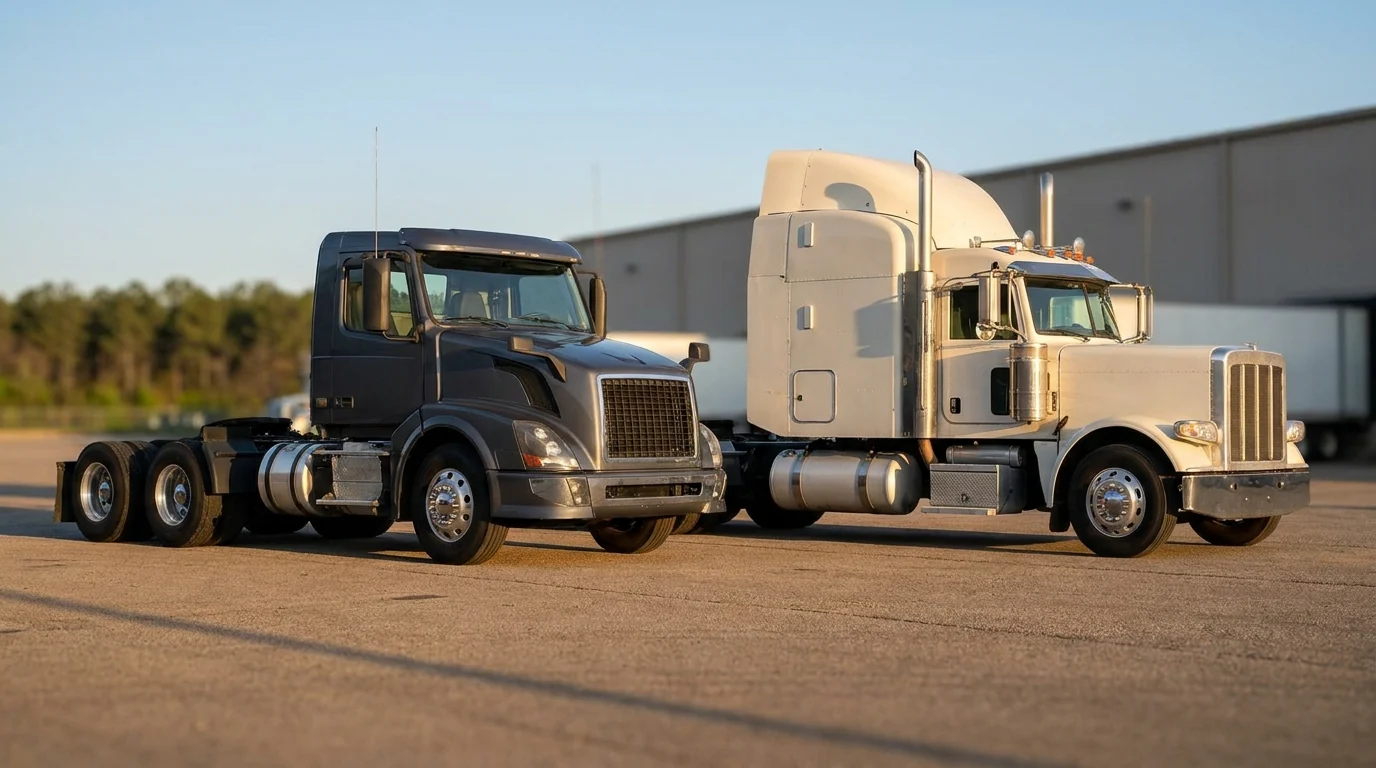
Day cab vs sleeper is a decision about the tractor you buy and drive, the vehicle itself, not charging equipment and not yard electrical work. You are holding two quotes for the same brand and the same model year. One has a berth behind the seats. One does not.
The financing comes back structured differently, and the price gap is only part of the reason.
Most spec advice stops at driver comfort and fuel economy. A lender is reading the same spec sheet as a statement about something else entirely: what this specific unit will be worth in three years, and who will show up to buy it. That is a collateral question, and it gets answered at the dealer before anyone opens a credit file.
Here is what each configuration is actually built to serve, what it does to expected resale, and how that lands in the loan.
> Key Takeaways
> - Truck and trailer lease or purchase payments averaged $0.404 per mile in 2025, with the tractor alone accounting for $0.283 of that (ATRI, July 2026). The spec moves that line directly.
> - A compliant sleeper berth is what makes the FMCSA split rest provisions available at all. A day cab driver works a single 14-hour window, every day (FMCSA).
> - Used Class 8 retail averaged $60,986 in July 2026, with sales up 45% year over year (ACT Research, September 2026). That market is who buys your truck back, and the spec decides which half of it shows up.
> - Eos Loan is a direct lender with flexible terms and one team from application to funding, subject to approval and eligibility. No dealer fee.
See what financing a fleet expansion could look like
What actually separates a day cab from a sleeper?
A day cab has no berth behind the seats. A sleeper does, which adds wheelbase, tare weight and cost to the same chassis. That difference is not cosmetic. Under FMCSA hours-of-service rules, a compliant sleeper berth is the precondition for using the split rest provisions at all (FMCSA).
Three physical differences carry everything that follows.
Wheelbase and turning radius come first. A day cab is shorter, so it backs into tight urban docks, rail ramps and older terminals that a long-wheelbase sleeper has to work at. Second is tare weight. The berth, the extra frame and the insulation all ride on every load, and on weight-sensitive freight that comes straight out of payload. Third is the berth itself, which is less a bedroom than a regulatory asset.
One thing this article is not about: how old the truck is. Age and mileage move the terms on their own separate axis, and that comparison lives in used vs new truck financing. Configuration is a different question, and you can get it wrong on a brand new unit.
Which lanes does each spec actually serve?
FMCSA gives property-carrying drivers an 11-hour driving limit inside a 14-hour window, after 10 consecutive hours off duty. The split sleeper berth provision, the 8/2 and 7/3 splits, requires a compliant berth. Drivers running inside a 150 air-mile radius who return to the same reporting location may qualify for the short-haul exception (FMCSA).
Read that with a spec sheet in your hand. The regulation is why the configuration is not a preference.
A day cab fits work where the driver sleeps at home. Drayage out of a port or rail yard. Regional distribution on a fixed radius. Dedicated runs. Private fleet delivery. Anything where the day starts and ends at the same gate, and where the 150 air-mile exception may apply to the logging.
A sleeper fits work where the clock has to be managed on the road. Over the road, long irregular route, team operations, anything where a driver needs to stop the 14-hour window from running out in a place with no bed.
What does the spec do to the amount you finance?
ATRI put truck and trailer lease or purchase payments at $0.404 per mile in 2025, with the tractor alone at $0.283 of that. Total operating cost hit a record $2.336 per mile, up 3.4%, and costs excluding fuel rose 4.2% to $1.854 (ATRI, July 2026). The equipment line is measurable, and the spec moves it.
A sleeper adds meaningfully to the amount financed on the same chassis. Every published price range for that gap traces back to dealer inventory pages rather than a named research source, so take the number off your own two quotes.
What the larger balance does is plain arithmetic. A bigger amount financed means a bigger down payment in absolute dollars for the same percentage ask, and a bigger payment against the same freight. That is not a worse deal. It is a larger purchase. If you are sizing that number, down payment options on a semi truck covers how that number gets set.
Truck financing at Eos Loan is flexible terms, sized to the equipment and the operation. We do not publish a rate, and every application is subject to approval and eligibility. Whether you buy the unit outright or structure it another way is a separate call, covered in lease or buy the unit.
Ask about flexible terms on a truck purchase
How does the spec change what the truck is worth later?
Used Class 8 retail averaged $60,986 in July 2026, down 4.0% month over month, with retail sales down 2.5% for the month but up 45% year over year (ACT Research, September 2026). That market is the exit for both configurations. The same buyers do not show up for each.
> Our read as a lender: expected resale is what actually gets underwritten, and the spec changes both the size and the geography of the buyer pool that produces it.
A sleeper is nationally liquid. It sells into the over-the-road replacement market, which is deep, spread across the country, and used to buying units off a listing. More buyers are in the room.
A day cab is regionally liquid. It sells into local distribution, drayage and private fleet operations, a steadier and less volatile pool inside a narrower geography. A day cab in a metro with port and rail volume moves quickly. The same unit 400 miles from that demand is a harder sale.
Neither profile is a defect. They are different disposal paths, and a lender prices the path rather than the brochure. What happens at the end of it, including equity and trade credit, is covered in what your current truck is worth at trade.
!A row of Class 8 sleeper tractors parked side by side in a carrier yard under daylight.
How does a lender read the spec on a credit file?
A lender is not pricing the sticker. It is pricing what the specific unit should be worth partway through the term, against the operation that has to make the payment. Operating margins for truckload and refrigerated carriers ran below 1.0% in 2025, and flatbed came in at -0.5% (ATRI, July 2026). There is very little cushion when the spec and the work disagree.
Three things sit on the file together: the spec on the invoice, the authority type, and the lane profile in the operating history. The question is whether all three agree.
They usually do. When they do not, it shows. A sleeper on a file whose entire operating history sits inside a 150-mile radius reads as an over-buy, and the fair follow-up is whether the plan is changing. A day cab on a file full of 1,200-mile runs reads the other way, as a plan that has not been worked through yet, because the hours math does not close without a berth.
Neither answer stops a deal. Both start a conversation, and the borrowers who have an answer ready move faster than the ones who do not. What else gets reviewed is set out in what carriers need to qualify and in the wider guide to how truck fleet financing works.
What does the wrong spec cost you?
In 2025, fleets cut truck counts by 2.4% and ran an average of 10% of their trucks unseated (ATRI, July 2026). An unseated truck still carries its payment every month it sits. The configuration decides how hard that seat is to fill.
There are two ways to get this wrong, and they fail differently.
Over-spec is buying a sleeper for regional work. You financed a berth and the weight that rides with it, you carry both on every load, and the berth never earns. On weight-sensitive freight it costs you payload too.
Under-spec is buying a day cab and then chasing longer lanes. Every load now has to be legal inside a single 14-hour window with a full 10 hours off between, because the split rest provisions are not available to you. That caps the freight you can bid on, and the cap arrives silently, as loads you never quote.
Hiring lands in the same place. BLS put median annual pay for heavy and tractor-trailer drivers at $58,640 in May 2025, with the top 10% above $79,380 (BLS). Home-daily day cab work and over-the-road sleeper work draw from different applicant pools at different pay points, and you commit to one of them when you sign the invoice.
!A truck operator standing beside a parked tractor in a daylight yard, reviewing paperwork.
Which spec fits the way you actually run?
Run three checks, in this order, and you can settle it at the dealer in five minutes. Employment for heavy and tractor-trailer drivers is projected to grow 4% from 2025 to 2035, with about 214,500 openings a year (BLS), so the seat you are speccing for is one you will be filling again.
Where does the driver sleep on a normal Tuesday? Not the best week, not the worst one. If the honest answer is "at home," the berth is financed weight.
What is your longest recurring lane, not your longest possible lane? Spec to the lane that repeats. One long run a quarter does not justify a berth you carry every day.
Where would you sell this unit? If the answer is "to somebody within 200 miles of here," a day cab sells fine into that pool. If the answer is "on the national used market," the sleeper pool is deeper.
One last thing, and buyers tend to get it backwards. The spec does not change what a lender wants from you. Credit, time in operation, authority and documentation are the same review either way, and that holds whether you are buying a tractor or the lighter delivery vehicles that run on different rules. See truck fleet financing from Eos Loan for how the purchase side works.
!A Class 8 tractor parked inside a maintenance bay during a daytime service check.
Talk to our team about financing your next truck
Prefer to talk it through? Call +1 833-989-3737, or read some common financing questions first.
Frequently Asked Questions
question: "Is a day cab cheaper to finance than a sleeper?",
answer: "The amount financed is smaller on the same chassis, so the down payment and the payment are smaller in absolute dollars. That is arithmetic, not a better rate. ATRI put truck and trailer payments at $0.404 per mile in 2025 (July 2026). Terms are flexible and subject to approval and eligibility."
},
{
question: "Does a sleeper truck hold its value better than a day cab?",
answer: "The better framing is buyer pool, not percentage. A sleeper sells into a deep national over-the-road replacement market. A day cab sells into a narrower regional one. Used Class 8 retail averaged $60,986 in July 2026 with sales up 45% year over year (ACT Research, September 2026), and both specs exit through that market."
},
{
question: "Can you run a day cab over the road?",
answer: "Legally yes. Practically, without a compliant sleeper berth you cannot use the FMCSA split rest provisions, so every load has to work inside a single 14-hour window with 10 consecutive hours off between (FMCSA). That caps the lanes you can bid on more than most buyers expect."
},
{
question: "Which spec do lenders prefer as collateral?",
answer: "Neither, categorically. What gets reviewed is whether the spec, the authority and the lane history on the file agree with each other. With truckload and refrigerated operating margins below 1.0% in 2025 (ATRI, July 2026), a unit matched to the work is what protects the payment."
},
{
question: "Should I match the spec to the truck I already run?",
answer: "A uniform fleet simplifies parts stocking, technician familiarity and moving drivers between units. Splitting the fleet by lane type is still right when the work genuinely splits, for example a day cab on dedicated drayage alongside sleepers on irregular route. Match the spec to the freight, not to the yard."
}
]} />
Spec to the lane you actually run
The chain runs one direction. The spec decides the lane, the lane decides who buys the truck later, and that resale pool decides the loan a lender is willing to write against it. Comfort is real, and it is the last link, not the first.
Two things should be settled before a salesperson asks which one you want. Where the driver sleeps on an ordinary night, and which market you would sell this unit into in three years. Answer those honestly and the configuration picks itself, along with most of the financing conversation that follows.
Eos Loan is a direct lender. One team from application to funding, flexible terms sized to the purchase, and no dealer fee. To date we have originated $4B+ and processed 30k+ proposals. Every application is subject to approval and eligibility.
---
About the author: Eduardo Donadi is the CEO of Eos Loan, a US direct lender financing essential projects including truck fleet expansion, battery energy storage, EV chargers, and water filtration. He works directly with carriers, owner-operators, and distributors on how equipment purchases get structured and funded.
---
Sources
1. American Transportation Research Institute. "New ATRI Report Details Accelerating Costs and Low Profitability Despite Cuts." July 2026. Retrieved 2026-09-08. https://truckingresearch.org/2026/07/new-atri-report-details-accelerating-costs-and-low-profitability-despite-cuts/
2. American Transportation Research Institute. "Operational Costs of Trucking." July 2026. Retrieved 2026-09-08. https://truckingresearch.org/about-atri/atri-research/operational-costs-of-trucking/
3. Federal Motor Carrier Safety Administration. "Summary of Hours of Service Regulations." Retrieved 2026-09-08. https://www.fmcsa.dot.gov/regulations/hours-of-service
4. ACT Research. "US Classes 3-8 Used Trucks." July 2026 data, released September 2026. Retrieved 2026-09-08. https://www.actresearch.net/resources/blog/us-classes3-8-used-trucks-blog
5. US Bureau of Labor Statistics. "Occupational Outlook Handbook: Heavy and Tractor-trailer Truck Drivers." May 2025 wage data. Retrieved 2026-09-08. https://www.bls.gov/ooh/transportation-and-material-moving/heavy-and-tractor-trailer-truck-drivers.htm