

Truck Lease vs Buy: Which Fits a Small Carrier's Growth Plan
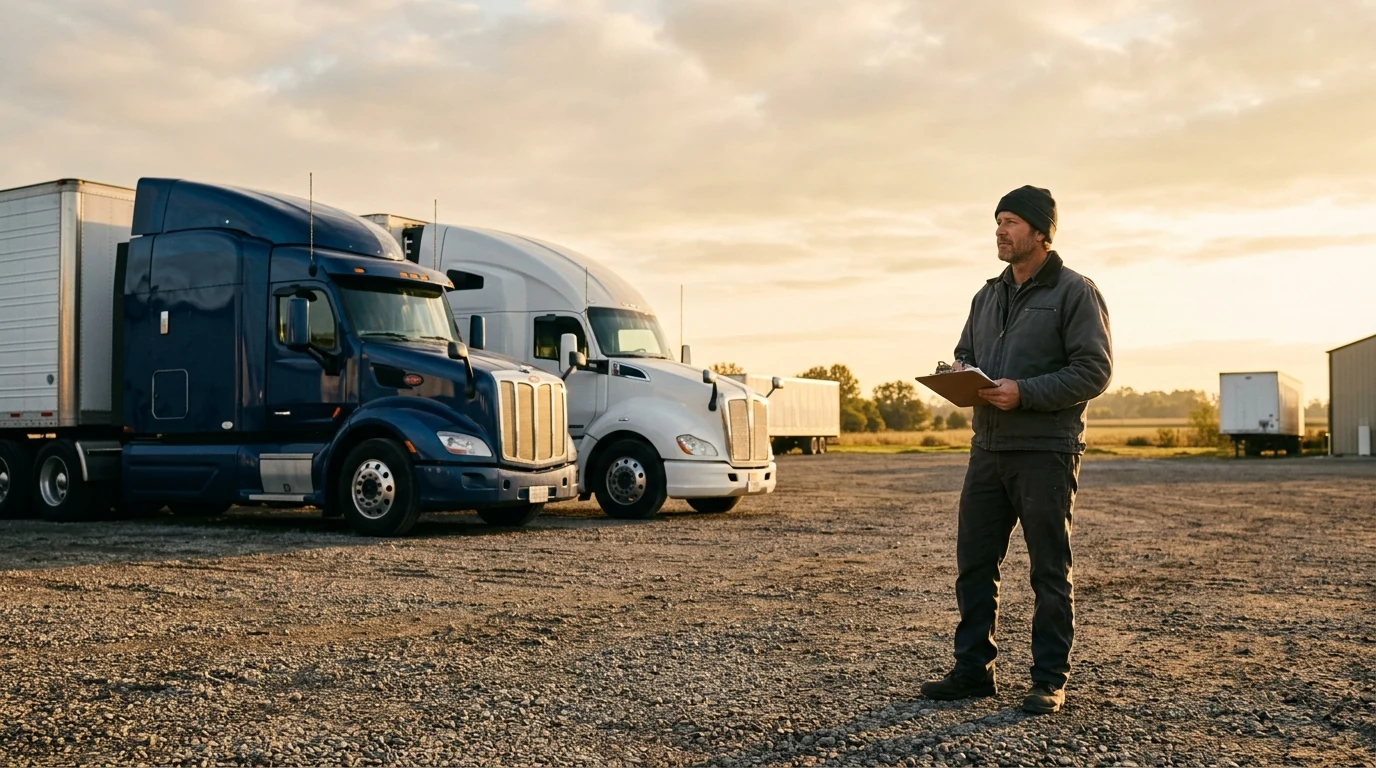
This is a decision about the truck itself, the tractor you sign for and put under load. In June 2025, the American Trucking Associations counted almost 580,000 active motor carriers, and 91.5% of them run 10 or fewer power units (ATA, June 2025). Most operators make this call alone, on a dealer lot, holding a payment quote.
The quote is where the question usually starts, and that is the problem. Truck lease vs buy is not a payment-size question. It is a risk-transfer question.
Three different contracts get called "a lease" in trucking, and each one hands you a different set of risks. What follows is the mechanics that actually decide it: residual value, mileage caps, maintenance responsibility, and equity, plus who ends up holding each one.
> Key Takeaways
> - Lease vs buy is a risk-transfer decision, not a payment-size decision. The question is who carries residual value, mileage exposure, and the repair bill.
> - Used Class 8 retail prices averaged $61,751 in June 2026, up 2.0% month over month and 1.5% year over year (ACT Research, June 2026). That number is the residual, whoever is holding it.
> - Repair and maintenance ran 21.5 cents per mile in 2025 and rose 8.6%, one of the fastest-growing cost lines in the industry (ATRI, July 2026).
> - The FMCSA Truck Leasing Task Force asked Congress to ban carrier lease-purchase agreements (FMCSA TLTF, January 2025). That product is not the same thing as a third-party lease or a purchase loan.
> - Eos Loan is a direct lender with flexible terms and one team from application to funding, subject to approval and eligibility.
See what financing a fleet expansion could look like
What actually gets called "leasing a truck"?
Three separate contracts share the word. An open-end TRAC lease sets a residual in the contract and settles the gap at the end. A closed-end fair-market-value lease leaves that residual with the lessor. A carrier lease-purchase ties the truck, the freight, and the paycheck to one company. Federal lease rules for motor carriers sit in 49 CFR Part 376.
Part 376.12 requires a written lease and, for the duration of that lease, exclusive possession, control, and use of the equipment by the authorized carrier, along with complete responsibility for its operation (eCFR, current). That language is about operating authority, not about who owns the asset. Plenty of operators read one and assume the other.
So the useful question is not "lease or buy." It is "who is on the other side of this paper, and what did they agree to hold?" A TRAC lease from an equipment lessor is a financing relationship. A closed-end lease is a rental with a return inspection at the end. A carrier lease-purchase is your freight provider, your pay source, and your creditor, all at once.
!New Class 8 tractors lined up on a dealer lot in bright daylight.
The counterparty matters more than the payment. Two contracts can quote the same monthly number and leave you in very different positions three years later. The high-level view of how carriers fund a truck purchase covers the paths at altitude. This post stays inside the lease question and goes down one level.
Who carries the residual value, and what is it worth right now?
Residual value is what the truck is worth when the term ends, and every structure is a decision about who holds that number. In June 2026, ACT Research put the average used Class 8 retail price at $61,751, up 2.0% month over month and 1.5% year over year (ACT Research, June 2026). Buy the truck and that value is yours, up or down.
In an open-end TRAC lease, a residual is stated in the contract at signing. At termination the truck is sold, and the difference between that stated residual and what it actually brought is settled with you. Sells high, you get the surplus. Sells low, you owe the shortfall.
A closed-end fair-market-value lease removes both sides. You hand the keys back, the lessor owns whatever the truck is worth, and you keep neither the gain nor the loss. That is the trade you are paying for.
Ownership makes you the seller. You pick the timing, you pick the buyer, and you carry the market.
One caution before anyone builds a plan on that price. ACT also noted auction volumes slumped 22% month over month in June 2026, which is unusual for the last month of a quarter (ACT Research, June 2026). Residual math is a forecast, not a fact. Say "the residual stated in the contract," because that is exactly what it is.
How do mileage caps change the math for a small carrier?
A lease prices a specific number of miles. Run more and you pay an excess-mileage charge per mile on top of the payment. Run fewer and you paid for capacity you never used. In 2025, ATRI measured average operating cost at a record $2.336 per mile, $1.854 excluding fuel (ATRI, July 2026). Every mile costs, whether the contract priced it or not.
Ownership has no cap. That single line is why high-mileage long-haul operations tend to buy and why lower-mileage regional and local work tolerates a lease more comfortably.
!A truck operator standing beside a parked tractor in a daylight yard, reviewing paperwork.
Do this before any conversation about structure: pull 12 months of your own odometer or ELD data. Not the number you assume, not the number the lane pays on paper. The actual miles. Guessing low is common, and an excess-mileage rate applied to that gap is not small.
Then there is the second cap, the one nobody reads. Return standards: tires at a stated tread depth, body damage, glass, interior condition, sometimes powertrain hours. Excess-wear charges land at the end of the term, when your negotiating position is weakest. Ask for the return conditions in writing before you sign.
Who pays for maintenance, and what is that worth?
In 2025, repair and maintenance cost the industry 21.5 cents per mile, an 8.6% jump and one of the fastest-rising cost lines in the report (ATRI, July 2026). ATRI also found repair costs generally fell as fleet size rose, which leaves the smallest carriers carrying the heaviest per-mile repair burden.
A full-service lease bundles maintenance into the payment. What that buys is variance reduction, not a lower total. You are paying someone to smooth a lumpy expense into a flat one, and they price that service to make money on it.
A TRAC lease or a finance lease usually leaves maintenance with you. So does ownership, always. If you have a bay, a mechanic, or a shop relationship that treats you well, holding maintenance yourself is cheaper. Paying dealer rates on every fault code, it is not.
The small-carrier angle is blunt. One out-of-warranty aftertreatment repair can outrun a full year of the difference between two monthly payments. That is why the cash reserve behind the truck matters more than shaving the payment. A structure that leaves you with maintenance and no reserve is the worst of both.
Ask about flexible terms on a truck purchase
Why do carrier lease-purchase programs fail so often?
On January 16, 2025, the FMCSA Truck Leasing Task Force submitted its final report, telling Congress it should ban commercial motor vehicle lease-purchase agreements as "irredeemable tools of fraud and driver oppression that threaten a safe national transportation system" (FMCSA TLTF, January 2025). That is a federal advisory committee, on the record, about one specific product.
The structural problem the task force identified is concentration. In a carrier lease-purchase, one company controls the driver's operations, compensation, and debt at the same time. Dispatch decides the miles. Settlements decide the pay. Deductions decide what is left. The same entity sets all three.
That is categorically different from a third-party lease or a purchase loan, where the freight relationship and the financing relationship sit with separate companies that have no ability to adjust each other's terms. If your dispatcher and your lienholder can talk to each other about your paycheck, you are in the structure the task force flagged.
The task force also recommended, for as long as these programs continue, mandatory disclosure of contract terms, program success rates, and expected take-home pay, plus record-keeping on how participants actually fare (FMCSA TLTF, January 2025). Those are the disclosures a regulator asks for when outcomes are bad enough to warrant counting. Worth knowing before you sign a contract that shares the name.
How do hold period and annual miles decide truck lease vs buy?
Two numbers answer the question: how many miles the truck runs per year, and how many years you keep it. Everything else is downstream. In 2025, carriers made their largest capacity cut since 2022, reducing truck counts by 2.4% and leaving roughly 10% of trucks unseated (ATRI, July 2026). Hold-period assumptions get tested in markets like that.
High miles plus a long hold points toward ownership. Caps and return standards cost you real money at that volume, and the equity you build is worth having when the market turns. Moderate miles plus a short refresh cycle points toward a lease, because what you are buying is an exit from the resale decision.
!A Class 8 tractor parked inside a maintenance bay during a daytime service check.
Three variables sit underneath those two numbers. Maintenance capability: do you have a shop, or are you paying retail on every repair? Obsolescence: over a long hold, emissions rules and spec changes can strand you on a truck nobody wants. Working capital: a smaller monthly outlay preserves cash, and cash covers the first breakdown.
Here is the whole truck ownership vs leasing decision in one table. Rows are risks. Columns are structures. Read across your own line.
| Risk | Buy with financing | Open-end TRAC lease | Closed-end FMV lease | Carrier lease-purchase |
|---|---|---|---|---|
| Residual value | You, upside and downside | You settle the gap at termination | Lessor | Structurally unclear, flagged by FMCSA TLTF |
| Mileage exposure | No cap | Usually capped, excess billed per mile | Capped, excess billed per mile | Set by the carrier |
| Maintenance | You, unless separately covered | Usually you | You, or bundled in a full-service version | Often deducted from settlements |
| Equity at the end | Yours, a titled asset | Only through the residual settlement | None | Frequently none |
| Who you answer to | Your lender, separate from your freight | The lessor, separate from your freight | The lessor, separate from your freight | One company holds freight, pay, and debt |
If you want the money side of that table, how term length and monthly payment interact explains the trade between outlay and total cost, and how credit history factors into an approval covers what underwriting is reading while you do the math.
What changes when the truck is yours at payoff?
At payoff you hold a titled asset with no use restrictions, no return inspection, and resale timing you control. That title also becomes collateral you can put toward the next truck. Eos Loan has originated $4B+ to date across 30k+ proposals processed, and this is the pattern that moves a carrier from one power unit to three.
Equity is the compounding piece. Every payment on a purchase loan buys a slice of an asset you can sell, borrow against, or run past the note. Payments on a closed-end lease buy use of the truck and nothing else, which is a fair trade if you knew that was the trade.
Ownership also means no mileage limit and no modification limit. Spec it how your lanes need it. Add an APU. Wrap it. Run it as long as the maintenance history says it earns its keep. The honest flip side is that you own the downside too, and used values move.
We underwrite truck purchases directly, and the pattern we see most often in applications is an operator who already holds a lease that priced their miles wrong. Nobody misread the payment. They misread the hold period. In practice, the two-number question gets answered in the first ten minutes of a real conversation, well before anyone talks structure.
Eos Loan is a direct lender. We originate, underwrite, and service the credit ourselves, so you work with one team from application to funding, subject to approval and eligibility. Terms are flexible and sized to the truck and the operation. Eos Loan charges no dealer fee. If you are comparing offers, how dealer fees work at other lenders and the difference between a direct lender and a marketplace are both short reads, and financing for trucks and fleet expansion covers the product side without the essay.
Talk to our team about financing your next truck
Or call +1 833-989-3737 to talk through a truck purchase with our team. You can also skim common financing questions first.
Frequently asked questions
{ question: "Is it cheaper to lease or buy a semi truck?", answer: "Neither is universally cheaper. A lease usually lowers the monthly outlay by moving residual risk somewhere else. Buying builds equity and removes mileage caps but leaves you holding resale. The deciding inputs are annual miles and hold period, not the size of the payment." }, { question: "What is a TRAC lease on a commercial truck?", answer: "A terminal rental adjustment clause lease is an open-end structure for commercial vehicles where a residual value is stated in the contract at signing. At the end of the term the truck is sold, and the difference between that stated residual and the actual sale price is settled with you, up or down." }, { question: "Who pays for maintenance on a leased truck?", answer: "It depends on the structure. A full-service lease bundles maintenance into the payment. A TRAC or finance lease usually leaves it with you, the same as ownership does. Repair and maintenance averaged 21.5 cents per mile industry-wide in 2025, up 8.6% year over year (ATRI, July 2026)." }, { question: "Are truck lease-purchase programs a good idea for owner-operators?", answer: "In January 2025 the FMCSA Truck Leasing Task Force recommended that Congress ban carrier lease-purchase agreements, citing drivers who make payments without accruing equity. That recommendation targets programs where one carrier controls your freight, your pay, and your debt. A third-party lease or a purchase loan is a different arrangement." }, { question: "What happens at the end of a commercial truck lease?", answer: "It depends on the structure. An open-end TRAC lease settles the gap between the stated residual and the sale price. A closed-end lease is returned subject to mileage and wear standards. A purchase loan ends with the title in your name. Read the return conditions before signing, not at the end." } ]} />Truck lease vs buy: two numbers, then the contract
Lease vs buy stops being confusing the moment you stop comparing payments and start asking who carries what.
- Residual value belongs to whoever the contract says it belongs to, and in June 2026 that number averaged $61,751 on a used Class 8 (ACT Research).
- Mileage caps and return standards are the second price of a lease, and they land at the end of the term.
- Maintenance ran 21.5 cents per mile in 2025 and rose 8.6%, with the smallest fleets carrying the most of it (ATRI).
- A carrier lease-purchase is its own product, and a federal task force asked Congress to ban it in January 2025.
- Equity is the reason ownership compounds and a closed-end lease does not.
Before anyone quotes you a payment, write down two numbers: the miles this truck will run per year, and the years you intend to keep it. Those two lines pick the structure. The payment is just the receipt. When you are ready, financing for trucks and fleet expansion is a conversation, and how carriers fund a truck purchase is the wider map.
---
About the author: Eduardo Donadi is the CEO of Eos Loan, a US direct lender financing essential projects including truck fleet expansion, battery energy storage, EV chargers, and water filtration. He works directly with carriers, owner-operators, and distributors on how equipment purchases get structured and funded.
---
Sources
1. American Trucking Associations. "Economics and Industry Data." June 2025. Retrieved 2026-08-27. https://www.trucking.org/economics-and-industry-data
2. ACT Research. "US Classes 3-8 Used Trucks." June 2026. Retrieved 2026-08-27. https://www.actresearch.net/resources/blog/us-classes3-8-used-trucks-blog
3. American Transportation Research Institute. "New ATRI Report Details Accelerating Costs and Low Profitability Despite Cuts." July 2026. Retrieved 2026-08-27. https://truckingresearch.org/2026/07/new-atri-report-details-accelerating-costs-and-low-profitability-despite-cuts/
4. Federal Motor Carrier Safety Administration, Truck Leasing Task Force. "Final Report to the Secretary of Transportation and Congress." January 16, 2025. Retrieved 2026-08-27. https://www.fmcsa.dot.gov/mission/advisory-committees/tltf/tltf-final-report
5. Electronic Code of Federal Regulations. "49 CFR Part 376: Lease and Interchange of Vehicles." Current edition. Retrieved 2026-08-27. https://www.ecfr.gov/current/title-49/subtitle-B/chapter-III/subchapter-B/part-376