

Builders Risk Insurance: The Coverage Gap on a Vacant Project
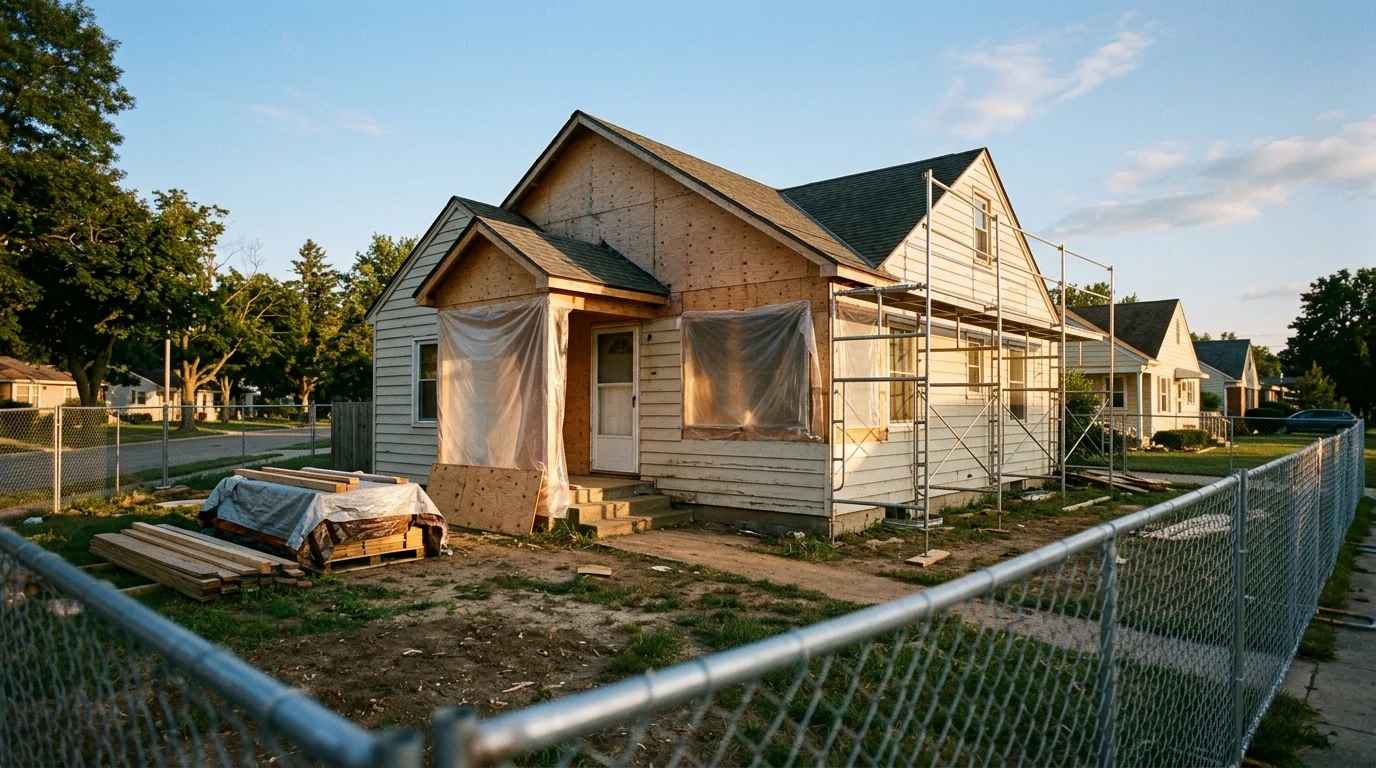
You bought a non-owner-occupied property as business inventory. Nobody lives in it, and crews are working on it. That combination is what a standard property policy was not written to cover, and the forms say so in plain language.
Here is the mechanic almost nobody checks before the first invoice. The vacancy clock counts consecutive days the building sits empty, and it does not reset when you take title. At 60 consecutive days, specific perils stop paying. The typical flip took a median of 165 days from purchase to resale in Q1 2026 (ATTOM, June 2026). The clock runs out before the drywall goes up, and the replacement policy carries its own expiration date that lands while the finished property is still empty.
> Key Takeaways
> - A property with nobody in it and work underway is a different risk class, and standard forms treat it that way in writing.
> - ISO dwelling and commercial property forms both suspend key perils once a building has been vacant more than 60 consecutive days.
> - Builders risk on the ISO CP 00 20 form ceases 90 days after the work is complete or 60 days after occupancy or intended use, whichever comes first.
> - The typical flip ran 165 days purchase to resale in Q1 2026 (ATTOM, June 2026), which outruns both policy edges.
> - Eos Loan is a direct lender with flexible terms and no dealer fee, subject to approval and eligibility.
Talk to our team about financing your next project
Why does a standard policy stop paying on a vacant project?
Because the form suspends perils on a schedule. ISO's Dwelling Property Special Form DP 00 03 stops paying for vandalism, malicious mischief and theft once the dwelling has been vacant more than 60 consecutive days. The commercial equivalent, CP 00 10, does the same and cuts payment on every other covered loss, fire included, by 15% (Adjusters International).
The wording is the trap. The policy is not cancelled. It is still in force, still billing, still producing a declarations page you can hand to anyone who asks. What changed is which causes of loss it responds to.
!An unoccupied house exterior in daylight during a business-purpose project.
Two definitional points decide whether the clock is already running on your property.
- "Vacant" is a form term, not a feeling. The commercial owner test turns on square footage not being used for customary operations. An empty house with a lockbox on the door qualifies.
- The count is consecutive days of vacancy, not days of ownership. If the last occupant left in March and you took title in May, you inherited a clock already in motion.
The suspended perils are not random. Vandalism, malicious mischief, theft, water damage from an unattended failure: those are the losses an empty jobsite attracts. The form removes coverage for the risks the vacancy itself creates.
How much riskier is an empty building, really?
Measurably. From 2013 to 2015, an estimated 23,800 vacant residential building fires were reported each year in the United States, accounting for 6% of all residential building fires and causing an estimated 75 deaths, 200 injuries and $785 million in property loss annually. The leading cause was intentional actions, at 34% (USFA/FEMA, Vacant Residential Building Fires, Topical Fire Report Series Vol. 18 Issue 9, published January 2018).
A word on that vintage, because it matters more than dressing it up would. This is the most recent USFA topical report on the subject, and it covers 2013 to 2015. It describes a durable loss pattern, not current-year conditions.
Empty buildings are not rare, either. In the second quarter of 2026 the Census Bureau counted 15.6 million vacant housing units, at a 7.3% rental vacancy rate and a 1.2% homeowner vacancy rate (US Census Bureau, July 2026). Underwriters are not being difficult. They are pricing something they have counted.
What is course of construction coverage, and what does it actually cover?
Builders risk, also written builder's risk and sold as course of construction coverage, insures direct physical loss to a structure while work is underway. It picks up what a vacancy provision drops and adds what a dwelling policy never contemplated: materials, supplies and equipment intended to become a permanent part of the building, on or within 100 feet of the premises (ISO CP 00 20).
Ask for these additions by name, because none of them are automatic on every quote: temporary structures such as scaffolding and storage containers, materials held in off-site storage, and materials in transit.
Then the number that gets fumbled most. The limit is written on estimated completed value, what the finished structure costs to build. It is not the price you paid, and it is not the resale number. Size the limit off your exit estimate and you are insuring the wrong figure. Our breakdown of how after-repair value is calculated and where it is used separates the two properly.
| What the property faces | Standard policy, vacant past 60 days | Vacant dwelling policy | Builders risk (CP 00 20) |
|---|---|---|---|
| Fire | Paid, reduced 15% on the commercial form | Typically covered | Covered |
| Vandalism and theft while vacant | Suspended | Often covered, sometimes by endorsement | Covered |
| Theft of materials staged on site | Not covered | Generally not covered | Covered when materials are scheduled |
| Work in progress and installed materials | Not contemplated | Not contemplated | Covered to completed value |
Read the columns as a sequence, not a menu. Most projects need the third column for the work window, and something in the second only if the property sits empty before work begins. All of it sits inside the same real estate project financing decision.
See how business-purpose financing fits your deal
When does builders risk coverage end?
On dates, and both of them arrive earlier than investors expect. Under the ISO CP 00 20 form, coverage ceases at the earliest of policy expiration, 90 days after construction is complete, or 60 days after the building is occupied in whole or in part or put to its intended use (ISO Builders Risk Coverage Form CP 00 20). The carrier can extend that, but only in writing, and only before it expires.
Now put those day counts next to a real project calendar, which nobody seems to do. Coverage stops 90 days after the work finishes. What is happening in those 90 days? The property is staged, listed and empty, and strangers are walking through it on showings. The construction policy expires at the moment third-party exposure peaks and the building is still unoccupied. That is an assumption about owner-occupants baked into the form, and it does not hold for an investor.
The fix is a calendar entry, not a product. Arrange the replacement policy to begin the day builders risk ceases, not the day the property sells, because those are rarely the same date. For the schedule behind those dates, see the full project timeline from offer to payoff.
What does your lender require, and why does it hold up funding?
Evidence of coverage that names the lender's interest. Funding on a business-purpose real estate loan is generally conditioned on a certificate showing special form coverage at an adequate limit with the lender named, usually through a lender's loss payable provision rather than a plain loss payee designation. ATTOM found 38.9% of Q1 2026 flips were purchased with financing (ATTOM, June 2026).
!Two people reviewing project paperwork at a table in daylight.
The wording distinction is worth two minutes. A plain loss payee gets added to the claim check. A lender's loss payable provision gives rights closer to those of a mortgage holder under the policy, including protection where the named insured's own recovery is impaired (Big "I" Virtual University). Both sets of provisions live on ISO endorsement CP 12 18. That phrase describes the carrier's endorsement wording, not a consumer mortgage product, which Eos Loan does not offer.
> What I see from the lending desk: the certificates that sail through are the ones where the named insured matches the entity on the loan exactly. When title sits in an LLC and the policy was bound in the investor's personal name, or the endorsement says loss payee where the loan documents call for lender's loss payable, the file sits until the agent reissues it. That is a document mismatch, not a credit question. Every application is still subject to approval and eligibility.
Carriers and draw schedules gate on the same instinct: documentation that matches reality. Read this alongside how draw funding releases money against completed work, and if the loan type is new to you, start with what a business-purpose loan actually is.
How much does builders risk cost, and where does it land in the budget?
It is rated on estimated completed value, which means the premium moves with the budget. IRMI puts the relationship plainly: a project that comes in 20% over budget will generally cost about 20% more in builders risk premium, because the policy is sold on the condition that a change in project cost gets reported and audited at completion (IRMI).
I am not going to hand you a percentage-of-budget range. The pages publishing one are content marketing, not carrier data, and premium turns on construction type, location, limit, deductible and the length of the work window. Get it quoted per property, the same way you quote a roof. For what an empty property costs per month, see where insurance sits in the holding-cost line.
The actionable point hides inside the IRMI rule. Because the premium tracks completed value, a scope increase you never reported does two things at once: it leaves you underinsured on a bigger project, and it sets up an audit adjustment anyway. You pay the difference either way. Reporting it when the budget moves is the version where you also get the coverage.
How do you sequence coverage across the project?
Three handoffs, each one a date. Bind coverage before the property goes empty, hold builders risk across the full work window plus the listing window, and start the permanent policy the day builders risk ceases. Miss a handoff and the exposed period gets measured in the same 60 and 90 day units the forms use.
!Interior of a house mid-project in daylight with tools and materials on the floor.
1. Establish the vacancy date in writing before you rely on any existing policy. Ask the seller or the agent when the last occupant left, and count from there.
2. Write the limit to estimated completed value, not to purchase price and not to your resale estimate.
3. Add the lender's loss payable wording in the exact form the loan documents name, with the entity spelled the way it appears on title.
4. Calendar both CP 00 20 termination triggers the day the policy binds: 90 days after work complete, 60 days after occupancy or intended use.
5. Report scope and budget changes to the carrier in writing as they happen, not at the audit.
6. Request any extension before expiration. After the date, you are asking for new coverage, not an extension.
7. Bind the permanent policy to start on the termination date, and confirm the effective date in writing before builders risk lapses.
Put the two termination dates in the same calendar as your draw requests. They belong to the same project, and only one of them sends a reminder.
Ask about flexible terms for fix and flip projects
Prefer to talk it through? Call +1 833-989-3737.
{ question: "Does homeowners insurance cover a house nobody lives in?", answer: "Not fully. The ISO dwelling form DP 00 03 stops paying for vandalism, malicious mischief and theft once the dwelling has been vacant more than 60 consecutive days, and the commercial form CP 00 10 reduces payment on other covered losses, fire included, by 15%. The policy stays in force, which is why the gap goes unnoticed." }, { question: "What is the difference between builders risk and a vacant property policy?", answer: "A vacant property policy insures an empty building at rest. Builders risk, or course of construction coverage, insures the structure while work is underway, including materials, supplies and equipment intended to become a permanent part of the building. Some carriers write a combined vacant-with-work form for investor projects." }, { question: "When does builders risk coverage end?", answer: "On the ISO Builders Risk Coverage Form CP 00 20, coverage ceases at the earliest of policy expiration, 90 days after construction is complete, or 60 days after the building is occupied in whole or in part or put to its intended use. An extension has to be agreed in writing before expiration." }, { question: "Does a lender require builders risk on an investor project?", answer: "Lenders on business-purpose real estate loans generally condition funding on evidence of coverage naming the lender's interest, commonly on a special form basis with a lender's loss payable provision rather than a plain loss payee. ATTOM found 38.9% of Q1 2026 flips were purchased with financing (ATTOM, June 2026)." }, { question: "Should the insured limit match the after-repair value?", answer: "No. Builders risk is written on estimated completed value, a cost-to-complete figure covering purchase plus the full budget for the work. After-repair value is a resale estimate. Sizing the policy limit off the resale number is a common way to end up mis-insured on the structure." } ]} />The date nobody puts on the calendar
Two edges bound coverage on an investor project, and neither asks your permission. The opening edge is the vacancy clock, which starts when the last occupant leaves and suspends the perils an empty jobsite attracts at 60 consecutive days. The ending edge is written into the builders risk form, and it arrives 90 days after the work is done, while the property is still empty and being shown. A 165-day median project outruns both.
Eos Loan is a direct lender. We originate, underwrite and service business-purpose real estate financing ourselves across fix and flip, fix and keep and fix and hold, with flexible terms and no dealer fee, subject to approval and eligibility. For the full structure, start with business-purpose financing for a fix and flip project.
---
About the author: Eduardo Donadi is the CEO of Eos Loan, a US direct lender financing essential projects including business-purpose real estate, truck fleet expansion, battery energy storage, EV chargers, and water filtration. He works directly with investors on how fix and flip, fix and keep and fix and hold projects get structured and funded.
---
Sources
1. USFA/FEMA. "Vacant Residential Building Fires (2013-2015), Topical Fire Report Series Vol. 18 Issue 9." Published January 2018. Retrieved 2026-09-30. https://www.usfa.fema.gov/downloads/pdf/statistics/v18i9.pdf
2. ATTOM. "Q1 2026 US Home Flipping Report." Published June 2026. Retrieved 2026-09-30. https://www.attomdata.com/news/market-trends/flipping/q1-2026-home-flipping-report/
3. Insurance Services Office. "Builders Risk Coverage Form CP 00 20." Form reference. Retrieved 2026-09-30. https://www.insurancexdate.com/insurance-forms/CP/CP-00-20/
4. Adjusters International. "Vacancy/Occupancy Clauses; Protective Safeguards Endorsements." Retrieved 2026-09-30. https://www.adjustersinternational.com/pubs/adjusting-today/vacancy-occupancy-clauses-protective-safeguards-endorsements/
5. US Census Bureau. "Quarterly Residential Vacancies and Homeownership, Second Quarter 2026." Published July 2026. Retrieved 2026-09-30. https://www.census.gov/housing/hvs/files/currenthvspress.pdf
6. Big "I" Virtual University. "The Difference Between a Loss Payee Versus a Lender's Loss Payable Form." Retrieved 2026-09-30. https://www.independentagent.com/vu_resource/ask-an-expert-strikes-again-with-the-difference-between-a-loss-payee-versus-a-lenders-loss-payable-form/
7. IRMI. "Beware of Builders Risk Additional Premiums and Policy Expirations." Retrieved 2026-09-30. https://www.irmi.com/articles/expert-commentary/beware-of-builders-risk-additional-premiums-and-policy-expirations