

The Flip Timeline: From Offer to Payoff, Stage by Stage
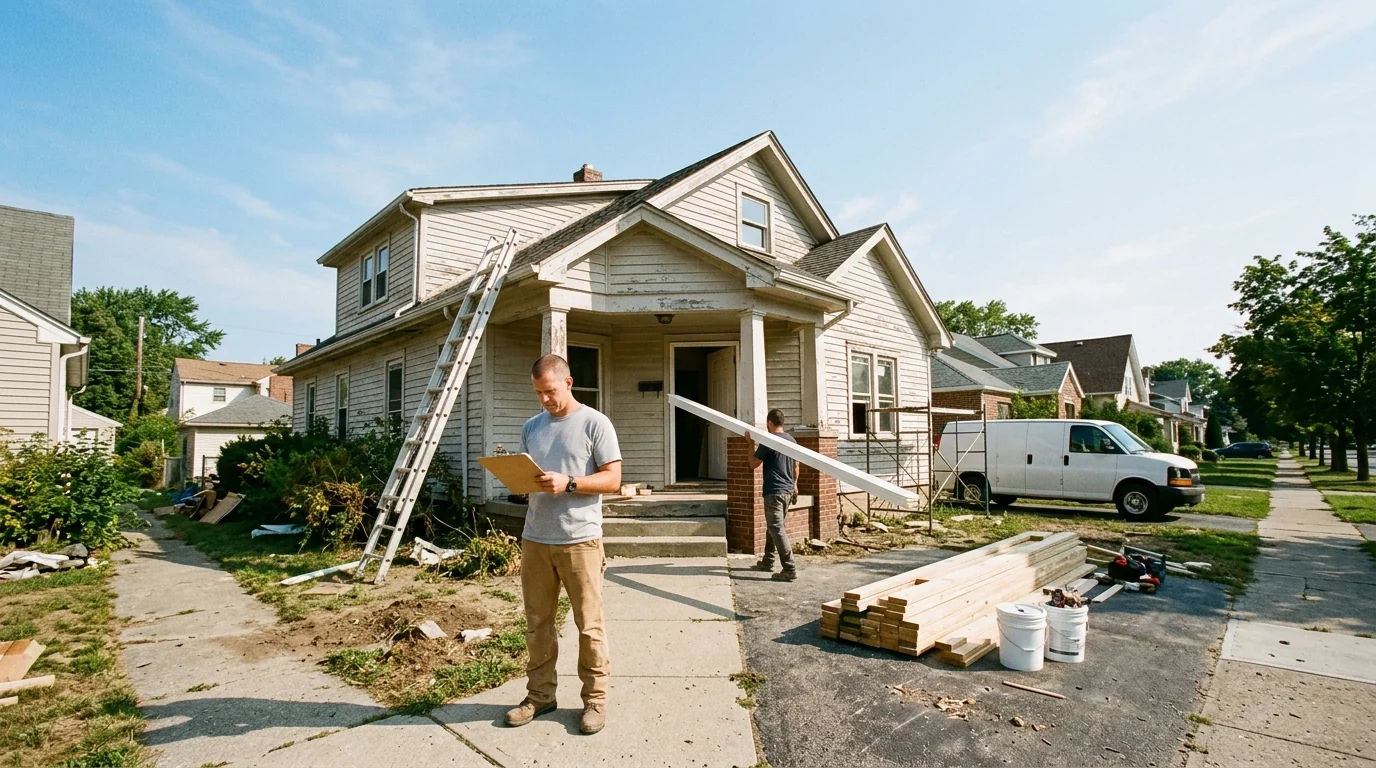
This is a stage-by-stage fix and flip timeline, an elapsed-time schedule for a business-purpose residential investment project, written for the investor running it, from the day you write the offer to the day the loan is paid off. Flips averaged 165 days from purchase to resale in Q1 2026, up from 160 days in Q4 2025 and 164 days a year earlier (ATTOM, June 2026).
One number, five very different stages. Most schedules hand almost all of it to the crew and treat everything before demolition and after the last coat of paint as rounding error. That is usually where projects run late: in the weeks on either side of the work, when nobody is holding a hammer and the clock runs anyway.
Here is the full schedule, stage by stage, with what each one is benchmarked at and what stalls it.
> Key Takeaways
> - Flips averaged 165 days from purchase to resale in Q1 2026 (ATTOM, June 2026). That is a closing-to-closing measure, so your real schedule is longer at both ends.
> - A US home spends a median of 49 days on the market before an offer is accepted, then 30 to 60 more days to close (Redfin, June 2026).
> - The construction window tracks scope size, not crew speed: Atlanta projects averaged a $190,000 budget and a 91-day payoff period, Denver $431,250 and 133 days (ATTOM, July 2026).
> - The clock starts at the closing table, not on demolition day, and it stops at the payoff, not at the accepted offer.
See how business-purpose financing fits your deal
How long does a fix and flip take from offer to payoff?
The typical US flip took 165 days from purchase to resale in Q1 2026, up from 160 days in Q4 2025 (ATTOM, June 2026). Across full-year 2025 the figure was 163 days (ATTOM, March 2026). Both measure closing to closing, so they start after you take title and end at the resale.
That definition matters more than the number. The weeks spent getting a property under contract sit outside it, and so does the day your loan is actually repaid, which is not the day the buyer signs.
So break the fix and flip timeline into the five stages it actually contains. Call it the Five-Stage Flip Clock. Each stage has its own benchmark, its own failure mode, and a different amount of it under your control.
| Stage | What it covers | Benchmark | What stalls it | What you control |
|---|---|---|---|---|
| 1. Offer to closing | Signed contract to the day you take title | No national benchmark for flip acquisitions; 61.1% of Q1 2026 flips were all cash (ATTOM) | Title work, the seller's timeline, a funding date never committed | Financing arranged before you write the offer |
| 2. Closing to first day of work | Title in hand to the first crew on site | No national benchmark, use your own last three projects | Scope revisions, crew mobilization, material lead times, clearances | Booking the crew to the closing date, ordering long-lead items early |
| 3. Construction window | First day of work to listing-ready | Tracks budget size: $190,000 and 91 days in Atlanta, $431,250 and 133 days in Denver (ATTOM) | Change orders, phase sign-offs, anything that opens a wall | Scope discipline and decision speed |
| 4. Listing to accepted offer | Live listing to a signed contract | 29 days median time on market (NAR); 49 days (Redfin) | Pricing at the top of the local band, a thin buyer pool | List price, presentation, and the date you go live |
| 5. Accepted offer to payoff | Signed contract to the resale closing that repays the loan | 30 to 60 days (Redfin) | The buyer's financing, the appraisal, inspection items | Responsiveness, clean title, how you handle repair requests |
Every extra week on that clock costs carry, which is the pillar's argument and not this post's. If you want the money side of the schedule, read the full guide to fix and flip financing. This post stays on the calendar. Eos Loan writes business-purpose financing for residential real estate projects across fix and flip, fix and keep and fix and hold.
Stage 1: How long does it take to get from offer to closing?
This stage sits entirely outside the 165 days, which is exactly why it disappears from most schedules. Cash closes fastest, and 61.1% of homes flipped in Q1 2026 were bought with all cash (ATTOM, June 2026), leaving just under 39% that involved financing. In the wider market, cash was 26% of existing-home sales in July 2026 (NAR, August 2026).
Four things set the length here, and only one is yours. Title work has to come back clean. A distressed or estate seller usually sets this stage's length rather than the buyer. An inspection contingency adds its own window. And the funding date is the real gate.
That last one is worth sitting with. A financed offer committed before you wrote it behaves like a cash offer on the calendar. One arranged afterward behaves like a question mark, and sellers price question marks accordingly. Any deal is subject to approval and eligibility, so start the conversation early rather than assuming a date.
Here is the thing investors get wrong most often, and it is not "how long will the work take." It is when the clock starts and when it actually stops. The clock starts at the closing table, not on the first day of demolition. Everything before that is your acquisition schedule, and it is real time on a real calendar.
Stage 2: What happens between closing and the first day of work?
There is no national dataset that measures this gap, and that absence is the point. The only anchor you have is the outer envelope: 165 days from purchase to resale (ATTOM, June 2026), inside which this stage is invisible. Most investors score it at zero days. It is never zero.
What fills it is mundane. The walkthrough after closing shows you something the inspection did not, so the scope gets revised. The crew you booked three weeks ago is finishing someone else's job. Cabinets, windows and specialty fixtures carry lead times that do not care about your closing date. Power and water have to be on, access sorted, a dumpster scheduled, and whatever clearances the scope requires have to be in hand before a crew can start.
Money is also a date on this schedule. On a financed project, the first disbursement has to land before work begins. That is a scheduling fact, not a procedure, and it belongs on your calendar next to the crew's start date. If the mechanics are new to you, the step-by-step version lives in our walkthrough on how to fund your first flip.
Since no benchmark exists, build one. Pull your last three projects, count the days between the closing date and the first invoice from the crew, and use that average.
Stage 3: What actually sets the length of the construction window?
Scope size, not crew speed. In a Q1 2026 analysis of fix and flip loan originations published by ATTOM (July 2026), Denver projects carried an average construction budget of $431,250 and an average payoff period of 133 days, while Atlanta projects averaged a $190,000 budget and a 91-day payoff period. The underlying figures come from lender loan-origination data analyzed by ATTOM.
Bigger budget, longer window. That relationship holds across markets and beats any crew-speed estimate, because you set the budget before you set the schedule. A cosmetic turn runs on a different clock than a project that opens walls, moves plumbing, or touches the roof. Same house, same crew, very different calendars.
Two things stretch this stage more than anything else. Change orders are calendar events before they are cost events: the decision itself takes days, and the material behind it takes weeks. And phase sign-offs sit between stages of work, so a delayed inspection stops the next trade from starting even when everyone is available.
Which is why the crew is rarely what broke the schedule. Ask any operator who ran late and they will describe a decision that took nine days, a fixture that shipped in five weeks, or an inspector who came on a Thursday instead of a Monday. The hammer was never the bottleneck.
Ask about flexible terms for fix and flip projects
Stages 4 and 5: How long does the sale stage take once the work is done?
Longer than most flip schedules assume. A US home spends a median of 49 days on the market before an offer is accepted (Redfin, June 2026), and Redfin puts another 30 to 60 days between that accepted offer and closing. NAR's July 2026 reading gives a median time on market of 29 days (NAR, August 2026). Both are correct.
The two "days on market" numbers are not the same number
NAR measures listing to contract on homes that sold. Redfin's figure covers a broader listing population, including the listings that sit. Neither is wrong, and neither is flip-specific: there is no Tier 1 dataset for days on market on flipped homes only, so treat both as general-market context rather than as your number.
The consequence is blunt. An investor who models 29 days and lives 49 is close to three weeks behind before anything went wrong, on the stage where you can least catch up. Model the wider figure and let the faster one be a good surprise.
The loan is not paid off when the buyer signs
The accepted offer feels like the finish line. It is not. Redfin puts 30 to 60 days between the accepted offer and closing, with inspection and appraisal running 7 to 14 days and the buyer's final loan approval and escrow taking 2 to 4 weeks (Redfin, June 2026). Your loan is repaid at that closing.
So the buyer's financing is now on your schedule. Their lender's appraisal, their underwriter's conditions, their escrow timeline. You do not control any of it, and it runs while your project still carries.
Now put the two datasets side by side. They are not measuring the same thing, so this is illustrative arithmetic rather than a sourced statistic: ATTOM measures flipped homes closing to closing, while Redfin's figures describe the general US market, including retail buyers using financing. With that caveat stated plainly, 49 days plus 30 to 60 days is roughly 79 to 109 days on the sale side. Subtract that from ATTOM's 165 days and something in the range of 56 to 86 days is left for everything between taking title and the listing going live, which is Stages 2 and 3 combined. The sale stage can eat as much calendar as the crew, or more.
Nothing in the market is shrinking that window. NAR reported a 4.6-month supply of unsold inventory in July 2026, unchanged from June and from a year earlier (NAR, August 2026). Investors made only 7.8% of all listings in Q1 2026, the smallest share in five years (Redfin, May 2026).
Why does the same project take 91 days in one market and 154 in another?
Because the local market sets the scope and the sale window, not the calendar. In ATTOM's Q1 2026 origination analysis, Austin carried the longest average payoff period at 154 days and Denver ran 133 days, while Atlanta came in at 91 days (ATTOM, July 2026). That is a 63-day spread on the same activity.
Price tier and scope size travel together. A market where the finished product sells higher generally asks for a deeper project, and a deeper project runs longer. Local inspection cadence adds to it, since some jurisdictions schedule in days and others in weeks. Then the buyer pool at your finished price point decides Stage 4, and that pool thins at the top of the local band.
So benchmark against your own market and your own last three projects, not a national average built from every market at once. If your metro runs closer to Austin than to Atlanta, a 165-day plan was optimistic the day you wrote it.
How does financing keep pace with the schedule?
Eos Loan is a direct lender. It originates, underwrites and services the credit in-house, so you work with one team from application through funding instead of being handed between an intermediary and whoever ends up holding the paper. To date the company has originated $4B+ and processed 30k+ proposals across essential projects. On a deal with a real closing date, the structure behind the money matters.
Three paths are financed on the real estate side: fix and flip, fix and keep, and fix and hold. All business purpose, never for a property you occupy. Terms are flexible and sized to the project rather than pulled from a table, subject to approval and eligibility. The classification is worth understanding, and we cover it in why a business-purpose loan is not a consumer product.
Eos Loan charges no dealer fee. Other lenders in this space do, and knowing how those fees work elsewhere is worth your time before you compare offers. There is no self-serve signup here. The application is digital and a dedicated support team stays on your file. More about who we are.
---
Talk to our team about financing your next project
Or call +1 833-989-3737 to talk through the schedule on a project you are working now. More common financing questions are answered on our FAQ page.
---
question: "How long does a fix and flip take from start to finish?",
answer: "Flips averaged 165 days from purchase to resale in Q1 2026, up from 160 days in Q4 2025 (ATTOM, June 2026). That measures closing to closing, so the weeks spent getting a property under contract sit outside it, and so does the gap between an accepted offer and the resale closing."
},
{
question: "How long does the construction stage of a flip take?",
answer: "It tracks scope size more than crew speed. In ATTOM's Q1 2026 analysis of fix and flip loan originations, Denver projects averaged a $431,250 construction budget and a 133-day payoff period, while Atlanta averaged a $190,000 budget and 91 days (ATTOM, July 2026)."
},
{
question: "How long does it take to sell a flipped house?",
answer: "A US home spends a median of 49 days on the market before an offer is accepted, then 30 to 60 more days to close (Redfin, June 2026). NAR's July 2026 median time on market was 29 days (NAR, August 2026). The two figures measure different populations, and neither is flip-specific."
},
{
question: "When is the loan on a flip actually paid off?",
answer: "At the resale closing, not when the buyer's offer is accepted. Redfin puts 30 to 60 days between an accepted offer and closing, including 7 to 14 days for inspection and appraisal (Redfin, June 2026). Budget the schedule to the payoff date rather than the contract date."
},
{
question: "Does Eos Loan finance fix and flip projects?",
answer: "Yes. Eos Loan is a direct lender for business-purpose residential projects across fix and flip, fix and keep and fix and hold, with flexible terms sized to the project and no dealer fee, subject to approval and eligibility."
}
]} />
Where the calendar actually goes
A flip is not one long stretch of construction with paperwork attached. It is five stages, each with a different owner and a different failure mode, and the two at the end are the ones most schedules underprice.
- 165 days is a closing-to-closing measure, so your real schedule is longer at both ends.
- The clock starts at the closing table, not on demolition day, and it stops at the payoff, not at the accepted offer.
- The construction window tracks scope size, not crew speed.
- The sale stage can consume as much calendar as the crew, and you control the least of it.
- Benchmark against your own market, because 91 days and 154 days are both averages.
Before your next offer, put the five stages on a calendar with real dates and see where the payoff lands. If the deal still works on that date, the financing conversation is straightforward.
---
About the author: Eduardo Donadi is the CEO of Eos Loan, a US direct lender financing essential projects including business-purpose residential real estate, battery energy storage, EV chargers, water filtration, and truck fleets. He works directly with investors and operators on how acquisitions and improvement budgets get structured and funded.
---
Sources
1. ATTOM. "Q1 2026 US Home Flipping Report." June 2026. Retrieved 2026-08-27. https://www.attomdata.com/news/market-trends/flipping/q1-2026-home-flipping-report/
2. ATTOM. "2025 Year-End US Home Flipping Report." March 2026. Retrieved 2026-08-27. https://www.attomdata.com/news/market-trends/flipping/2025-year-end-home-flipping-report/
3. ATTOM. "Special Analysis: How Pricing, Renovation Costs and Timing Shaped Returns in Q1 2026." July 2026. Retrieved 2026-08-27. https://www.attomdata.com/news/market-trends/flipping/special-analysis-how-pricing-renovation-costs-and-timing-shaped-returns-in-q1-2026/
4. Redfin. "How Long Does It Take to Sell a House?" June 2026. Retrieved 2026-08-27. https://www.redfin.com/blog/how-long-does-it-take-to-sell-a-house/
5. Redfin. "Investor Report, Q1 2026." May 2026. Retrieved 2026-08-27. https://www.redfin.com/news/investor-report-q1-2026/
6. National Association of Realtors. "Existing-Home Sales Report, July 2026." August 2026. Retrieved 2026-08-27. https://www.nar.realtor/newsroom/nar-existing-home-sales-report-shows-1-7-decrease-in-july