

Water Filtration Financing for Medical and Dental Offices: 2026 Compliance Guide
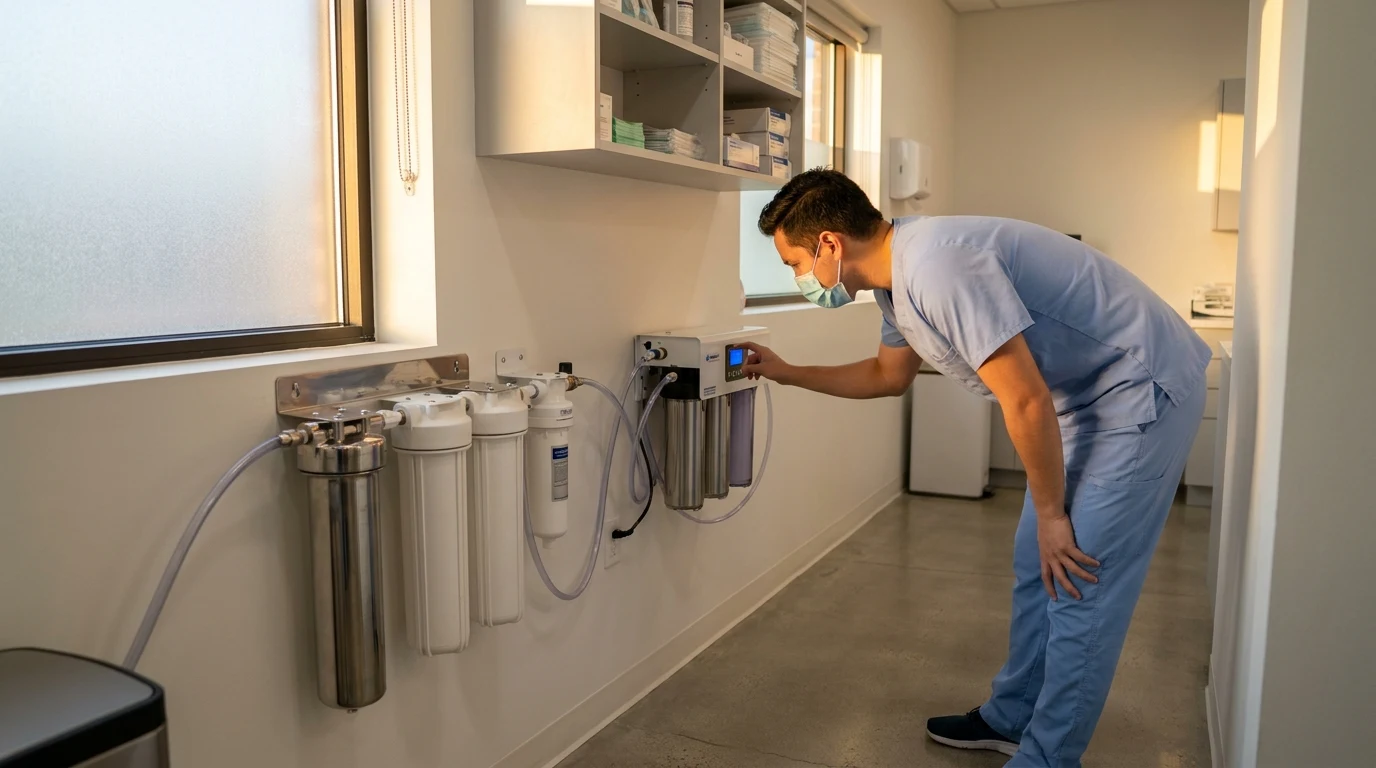
In 2026, most medical and dental water filtration projects still don't start as a planned purchase. They start with a failed waterline test, a new-build plumbing inspection, or a survey citation that shows up without warning. Dental unit water has to meet the same bacteria limit as the water coming out of a kitchen tap: no more than 500 CFU/mL of heterotrophic bacteria (CDC, Dental Unit Water Quality, BESC Module 9, 2024). That number rarely shows up on a practice's radar until a test comes back over the line.
Medical facilities face a separate, building-wide rule. This guide covers both: the chairside standard that applies to a dental unit and the facility-wide program that applies to hospitals and long-term care buildings. It also breaks down what a compliant system typically costs and how financing bridges the gap between a failed test and an installed fix, for the practice and for the dealer who sells and installs the system.
> Key Takeaways
> - Dental unit water for routine treatment must meet ≤500 CFU/mL of heterotrophic bacteria, the same limit as drinking water (CDC, BESC Module 9, 2024).
> - Since June 2, 2017, CMS has required hospitals, critical access hospitals, and long-term care facilities to maintain a documented water management program addressing Legionella, built on ASHRAE Standard 188 (CMS, QSO-17-30, revised 2018).
> - System cost spans a wide range: a point-of-use dental unit system lists around $1,700 (US Water Systems, retrieved 2026), while a medical-grade build for a new outpatient surgical center ran $120,000 (Crestmont Capital, 2025).
> - Eos Loan is a direct lender offering flexible terms on water filtration financing, subject to approval and eligibility, and charges no dealer fee.
See how Eos Loan financing helps you close more projects
What Water Quality Standard Applies to Dental Offices?
Dental unit water for routine, nonsurgical treatment must meet the same bacteria limit the EPA sets for drinking water: no more than 500 CFU/mL of heterotrophic bacteria, according to the CDC's Dental Unit Water Quality guidance, BESC Module 9 (2024). Untreated dental unit waterlines, the narrow-bore tubing that feeds a handpiece, air-water syringe, or ultrasonic scaler, can otherwise colonize with bacteria and exceed 1 million CFU/mL, according to the same CDC guidance.
The American Dental Association's own waterline guidance confirms the same 500 CFU/mL benchmark and recommends flushing any device that enters a patient's mouth for at least 20 seconds between patients. For surgical procedures, the ADA recommends sterile saline or sterile water instead of unit water entirely. None of this happens automatically. A dental unit's water only stays compliant through manufacturer-directed treatment products, anti-retraction valves or separate water sources, and routine testing that the practice documents itself.
A 2024 ADA-commissioned study found dental teams recognize why waterline infection control matters but still run into knowledge gaps, time constraints, and financial limitations that get in the way of consistent maintenance (ADA, Dental Unit Waterlines, 2024). A single failed test rarely reflects one bad day. It usually reflects a maintenance program that never had a documented owner or a system that was never installed in the first place.
Do Hospitals and Medical Facilities Need a Legionella Water Management Program?
Yes. Since June 2, 2017, the Centers for Medicare & Medicaid Services has required every Medicare and Medicaid-certified hospital, critical access hospital, and long-term care facility to develop and maintain water management policies that reduce the risk of Legionella and other opportunistic pathogens in the building's water systems (CMS, QSO-17-30 memo, revised 2018). That policy has to be built around ASHRAE Standard 188-2015, which lays out how to identify where a building's water systems can grow and spread Legionella and how to control it.
The Joint Commission enforces the same expectation through survey standard PE.04.01.05, which replaced the older EC.02.05.02 standard and took effect January 1, 2022 for accredited hospitals and nursing care centers (The Joint Commission, R3 Report Issue 32, 2021). A compliant program names a responsible individual or team, maps every point where water enters, is stored, and exits the building, and sets monitoring ranges for control measures such as water temperature and disinfectant levels.
Most content on this topic treats "medical" and "dental" water quality as one undifferentiated compliance bucket. They're not the same rule. The CDC/ADA dental unit waterline standard governs the water inside a single chairside device, while the CMS/Joint Commission Legionella program governs an entire building's plumbing. A practice or dealer that buys a system for one rule while the other rule actually applies has bought the wrong equipment.
How Much Does a Water Filtration System Cost for a Medical or Dental Office?
Cost depends entirely on which of those two systems is being addressed. A single-chair dental practice fixing a failed waterline test typically needs a point-of-use unit: US Water Systems' dental office water purification system lists at $1,666.59, with a sale price near $999.95, and produces up to 20 gallons per day of deionized water to 16 meg/ohm purity (US Water Systems product listing, retrieved 2026). A multi-chair practice usually needs several of these units or a larger shared system, scaling roughly with chair count.
A medical facility addressing the Legionella program operates on an entirely different scale. Crestmont Capital's equipment financing guide describes a real-world example: a new outpatient surgical center needed medical-grade water treatment, including deionization, ultraviolet purification, and continuous monitoring, to meet state health department requirements, at a total cost of $120,000 (Crestmont Capital, Water Filtration Equipment Financing & Leasing, 2025). For scale, a food-manufacturer compliance build can run as high as $280,000 under the same financing data, context that shows the healthcare tier sits well below the largest industrial builds but far above a single point-of-use fixture.
| System tier | Approximate cost |
|---|---|
| Dental point-of-use unit (single chair) | ~$1,000-$1,700 |
| Multi-chair practice (several point-of-use units) | Scales with chair count |
| Medical facility build (e.g., outpatient surgical center) | ~$120,000 |
| Food-manufacturer compliance build (context, not healthcare) | ~$280,000 |
Sources: US Water Systems product listing, retrieved 2026; Crestmont Capital, 2025.
Add financing to your installs, talk to our team
What Triggers a Water Filtration Purchase in a Medical or Dental Practice?
A water filtration purchase in this vertical almost never starts as a planned budget line. It starts with a failed waterline test, a new-build plumbing inspection ahead of opening day, or a state or Joint Commission survey finding that flags the facility's water management documentation. None of those triggers give a practice months of lead time to shop quotes.
Across the water-treatment dealer deals Eos Loan sees, medical and dental requests follow the same shape as the compliance-driven pattern already visible in restaurants and schools, but the trigger itself is different: a bacteria count over 500 CFU/mL on a dental waterline test, or a surveyor flagging a missing water management plan, rather than a lead test or a routine health inspection. The request almost always arrives the same week as the failed result, not months later.
!A practice manager reviewing a printed water test report at a desk in a bright office.
That timing matters because cash reserves in a small practice are already committed to payroll, supplies, and rent. A $120,000 medical-grade system, or even a $1,700 point-of-use unit multiplied across six chairs, is rarely money a single-location practice has sitting uncommitted, which is exactly why financing enters the conversation at the moment the test result does, not before.
How Does Financing Help a Practice or Dealer Close This Job Faster?
Financing spreads a compliance-driven system cost into a payment a practice can absorb inside normal monthly overhead, while the dealer or system provider gets funded promptly instead of waiting on the practice to save up. Industry-wide, dental equipment financing terms commonly match the equipment's useful life, often five to seven years, with rates that vary by credit and equipment type (Dental Practice Insider, Dental Equipment Financing, 2026). That's third-party context, not an Eos Loan rate or term commitment.
Eos Loan is a direct lender, never a marketplace, broker, or platform that connects a practice to other funding sources. It offers flexible terms on water filtration financing tailored to the project, subject to approval and eligibility, and it charges no dealer fee. For dealers already serving the wider water treatment market, the water treatment dealer financing guide covers fee structures, funding speed, and credit bands across every water vertical, and Eos Loan's water filtration financing program has the underlying program details.
As CEO of Eos Loan, I've watched multi-chair dental practices and multi-location medical groups run the same math every time a waterline remediation quote lands on the desk: they weigh the quote against case volume and treatment-chair downtime, not against a theoretical annual budget line. A practice that can't treat patients on a chair that's offline for retrofit work feels that cost daily, which is why a fast financing decision often matters as much as the rate attached to it.
Become an Eos Loan financing partner
Or call +1 833-989-3737 to talk through a financing program for your business.
How Does This Differ From a Restaurant or School Compliance Job?
The financing logic is the same across every compliance-driven water vertical: a regulatory trigger turns a discretionary upgrade into an urgent one, and financing closes the gap between the trigger and the installed fix. What's different here is the regulator and the trigger itself. Water filtration financing for restaurants is driven by FDA Food Code inspections and ice-machine warranty terms. Water filtration financing for schools and daycare facilities is driven by EPA's lead-testing deadline for child-care and K-12 facilities. Medical and dental offices face neither of those rules; they face a bacteria count limit on the dental chair and a Legionella management program on the building.
For the broader cost picture across every commercial water vertical, including restaurants, hotels, agriculture, and food manufacturers, see the commercial water filtration financing guide. For a closer look at how a point-of-entry reverse osmosis system is priced and financed on its own, see reverse osmosis system financing costs and terms. And because Eos Loan charges no dealer fee on any of these jobs, dealers comparing financing partners can see how dealer fees work at other lenders before choosing who to work with on a medical or dental account.
Frequently Asked Questions
{ question: "What CFU/mL standard applies to dental unit water?", answer: "Dental unit water for routine, nonsurgical treatment must meet no more than 500 CFU/mL of heterotrophic bacteria, the same limit the EPA sets for drinking water (CDC, BESC Module 9, 2024; ADA, Dental Unit Waterlines, 2024)." }, { question: "Which facilities must have a Legionella water management program?", answer: "Since June 2, 2017, CMS has required hospitals, critical access hospitals, and long-term care facilities to maintain a documented water management program addressing Legionella, built on ASHRAE Standard 188 (CMS, QSO-17-30 memo, revised 2018). The Joint Commission enforces the same expectation through standard PE.04.01.05, effective January 1, 2022." }, { question: "How much does a water filtration system cost for a dental office vs. a medical facility?", answer: "A dental point-of-use unit lists around $1,700 (US Water Systems, retrieved 2026). A medical facility build, such as an outpatient surgical center's deionization, UV, and monitoring system, can run around $120,000 (Crestmont Capital, 2025)." }, { question: "Does Eos Loan charge a dealer fee on water filtration financing?", answer: "No. Eos Loan is a direct lender, never a marketplace or broker, and charges no dealer fee on water filtration financing for medical, dental, or any other vertical, subject to approval and eligibility." }, { question: "How fast can a practice get financing after a failed water test?", answer: "Financing decisions move faster than most practices expect once a system quote is in hand, letting a practice move from a failed test to a scheduled install without waiting on a capital budget cycle, subject to approval and eligibility." } ]} />The Bottom Line for Medical and Dental Practices and Dealers
Medical and dental water filtration is rarely a planned purchase. It's a reactive one, triggered by a failed waterline test, a new-build inspection, or a survey finding, and the practice facing that trigger needs a fast, documented answer. Here's what to carry into the next conversation:
- Dental unit water must meet ≤500 CFU/mL of heterotrophic bacteria (CDC, ADA), a chairside rule enforced through manufacturer-directed treatment and routine testing.
- Hospitals, critical access hospitals, and long-term care facilities have needed a documented Legionella water management program since June 2017 under CMS, matched by Joint Commission standard PE.04.01.05 since January 2022.
- Cost spans roughly $1,000-$1,700 for a dental point-of-use unit to around $120,000 for a medical-grade facility build.
- The purchase trigger is almost always a failed test or a survey finding, not a planned budget cycle, which is exactly where cash flow breaks down.
- Eos Loan is a direct lender with flexible terms and no dealer fee, subject to approval and eligibility.
- CDC, Dental Unit Water Quality, BESC Module 9, retrieved 2026-09-30, https://www.cdc.gov/dental-infection-control/media/pdfs/besc9-dental-unit-water-508.pdf
- ADA, Dental Unit Waterlines, retrieved 2026-09-30, https://www.ada.org/resources/ada-library/oral-health-topics/dental-unit-waterlines
- CMS, QSO-17-30 memo on Legionella in healthcare facility water systems (revised), retrieved 2026-09-30, https://www.cms.gov/medicare/provider-enrollment-and-certification/surveycertificationgeninfo/downloads/qso17-30-hospitalcah-nh-revised-.pdf
- The Joint Commission, R3 Report Issue 32: New Standard for Water Management Program, retrieved 2026-09-30, https://www.jointcommission.org/en-us/standards/r3-report/r3-report-32
- Crestmont Capital, Water Filtration Equipment Financing & Leasing, retrieved 2026-09-30, https://www.crestmontcapital.com/blog/water-filtration-equipment-financing-leasing
- US Water Systems, Dental Office Water Purification System product listing, retrieved 2026-09-30, https://uswatersystems.com/products/dental-office-water-purification-system-by-us-water-systems
- Dental Practice Insider, Dental Equipment Financing, retrieved 2026-09-30, https://dentalpracticeinsider.org/dental-equipment-financing/
A practice that treats waterline and Legionella compliance as two separate, ongoing programs, rather than one vague "water quality" line item, is the one that avoids the surprise failed test in the first place. A dealer who can put a fast financing answer next to that compliance quote is the one who wins the job when the test does come back positive.
About the author: Eduardo Donadi is CEO of Eos Loan, a US fintech direct lender. He helps installers, contractors, and dealers offer point-of-sale financing on essential projects, including battery energy storage, EV chargers, and water filtration.
---