
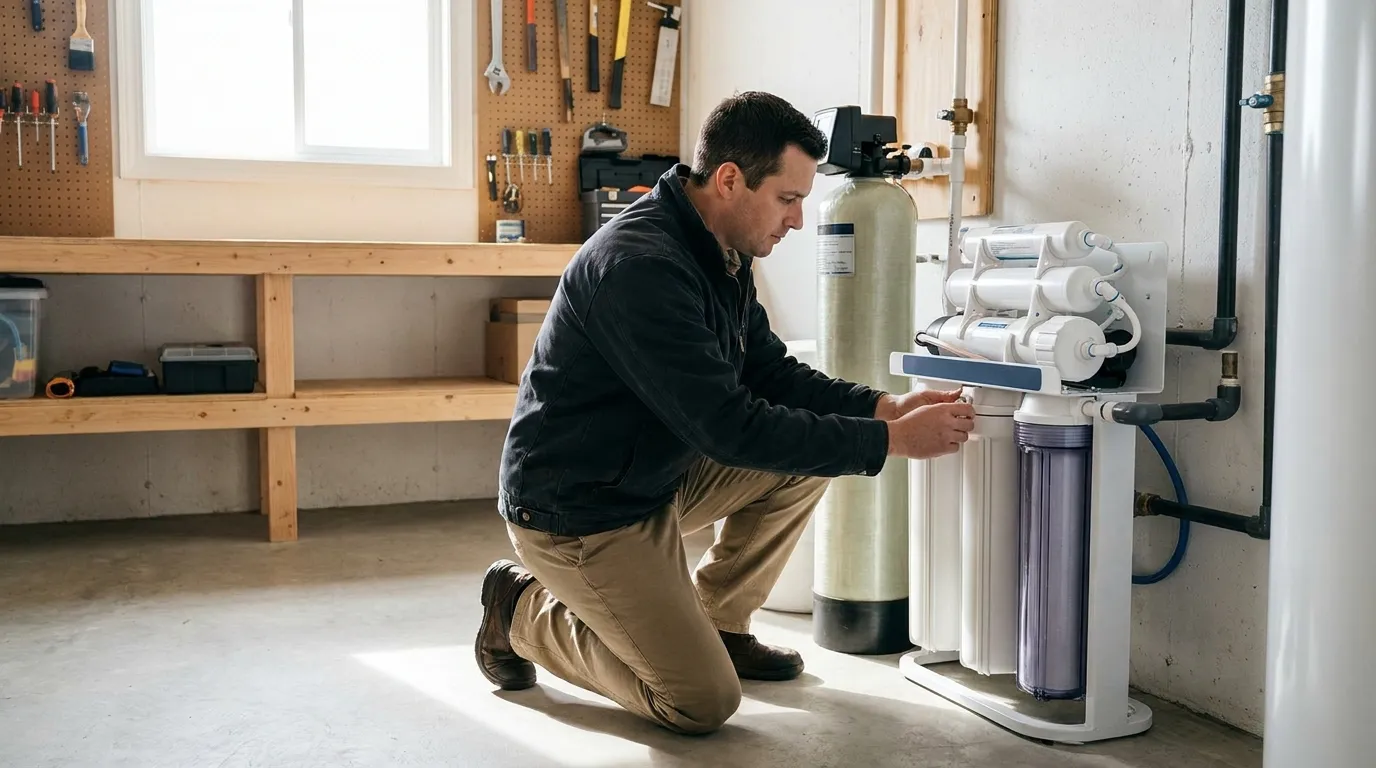
A homeowner just failed a water test. The hardness numbers are bad, the kitchen tap tastes off, and they want the system. Then they see the price, and the deal stalls. Price, not need, is what kills most water treatment sales. The water is still hard. The customer still wants clean water. The check just never gets written.
Water treatment dealer financing fixes that. Your customer pays over time while you get funded fast, so sticker shock stops ending good jobs. This is the full 2026 playbook: what dealer financing is, why demand is climbing, how dealer fees and funding actually work, what credit bands qualify, and how to pick a partner you can trust. The water vertical has its own quirks, and the partner you choose is the biggest decision you'll make.
> Key Takeaways
> - Water treatment dealer financing lets customers pay monthly while you collect fast at install, turning price hesitation into signed jobs.
> - The US water filtration market was valued at $6.89 billion in 2024 (Custom Market Insights, 2024), and EPA lead and PFAS rules are driving homeowner demand.
> - A direct lender like Eos Loan funds loans itself and charges no dealer fees; a marketplace routes you through third parties with variable terms.
> - In 2024, an FTC action led to $43.6 million in financial relief from a major water-treatment financing company over deceptive and FCRA practices (FTC, 2024). Vet your partner for transparency.
See how Eos Loan financing helps you close more projects
What is water treatment dealer financing?
Water treatment dealer financing is an arrangement that lets your customers pay for a system over time while you, the dealer, get funded quickly after install. It covers everything from a whole-home softener to a single under-sink filter. In 2025, point-of-use systems held a 76.6% share of the water treatment market (Precedence Research, 2025), so the projects worth financing span a wide price range.
The mechanics are simple. You run the water test, recommend a system, and present a monthly payment beside the cash price. The customer applies, a lender funds the loan, the customer repays the lender, and you get paid without waiting weeks. That fast funding matters for your cash flow as much as the monthly payment matters for their budget.
Water treatment splits into two buckets. Whole-home solutions include water softeners and whole-house filtration that treat every tap in the house. Point-of-use solutions sit at one spot: under-sink reverse osmosis, countertop filters, refrigerator lines. Both residential and commercial systems qualify for financing, which means a single program can cover a $400 filter and a $12,000 whole-home build.
Reverse osmosis dominated equipment demand with a 28.0% share in 2025 (Precedence Research, 2025), which tells you where homeowner interest sits. Your role stays focused on testing, recommending, and installing. The lender handles underwriting, disclosures, and servicing. For the broader picture across project types, see our contractor's guide to offering customer financing.
Why offer financing on water treatment in 2026?
Offering financing converts price-sensitive homeowners into buyers, and 2026 demand makes the case stronger than ever. The US water filtration market was valued at $6.89 billion in 2024, growing at a 5.5% CAGR (Custom Market Insights, 2024). That is a large, expanding base of households who need treatment and will say yes more often when the price becomes a monthly payment instead of a lump sum.
Regulation is pushing homeowner concern higher. The EPA's Lead and Copper Rule Improvements lowered the lead action level from 15 to 10 parts per billion and mandate lead service line replacement, effective December 30, 2024, with compliance required by November 1, 2027 (EPA, 2024). When a homeowner reads about lead in the news, a point-of-use or whole-home system stops feeling optional.
PFAS rules add a second driver. The EPA's 2024 rule set enforceable maximum contaminant levels for PFOA and PFOS, with the compliance timeline updated in 2025 (EPA, 2025). These "forever chemicals" are now a household-level worry, and treatment is the answer homeowners can act on at their own sink. Regulation creates the concern; financing closes the deal.
In 2026, regulatory pressure is doing the demand generation for you. The EPA lowered the lead action level from 15 to 10 ppb and set enforceable PFAS limits (EPA, 2024), pushing more homeowners to treat their water. Financing turns that concern into a signed job by replacing a large lump sum with a monthly payment the household can fit.
For context, the global water treatment systems market reached $45.15 billion in 2025 with an 8.15% CAGR through 2034, a vendor estimate from Precedence Research (2025). The takeaway for you is simple: this is a growing category where affordability is the last barrier, and financing is the lever that removes it.
How do water treatment dealer fees and funding work?
A water treatment dealer fee is the discount you absorb so the lender can offer your customer a payment plan, and funding is the fast payout you receive after the job is done. The fee is how the lender prices the cost of carrying that loan. With a transparent partner, the fee is disclosed up front, so your system price stays honest and your margin math is clear before you ever sign a job.
Here is the flow on a typical deal. The customer is approved, you install the system, you submit proof of completion, and the lender sends funding by ACH, often within a day or two. You are not waiting on the customer to pay over five years; you collect now and the lender collects over the term. Speed of funding is one of the first things to compare between programs.
The dealer fee mechanics deserve attention because this is where transparency separates partners. A clean structure discloses the fee as a percentage tied to the term and program. A murky structure buries the cost inside an inflated system price, which makes the advertised rate look lower while the customer quietly pays more overall. Always ask for the fee in writing, and hold your cash price constant so you can see any buried markup.
A water treatment dealer fee is the discount the dealer absorbs in exchange for fast funding and a customer payment plan. Many programs in the market automate credit decisions in roughly 60 seconds, a speed norm referenced by industry programs such as Aqua Finance (2025). Quick approvals keep the homeowner in the buying moment instead of going home to "think about it."
A customer benefit worth naming at the table is the absence of prepayment penalties on many programs, so a homeowner who pays the loan off early is not punished for it. That detail closes nervous buyers. If you want a program where the dealer fee is disclosed rather than buried inside the price, talk to our team.
Offer your customers flexible financing on essential projects
Whole-home vs point-of-use: what can you finance?
You can finance both, and bundling them is how you raise ticket size. Whole-home softeners and whole-house filtration treat every tap; point-of-use reverse osmosis polishes the drinking water at the kitchen sink. Point-of-use systems held a 76.6% share of the market in 2025 (Precedence Research, 2025), but the bigger tickets sit in whole-home and commercial builds, which is exactly where a monthly payment changes the answer.
Water softener financing is the workhorse of the vertical. A whole-home softener plus a point-of-use RO unit is a natural pairing: one protects the plumbing and appliances, the other handles taste and contaminants at the tap. Presented as a single monthly payment, that bundle lands far better than two separate prices, and it lifts your average job size without a harder sell.
Commercial water treatment qualifies too. Restaurants, salons, car washes, and small manufacturers all need treatment, and these jobs run larger than residential. A financing program that covers both residential and commercial lets one sales conversation serve a much wider book of business. The term flexibility is what makes the range work: a short term for the homeowner who wants it paid down, a longer term for the lowest monthly payment.
For proof that term flexibility is real across verticals, look at how Eos Loan handles battery energy storage, where terms range from 6 to 240 months. Water treatment is described as flexible terms, matched to the job and the customer's budget. A water customer is also a candidate for other essential projects, so the same relationship can later support battery storage financing or EV charger financing.
What credit profiles qualify for water softener financing?
Water treatment financing programs serve a range of credit bands, from prime to subprime, subject to approval and eligibility. There is no single cutoff score, because the right program spreads approvals across more profiles than a single bank would. A wider approval window means you lose fewer deals to a declined application. The US water softening systems market was valued at $763.6 million in 2025 and is projected to reach $1,190.5 million by 2032 at a 6.5% CAGR (Fortune Business Insights, 2025), so the volume of financeable jobs is climbing.
Why does the approval window matter so much? Because every declined customer is a job you already earned and then lost at the finish line. A program that can place prime, near-prime, and subprime applicants under one process recovers deals that a narrow lender would turn away. The breadth of the credit bands a partner serves is one of the most practical things to ask about before you enroll.
A soft-pull pre-qualification is the tool that protects the experience. A soft check, which does not affect the customer's credit, can tell you what payment fits before you design a scope the financing cannot support. That keeps you from selling a system the customer cannot finance, and it keeps the conversation honest. Approval is always subject to eligibility, and no responsible program promises a guaranteed yes.
Water softener financing serves a spread of credit profiles, prime to subprime, subject to approval, which is why a broad program loses fewer deals at the application step. With the US water softening market projected to reach $1,190.5 million by 2032 (Fortune Business Insights, 2025), the dealers who can approve a wider range of customers will capture more of that growth.
One hard rule for your own marketing: never quote a specific rate, APR, or fee as a promise, and never imply guaranteed approval. Use "subject to approval and eligibility." That language protects you and your customer, and it keeps your pitch accurate.
Direct lender vs financing marketplace: which should a water dealer pick?
A direct lender funds the loan itself, so you deal with one party, no hidden dealer fees, and a single consistent approval standard. A financing marketplace routes your customer through third-party lenders, adding handoffs and variable terms. For a water dealer, that distinction decides who actually owns the approval, the fee, and the customer experience. In 2024, an FTC action led to $43.6 million in financial relief from a major water-treatment financing company over deceptive and FCRA-related practices (FTC, 2024), which is exactly why partner transparency belongs at the top of your checklist.
Eos Loan is a direct lender. We fund the loans we offer, which is why we charge no dealer fees and keep the approval standard consistent. We are not a marketplace, a broker, or a platform that connects you to other lenders. That difference shows up most when a deal is borderline: with a marketplace, an application can bounce between lenders, each with its own rules, and your customer feels every handoff. With a direct lender, the answer comes from one place.
The FTC case is worth understanding without disparaging anyone. The point is not that one company behaved badly; it is what you should vet for. Ask any prospective partner how they handle FCRA compliance, whether dealer fees are disclosed in writing, and whether the system price stays constant when financing is added. Those three questions surface the transparency the FTC action was about, and they protect your reputation as much as the lender's.
In 2024, the FTC action that led to $43.6 million in relief over water-treatment dealer and FCRA practices (FTC, 2024) is the reason transparency, not just rate, should drive partner selection. Vet for no hidden dealer fees, a single approval standard, and clear FCRA practices before you enroll.
The proof behind our model is scale. Eos Loan has originated $4 billion and more in financing and processed 30,000 and more proposals to date. That is direct-lender volume, not a referral count from routing customers elsewhere. For the cross-vertical comparison of these models, see our contractor's guide to offering customer financing.
How do you add water treatment financing to your sales process?
Present the monthly payment at the water test, not after you reveal the total. The moment the homeowner sees their hardness or contaminant results is the moment they are most motivated, and pairing that result with a payment they can picture is what keeps the deal alive. Add financing in four moves: show payment beside price on every quote, pre-qualify early with a soft pull, keep paperwork digital, and train every rep to lead with the monthly number.
Start with how you present the figure. Show the monthly payment next to the cash price on every proposal, not only the ones where the customer flinches. When the payment is always visible, customers self-select into financing without you selling it separately. Pre-qualify early with a soft check so you design a system the financing can actually support.
> Our finding: What I'm seeing from water dealers is that the ones who attach financing to the quote at the point of the water test, not after the total lands, stall fewer deals. The result is in front of the customer, the emotion is high, and the payment makes the system feel reachable. I frame this as a pattern we observe across partners, not a promise of results.
Keep the documents digital so the homeowner can finish the application from the couch, and train your team to follow up on stalled deals with a financing angle. A "no" from last season is often a "not at that price," which a payment plan can reopen. The same workflow lets you cross-sell other essential projects later, because a customer who financed clean water is an easy candidate for the next upgrade.
For the step-by-step workflow from test to funded install, including exact timing at each stage, see our full water testing to financed install workflow. For shared or building-wide properties, see our guide to multifamily and property-management water financing.
A quick note on taxes, since dealers ask. Water treatment systems are generally not eligible for clean-energy tax credits, so do not pitch them that way, and do not describe Eos Loan financing as a tax credit, rebate, or incentive. It is a loan that lets your customer pay over time. This is general information, not tax advice. Consult a qualified tax professional.
How to choose a water treatment financing partner (checklist)
Choose a water treatment financing partner on five tests: are they a direct lender, are dealer fees transparent, how flexible are the terms, how broad are the approved credit bands, and how clean is their FCRA and transparency track record. A partner that scores well on all five gives you honest economics and a smooth customer experience. One that is strong on a single feature and weak on the rest creates friction you feel on every deal.
These five criteria reinforce each other. A direct lender can keep fees transparent because it controls the fee. Broad credit-band coverage only helps if approvals are fast and consistent. Multi-vertical coverage extends the relationship past water into battery storage financing and beyond. Judge the whole package, not one line on a rate sheet.
Here is how Eos Loan maps to the checklist. We are a direct lender, we charge no dealer fees, we offer flexible terms on water treatment with battery energy storage terms running from 6 to 240 months as proof of that flexibility, we approve a range of credit profiles subject to eligibility, and we operate under one consistent standard. For a water spoke that goes deeper on the sales motion, see how to offer water filtration financing.
Pick a water treatment financing partner on five tests, direct lender, no hidden dealer fees, flexible terms, broad credit-band coverage, and a clean FCRA track record, weighed together rather than chasing one feature. Eos Loan is a direct lender with no dealer fees and proven term flexibility, all subject to approval and eligibility.
Ready to evaluate Eos Loan against that checklist for your water business?
Become an Eos Loan financing partner
Or call +1 833-989-3737 to talk through a financing program for your business.
Frequently Asked Questions
How does water treatment dealer financing work?
You present a system at a monthly payment beside the cash price, the customer applies, a lender funds the loan, and you get paid by ACH soon after install. The customer repays the lender over the term. With a direct lender like Eos Loan, this runs through one party, and approval is subject to eligibility. Point-of-use systems held a 76.6% share in 2025 (Precedence Research, 2025).
What credit score do I need for water softener financing?
There is no single cutoff. Programs serve a spread of profiles from prime to subprime, all subject to approval and eligibility, and no responsible lender promises guaranteed approval. A broad program approves a wider range of customers, so you lose fewer deals. The US water softening market is projected to reach $1,190.5 million by 2032 (Fortune Business Insights, 2025). For a full breakdown of what credit score you need for water treatment financing, including FICO tiers and how soft-pull pre-qualification works, see our dedicated guide.
Can dealers finance both residential and commercial water treatment?
Yes. A strong program finances whole-home softeners, whole-house filtration, point-of-use reverse osmosis, and commercial systems for restaurants, salons, and small manufacturers. Bundling whole-home and point-of-use raises your average ticket. Point-of-use led the market with a 76.6% share in 2025 (Precedence Research, 2025), but commercial jobs run larger and benefit most from a payment plan.
What is a water treatment dealer fee?
A dealer fee is the discount you absorb so the lender can offer your customer a payment plan and fund you fast. With a transparent partner, the fee is disclosed in writing, so your system price stays honest. A hidden fee gets buried in an inflated price to make the rate look lower. Always ask for the fee in writing and hold your cash price constant.
Is a direct lender better than a marketplace for water dealers?
A direct lender funds loans itself, giving you one party, transparent fees, and one consistent approval standard. A marketplace routes your customer to third-party lenders with variable terms and extra handoffs. In 2024, an FTC action led to $43.6 million in relief over water-treatment financing practices (FTC, 2024), so vet for transparency. Eos Loan is a direct lender, not a marketplace.
The bottom line for 2026
Water treatment dealer financing is one of the most direct ways to close more jobs and raise your average ticket on essential projects. The core moves are clear:
- Make financing standard. Present the monthly payment beside the cash price at the water test, not after the total.
- Choose a direct lender with no dealer fees, so your customer's total price stays honest and your economics stay clean.
- Finance the full range, whole-home softeners, whole-house filtration, point-of-use RO, and commercial systems, and go multi-vertical to cross-sell.
- Vet your partner for FCRA compliance and disclosed fees; the EPA lead and PFAS rules are driving real demand you can capture.
- Custom Market Insights, US Water Filtration Market (valued at $6.89 billion in 2024, 5.5% CAGR), retrieved 2026-06-05, https://www.custommarketinsights.com/report/us-water-filtration-market/
- Fortune Business Insights, US Water Softening Systems Market ($763.6M in 2025 to $1,190.5M by 2032, 6.5% CAGR), retrieved 2026-06-05, https://www.fortunebusinessinsights.com/u-s-water-softening-systems-market-109926
- Precedence Research, Water Treatment Systems Market (point-of-use 76.6% share and reverse osmosis 28.0% share in 2025; global market $45.15B in 2025), retrieved 2026-06-05, https://www.precedenceresearch.com/water-treatment-systems-market
- US Environmental Protection Agency, Lead and Copper Rule Improvements (lead action level 15 to 10 ppb; effective December 30, 2024; compliance by November 1, 2027), retrieved 2026-06-05, https://www.epa.gov/ground-water-and-drinking-water/lead-and-copper-rule-improvements
- US Environmental Protection Agency, PFOA and PFOS Compliance (2024 enforceable MCLs; 2025 compliance timeline), retrieved 2026-06-05, https://www.epa.gov/sdwa/proposed-pfoa-and-pfos-compliance-extension-rule
- Federal Trade Commission, FTC Action Leads to $43.6 Million in Financial Relief from Water Treatment Financing Company (2024), retrieved 2026-06-05, https://www.ftc.gov/news-events/news/press-releases/2024/05/ftc-action-leads-436-million-financial-relief-water-treatment-financing-company-aqua-finance
- Aqua Finance, Dealer Programs (market reference for automated credit-decision speed), retrieved 2026-06-05, https://www.aquafinance.com/dealers/
Eos Loan is a direct lender built for exactly this: no dealer fees, flexible terms across water treatment, and proven term flexibility with battery energy storage running from 6 to 240 months, all subject to approval and eligibility. If you want to add financing to your water installs, contact our team to talk through a water financing program. There is no self-serve signup; we work with you directly.
Or call +1 833-989-3737 to talk through a financing program for your business.
---
Sources
About the author: Eduardo Donadi is the CEO of Eos Loan, the fintech built to finance essential projects (battery energy storage, EV chargers, and water filtration) for installers, contractors, and resellers across the United States.