
Water Filtration Financing for Schools and Daycares: 2026 Guide
In 2026, most school and daycare water filtration projects still aren't planned capital purchases. They start with a failed lead test, a parent complaint, or a new state notice that a testing cycle is now mandatory. A 2018 US Government Accountability Office survey found that 41% of school districts had not tested their drinking water for lead in the prior 12 months, and of the districts that did test, 37% found lead levels above their own action threshold (GAO-18-382, 2018).
That testing gap is about to close. Starting November 1, 2027, EPA's Lead and Copper Rule Improvements requires every community water system to identify every school and child-care facility it serves and begin offering lead sampling, and several states already require testing sooner than that. This guide covers what's required, what remediation typically costs, and how financing bridges the gap between a test result and a compliant, installed system.
> Key Takeaways
> - In 2024, EPA finalized the Lead and Copper Rule Improvements, which requires water systems to identify every school and child-care facility in their service area for lead sampling by November 1, 2027 (EPA, LCRI fact sheet for schools and child care facilities, 2024).
> - A 2018 GAO survey found 41% of school districts had not tested for lead in the prior year, and 37% of the districts that did test found levels above their own action threshold (GAO-18-382, 2018).
> - Filtered hydration stations typically cost $600 to $3,000 per unit installed, and Filter First guidance recommends roughly 1 station per 100 students enrolled (Ecology Center, Filter First; EdWeek, 2023).
> - Washington, New York, and Colorado already require school and daycare lead testing ahead of the federal 2027 deadline, each with its own action level and retest cycle.
> - Eos Loan is a direct lender offering flexible terms on water filtration financing, subject to approval and eligibility, with no dealer fee.
See how Eos Loan financing helps you close more projects
Do Schools and Daycares Have to Test for Lead in Drinking Water?
Not yet, on a single nationwide schedule, but that changes on November 1, 2027. That's when EPA's Lead and Copper Rule Improvements requires every community water system to identify every school and child-care facility it serves and start offering lead sampling, with elementary schools and child-care facilities getting proactive sampling offers and secondary schools sampled on request (EPA, LCRI fact sheet for schools and child care facilities, 2024). Until then, federal testing runs through a voluntary program, and a growing list of states already require it on their own timeline.
That voluntary program is EPA's 3Ts framework, short for Train, Test, Take Action, which gives schools and child-care facilities a protocol for sampling outlets and responding to results before the federal rule takes effect. Adoption has been real but partial. In 2026, EPA reported that its WIIN grant program had helped test more than 20,000 child care facilities and nearly 13,000 schools since 2019, with over 1,300 child-care facilities and more than 2,500 schools completing remediation work as a result (EPA, WIIN Grant program page, 2026). That's meaningful progress, but it still leaves the large majority of the country's K-12 schools and licensed child-care sites untested under a program that facilities have to opt into.
Across the water filtration deals Eos Loan sees from dealers, school and daycare requests almost never arrive as a planned upgrade. They arrive after a district or center gets a test result back, which means the financing conversation starts under a compliance clock rather than a routine budget cycle. That timing pattern is the core reason this vertical behaves differently from a typical residential water filtration financing job.
What Does the Lead and Copper Rule Deadline Mean for Facilities?
By November 1, 2027, every community water system must submit a list of every school and child-care facility it serves. From there, elementary schools and child-care facilities get proactive sampling offers, a minimum of 20% each year for five years, five samples per school and two per child-care facility, while secondary schools are sampled on request only (EPA, LCRI fact sheet for schools and child care facilities, 2024). That structure turns a voluntary, opt-in process into a scheduled, facility-by-facility obligation for the water system serving each site.
For a facility administrator, that means a notification and sampling offer will eventually arrive whether or not the district or center has ever tested before. Every identified elementary school and child-care facility must be sampled once, have declined, or be marked non-responsive within five years of the November 1, 2027 start date (EPA, LCRI fact sheet for schools and child care facilities, 2024). Waiting for that offer to arrive is still the riskiest strategy. A facility that tests proactively controls its own timeline and budget; a facility that waits on the water system's notice inherits whatever sampling window that system assigns it, and secondary schools have to actively request sampling rather than wait for an offer at all.
How Do State Testing Rules Differ for Schools and Child Care Centers?
States are moving faster than the federal timeline. In 2026, Washington's first mandatory five-year retesting cycle takes effect, requiring schools built or fully re-plumbed before 2016 to test with a 5 parts-per-billion action level (Washington State Department of Health, 2026), and New York requires testing at every potable outlet in public and charter schools with a 5 microgram-per-liter action level (New York State Department of Health, 2026).
Colorado's HB22-1358 covers both licensed child-care centers and homes and pre-K through 8th grade schools, and the state extended that testing requirement through June 30, 2029. The pattern across all three states is the same: a lower action level than the old federal Lead and Copper Rule's 15 ppb trigger, and a fixed retest cycle instead of a one-time check. A facility in any of these states that hasn't tested is already behind its own state's clock, not just the 2027 federal one.
What Does a School or Daycare Water Filtration System Cost?
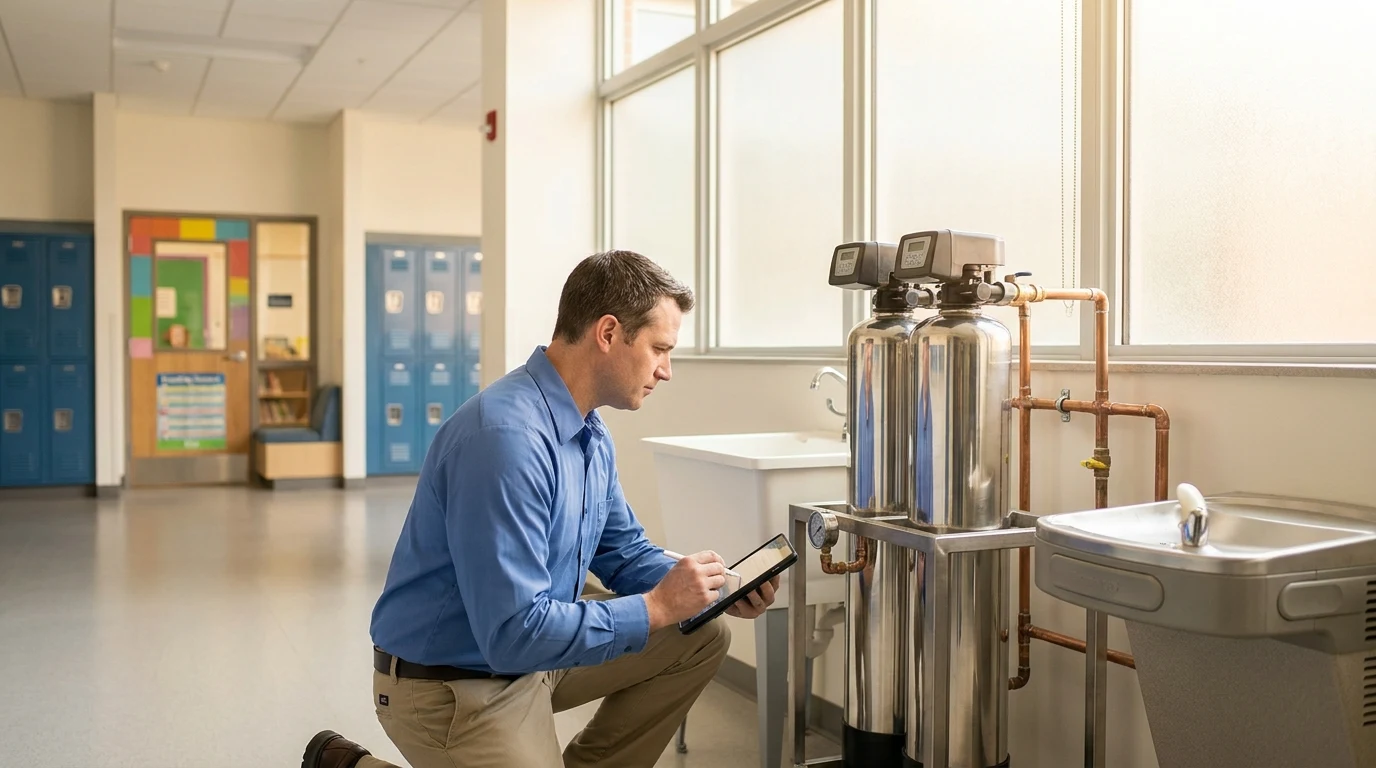
Filtered hydration stations, the fixture EPA and advocacy groups recommend for remediation, typically cost $600 to $3,000 per unit installed. One district-level lead-remediation program budgeted roughly $2,700 per unit plus about $150 a year in filter replacement costs (EdWeek, 2023). That's the cost of getting one outlet compliant. Most facilities need several.
The Ecology Center's Filter First guidance recommends roughly 1 filtered hydration station per 100 students enrolled to ensure adequate access to lead-free water throughout a building (Ecology Center, Filter First, 2023). For a single elementary school with 500 students, that's roughly five units, a project in the $3,000 to $15,000 range before annual filter costs. For a multi-building district or a daycare chain with several locations, that number multiplies fast, and a single test-driven fix rarely covers the full facility rollout a compliance-minded administrator actually needs.
!A facilities administrator reviewing a printed water test report at a desk.
| Facility scope | Approximate installed cost |
|---|---|
| Single filtered hydration station | $600-$3,000 |
| One elementary school (~5 units at 1/100 students) | ~$3,000-$15,000, plus ~$150/unit/year in filters |
| Multi-building district or daycare chain (several locations) | Scales linearly with unit count across sites |
Sources: EdWeek, 2023; Ecology Center, Filter First, 2023.
Add financing to your installs, talk to our team
How Can Schools Pay for Filtration Without a Capital Budget Cycle?
Financing turns a facility-wide filtration rollout into a predictable monthly cost instead of a lump-sum capital request. That distinction matters because most school and daycare capital budgets are set annually, and a lead test result rarely lines up with that calendar. A test that comes back in October doesn't wait for a budget vote the following spring, but the fix usually has to.
That's the timing gap financing closes. A district or center that finances a filtration rollout can move from test result to installed system in weeks rather than waiting out a 6-to-18-month budget cycle for the capital line item to clear. Eos Loan is a direct lender, not a marketplace or broker connecting a facility to other lenders, and offers flexible terms on water filtration financing tailored to the project, subject to approval and eligibility.
A realistic version of this timeline, illustrative rather than a specific named district, looks like this: a facility follows EPA's 3Ts protocol, tests come back above the state action level, and the facilities director gets a remediation quote the same week. Instead of tabling the project until the next capital budget cycle opens, the district finances the rollout, and the installer schedules work within days of approval rather than months after a board vote.
How Should Installers Pitch Financing to School and Daycare Customers?
Frame financing as closing the timing gap between a failed test and an installed fix, not as a discount pitch. Procurement staff at schools and daycares respond to compliance urgency, documentation, and a clear payment structure far more than they respond to price-off language, because the purchase decision is rarely discretionary once a test result is in hand.
Bring the test results, a written remediation plan, and financing terms to the same conversation, all in writing, since school business offices and daycare owner-operators typically need documentation for their own board or licensing file. Isn't that also exactly the moment a dealer can raise ticket size? A district weighing a five-unit pilot against a full building rollout is far more likely to say yes to the larger scope once the payment is monthly instead of a single capital request. Of the districts GAO surveyed that did test their water, 37% found lead above their own action threshold (GAO-18-382, 2018), a stat worth having ready when a prospect asks why this can't wait for next year's budget.
See how installers offer water filtration financing walks through the enrollment and quoting steps in detail, and the workflow from a failed water test to a financed install covers how to move from test result to funded project inside a single appointment.
Where Does School Filtration Fit in the Financing Landscape?
School and daycare projects are one regulated vertical inside a much larger commercial water filtration market. Water filtration financing for another regulated vertical, restaurants, shows a similar pattern: a compliance trigger (a health inspection note there, a lead test here) turns a discretionary upgrade into an urgent one, and financing is what keeps the project moving on the compliance timeline instead of the capital-budget one.
For the broader cost and financing picture across commercial water projects, see how businesses finance commercial water filtration systems. And for the underlying water filtration financing program details, including how Eos Loan structures financing for installers and dealers across every essential project category, visit the program page directly.
Most competing content on this topic either explains the testing mandate (state health department pages, EPA's own guidance) or sells the filtration equipment (vendor product pages). Almost none of it addresses the actual bottleneck: the 6-to-18-month gap between "the test found lead" and "the budget cycle allows a purchase." Financing is the mechanism that closes that specific gap, and it's the piece missing from most compliance-focused or product-focused content on this subject.
Become an Eos Loan financing partner
Or call +1 833-989-3737 to talk through a financing program for your business.
Frequently Asked Questions
{ question: "Is lead testing required for all US schools?", answer: "Not yet nationwide. It becomes effectively required through EPA's Lead and Copper Rule Improvements, which requires water systems to identify every school and child-care facility for sampling starting November 1, 2027 (EPA, LCRI fact sheet, 2024). Some states, including Washington, New York, and Colorado, already mandate testing today." }, { question: "What is the EPA's 3Ts program?", answer: "A voluntary federal framework, Train, Test, Take Action, that gives schools and child-care facilities protocols for lead sampling and remediation ahead of the 2027 federal deadline. EPA's WIIN grant program has helped test more than 20,000 child care facilities and nearly 13,000 schools since 2019 (EPA, WIIN Grant program page, 2026)." }, { question: "How much does it cost to filter a school's drinking water?", answer: "Filtered hydration stations generally run $600 to $3,000 per unit installed, with one district program budgeting about $2,700 per unit plus roughly $150 a year in filter costs (EdWeek, 2023). Total cost scales with the number of outlets, at a recommended density of about 1 unit per 100 students (Ecology Center, Filter First)." }, { question: "Can a daycare finance water filtration the same way a school does?", answer: "Yes. Water filtration financing structures apply to any facility owner, whether a school district, a daycare operator, or a multi-location child-care chain, subject to approval and eligibility." }, { question: "Does Eos Loan charge a dealer fee on water filtration financing?", answer: "No. Eos Loan is a direct lender and charges no dealer fee on financed water filtration projects, for schools, daycares, or any other facility type." } ]} />The Bottom Line for Schools, Daycares, and Installers
School and daycare water filtration is shifting from a voluntary, reactive fix to a scheduled, regulatory obligation. Here's what to carry into the next conversation:
- The federal deadline is November 1, 2027, under EPA's Lead and Copper Rule Improvements, with sampling phased through 2032.
- A 2018 GAO survey found 41% of districts untested and 37% of tested districts over their own action threshold, a gap the new rule is designed to close.
- Washington, New York, and Colorado already require testing ahead of the federal timeline, each with a stricter action level than the old 15 ppb federal standard.
- Filtered hydration stations run $600 to $3,000 per unit, and costs multiply fast across a multi-building district or a daycare chain.
- Financing bridges the 6-to-18-month gap between a failed test and a capital budget cycle, and Eos Loan offers flexible terms as a direct lender with no dealer fee, subject to approval and eligibility.
- US Government Accountability Office, GAO-18-382, "K-12 Education: Lead Testing of School Drinking Water Would Benefit from Improved Federal Guidance," retrieved 2026-08-02, https://www.gao.gov/products/gao-18-382
- EPA, Lead and Copper Rule Improvements fact sheet for schools and child care facilities, retrieved 2026-08-02, https://www.epa.gov/system/files/documents/2024-10/final_lcri_fact-sheet_schools-and-child-care.pdf
- EPA, WIIN Grant Voluntary School and Child Care Lead Testing and Reduction Grant Program, retrieved 2026-08-02, https://www.epa.gov/dwcapacity/wiin-grant-voluntary-school-and-child-care-lead-testing-and-reduction-grant-program
- Washington State Department of Health, "Lead in Schools" program page, retrieved 2026-08-02, https://doh.wa.gov/community-and-environment/drinking-water/contaminants/lead/lead-schools
- New York State Department of Health, "Lead Testing of School Drinking Water," retrieved 2026-08-02, https://www.health.ny.gov/environmental/water/drinking/lead/lead_testing_of_school_drinking_water.htm
- EdWeek, "A New and Cheaper Approach to Lead-Free Drinking Water in Schools," retrieved 2026-08-02, https://www.edweek.org/leadership/a-new-and-cheaper-approach-to-lead-free-drinking-water-in-schools/2023/10
- Ecology Center, "Filter First: Ensuring Safe and Lead-Free Drinking Water in Schools," retrieved 2026-08-02, https://www.ecocenter.org/filter-first-ensuring-safe-and-lead-free-drinking-water-schools-filtered-drinking-water-stations
A facility that tests before its water system's notice arrives controls its own timeline. A dealer who leads with financing, not just equipment, is the one who wins that project when the test comes back positive.
Become an Eos Loan financing partner
Or call +1 833-989-3737 to talk through a financing program for your business.
About the author: Eduardo Donadi is CEO of Eos Loan, the fintech built to finance essential projects, including battery energy storage, EV chargers, and water filtration, for installers, contractors, and resellers across the United States.
---