

Water Filtration Financing for Restaurants: Full Guide
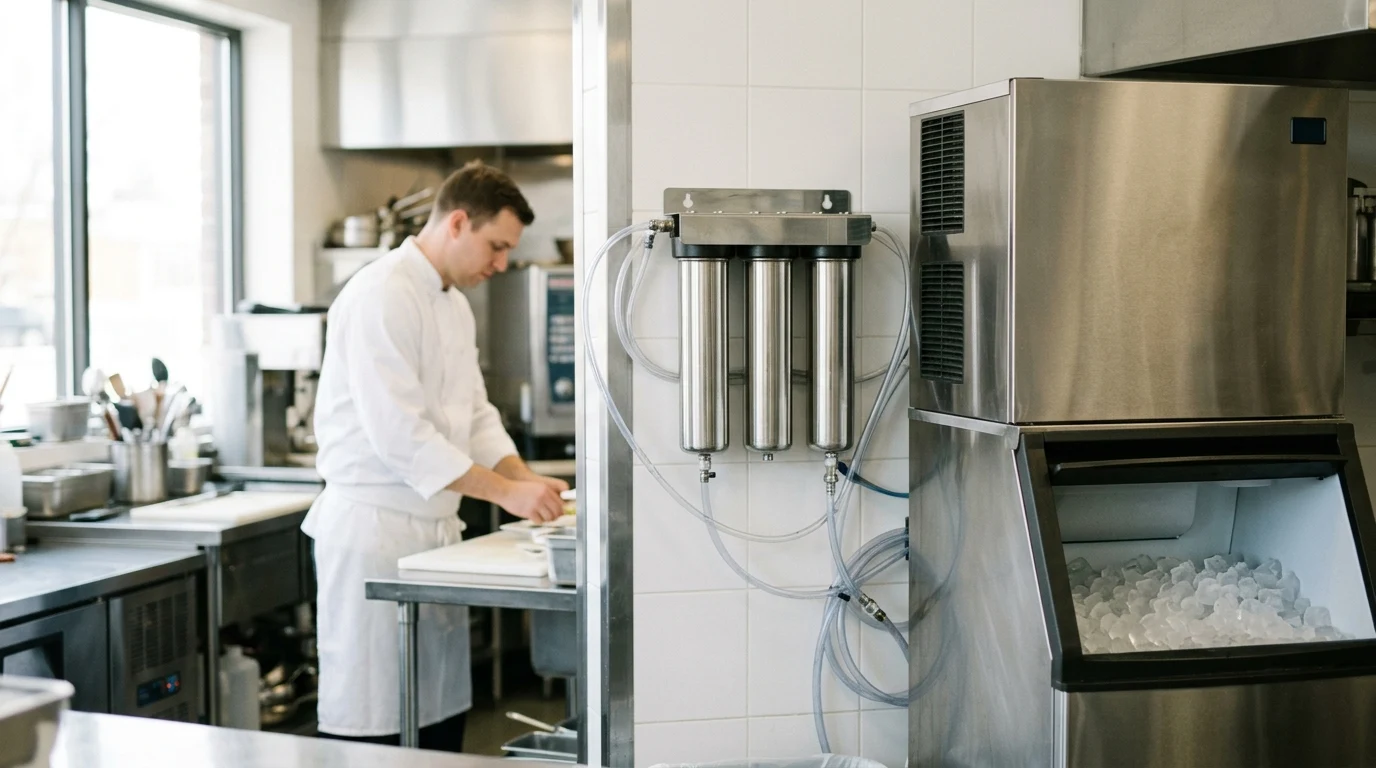
In 2026, most restaurant water filtration upgrades still don't start as a planned capital project. They start with a scale-clogged ice machine or a health inspector's note. Restaurant and food service water filtration systems typically cost $5,000 to $18,000 per location (Crestmont Capital, 2025), and that number rarely shows up on a budget line until something breaks.
Cash is already tied up in payroll, inventory, and rent, so a surprise five-figure quote stalls the fix, sometimes for weeks. This guide covers what restaurant water systems cost by equipment type and why the fix is more urgent than most operators realize. It also breaks down the financing structures that fit and how dealers use financing to close these jobs faster instead of losing them to a stalled decision.
> Key Takeaways
> - Restaurant water filtration systems typically cost $5,000-$18,000 per location, plus $100-$500 for an ice machine filtration system installed, and $40-$150 per replacement cartridge every six months (ICE MAKER SUPPLY pricing guide, 2026).
> - Nearly every commercial ice machine manufacturer requires filtered water for warranty coverage, which turns a filtration upgrade into a protection decision, not just a taste decision.
> - Equipment financing is restaurants' most common financing use, accounting for 35%-45% of all restaurant financing transactions, ahead of working capital and expansion needs (Crestmont Capital, Restaurant Financing Data, 2026).
> - Eos Loan is a direct lender offering flexible terms on water filtration financing, subject to approval and eligibility, and charges no dealer fee.
See how Eos Loan financing helps you close more projects
How Much Does a Restaurant Water Filtration System Cost?
Restaurant and food service water filtration systems typically run $5,000 to $18,000 per location for reverse osmosis and point-of-use setups, according to Crestmont Capital's equipment financing data (2025). Point-of-use filtration treats water at a single fixture, such as a beverage station or ice machine line, rather than the whole building's supply. Full-service kitchens that need whole-facility treatment instead land at the higher end of that range.
The gap between the low and high end comes down to scope. A quick-service location often only needs a compact point-of-use reverse osmosis unit tucked under a beverage station or coffee machine. A full-service restaurant, by contrast, needs whole-kitchen treatment covering ice, beverages, cooking water, and dish equipment at once. Ice machine filtration is usually a separate line item on top of that base system. It adds $100 to $500 per machine for the filtration system installed, plus $40 to $150 per replacement cartridge roughly every six months (ICE MAKER SUPPLY pricing guide, 2026).
For an operator running more than one location, that per-site cost multiplies fast. A five-unit quick-service group facing simultaneous filtration upgrades isn't looking at a $6,000 decision. It's looking at $30,000 or more across the portfolio, which is exactly the kind of number that pushes an operator toward financing instead of writing one large check.
Restaurant water filtration is one segment of a much wider cost range across commercial water projects generally, from a $1,000 point-of-use softener to a $280,000 food-manufacturer compliance build (Crestmont Capital, 2025). Compared to that spread, restaurant jobs sit toward the smaller, faster-moving end. They're also far more numerous, though, which is what makes this vertical valuable for a dealer building repeat business.
Why Do Ice Machines and Beverage Equipment Need Filtered Water?
Nearly every commercial ice machine manufacturer requires water filtration for warranty coverage (ICE MAKER SUPPLY pricing guide, 2026). Unfiltered water causes scale buildup that clogs heating elements and valves, which leads to costly repairs and downtime. That single fact turns filtration from a nice-to-have into a protection requirement, one most operators only learn about after a failure.
Scale doesn't announce itself. Mineral deposits build gradually inside a machine's water lines and heat exchanger, and by the time ice production slows or the unit trips offline, the damage is usually already done. A manufacturer can and does deny warranty claims tied to unfiltered water. As a result, a $10,000 ice machine failure can turn into an uncovered repair bill on top of the filtration system the operator should have installed in the first place.
In my experience as CEO of Eos Loan, I've seen this pattern play out the same way across dozens of restaurant deals: a quick-service location runs a busy summer weekend, the ice machine can't keep pace, and it trips out entirely by Monday. The technician's diagnosis is scale, not a mechanical defect. What I've watched happen next is the owner facing an emergency replacement and a filtration retrofit in the same week, with no time to shop cash reserves before the next rush.
| Project type | Typical installed cost |
|---|---|
| Quick-service point-of-use system | $5,000-$8,000 |
| Ice machine filtration (per machine) | $100-$500, plus $40-$150 per cartridge every ~6 months |
| Full-service kitchen (whole-facility) | Up to $18,000 |
| Hotel/hospitality facility-wide system (context) | ~$45,000 |
Sources: Crestmont Capital, 2025; ICE MAKER SUPPLY pricing guide, 2026.
Beverage quality carries the same stakes on a slower timeline. Scaled or chlorinated water changes how coffee, soda fountains, and cocktails taste, and returning customers notice even when they can't name why. Filtration protects the equipment first and the guest experience second, but both losses show up on the same P&L line eventually.
How Does Water Quality Affect Health Inspections and Compliance?
The FDA Food Code requires food establishments to maintain a safe, sufficient, and potable water supply designed to prevent backflow and contamination (FDA Food Code, 2022 edition). Health inspectors check this requirement as part of routine facility visits, so a flagged water system doesn't just create a compliance headache. It creates a deadline.
That's the difference between a planned upgrade and a reactive one. An operator who schedules filtration on their own timeline can shop quotes and financing options at leisure. An operator responding to an inspection note is working against a re-inspection clock, and the fix needs to happen fast, which is exactly the scenario where a slow financing process kills the deal instead of saving it.
Backflow prevention and potable water design aren't just paperwork requirements either. They protect the kitchen's actual water supply from contamination that could travel back into the building's plumbing, a risk that scales with the size and complexity of the kitchen's equipment. A single-location diner and a 40,000-square-foot banquet kitchen face the same FDA standard, just at very different equipment scales.
Restaurants are a repeat-purchase, reactive-trigger vertical unlike most residential water categories. Filter and cartridge replacement cadence, multi-location rollouts, and inspection-driven urgency create recurring dealer revenue that a one-time residential install never generates. As a result, it changes the sales conversation from "would you like an upgrade" to "here's how fast we can fix this."
Add financing to your installs, talk to our team
What Financing Structures Fit Restaurant Water Filtration Projects?
In 2026, equipment financing accounts for 35% to 45% of all restaurant financing transactions, more than any other single use, according to Crestmont Capital's restaurant financing data. Water filtration falls squarely inside that equipment-upgrade category, and it's one operators are increasingly financing rather than paying for out of pocket.
Industry-wide, restaurant equipment financing terms commonly span 24 to 72 months (Crestmont Capital, 2026). That structure spreads a five-figure system cost into a payment that fits inside monthly overhead instead of draining a cash reserve. Eos Loan, for example, offers flexible terms on water filtration financing tailored to the project and the applicant, subject to approval and eligibility; specific terms depend on underwriting, not a fixed published rate.
Speed matters as much as the term length here. When the trigger is a failed ice machine or an inspection note, an operator isn't shopping for the best rate over six weeks. They need a decision fast enough to hit their re-inspection window or get the ice machine back online before a weekend rush. A financing partner that can move quickly on approval is often the deciding factor over one offering a marginally better structure but a slower process.
How Does Section 179 Apply to Restaurant Water Filtration Equipment?
Section 179 is a federal tax provision that lets a business deduct the full purchase price of qualifying equipment in the year it's placed in service, instead of depreciating the cost over several years. The 2026 Section 179 deduction limit is $2,560,000 (Section179.org, 2026), meaning a restaurant or restaurant group can finance a water filtration system and still deduct the full equipment cost in the year it's placed in service. Financing the equipment doesn't disqualify it from the deduction. What matters, instead, is that the system is placed in service by December 31 of the tax year claimed.
The phase-out threshold sits at $4,090,000 for 2026, a ceiling that matters more for larger restaurant groups running simultaneous equipment purchases across several locations than for a single independent operator. For most single-location or small-group operators, a $5,000-$18,000 water filtration system falls well within the deductible range without approaching that phase-out.
This makes financing and Section 179 work together rather than against each other. An operator doesn't have to choose between preserving cash flow and capturing the deduction. Financing keeps the cash in the business, and the equipment still qualifies for the same-year write-off as long as it's installed and operating before year-end.
This is general information, not tax advice. Consult a qualified tax professional.
How Should Dealers Pitch Financing to Restaurant Customers?
Restaurants are a small-business-dominated vertical: 9 in 10 US restaurants have fewer than 50 employees (National Restaurant Association, National Statistics). That statistic matters because most owners feel a five-figure cash outlay directly, in their own operating account, not through a corporate finance department. That's exactly where leading with a payment option instead of a lump-sum quote wins the deal.
Present financing alongside the quote, not after it. An owner who's already emotionally committed to a $12,000 number before hearing about a monthly payment option has had time to talk themselves out of the project. Presenting both together, quote and payment side by side, keeps the conversation moving toward yes instead of "let me think about it."
Across the battery storage, EV charger, and water filtration deals I've reviewed as CEO, I've noticed restaurant and food service jobs consistently arrive as reactive, trigger-driven decisions rather than planned upgrades. In my view, that pattern should shape how a dealer opens the conversation: lead with urgency and affordability together, not price alone.
Multi-location and franchise operators add another layer of opportunity. A dealer who lands one location's ice machine job often finds four or five more locations behind it with the same aging filtration setup. Eos Loan is a direct lender, never a marketplace, broker, or platform that connects a deal to other lenders. It also charges no dealer fee, a real differentiator worth mentioning when a restaurant group is comparing financing partners across several locations at once.
For a full breakdown of how those other lenders' fees typically work, see how dealer fees work at other lenders.
Offer your customers flexible financing on essential projects
Where Does Restaurant Filtration Fit in Commercial Water Strategy?
Restaurant projects are one segment of the wider commercial water filtration market, which spans $1,000 point-of-use softeners to $280,000 food-manufacturer compliance builds (Crestmont Capital, 2025). Dealers already serving restaurants have an easy path to extend the same financing conversation into hotels, medical clinics, and food processors facing similar compliance and equipment-protection pressure.
For the full cross-vertical cost breakdown and financing structures across commercial water projects generally, see the commercial water filtration financing guide. For the step-by-step process of building a financing offer into a quote, see how dealers offer water filtration financing. For how a water test connects to a financed install from first visit to funding, see the water testing to financed install workflow, and for the complete dealer playbook on fees, funding speed, and credit bands across the water vertical, see the water treatment dealer financing guide. A different regulated vertical follows the same compliance-driven pattern: water filtration financing for schools and daycare facilities covers how EPA's lead-testing deadline is pushing districts and child-care centers toward the same financed, urgency-first buying pattern restaurants already show.
Restaurants make a strong entry point into commercial water because the trigger events (an ice machine failure, an inspection note) are common, urgent, and easy to recognize. A dealer who builds a financing process around that reactive pattern is building a repeatable, multi-location pipeline, not a one-off job.
Frequently Asked Questions
{ question: "How much does a restaurant water filtration system cost?", answer: "$5,000-$18,000 per location for reverse osmosis or point-of-use systems (Crestmont Capital, 2025), plus $100-$500 per ice machine for the filtration system installed and $40-$150 per replacement cartridge every six months (ICE MAKER SUPPLY pricing guide, 2026). Full-service kitchens with whole-facility treatment land toward the higher end." }, { question: "Why do commercial ice machines require water filtration?", answer: "Nearly every commercial ice machine manufacturer requires filtration for warranty coverage. Unfiltered water causes scale buildup that clogs heating elements and valves, leading to costly repairs, downtime, and potential denial of warranty claims." }, { question: "Can a restaurant finance water filtration equipment instead of paying cash?", answer: "Yes. Restaurant water filtration financing is available through direct lenders like Eos Loan with flexible terms tailored to the project, subject to approval and eligibility. Equipment financing is restaurants' most common financing use, accounting for 35%-45% of all restaurant financing transactions (Crestmont Capital, Restaurant Financing Data, 2026)." }, { question: "Does water quality affect health inspection results?", answer: "Yes. The FDA Food Code requires food establishments to maintain a safe, sufficient, and potable water supply designed to prevent backflow and contamination, and inspectors check this during routine facility visits (FDA Food Code, 2022 edition)." }, { question: "Does Section 179 apply to financed restaurant water filtration equipment?", answer: "Generally yes. Equipment placed in service by December 31 can be deducted up to the 2026 limit of $2,560,000, even if financed, with the deduction phasing out starting at $4,090,000 (Section179.org, 2026). This is general information, not tax advice; consult a qualified tax professional." } ]} />The Bottom Line for Restaurant Operators and Dealers
Restaurant water filtration is rarely a planned purchase. It's a reactive one, triggered by a scale-damaged ice machine or an inspection note, and the operator facing that trigger needs a fast answer, not a six-week financing process. Here's what to carry into the next restaurant water conversation:
- Systems typically cost $5,000-$18,000 per location, plus $100-$500 per ice machine for filtration installed and $40-$150 per replacement cartridge every six months.
- Filtration protects ice machine warranty coverage first and beverage quality second, both real costs if skipped.
- The FDA Food Code ties water quality directly to health inspection compliance, adding urgency to reactive fixes.
- Equipment upgrades are restaurants' top financing use case, and Section 179 lets financed equipment still qualify for a same-year deduction.
- Eos Loan is a direct lender with flexible terms and no dealer fee, subject to approval and eligibility.
Lead with speed and affordability together, present the payment option alongside the quote, and treat every ice machine failure or inspection note as the opening for a financing conversation, not a cash-only ultimatum.
Become an Eos Loan financing partner
Or call +1 833-989-3737 to talk through a financing program for your business.
About the author: Eduardo Donadi is CEO of Eos Loan, a US fintech direct lender. He helps installers and contractors offer point-of-sale financing on essential projects, including battery energy storage, EV chargers, and water filtration.