

How to Finance Home Battery Storage After the Tax Credit Ended
The 30% credit that made the math easy is gone. As of December 31, 2025, the residential clean-energy credit (Section 25D) no longer applies to property placed in service after that date, per the IRS. So the numbers a homeowner ran in 2024 no longer hold. Without the credit, the up-front price looks bigger, and a lot of people now assume a home battery is out of reach.
It is not. Financing was never the same thing as the credit, and it did not end with it. This guide walks through how to finance a home battery in 2026: the payment options you actually have, how the monthly payment works, and the exact steps to get started.
> Key Takeaways
> - The residential clean-energy credit (Section 25D) ended December 31, 2025 (IRS, 2025), but financing is separate and still available subject to approval.
> - Eos Loan offers battery energy storage terms from 6 to 240 months, so the cost spreads into a predictable monthly payment instead of one lump sum.
> - Term length is now the main affordability lever: a longer term lowers each monthly payment.
> - US residential storage still grew 92% in 2025 (Wood Mackenzie, 2025). This is general information, not tax advice; consult a qualified tax professional.
Offer your customers flexible financing on essential projects
Can you still finance a home battery after the tax credit ended?
Yes. The Section 25D residential clean-energy credit ended for property placed in service after December 31, 2025 (IRS, 2025), but financing is independent of the credit. Battery storage loans are still available in 2026, subject to approval and eligibility. The credit was a tax offset; financing is a payment structure. One ending did not end the other.
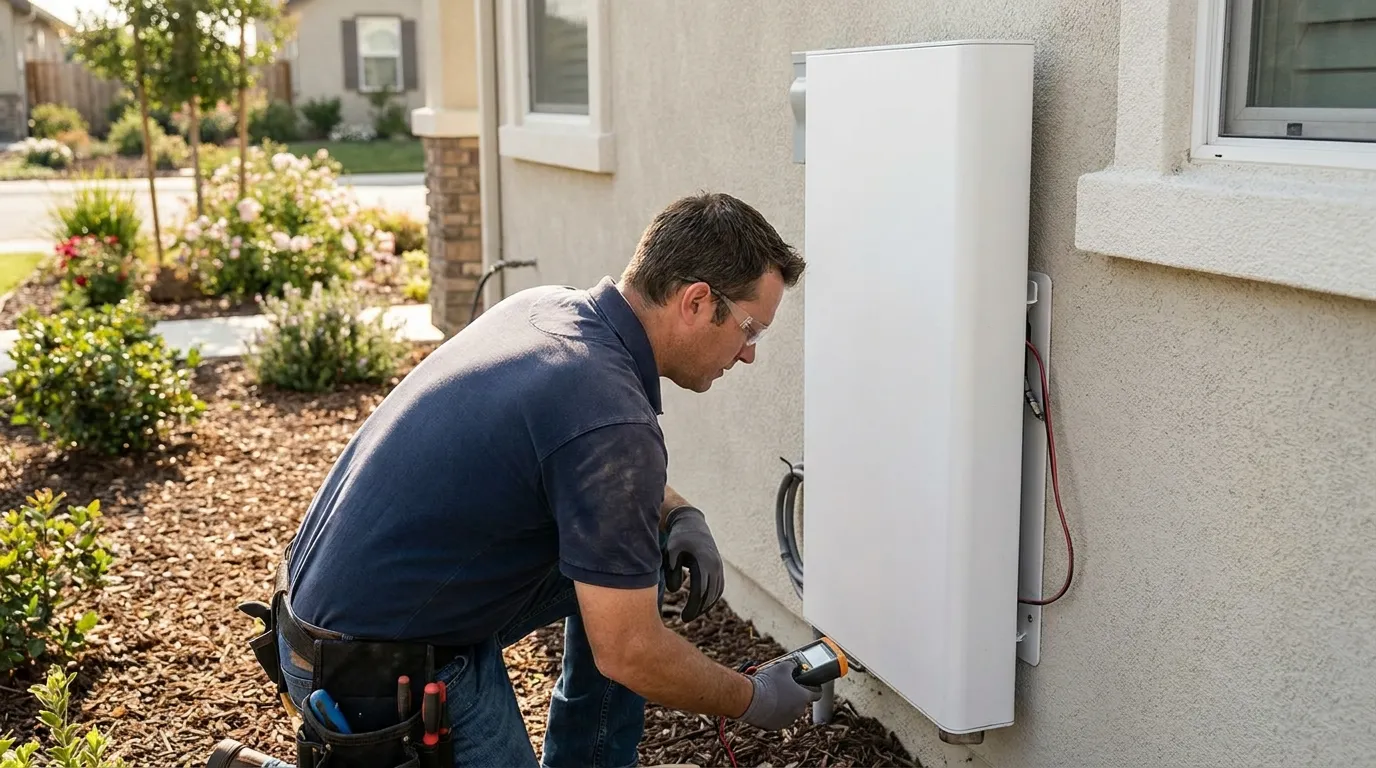
!A home battery storage unit mounted on an exterior house wall in daylight
Here is the precise distinction that earns trust. The credit reduced your tax bill after the system was placed in service. A loan changes how and when you pay for the system. The two never depended on each other, so a homeowner energizing a battery in 2026 simply pays through financing without the credit on top. Demand backs this up: US residential storage reached 2.7 GW in 2025, up 92% year over year (Wood Mackenzie, 2025), even as the credit was sunsetting.
You also do not need solar to qualify. A standalone home battery, with no panels attached, is financeable on its own. That matters because storage value comes from outage protection and shifting usage off peak rates, neither of which requires a solar array.
One note for readers who own a business. The residential 25D credit ended, but the commercial clean-electricity investment credit (48E) path generally remains available through 2032 (IRS / statute). That is a separate, business-side lever. For a home, the consumer credit is off the table, so financing is how the price stays reachable.
For the installer-side view of this same shift, see the contractor's post-tax-credit playbook. This is general information, not tax advice. Consult a qualified tax professional.
What payment options do you have for a home battery in 2026?
You have three main paths in 2026: pay cash, use a secured home-equity product, or take an unsecured battery storage loan. The loan route spreads the cost into fixed monthly payments, with terms from 6 to 240 months at Eos Loan, subject to approval. Each path trades off differently on collateral, speed, and flexibility.
Cash is the simplest on paper. You pay the full price once and owe nothing after. The catch is that it ties up a large chunk of savings in a single asset and drains the cushion you might want for emergencies.
A home-equity line or loan (a HELOC) borrows against your house. It can carry a competitive rate, but it places a lien on your home and the rate is often variable, so the payment can move. You are also putting the house itself on the line as collateral.
A purpose-built battery storage loan is unsecured against your home. It does not require home equity or a lien, and because it is built for these projects it can move faster through your installer at the point of sale. Here is how the three options compare on the attributes that decide the choice.
No rate, APR, or fee is quoted here on purpose, because those are set by underwriting, not published as a fixed number. The point is structure, not price. A dedicated battery storage loan keeps your home out of the collateral question and tends to move quickly through the installer. The point is structure: a battery loan turns the price into a payment without touching your home equity.
How does the monthly payment on a home battery work?
A battery loan converts the system price into a fixed monthly payment. The longer the term, the lower each payment, which is why term length is the main affordability lever now that buyers cannot offset 30% up front. Eos Loan terms run from 6 to 240 months, so the same system can carry very different monthly payments depending on the term you choose.
The mechanics are straightforward. The loan principal is the system price. That principal is spread across the number of months in your term. A shorter term packs the cost into fewer payments, so each one is larger. A longer term spreads it across more payments, so each one is smaller. The trade-off is that a longer term means more total months of financing cost, so it is a budget decision, not a free lunch.
This relationship is the whole game after the credit. When a homeowner could subtract 30% up front, the up-front number did the heavy lifting. Now the term does. Stretching to a longer term is what keeps the monthly figure inside a household budget. The chart below shows the relationship conceptually.
> What I'm seeing from installers in 2026: Since the credit lapsed, the most consistent pattern I hear is that the winning reps lead with the monthly payment, not the sticker price. Standalone-battery quotes are also coming through more often, because the resilience case stands on its own without the credit. The teams that retrained the pitch around the payment are the ones still booking installs. Eduardo Donadi, CEO, Eos Loan
That observation is a pattern, not a guarantee, but it lines up with the math. When the up-front discount disappears, the lever that remains is the term. Pick the term that lands the payment where your monthly budget actually sits.
See how Eos Loan financing helps you close more projects
How long are home battery loan terms, and why does that matter now?
Eos Loan offers battery energy storage terms from 6 to 240 months, a 20-year ceiling that is wider than most home-improvement loans. That range matters more in 2026 than it did before, because buyers can no longer offset 30% up front, so a longer term is what keeps the monthly payment in reach. The width of the range is the differentiator.
!A homeowner reviewing a battery storage financing proposal on a tablet in a sunlit kitchen
Why does a 240-month ceiling matter so much? Because it lets the payment match real life. A household on a tight monthly budget can stretch the term to bring the payment down. A homeowner who wants to own the system free and clear sooner can pick a shorter term and pay it off faster. The same system price fits very different budgets depending on where you land in that 6-to-240-month window.
Match the term to how long you plan to stay, too. If you expect to be in the home for the long haul, a longer term keeps cash free for other needs while you enjoy the battery. The flexibility is the point: the term is a dial you set, not a fixed number handed to you. Eos Loan has originated more than $4B across 30k+ proposals to date, and term flexibility is consistently part of what makes a payment work for a household.
For the deeper installer-facing version of this, see the complete 2026 guide to battery storage financing.
What steps do you take to finance a home battery?
Financing a home battery comes down to five steps: get a system quote from an installer, confirm the battery scope, choose a term that fits your budget, apply through the installer's Eos Loan financing, and schedule the install once approved. The process runs through your installer, and Eos Loan is a direct lender, not a marketplace, so the decision and the funds come from one source.
Here is the sequence in order.
1. Get a quote from a qualified installer. Have them size the battery for your home's usage and the outages you want to cover. The quote sets the system price, which becomes your loan principal.
2. Decide standalone battery or paired with solar. A battery works on its own for resilience and off-peak savings. If you have or plan solar, confirm whether you are financing the battery alone or as part of a larger scope.
3. Pick a term length. Choose from the 6-to-240-month range the term that lands the monthly payment where your budget sits. Shorter pays off faster; longer lowers the monthly figure.
4. Apply through your installer. Eos Loan financing is offered at the point of sale through the installer, so you apply right there. Because Eos Loan is a direct lender, the application goes to the lender directly, not out to a panel of third parties.
5. Get a decision and schedule the install. Approval is subject to eligibility. Once approved, the installer schedules the work, and your fixed monthly payment begins per the loan terms.
!An installer and a homeowner standing at a front door beside a home battery box in daylight
The simplest move on your end is to ask your installer about Eos Loan financing when you request the quote. That puts the payment option on the table from the start, so you are choosing a term instead of scrambling for funds after the price lands.
Should you finance the battery or pay cash after 2025?
It depends on what you value more: keeping savings liquid or avoiding financing cost. Cash avoids that cost but ties up capital and drains your cushion. Financing preserves savings and turns a large up-front number into a predictable payment, which is why more homeowners lean toward financing now that the credit no longer softens the up-front hit. US residential storage still grew 92% in 2025 (Wood Mackenzie, 2025), credit or not.
Think about opportunity cost. Money spent in full on a battery is money not in your emergency fund or earning elsewhere. For many households, keeping that cushion intact is worth spreading the project into a monthly payment they can plan around.
Predictability is the other half. A fixed monthly payment is easy to budget against, the same way you already budget for a utility bill. Cash makes sense if you have surplus capital you are happy to commit and you want no monthly obligation. Neither choice is universally right; this is a personal call, not financial advice. For a side-by-side on the decision, see financing versus paying cash.
How home battery financing fits the bigger picture
A home battery is one of several essential projects homeowners finance through their installer, alongside EV chargers and water filtration. The same payment approach applies across all of them, and Eos Loan is a direct lender for each. That means one financing conversation can cover more than one project in a single appointment.
This is useful context an installer can share. A homeowner adding battery storage might also want an EV charger in the garage or water filtration for the house. Because the financing structure is the same, the payment-based approach scales from one project to several without changing the math the homeowner has to follow. For installers, that is how a single close grows into a larger one, which is part of offering customer financing as an installer.
The throughline is simple. After the credit, the monthly payment is the lever that keeps essential projects reachable, and a direct lender that decides at the point of sale keeps the process fast. The credit ended; the path to a home battery did not.
Add financing to your installs, talk to our team
Or call +1 833-989-3737 to talk through a financing program for your business.
Frequently Asked Questions
Can you still finance a home battery now that the tax credit ended?
Yes. The Section 25D residential clean-energy credit ended for property placed in service after December 31, 2025 (IRS, 2025), but financing is separate and still available subject to approval. US residential storage still grew 92% in 2025 (Wood Mackenzie, 2025). This is general information, not tax advice; consult a qualified tax professional.
What are the monthly payments on a home battery?
They depend on the system price and the term you choose. A longer term spreads the cost across more months, so each payment is lower; Eos Loan terms run up to 240 months. No rate or dollar amount is quoted here, and financing is subject to eligibility. Ask your installer for a quote tied to your specific system.
Do you need home equity to finance a battery?
Not with a purpose-built battery storage loan. Unlike a HELOC, it does not require home equity or a lien on your house, and it can move faster through your installer at the point of sale (subject to approval). A home-equity product is one option, but it is not the only one, and it puts your home up as collateral.
How long are home battery loan terms?
Eos Loan offers battery energy storage terms from 6 to 240 months, a 20-year ceiling that is wider than most home-improvement loans. That range lets you set the term that lands your monthly payment where your budget sits, whether you prefer a faster payoff or a lower monthly figure. Terms are subject to approval and eligibility.
Is it better to finance or pay cash for a battery after the credit ended?
Financing preserves your savings and gives you a predictable monthly payment; cash avoids financing cost but ties up capital. After the Section 25D credit ended December 31, 2025 (IRS, 2025), more homeowners lean toward financing to keep the up-front hit manageable. This is general information, not financial or tax advice.
The takeaway for homeowners
The headline is simple. The residential clean-energy credit (Section 25D) ended December 31, 2025 (IRS), but financing did not end with it. You can still finance a home battery in 2026, and the term you choose, anywhere from 6 to 240 months at Eos Loan, is now the main lever that keeps the monthly payment reachable.
The five steps are clear: get a quote, confirm the battery scope, pick a term, apply through your installer, and schedule the install once approved. Ask your installer about Eos Loan financing when you request the quote, and you turn a big sticker price into a payment you can plan around. This is general information, not tax advice; consult a qualified tax professional.
---
Written by Eduardo Donadi, CEO of Eos Loan. Eos Loan is the fintech built to finance essential projects (battery energy storage, EV chargers, and water filtration) for installers, contractors, and resellers across the United States.
Sources
- IRS, Residential Clean Energy Credit (Section 25D), retrieved 2026-06-05, https://www.irs.gov/credits-deductions/residential-clean-energy-credit
- Wood Mackenzie, US energy storage monitor (2025 full-year figures: 18.9 GW total, +52% YoY; residential 2.7 GW, +92% YoY), retrieved 2026-06-05, https://www.woodmac.com/
- Eos Loan, originations and proposals to date ($4B+ originated, 30k+ proposals processed), internal data, retrieved 2026-06-05