

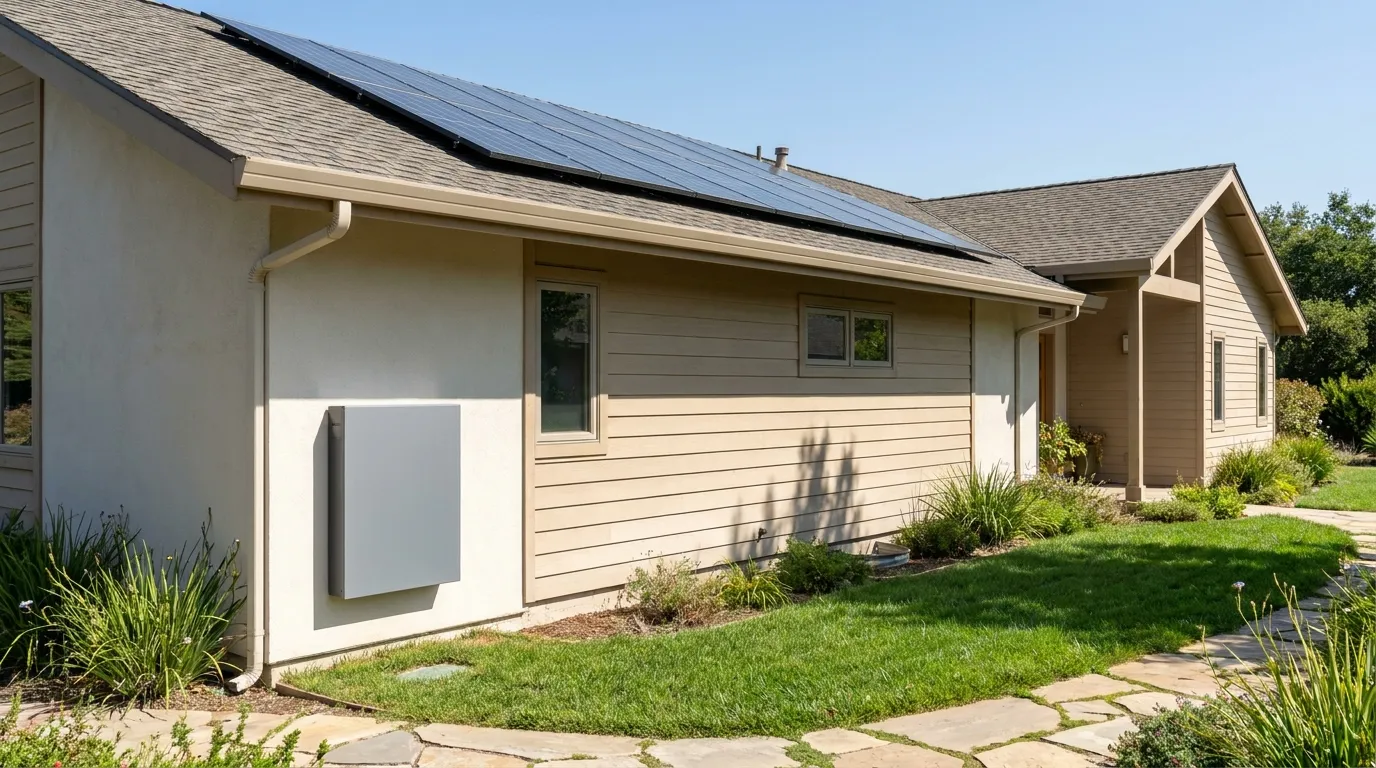
Not long ago, a home battery was something you tacked onto a solar quote. That is no longer how the market works. US residential storage reached 2.7 GW in 2025, up 92% year over year (Wood Mackenzie, 2025), and a growing share of those batteries were sold on their own, often retrofit onto homes that already have panels. For installers and homeowners, that raises a practical question: can you finance a battery by itself, and how does that loan differ from bundling it into a solar-plus-storage deal?
This comparison answers both. It walks through how each financing structure is built, lays the two paths side by side, and gives you a simple rule for which one to lead with.
> Key Takeaways
> - Standalone battery storage is now its own product. US residential storage grew 92% year over year in 2025 (Wood Mackenzie, 2025).
> - A battery-only loan finances one product on its own value case; a solar-plus-storage loan bundles two products into one larger ticket.
> - Eos Loan finances battery energy storage on terms from 6 to 240 months, subject to approval and eligibility.
> - The right structure usually depends on whether solar already exists on the roof, not on price alone.
See how Eos Loan financing helps you close more projects
Can you finance a battery without solar?
Yes. Standalone battery storage is financed as its own product, on its own value case, and the category is growing fast: US residential storage rose to 2.7 GW in 2025, up 92% year over year (Wood Mackenzie, 2025). A homeowner does not need panels on the roof to finance a battery, and many now buy one without ever adding solar.
!A wall-mounted residential battery storage unit installed in a daylit garage
Why does a battery stand on its own? The value drivers live outside any solar system. Outage protection when the grid drops. Lower bills by shifting usage away from peak-rate hours. Better day-to-day economics as net-metering rules shift and pay less for exported power. None of those benefits require a panel on the roof to be real.
Then there is the retrofit case, which is quietly large. A homeowner with existing solar often wants storage added later, after the original install. Financing that battery on its own keeps the original solar loan untouched and treats the new product as exactly that: a new product with its own payment. In 2026, that retrofit path is a meaningful slice of what installers are quoting.
According to Wood Mackenzie, US residential storage reached 2.7 GW in 2025, a 92% jump over the prior year (Wood Mackenzie, 2025). That growth tells installers something direct: the battery sells as a standalone product, and financing it as one is now a normal, fundable transaction rather than an exception.
How is standalone battery financing structured?
A standalone battery loan finances one product against its own value, and Eos Loan offers battery energy storage on terms from 6 to 240 months, subject to approval and eligibility. The ticket covers a single product, the underwriting reviews one project, and the payment is sized to that battery alone, not a bundle.
The structure has a practical advantage for retrofit work. When a home already has solar with its own financing in place, a standalone battery loan does not disturb that arrangement. The original loan keeps running; the new battery gets its own clean payment. That separation is often exactly what a homeowner with existing panels wants.
Term flexibility is where this structure earns its keep. With battery energy storage terms running from 6 to 240 months, you can stretch a payment far enough that the monthly figure sits comfortably against a homeowner's current utility bill. That comparison, payment against bill, is what closes a battery-only deal.
A word on tax handling, because it changed. The residential clean-energy credit (Section 25D) ended for property placed in service after December 31, 2025 (IRS, 2025). Do not frame a battery loan as a credit, rebate, or incentive; it is financing. This is general information, not tax advice. Consult a qualified tax professional.
How is solar-plus-storage financing different?
A solar-plus-storage loan bundles two products, panels and a battery, into one larger ticket financed together. Instead of two separate transactions, the homeowner signs once for a combined project, and the installer raises average project size in a single close. Total US storage deployment hit 18.9 GW in 2025, up 52% over the prior year (Wood Mackenzie, 2025), and much of that volume rode in on bundled new-build projects.
The timing is usually different too. Solar-plus-storage fits the new-build scenario: a home with no system yet, where panels and a battery go in together. One underwriting event covers both products. One payment, spread across the term, covers the whole scope.
That single combined ticket is the installer's upside. A bundled project is larger than a battery alone, so the average deal size climbs. The trade-off is that the bundle assumes you are also selling the solar, which is why it fits new solar customers far better than it fits homes that already have panels.
For the full picture on how to fund either path, see the complete battery storage financing guide.
Standalone battery vs solar-plus-storage: side-by-side
The core difference is scope. Battery-only finances one product on its own value; solar-plus-storage finances two products together as a single larger ticket. Everything else, the typical home, the underwriting, the best-fit customer, follows from that one distinction. US residential storage grew 92% in 2025 (Wood Mackenzie, 2025), and both structures are funding that growth.
| Attribute | Standalone battery | Solar-plus-storage |
|---|---|---|
| Products financed | One (battery) | Two (solar + battery) |
| Typical home | Existing solar, or no solar wanted | No system on the roof yet |
| Project type | Retrofit-friendly | New-build fit |
| Ticket size | Single product | Larger, bundled |
| Underwriting events | One | One, covering both products |
| Term flexibility | 6 to 240 months (Eos Loan storage) | Flexible terms |
| Best-fit customer | Adding storage to an existing home | Buying solar and storage together |
The table makes the decision visible. If a homeowner already has panels, or only wants a battery, the standalone path keeps things clean and leaves any existing solar financing alone. If there is nothing on the roof yet and the homeowner wants the full system, the bundle raises ticket size and closes both products in one motion.
Notice what does not appear in the table: a rate. The structure that fits a customer is a separate question from price, and price is never a fixed number here. Financing is subject to approval and eligibility, and we never quote a specific APR or fee.
Offer your customers flexible financing on essential projects
Which structure should an installer lead with?
Lead with standalone battery for retrofit homes that already have solar, and lead with solar-plus-storage when there is no system on the roof yet. The deciding factor is the home's existing assets, not the headline price. US residential storage grew 92% in 2025 (Wood Mackenzie, 2025), and a large part of that came from retrofit batteries on solar homes.
!An installer and a homeowner reviewing a financing proposal at a table in a sunlit room
Here is the reframe that matters. Most coverage asks which option is cheaper, but that is the wrong first question. The first question is what is already on the roof. A home with panels almost forces the standalone path, because bundling solar a customer already owns makes no sense. A home with nothing yet favors the bundle, because you can close both products together and raise the ticket.
> What I'm seeing from installers in 2026: A steady rise in retrofit battery quotes for homes that already have solar. The reps who handle these best do not try to refinance the original solar deal. They keep that loan untouched and write the battery as its own standalone payment. It is cleaner for the homeowner, and it tends to close faster because nothing about the existing system has to change. Eduardo Donadi, CEO, Eos Loan
The installer upside cuts both ways. On a new-build home, leading with solar-plus-storage raises average ticket size in one appointment. On a solar home, leading with a clean standalone battery removes the friction of touching an existing loan, which keeps the deal moving. Either way, financing at the point of sale is what turns a quote into a close, and Eos Loan has originated $4B+ across 30k+ proposals to date (Eos Loan internal data, 2026).
What about adding an EV charger or water filtration to the ticket?
Either path can grow when a single appointment covers more than one essential project, and Eos Loan finances battery energy storage, EV charger, and water filtration, which turns one close into a larger one. A homeowner already financing a battery is often the same homeowner who wants a charger in the garage or filtration for the house.
The mechanics are simple. Once financing is on the table, adding a second or third essential project to the same ticket spreads more value across one monthly payment. That raises ticket size for the installer without requiring a separate sale on a separate day.
Keep the scope to essential projects and keep the terms canonical. Battery energy storage runs 6 to 240 months; the EV charger and water filtration carry flexible terms, subject to approval and eligibility. Bundling these into one financed appointment is one of the most direct ways an installer lifts average deal size in 2026.
Become an Eos Loan financing partner
Or call +1 833-989-3737 to talk through a financing program for your business.
Frequently Asked Questions
Can you finance a battery without solar?
Yes. Standalone battery storage is financed on its own value case, resilience and time-of-use savings, with no panels required. The category is growing fast: US residential storage reached 2.7 GW in 2025, up 92% year over year (Wood Mackenzie, 2025). Financing is subject to approval and eligibility.
Is standalone battery financing or solar-plus-storage cheaper?
It depends on scope, not a fixed rate, and we never quote an APR or fee. A battery-only loan finances one product; a solar-plus-storage loan bundles two into a larger ticket. The better question is what is already on the roof. For a deeper walkthrough, see financing a home battery after the tax credit.
How long are standalone battery loan terms?
Eos Loan offers battery energy storage on terms from 6 to 240 months, subject to approval and eligibility. That long-term flexibility lets you size a monthly payment against a homeowner's current utility bill, which is the comparison that closes a battery-only deal. EV charger and water filtration carry flexible terms as well.
Does the tax credit affect this choice?
The residential clean-energy credit (Section 25D) ended for property placed in service after December 31, 2025 (IRS, 2025). It no longer favors one structure over the other for new residential work. Do not treat financing as a credit. This is general information, not tax advice; consult a qualified tax professional.
The takeaway for installers
The choice comes down to scope and existing assets. A standalone battery loan finances one product on its own value and fits retrofit homes that already have solar, keeping the original financing untouched. A solar-plus-storage loan bundles two products into a larger ticket and fits new-build homes with nothing on the roof yet. Demand supports both: US residential storage grew 92% year over year in 2025 (Wood Mackenzie, 2025).
Pick the structure by what the home already has, lead with the monthly payment, and bundle in an EV charger or water filtration where it fits. Talk to our team about adding financing to your installs, backed by a direct lender that decides at the point of sale.
---
Written by Eduardo Donadi, CEO of Eos Loan. Eos Loan is the fintech built to finance essential projects (battery energy storage, EV chargers, and water filtration) for installers, contractors, and resellers across the United States.
Sources
- Wood Mackenzie, US energy storage monitor (2025 full-year figures: 18.9 GW total, +52% YoY; residential 2.7 GW, +92% YoY), retrieved 2026-06-05, https://www.woodmac.com/
- IRS, Residential Clean Energy Credit (Section 25D), retrieved 2026-06-05, https://www.irs.gov/credits-deductions/residential-clean-energy-credit
- Eos Loan, originations and proposals to date ($4B+ originated, 30k+ proposals processed), internal data, retrieved 2026-06-05