

Hiring a Driver Before or After the Truck: Sequencing the Risk
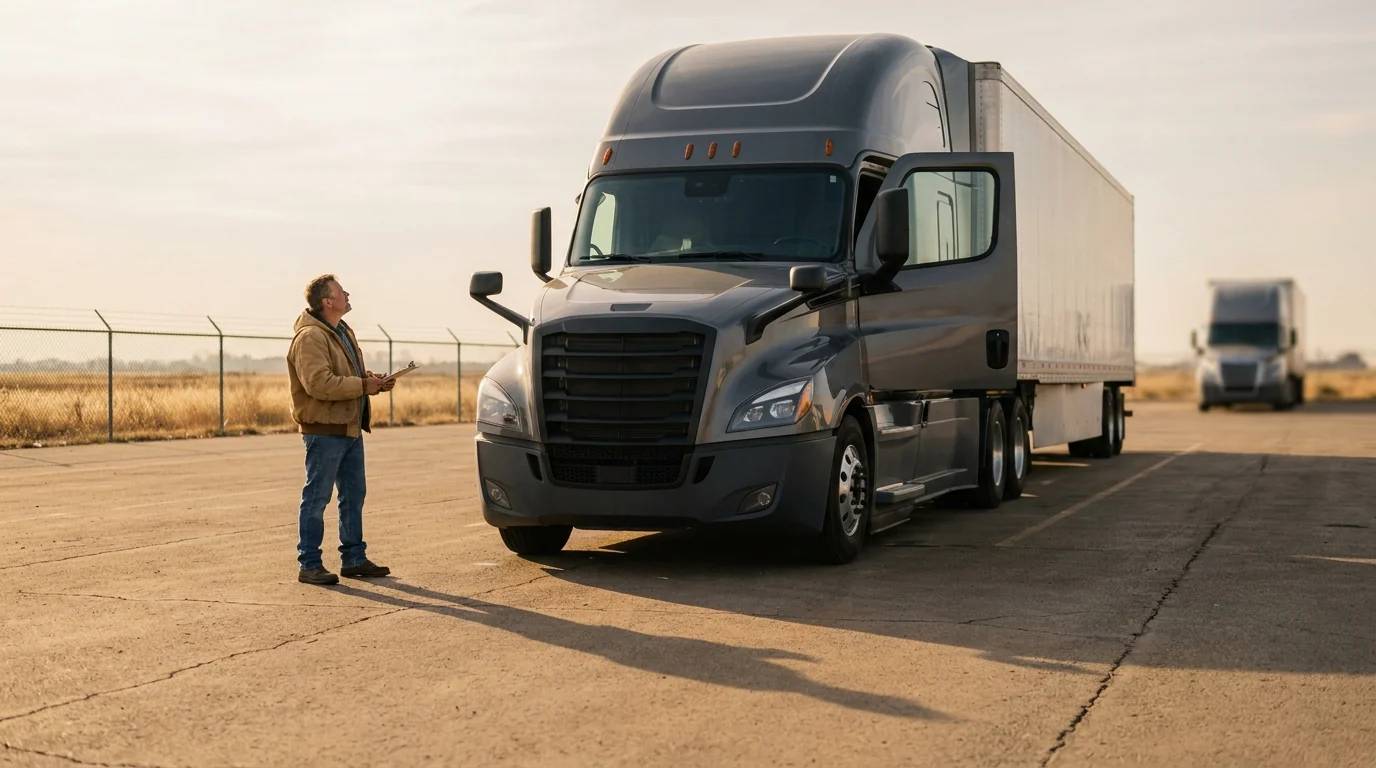
This page is about two commitments that have to land together: the truck itself, the tractor or straight truck your business will run, and the person who will sit in it. Which one do you sign for first?
In its 2025 to 2035 projections, the Bureau of Labor Statistics expects about 214,500 annual openings for heavy and tractor-trailer truck drivers, while total employment across the decade grows by only about 83,800 positions (BLS, 2025-35 projections). Nearly all of that hiring is churn, not expansion.
That one reading changes the sequencing question. Hire early and you carry a wage line against no revenue. Buy early and you carry a unit against no miles. Below: what each side of the mistake costs, how long each clock really runs, and how to overlap them.
> Key Takeaways
> - BLS projects about 214,500 annual openings for heavy and tractor-trailer drivers against roughly 83,800 net new jobs over 2025 to 2035, so about 96% of hiring is replacement (BLS, 2025-35 projections).
> - Median pay was $58,640 in May 2025, with the lowest 10% under $40,140 and the highest 10% above $79,380 (BLS, May 2025).
> - Carriers in ATRI's 2025 data cut truck counts 2.4% and still left about 10% of trucks unseated, with truckload operating margins under 1% (ATRI, July 2026).
> - Eos Loan is a direct lender with flexible terms and no dealer fee, subject to approval and eligibility.
Talk to our team about financing your next truck
Should you hire the driver before or after you buy the truck?
Neither, in the way the question is usually asked. Running the two commitments one after the other guarantees a gap, and the gap is where the money goes. In June 2025, the American Trucking Associations counted almost 580,000 active US motor carriers, and 91.5% of them run 10 or fewer trucks (ATA, June 2025).
At that size there is no recruiting department absorbing the wait. The owner is the recruiter, the buyer, and usually the backup driver. So the real question is not which commitment is safer. It's which one takes longer, because that is the one you have to start first.
!Class 8 sleeper tractors parked in a carrier yard in daylight with no drivers present.
Both failure modes are real and both are expensive. A financed unit with nobody in it pays insurance, registration and a payment while producing nothing. A qualified driver hired with no unit to run either sits on payroll or walks, and in a churn market the second one happens fast.
The answer this post argues for is an overlap, not an order. Run both clocks at once and aim them at the same two-week window, so the seat is filled inside the same fortnight the unit is plated. Which clock you start first depends entirely on which one is longer for your purchase.
One thing this page does not cover. Whether the freight market is telling you to buy at all is a separate question, and we treat it separately in when to finance a truck against the freight market. Assume here that you have already decided to add the unit.
What does a truck actually cost while it sits?
More than most operators expect, because the expensive part of an idle unit is the part that ignores the odometer. In its 2025 data, ATRI found carriers cut truck counts by 2.4% and still ran roughly 10% of their trucks unseated, while truckload operating margins sat below 1% (ATRI, July 2026).
Split your costs into two piles and the problem becomes obvious. One pile accrues on a calendar: the equipment payment, the insurance premium, apportioned registration, permits and filings. The other accrues on an odometer: fuel, tires, wages, most maintenance. Parking the truck shuts off the second pile and not one line of the first.
That would be survivable if the rest of the operation had a cushion. It mostly doesn't.
Read the truckload bar as a sentence rather than a number. At an operating margin of 0.4%, there is no slack anywhere else in the business to quietly carry a unit that isn't producing. The payment lands on the same account a working truck is barely clearing. Tank carriers at 4.0% have a little more room. Flatbed carriers at -0.5% have none at all.
This is also why sizing comes before sequencing. If you have not yet run the new payment against your existing revenue, start with sizing a second payment while the first one runs, then come back to the seat.
What does hiring early cost if the truck is not ready?
A wage line against zero revenue, and almost nobody in the recruiting literature prices it. BLS put the median annual wage for heavy and tractor-trailer truck drivers at $58,640 in May 2025, with the lowest 10% earning under $40,140 and the highest 10% above $79,380 (BLS, May 2025).
Every article on this topic tells you to lock the driver in first, and every one of them presents that as the free option. It isn't. You have exactly two ways to hire ahead of a truck. Carry the payroll while the unit is still in transit, which is a cost you can compute today. Or ask an experienced driver to wait without pay, which is how you lose them.
!A carrier owner standing beside a parked tractor in a daylight yard, reviewing driver paperwork.
Pay is also a lever on the clock itself, and that is the part operators underuse. The spread between $40,140 and $79,380 is the range you are competing inside, and you are not only competing against other carriers. In May 2025, BLS put median driver pay at $60,320 in truck transportation, $58,550 in wholesale trade, $56,570 in manufacturing and $56,080 in construction (BLS, May 2025).
So a seat that fills slowly at one number may fill quickly at another. That trade is worth pricing against a week of idle payment before you decide the market is simply empty.
See what financing a fleet expansion could look like
How long does each clock actually run?
Both run longer than the calendar in your head, and they are not the same length. Entry into the occupation typically requires a commercial driver's license plus a professional truck driving program of three to six months (BLS, 2026). "We'll find somebody" is a plan with no duration attached to it.
Here is the two-clock test. Write both columns on one page before you sign anything.
The unit clock
- Order-to-delivery on a factory build, or lot-to-plated on a used purchase
- Title work and apportioned registration
- Adding the power unit to your insurance policy and any required filings
- ELD provisioning before the truck turns a wheel
- Sourcing and screening candidates
- The driver qualification file required under 49 CFR Part 391
- A pre-employment query against the FMCSA Drug and Alcohol Clearinghouse
- MVR review, road test, and orientation on your equipment and your lanes
- An idle unit shuts off mileage costs and none of the calendar costs, and at a 0.4% truckload margin there is nothing to absorb it.
- Hiring early is not the free option. It is either payroll against no revenue or an unpaid wait, and the unpaid wait usually costs you the driver.
- The two-clock test is the tool: unit column, seat column, no invented durations, longer clock starts first.
- About 96% of projected openings are replacements, calculated from BLS figures, so a seat filled early is not a seat held.
- A specific seat plan makes an added-unit file legible, whatever else is in it.
The seat clock
Notice that neither column has a number beside it. That is deliberate. Lead times move with spec, dealer, state and local labor supply, and no source I would cite supports a week count that applies to your purchase. The exercise is not meant to predict the durations. It is meant to tell you which column is longer for you, this time.
Then the rule. Start the longer clock first, start the shorter one at the point where both finish inside the same two-week window, and work the paperwork column alongside them, because adding a power unit to your authority has its own filing sequence.
!New Class 8 tractors lined up on a dealer lot in bright daylight, waiting on delivery.
One spec decision shortens the seat clock directly: staying under 26,001 lbs GVWR changes which license the seat requires and therefore which labor pool you are fishing in, which we cover in how weight class changes which license the seat needs.
Is the driver shortage the reason your seat is empty?
Usually not in the way the phrase implies. BLS projects about 214,500 annual openings for heavy and tractor-trailer truck drivers over 2025 to 2035, against roughly 2.2 million jobs held in 2025, with employment growing 4%, or about 83,800 positions across the decade (BLS, 2025-35 projections).
Do the arithmetic, because the search results almost never do. About 214,500 openings a year across ten years is roughly 2,145,000 openings. Only about 83,800 of those are new positions. That leaves roughly 96% of projected openings as replacements rather than growth, calculated from the BLS figures above rather than published by BLS as a single statistic.
Two consequences follow, and they are the reason this post exists. First, your hire is somebody else's departure, which means yours can be too. Second, the constraint was never the national headcount. It's the count of qualified people available in the week your unit arrives, in your lanes, at your pay.
Churn data makes that concrete. ATRI's 2025 figures put driver turnover at 44.2%, an improvement from 48.0% in 2024, alongside an average truck age that rose to 3.6 years (ATRI via Heavy Duty Trucking, July 2026). Turnover falling and still sitting above 40% is what a churn market looks like. A seat filled early is not a seat held.
How does the sequencing decision change what a lender sees?
It changes how legible the file is. Eos Loan has originated $4B+ to date and processed 30k+ proposals, and across that volume the pattern on added-unit applications is consistent: a specific seat plan reads differently from an open one. A named driver, a driver moving over from the unit you already run, or a documented lane the owner will cover personally are all specific. "We'll find somebody" is not.
I'll say this plainly from the underwriting side of the desk. When I read a file for an added unit, the seat question is the one I want answered before anything else, because it is the difference between a truck with revenue behind it and a payment with a hope behind it. A specific answer does not change the credit criteria. It changes how much of the plan I have to infer.
Eos Loan is a direct lender. We originate, underwrite and service in-house, so you deal with one team from application through funding rather than being passed between parties. Terms are flexible and sized to the truck and the operation, and Eos Loan charges no dealer fee. Every application is subject to approval and eligibility.
If this is a first purchase rather than an addition, what a first truck file needs ready covers the documentation. For the whole picture, how truck fleet financing works for carriers adding capacity is the pillar, and you can read who we are before you call.
One clarification, since "fleet" gets used two ways. This page is about buying a vehicle. If you are also putting chargers in at a yard, financing charging equipment at a yard is a separate project on a separate timeline.
Ask about flexible terms on a truck purchase
Or call +1 833-989-3737 to talk through an added unit with our team. More common financing questions are answered on our FAQ page.
{ question: "Should I hire a driver before buying a truck?", answer: "Neither strictly first. Hiring ahead means payroll against zero revenue, or an unpaid wait that loses the driver. Buying ahead means a payment, insurance and registration on a unit producing nothing. Start whichever clock is longer for your purchase, then start the other so both land in the same two-week window." }, { question: "How long does it take to hire a CDL driver?", answer: "There is no reliable industry number, because it moves with pay, lanes and local supply. The sequence is fixed: sourcing, the driver qualification file under 49 CFR Part 391, a Clearinghouse pre-employment query, MVR and road test, then orientation. A new entrant also needs a CDL plus a three to six month driving program (BLS, 2026)." }, { question: "How much do truck drivers get paid?", answer: "BLS reported a median annual wage of $58,640 for heavy and tractor-trailer truck drivers in May 2025, with the lowest 10% under $40,140 and the highest 10% above $79,380. By industry, median pay ran $60,320 in truck transportation and $56,080 in construction (BLS, May 2025)." }, { question: "Is the driver shortage getting better?", answer: "Turnover improved to 44.2% in 2025 from 48.0% in 2024 (ATRI, July 2026), but the structure has not changed. BLS projects about 214,500 annual openings for 2025 to 2035 against roughly 83,800 net new jobs, so about 96% of openings are replacements. That is a churn market, not an expanding one." } ]} />Two clocks, one window
The sequencing question has a better answer than either absolute the industry hands you.
Write both clocks on one page, start the longer one, and aim them both at the same fortnight. When the two land together, financing for trucks and fleet expansion is a conversation, not a form.
---
About the author: Eduardo Donadi is the CEO of Eos Loan, a US direct lender financing essential projects including truck fleet expansion, battery energy storage, EV chargers, and water filtration. He works directly with carriers, owner-operators, and distributors on how equipment purchases get structured and funded.
---
Sources
1. US Bureau of Labor Statistics. "Heavy and Tractor-Trailer Truck Drivers, Occupational Outlook Handbook." May 2025 wage data and 2025-35 projections. Retrieved 2026-09-08. https://www.bls.gov/ooh/transportation-and-material-moving/heavy-and-tractor-trailer-truck-drivers.htm
2. American Transportation Research Institute. "New ATRI Report Details Accelerating Costs and Low Profitability Despite Cuts." July 2026. Retrieved 2026-09-08. https://truckingresearch.org/2026/07/new-atri-report-details-accelerating-costs-and-low-profitability-despite-cuts/
3. Heavy Duty Trucking. "ATRI: Average Truck Operating Cost Reaches Record $2.336 Per Mile." July 2026. Retrieved 2026-09-08. https://www.truckinginfo.com/news/trucking-fleets-faced-record-operating-costs-during-third-year-of-freight-recession
4. American Trucking Associations. "Economics and Industry Data." June 2025. Retrieved 2026-09-08. https://www.trucking.org/economics-and-industry-data
5. Federal Motor Carrier Safety Administration. "49 CFR Part 391, Qualifications of Drivers." Retrieved 2026-09-08. https://www.fmcsa.dot.gov/regulations/title49/part/391