

How to Finance a Second Truck Without Stalling the First One
Going from one truck to two is the most common expansion in American freight. This page is about how to finance a second truck, the vehicle itself, a tractor or a straight truck, not equipment installed at a yard. In June 2025, the American Trucking Associations counted almost 580,000 active motor carriers registered with FMCSA, and 91.5% of them operate 10 or fewer trucks (ATA, June 2025).
The trouble is that truck one is doing three jobs at once: collateral, credit history, and the whole revenue base. Size truck two wrong and all three are exposed.
So here is the practical version. What a lender reads on the second file, how to size payment two while payment one runs, and the reserve test before you sign.
> Key Takeaways
> - Almost 580,000 active US motor carriers are registered with FMCSA and 91.5% run 10 or fewer trucks, so one-to-two is the industry's normal growth step (ATA, June 2025).
> - Your first truck is the strongest document in the file: settlements, maintenance records, and time in operation are evidence a first-time buyer cannot produce.
> - Driver pay is the largest recurring cost in truck two, at 81.8 cents per mile in wages plus 21.0 cents in benefits, inside a record $2.336 total (ATRI, July 2026).
> - Eos Loan is a direct lender with flexible terms and no dealer fee, subject to approval and eligibility.
See what financing a fleet expansion could look like
What actually changes when you finance a second truck?
On truck one, a lender is underwriting a person with a plan. On truck two, it is underwriting a business with results. With 91.5% of the almost 580,000 active US carriers running 10 or fewer trucks (ATA, June 2025), this is the sector's default growth step, not an edge case.
That shift is the whole story, and almost nobody says it out loud. File one leans on personal credit and a story about the freight you intend to run. File two leans on what you actually did. The story is checkable now, which helps if the numbers are good and hurts if they are not.
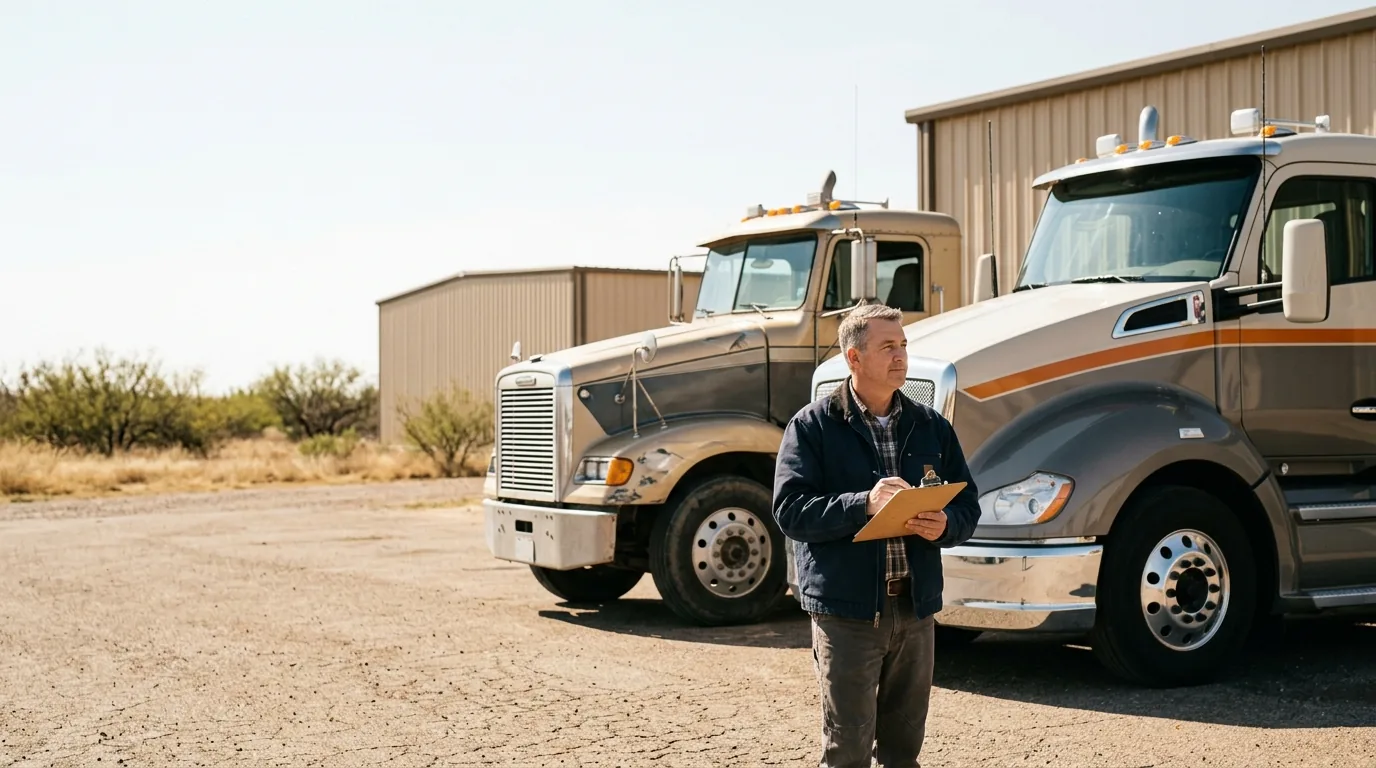
!Two Class 8 sleeper tractors parked side by side in a small carrier yard under daylight.
Two other things change the day unit two arrives. Two payments now draw on one revenue stream, so a slow month hits twice as hard. And you stop being only a driver. You become a scheduler, probably an employer, and the person who answers the phone when truck two breaks down four states away.
That is not a reason to wait. It is a reason to size the deal against your own numbers. For the mechanics from the top, see how truck fleet financing works end to end, and if you are still buying your first truck, that is a different process.
Does your first truck help you qualify for the second?
Yes, and it is the largest single advantage you have. Time in operation, settlement history, maintenance records, and a clean authority give a lender performance evidence that no first-time buyer can produce. It does not make approval automatic. Every application is still subject to approval and eligibility.
Here is what sits in a second-truck file that was simply missing the first time.
| What the lender reads | On truck one | On truck two |
|---|---|---|
| Time in operation | New or close to it | 12 to 24 months of trading, verifiable |
| Revenue evidence | A freight plan and projections | Bank statements and settlement history |
| Equipment history | None yet | Maintenance records on a unit you already run |
| Safety record | Nothing filed | An actual record under your authority |
| Freight for the new unit | Intent | Lanes you are already turning down |
Read that table twice, because it cuts both ways. Erratic deposits, a payment you stretched last winter, or a safety record with hard marks are now evidence too. The lender is not guessing anymore. Usually that helps. Occasionally it is the reason to run one more clean quarter first.
The equipment still matters on its own terms, since it is the collateral. But on file two it shares the stage with a business that has a track record, and the record generally does more work.
How do you size the second payment when the first is still running?
Size it against margin per mile, not against sticker price. In 2025, the American Transportation Research Institute measured average operating cost at a record $2.336 per mile, up 3.4%, with non-fuel costs at $1.854 per mile, up 4.2% (ATRI, July 2026). Payment two lands inside that number, beside fuel and repairs.
The mistake is modeling truck two on truck one's best quarter. A new unit almost never runs the same annual miles in year one. It waits on a driver, it waits on plates, it sits while you learn a lane. Size the payment on conservative miles: a fixed payment spread over 60,000 miles weighs twice as much per mile as the same payment over 120,000.
On the revenue side, resist the urge to compare a headline spot rate against that $2.336. Published averages usually quote linehaul separately from fuel, so the two numbers are not measuring the same thing. Do the comparison with your own rate confirmations, fuel included, on a soft week rather than your best one.
Then add both units together. Combined cost per mile across the operation is what decides whether payment two fits, and it is the number most operators never write down.
Ask about flexible terms on a truck purchase
Who drives truck two, and what does that seat cost?
The seat costs more than the steel. In 2025, ATRI put driver wages at 81.8 cents per mile and benefits at 21.0 cents, roughly $1.028 of the $2.336 total (ATRI, July 2026). BLS reported a median annual wage of $57,440 for heavy and tractor-trailer truck drivers in May 2024 (BLS, May 2024).
You have three realistic ways to fill it. Hire a driver for the new unit. Move yourself into truck two and hire for truck one, which is what operators who know their own lanes tend to do. Or lease on an operator with their own equipment, a different decision from the one on this page.
!A driver reviewing run paperwork inside a truck cab in daylight before heading out.
The labor pool is real but competitive. BLS projects about 237,600 annual openings for heavy and tractor-trailer truck drivers over the 2024 to 2034 decade, against 2,235,100 jobs held in 2024 (BLS, 2024-34 projections).
And here is the measurable failure mode of the one-to-two jump. In 2025, ATRI found carriers cut truck counts by 2.4% and ran roughly 10% of capacity unseated (ATRI, July 2026). A financed truck with nobody in it is a payment with no revenue behind it, and that is what stalls the truck already earning. Line up the seat before the steel.
How much cash should stay in the account before you sign?
Enough to cover a repair on either unit before the new truck has produced a settlement. In 2025, ATRI recorded repair and maintenance at 21.5 cents per mile, up 8.6% year over year and one of the fastest-rising line items in the sector (ATRI, July 2026).
The calendar is what gets people. Freight invoices land on 30 to 45 day terms while payments, fuel, insurance, and payroll run on their own schedule. Truck two joins that calendar on day one and starts paying into it much later, which is why draining the reserve for a bigger down payment is the exact move that stalls truck one.
I will not hand you a months-of-expenses rule, because I have not seen one I can source. The test is simpler. Your reserve is a two-unit number the day the second truck is delivered, and if it only covers one breakdown you are running two trucks on one truck's cushion. ATRI put 2025 operating margins below 1.0% for truckload and refrigerated carriers, and at -0.5% for flatbed.
What freight do you have that truck one cannot cover?
The demand test for unit two is committed volume you are already turning down, and have been turning down for more than one quarter. Order data says operators are buying again. In July 2026, ACT Research reported North American Class 8 net orders of 22,562 units, up 71% year over year (ACT Research, 2026).
!Class 8 tractors lined up on a dealer lot in bright daylight.
Order data is context, not permission. Your signal is your own refusal log. Which lanes did you say no to, how often, and for which customers? Turned-down freight that repeats is capacity you already sold. One good month is not a trend.
Aim truck two at freight you have, not freight you hope to win. Contract or dedicated volume behind the new unit gives the payment something predictable to sit on. Pure spot exposure means the softest week of the year decides whether both trucks stay current. Plenty of carriers run that way and do fine, with a deeper reserve.
What changes on your paperwork when you add a unit?
Adding a power unit is a filing event, not only a purchase. The carrier record, the insurance certificate, apportioned registration, and fuel tax reporting all have to reflect the extra truck, and a lender will ask to see most of that before funding.
Expect to touch four things. Your carrier record needs to show the added power unit. The truck goes on the insurance policy, with whatever filings your operation requires. Apportioned plates under IRP and fuel tax reporting under IFTA now cover two units. And the new truck needs an ELD provisioned before it turns a wheel.
One more that operators underestimate. Safety performance is now measured across two trucks and two drivers, including one you may not have hired yet. A clean record built over years of your own driving can move on someone else's inspection.
Requirements change and this is not legal advice, so check current rules on the FMCSA registration pages, not on a lender's blog, this one included.
Financing a second truck with a direct lender
Eos Loan is a direct lender. We originate, underwrite, and service the credit ourselves, so you work with one team from application to funding instead of being handed between a broker and whoever ends up holding the paper. To date we have originated $4B+ and processed 30k+ proposals across our lending programs.
What that changes on a second-truck file is mostly friction. One point of contact who has already seen your first unit's history. Decisions made in-house rather than shopped around. And Eos Loan charges no dealer fee. Terms are flexible and sized to the truck and the operation, subject to approval and eligibility.
If the lender categories blur together, we wrote up the difference between a direct lender and a marketplace separately. You can read who we are first, and what we fund on a truck purchase is the short version.
One clarification, since "fleet" gets used two ways. This page is about buying a vehicle. If you are also adding charging equipment at a yard, financing charging equipment at a yard is a separate project.
Talk to our team about financing your next truck
Or call +1 833-989-3737 to talk through a second truck with our team. More common financing questions are answered on our FAQ page.
{ question: "Can an owner-operator finance a second truck?", answer: "Yes, and it is the sector's most common expansion step, since 91.5% of the almost 580,000 active US carriers run 10 or fewer trucks (ATA, June 2025). Underwriting leans on the operating history of the first truck rather than on projections alone. Subject to approval and eligibility." }, { question: "Does my first truck help me qualify for a second truck loan?", answer: "It is your biggest advantage. Time in operation, bank and settlement history, maintenance records on the unit you already run, and a clean safety record under your own authority are evidence a first-time buyer cannot produce. It works in reverse too, since weak history is also evidence." }, { question: "How much does it cost to run a second truck?", answer: "ATRI measured the industry average at a record $2.336 per mile in 2025, with driver wages at 81.8 cents, driver benefits at 21.0 cents, and repair and maintenance at 21.5 cents (ATRI, July 2026). Your second unit lands inside that cost structure, payment included." }, { question: "What is the biggest risk when adding a second truck?", answer: "Running it unseated. ATRI found carriers cut truck counts by 2.4% in 2025 and left roughly 10% of capacity without a driver (ATRI, July 2026). A financed truck with nobody in it carries a payment and produces nothing, which is what pulls the first truck down with it." }, { question: "What paperwork changes when you add a truck to your authority?", answer: "The carrier record, the insurance policy and filings, apportioned registration under IRP, and fuel tax reporting under IFTA all have to reflect the added power unit, and the truck needs an ELD provisioned. Check current requirements on the FMCSA registration pages before you buy." } ]} />The test before you sign
The one-to-two jump is normal, financeable, and mis-sized far more often than it is refused.
- Your first truck is the file. Operating history and maintenance records do the work a down payment did last time.
- Payment two belongs inside cost per mile, next to fuel and repairs, not next to the sticker price.
- The driver's seat is the largest recurring cost, at $1.028 per mile in wages and benefits.
- The reserve becomes a two-unit number the day the truck is delivered.
- The demand signal is freight you are already turning down, quarter after quarter.
Before you sign, write two numbers on one page. Combined cost per mile across both units at conservative miles, and the rate on the freight truck two will really run. If the gap does not cover payment two with room left over, the truck is not ready. When it does, financing for trucks and fleet expansion is a conversation.
---
About the author: Eduardo Donadi is the CEO of Eos Loan, a US direct lender financing essential projects including truck fleet expansion, battery energy storage, EV chargers, and water filtration. He works directly with carriers, owner-operators, and distributors on how equipment purchases get structured and funded.
---
Sources
1. American Trucking Associations. "Economics and Industry Data." June 2025. Retrieved 2026-08-27. https://www.trucking.org/economics-and-industry-data
2. American Transportation Research Institute. "New ATRI Report Details Accelerating Costs and Low Profitability Despite Cuts." July 2026. Retrieved 2026-08-27. https://truckingresearch.org/2026/07/new-atri-report-details-accelerating-costs-and-low-profitability-despite-cuts/
3. US Bureau of Labor Statistics. "Heavy and Tractor-Trailer Truck Drivers, Occupational Outlook Handbook." May 2024 wage data and 2024-34 projections. Retrieved 2026-08-27. https://www.bls.gov/ooh/transportation-and-material-moving/heavy-and-tractor-trailer-truck-drivers.htm
4. ACT Research. "Class 8 Truck Orders." 2026. Retrieved 2026-08-27. https://www.actresearch.net/resources/data-tracking/class-8-truck-orders
5. Federal Motor Carrier Safety Administration. "Registration." Retrieved 2026-08-27. https://www.fmcsa.dot.gov/registration