

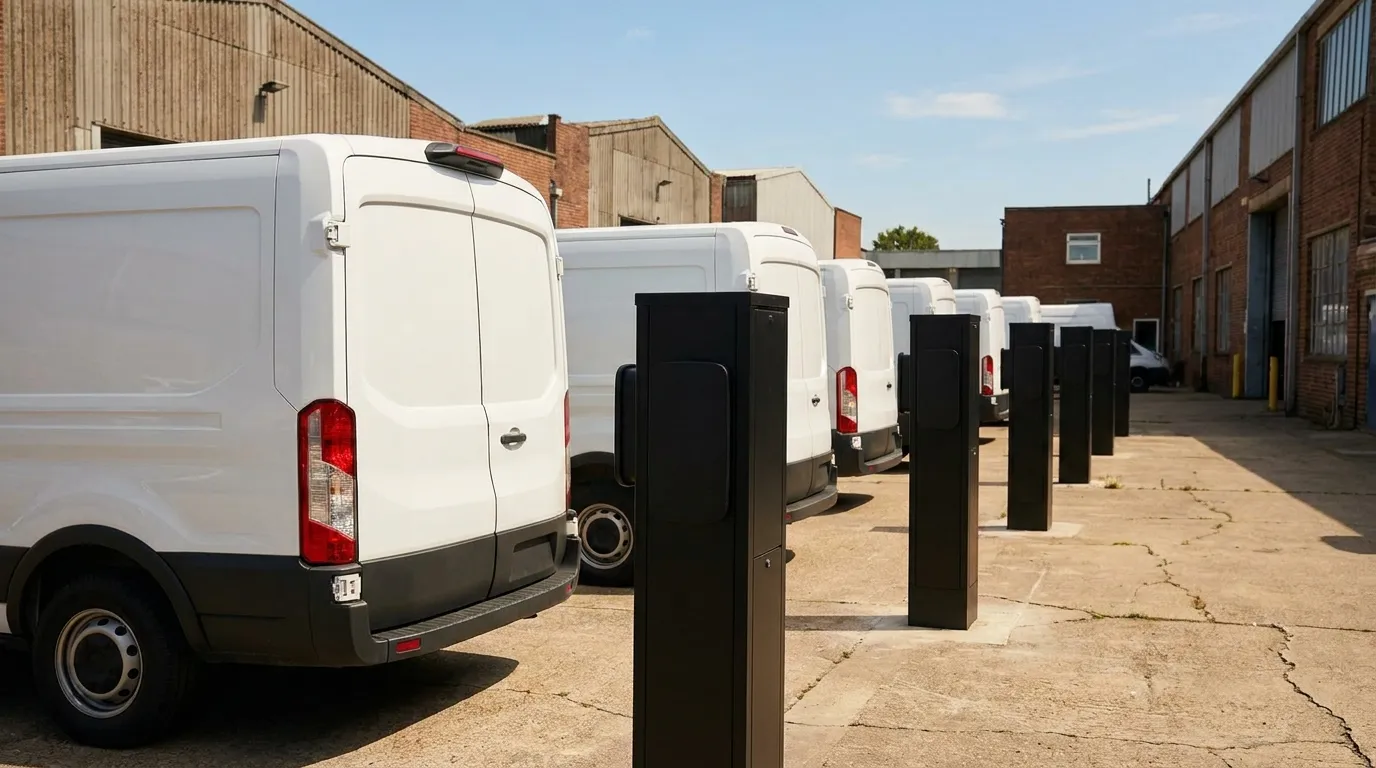
A 20-vehicle Level 2 fleet depot buildout can run $100,000 to $200,000 in infrastructure before incentives in 2026 (AmpUp, 2026; via Oxmaint, 2026). That is not a single-invoice job. It is a phased, multi-month rollout, and it often spans more than one property.
Most "fleet EV charging financing" content stops at the cost estimate. It treats a 20-port depot the same way it treats a single driveway charger: one price, one approval, one draw. That framing falls apart the moment a contractor is quoting 30 ports across two depot sites on a nine-month build schedule.
This guide covers the part that gets skipped: how to structure financing for a multi-charger, multi-site fleet project. Draw schedules, blanket versus per-site loans, ordering bulk hardware ahead of full site readiness, and how to pitch the whole thing. For the utility side of that timeline, see how grid capacity upgrades at fleet depot scale can push a single site's energization out six months to three years depending on station size.
> Key Takeaways
> - A 20-port fleet depot buildout can run $100,000 to $200,000 in infrastructure before incentives (AmpUp, 2026).
> - Bulk hardware orders can carry roughly 15-25% volume discounts, which makes ordering timing a financing question, not just a purchasing one (AmpUp, 2026).
> - Phased draw schedules, tied to milestones like site energization, match how large depots actually get built.
> - Choosing between one blanket loan and separate per-site loans depends on ownership structure and site scope, subject to approval and eligibility.
See how Eos Loan financing helps you close more projects
What makes financing a fleet depot different from a single-site job?
In 2026, a 20-vehicle Level 2 fleet depot buildout can run $100,000 to $200,000 in infrastructure before incentives (AmpUp, 2026; via Oxmaint, 2026), and that scale changes the financing question. On a single-site job, the question is "what does this cost." On a fleet depot rollout, the question becomes "how does this get funded across phases and sites."
A single-site install is one invoice and one decision-maker. A fleet depot order usually is not. The fleet manager, the facilities director, and sometimes a regional operations lead all weigh in before a contract is signed. The hardware order itself often locks in weeks or months before every site is fully ready for electrical work, because manufacturers and distributors price bulk orders on volume, not on individual site timelines.
That is the part financing has to accommodate: fleet-scale volume discounts on hardware can run roughly 15-25% when ordering in bulk (AmpUp, 2026), but locking that pricing means committing to the full order before every site has finished permitting. A financing structure built for one job at a time does not fit that reality.
Isn't a bigger order just a bigger version of the same job? Not quite. Procurement lead times, staggered site readiness, and multiple stakeholders turn a fleet depot order into a project-management problem as much as an electrical one. The financing has to flex with that, not force the rollout into a single lump-sum approval.
For the financing program itself, see our EV charger financing program for installers, which covers the underwriting basics this guide builds on for multi-charger scale.
How much does a multi-charger fleet depot rollout cost?
Level 2 depot ports run roughly $2,000 to $7,000 per port installed depending on site conditions (AmpUp, 2026), and that per-port number scales down as the order grows because trenching, panel work, and conduit runs get shared across more ports. A 20-port buildout can land at $100,000 to $200,000 or more.
Electrical infrastructure, not the charger hardware, is typically 40% to 60% of total project cost on larger commercial buildouts (TrendX Insights, 2026). A single charger's price barely moves the total. The panel upgrade, the trenching, and the switchgear do.
This guide will not repeat the full cost-driver breakdown here. For the single-site cost, tax-credit, and funding-stack walkthrough, see our single-site commercial EV charging cost and tax-credit breakdown.
How does phased financing work for a multi-site or staged rollout?
A phased draw schedule lets a contractor finance a rollout in stages: site one, then site two, then site three, rather than requiring a single lump-sum approval for the entire multi-site order upfront. Draws typically tie to milestones like equipment delivery, site energization, and inspection sign-off.
That structure matches how large depot buildouts actually get built. Nobody trenches, wires, and energizes 30 ports across three properties in the same week. Phased deployment plans that begin with a pilot site before expanding are a recognized best practice for managing large fleet electrification rollouts (Qmerit, 2026).
The contractor's role shifts here too. Instead of coordinating one electrical crew against one deadline, the installer is sequencing draw timing against the actual construction schedule, site by site. When a draw lines up with a milestone the client can point to, the whole rollout feels less like an open-ended loan and more like a project plan with funding attached at each step.
Blanket loan or per-site loans for a multi-site fleet client?
A single blanket approval covering the full multi-site order simplifies underwriting and locks bulk pricing early. Separate per-site loans give more flexibility if a later site's scope or timeline shifts. Which one fits depends on ownership structure and how similar the sites are, subject to approval and eligibility.
Blanket financing tends to fit when the same ownership entity controls every site, the scope is similar property to property, and the hardware was ordered in one batch to capture the volume discount. One approval, one draw schedule, one underwriting file.
Separate per-site loans tend to fit when different property owners or entities are involved, when scope is still uncertain at a later site, or when permitting is staggered across jurisdictions with unpredictable timelines. Utility make-ready programs, which can fund a meaningful share of shared electrical infrastructure at qualifying commercial and fleet sites (National Grid, 2026), are one reason financing structure should mirror how the actual infrastructure is shared or kept separate across a portfolio.
| Structure | Fits when | Trade-off |
|---|---|---|
| One blanket loan | Same owner, similar scope, bulk hardware ordered together | Simpler underwriting, but less flexible if one site's scope changes |
| Separate per-site loans | Different owners/entities, uncertain scope, staggered permitting | More flexible, but more underwriting files to manage |
What we see across the Eos Loan partner base: contractors who bring a single blanket request for a multi-site fleet order tend to close faster than ones who submit site-by-site applications over several months. That is an observed pattern in our partner base, not a guarantee of approval or turnaround time for any given deal.
Can bulk EV charger hardware be financed ahead of full site readiness?
The real bottleneck on a large fleet order is rarely the loan. It is that hardware lead times and bulk-order pricing windows often do not line up with when every site is fully permit-ready. Financing needs to accommodate ordering hardware in advance of full site completion, not just funding work as each site finishes.
That means treating the hardware and equipment line item as its own draw, separate from the labor and infrastructure draws tied to each site's construction schedule. Financing the equipment order early protects the volume discount, roughly 15-25% on bulk orders (AmpUp, 2026), without requiring the contractor or the fleet client to advance that capital out of pocket while sites finish permitting.
There is a real trade-off here. Hardware sitting in inventory for a few months carries some carrying cost and storage logistics. Losing the pricing window because the order waited for every site to be shovel-ready usually costs more. Structuring the financing around the order date, not the last site's completion date, is what protects the discount.
How should installers pitch financing on a large multi-charger order?
Lead with the phased monthly payment tied to the rollout schedule, not a single lump-sum number for the entire multi-site project. A fleet client evaluating a $150,000 depot order thinks differently about a payment that scales in with each site than about one intimidating total due at signing.
Frame the urgency around procurement timing and locked bulk pricing, not a tax-credit deadline. That urgency hook belongs to the single-site conversation. On a fleet depot order, the client already knows they need the chargers. What they need help seeing is how the financing keeps the rollout moving without a stalled purchase order sitting on someone's desk for three months.
Position the lender as a direct lender with no dealer fee, handling the full scope, hardware, labor, and infrastructure, across every phase. If the depot site also has battery energy storage needs for backup power during outages, one financing conversation can cover both, which raises ticket size on a single relationship. See our bundling EV charger and battery storage financing guide for that angle.
Here is what changes in the sales conversation once a contractor is quoting 20 or more ports across two or three depot locations instead of one site: the conversation moves from "what does this cost" to "when do the draws happen and what triggers each one." Procurement timing becomes the client's real question, not the sticker price. I have watched that shift happen in real time on calls with our installer partners, and it is the single biggest difference between pitching one charger and pitching a depot.
Add financing to your installs, talk to our team
How do installers choose a financing partner for multi-site projects?
A direct lender that can approve phased draws, cover full project scope, and handle multi-site or multi-entity structures is the right fit for bulk fleet depot orders, subject to approval and eligibility. Not every financing program built for a single residential install is built for that.
Confirm the program supports phased or staged funding, not just a one-time disbursement at close. Confirm the underwriting range actually fits large multi-site totals; a program built for $5,000 to $20,000 jobs is not sized for a $150,000 depot rollout. And confirm there is no dealer fee stacked onto the deal, since a fee embedded by another lender becomes a material cost difference once the project total reaches six figures.
Eos Loan is a direct lender, not a marketplace or broker, funding the loan itself across battery energy storage, EV chargers, and water filtration. For the broader installer playbook, see our step-by-step guide to offering EV charger financing and our contractor guide to offering customer financing.
---
Become an Eos Loan financing partner
Or call +1 833-989-3737 to talk through a financing program for your business.
---
{ question: "How do you finance multiple EV chargers at once?", answer: "Large multi-charger orders typically use either one blanket loan covering the full rollout or separate loans tied to each site, with draws released as phases hit milestones like equipment delivery and site energization. The right structure depends on ownership and scope, subject to approval and eligibility." }, { question: "What does a 20-port fleet depot buildout cost in 2026?", answer: "A 20-vehicle Level 2 fleet depot buildout can run $100,000 to $200,000 in infrastructure before incentives (AmpUp, 2026). For the single-site cost and tax-credit breakdown, see our commercial EV charging financing guide, which walks through per-port pricing and the Section 30C credit in detail." }, { question: "Can EV charger financing be phased across multiple sites?", answer: "Yes. Phased financing structures release draws as each site hits a milestone, such as equipment delivery, energization, or inspection sign-off, rather than requiring one lump-sum disbursement for a multi-site order. This matches how depot buildouts are actually constructed, in stages, subject to approval." }, { question: "Do lenders offer better terms for bulk EV charger orders?", answer: "Hardware volume discounts of roughly 15-25% on bulk orders come from manufacturers and distributors, not from financing terms (AmpUp, 2026). Flexible financing terms are a separate consideration from hardware pricing; no specific rate or discount is guaranteed by any lender, including Eos Loan." }, { question: "Is Eos Loan a broker or a direct lender for fleet depot financing?", answer: "Eos Loan is a direct lender, not a marketplace or broker. It funds the loan itself for battery energy storage, EV charger, and water filtration projects, including multi-site fleet depot rollouts, with no dealer fee, subject to approval and eligibility." } ]} />Financing the rollout, not just the invoice
A fleet depot order does not behave like a single-site job, and financing it well means structuring the loan around how the rollout actually gets built. Here is what to carry into the next multi-charger conversation:
- Scale changes the financing question from "what does this cost" to "how is this funded across phases and sites."
- Phased draw schedules, tied to milestones, match how large depots actually get built, one site or phase at a time.
- Choosing between one blanket loan and separate per-site loans depends on ownership structure and how similar the sites are.
- Hardware can be financed ahead of full site readiness to protect bulk pricing windows, subject to approval and eligibility.
Quoting a multi-site fleet depot buildout? Offer your customers flexible financing on essential projects and structure the phased draws before the first invoice goes out. For the single-site cost and Section 30C tax-credit walkthrough, see the single-site breakdown linked above. To raise ticket size on the same account, see our guide on financing a large multi-unit EV charger order.
---
About the author: Eduardo Donadi is the CEO of Eos Loan, a direct lender specializing in financing for essential projects including battery energy storage, EV chargers, and water filtration. He works directly with electrical contractors and fleet-electrification installers on financing structure for projects of every scale, from a single driveway charger to a multi-site depot rollout.
---
Sources
1. AmpUp. "Commercial EV Charging Station Buyer's Guide 2026." https://www.ampup.io/blog/commercial-ev-charging-station-buyers-guide-2026 Retrieved 2026-08-05.
2. Oxmaint. "EV Fleet Charging Infrastructure Planning 2026." https://oxmaint.com/industries/fleet-management/ev-fleet-charging-infrastructure-planning-2026 Retrieved 2026-08-05.
3. TrendX Insights. "EV Charging Station Cost in the USA." https://trendxinsights.com/blogs/ev-charging-station-cost-usa/ Retrieved 2026-08-05.
4. Qmerit. "Fleet Electrification: Best Practices for Charging Infrastructure Deployment." https://qmerit.com/blog/fleet-electrification-best-practices-for-charging-infrastructure-deployment/ Retrieved 2026-08-05.
5. National Grid. "Commercial and Fleet EV Charging Programs." https://www.nationalgridus.com/Upstate-NY-Business/Energy-Alternatives/Commercial-and-Fleet-EV-Charging-Programs Retrieved 2026-08-05.