

Financing Your First Truck: What New Carriers Need Ready
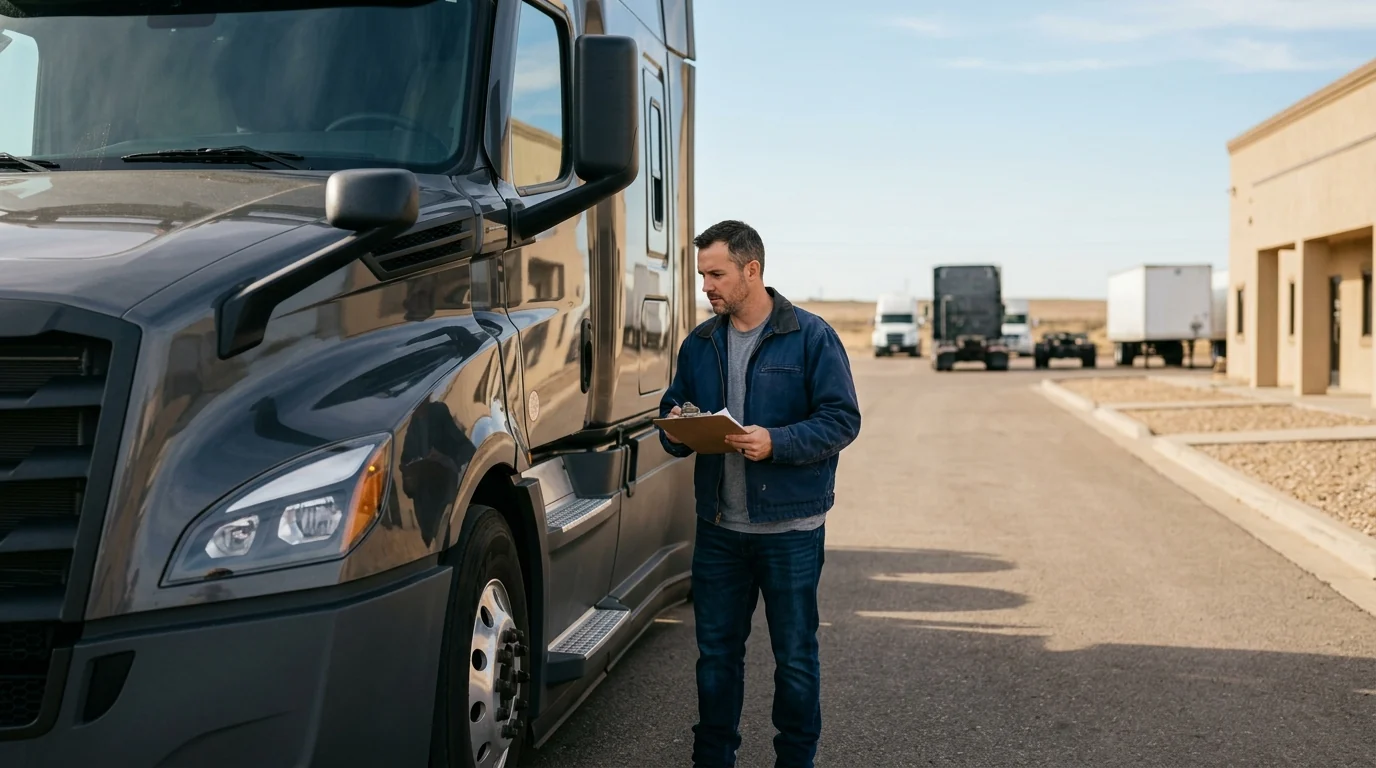
First truck financing is credit used to buy the truck you will own and haul with: the tractor or the straight truck itself, not charging equipment and not yard electrical work. If you are about to run under your own authority, the hard part is rarely the truck. It is proving there is a business behind it.
A new carrier's file is thin by definition. You have no operating history, or four months of it, and every page you have read told you to have good credit. That is not a plan, and credit is not what fills the gap.
Documentation fills the gap. Below is the sequence: which filings have to be live, what substitutes for history, what a credible freight plan looks like, and what belongs in the folder.
> Key Takeaways
> - FMCSA treats you as a new entrant for 18 months and audits your safety management controls inside that window (FMCSA, 49 CFR Part 385 Subpart D).
> - A one-truck applicant is the norm: 91.5% of almost 580,000 active US carriers run 10 or fewer trucks (ATA, June 2025).
> - Missing operating history is replaced by verifiable readiness: active authority, insurance already filed, bank statements, a clean MVR, and committed freight.
> - Eos Loan is a direct lender with flexible terms and no dealer fee, subject to approval and eligibility.
Talk to our team about financing your first truck
What counts as a "new carrier" in first truck financing?
To FMCSA, you are a new entrant for 18 months after registration, and the agency monitors your roadside performance and audits your safety management controls inside that window (FMCSA, 49 CFR Part 385 Subpart D). To a lender, "new" means the business has less operating history than the truck is expected to last.
Three different things get called new, and they are not the same file.
- New authority. The MC number is weeks old, whatever else is true about you.
- New entity. The LLC was formed this quarter, so there is no business credit history to pull.
- New to ownership. You have driven for twelve years and this is the first truck with your name on the title.
- Bank statements. Several months showing settlement deposits, even from work done under someone else's authority.
- A clean MVR and verifiable years behind the wheel. Driving experience does not disappear because the truck belonged to a former employer.
- Insurance already bound and filed, not quoted.
- A down payment with a documented source.
- Signed or committed freight, which is the subject of the next section.
- Personal credit, reviewed alongside business credit, because at this size a young entity does not screen the owner. How credit history factors into an approval decision is worth reading first.
- Operating authority letter and USDOT number
- Certificate of insurance with the FMCSA filings already made
- Entity documents: articles of organization, EIN letter, operating agreement
- Three to six months of business bank statements, or personal statements plus settlement statements if the entity is new
- Most recent personal tax return
- CDL and a current MVR
- Equipment details: year, make, model, VIN, mileage, spec, plus the seller's invoice or buyer's order
- Proof of the down payment and where it came from
- The written freight plan from the previous section
- Service records. A known-history unit with receipts beats a cheaper one with a shrug.
- Mileage and engine hours together. Highway miles and idle hours wear an engine differently, and low miles with high hours has a story you want to hear first.
- Spec matched to the freight you named. Buy for the lanes in your plan, not for the truck you have wanted since you were twenty-two.
- Dealer lot versus private seller. A dealership produces a buyer's order, a title process, and usually a reconditioning record. A private sale can be a fine deal and still leave you assembling that documentation by hand.
- A pre-purchase inspection before you commit, not after. Third-party, at a shop you chose.
- A new carrier is judged on readiness, not on size, and one-truck applicants are the norm.
- Registrations and insurance filings come before the loan application, not after it.
- What substitutes for missing history is documentation, not optimism.
- A freight plan naming real customers and lanes beats one quoting a national average.
- The truck is collateral, so its service records are part of your file.
A company driver with a decade behind the wheel and a three-month-old entity reads very differently from someone who has never held a CDL. Both are "new." Only one has a driving record that does real work in the file.
!Class 8 sleeper tractors parked side by side in a small carrier yard under daylight.
You are also not an outlier. In June 2025, the American Trucking Associations counted almost 580,000 active motor carriers registered with FMCSA, with 91.5% running 10 or fewer trucks and 99.3% running 100 or fewer (ATA, June 2025). The one-truck applicant is the shape of this market, and financing for trucks and fleet expansion starts at exactly that size.
Which registrations and filings need to be active before you apply?
A lender is financing a business that is legally allowed to haul. That means a USDOT number, operating authority if you are hauling for hire, a designated process agent, and liability coverage on file. FMCSA sets the floor at $750,000 for general freight in vehicles over 10,001 pounds GVWR, rising to $1,000,000 and $5,000,000 for hazardous commodities (FMCSA, 49 CFR 387.9).
Work through this list before you fill out anything financial:
1. USDOT number. The identifier everything else attaches to.
2. Operating authority (MC number) if you are hauling for hire. There is an application fee and a public protest window, so start early.
3. BOC-3 process agent designation, filed on your behalf by a process agent service.
4. Proof of financial responsibility filed by your insurer. Under 49 CFR 387.7 that means Form MCS-90, Form MCS-82, or written FMCSA authorization to self-insure.
5. UCR registration for the current year.
6. IRP apportioned plates and IFTA if you cross state lines.
7. State-level requirements where your base state adds them.
!Registration paperwork and a laptop spread across a desk during a daylight review.
One thing worth saying plainly: the federal floor and what your customers require are two different numbers. Many brokers and shippers ask for limits above the FMCSA minimum before they will tender you a load. Confirm what they expect before you bind coverage, because rewriting a policy afterward is slower than getting it right once.
How much operating history does a new carrier actually need?
There is no universal threshold, and any page that hands you one is guessing. Underwriting reads time in operation next to the equipment, the credit file, and the freight plan, and thin history raises the weight of everything else in the folder. Every application is subject to approval and eligibility.
History matters because it is evidence that revenue repeats. Two years of deposits is an argument. A projection is a hope. When history is short, these carry the weight instead:
Here is the reframe most competing pages miss. Your job before applying is not to improve a score in the eight weeks you have. It is to replace missing history with verifiable readiness, and the substitutes are regulatory and documentary rather than financial. Be skeptical of any page printing a credit-score cutoff as a rule. For the wider view of what lenders review across a truck financing file, start with the pillar guide.
What does a credible freight plan look like on a first truck?
A freight plan is credible when it names the customer, the lane, and the expected rate, and when that rate survives contact with cost. In 2025 the industry average cost to operate a truck hit a record $2.336 per mile, up 3.4%, with non-fuel costs at $1.854 per mile (ATRI, July 2026). A headline rate you read somewhere is not a plan.
Committed freight has a name attached: a broker you have hauled for, a shipper who has already asked when you go live, a lane you ran under someone else's authority and know the seasonality of. Hoped-for freight sounds like "I will find loads on the load board."
Write the specific version. Name the customers and the lanes, say what the rate has actually been on them, and say how many of those loads one truck and one driver can cover in a week.
Then pressure-test it against your own numbers rather than an industry average. In the first quarter of 2026, ATRI reported insurance premiums up 6.4%, fuel up 5.9%, driver benefits up 4.5%, and tolls up 2.7% (ATRI, 2026). A plan built on last year's assumptions is already behind.
The payment you take on lands inside that cost per mile, next to fuel and maintenance, so size it against what the truck actually earns on the lanes you named, not against what you would like to pay.
> What I see: The new-authority applications that read well are almost never the ones with the longest history. They are the ones where the freight plan names actual customers and lanes instead of quoting a national average rate. Every file is still subject to approval and eligibility. (Eduardo Donadi, CEO, Eos Loan)
See what financing a first truck could look like
Which documents belong in the folder before you apply?
Applications stall on missing paperwork far more often than on weak numbers. Assemble the folder before you start, not while an underwriter waits on a document your insurance agent needs three days to produce. Here is the set, short enough to screenshot:
!A financing contract, a folder and a pen laid out on a bright desk in daylight.
Scan everything to PDF and name the files so a stranger can tell what they are. Keep the set current, because a bank statement goes stale in about thirty days. While the folder is open, learn the vocabulary on a financing offer, term length and monthly payment included, so nothing in the paperwork is a new word when it arrives.
How do you pick a first truck that underwrites well?
The truck is the collateral, so its condition is part of your file. Model year, mileage, spec, and maintenance records all affect how a lender values the asset it is lending against, and a well-documented used tractor is often an easier file than an undocumented bargain that looks cheaper on the windshield.
What actually moves it:
!Class 8 tractors lined up on a dealer lot in bright daylight.
Design against the failure mode. With operating costs at a record $2.336 per mile in 2025 (ATRI, July 2026), an unbudgeted overhaul in month three is what ends a first year, not the payment. Budget for the second-year maintenance curve before you sign for the truck.
What happens after you send the application?
You apply, the lender underwrites the business and the equipment, and on approval the purchase is funded and repaid over a term sized to the operation. Eos Loan is a direct lender, so we originate, underwrite, and service the credit ourselves. To date we have originated $4B+ and processed 30k+ proposals across our lending programs.
In practice that means one point of contact, decisions made in-house, and no handoff to whoever ends up holding the paper. The application is digital. Eos Loan charges no dealer fee. Terms are flexible and sized to the truck and the operation, subject to approval and eligibility. If the categories are fuzzy, we wrote up the difference between a direct lender and a marketplace, and who we are is worth a look before you send anything over.
While you wait, keep the new entrant file clean. FMCSA monitors roadside safety performance across the 18-month window, audits your safety management controls inside it, and can revoke a new entrant registration when basic safety management controls are not demonstrated (FMCSA, 49 CFR Part 385 Subpart D). New entrants also stay subject to all CSA interventions during that period.
---
Ask about flexible terms on a truck purchase
Or call +1 833-989-3737 to talk through a first truck purchase with our team. More common financing questions are answered on our FAQ page.
---
question: "Can you finance a truck with a new MC authority?",
answer: "Yes. New authority is a question rather than a wall. Underwriting weighs time in operation alongside the equipment, credit history, and the freight plan, and thin history raises the weight of everything else in the file. Every application is subject to approval and eligibility."
},
{
question: "How much operating history do you need to finance your first truck?",
answer: "There is no universal threshold. Months of bank statements, verifiable driving experience, insurance already filed, and committed freight all substitute for a short history. Every file is reviewed individually and is subject to approval and eligibility."
},
{
question: "What documents do you need to apply for truck financing?",
answer: "Operating authority and USDOT number, a certificate of insurance with filings made, entity documents, recent bank statements, a personal tax return, CDL and MVR, the equipment details and buyer's order, proof of down payment, and a written freight plan."
},
{
question: "Do you need your own authority before you buy a truck?",
answer: "If you are hauling for hire under your own name, yes, you need operating authority and the insurance filings that go with it. FMCSA sets the general-freight liability floor at $750,000 for vehicles over 10,001 pounds GVWR (49 CFR 387.9). Leasing on to another carrier is a different path."
},
{
question: "How long does the FMCSA new entrant period last?",
answer: "Eighteen months. FMCSA monitors roadside safety performance across that window and audits the carrier's safety management controls inside it, then either makes the registration permanent or revokes it (FMCSA, 49 CFR Part 385 Subpart D)."
}
]} />
What to have ready
A first truck is bought by a business with almost no history behind it, which is why the paperwork does so much of the work.
When the first truck is running and you start thinking about the second, the truck fleet financing guide for owner-operators and carriers picks up where this one stops.
---
About the author: Eduardo Donadi is the CEO of Eos Loan, a US direct lender financing essential projects including truck fleet expansion, battery energy storage, EV chargers, and water filtration. He works directly with carriers, owner-operators, and distributors on how equipment purchases get structured and funded.
---
Sources
1. Federal Motor Carrier Safety Administration. "New Entrant Safety Assurance Program, Motor Carrier Safety Planner." 49 CFR Part 385 Subpart D. Retrieved 2026-08-27. https://csa.fmcsa.dot.gov/safetyplanner/MyFiles/Sections.aspx?ch=20&sec=53
2. Federal Motor Carrier Safety Administration. "Financial Responsibility Requirements, Motor Carrier Safety Planner." 49 CFR 387.9 and 49 CFR 387.7. Retrieved 2026-08-27. https://csa.fmcsa.dot.gov/safetyplanner/MyFiles/SubSections.aspx?ch=21&sec=60&sub=119
3. American Trucking Associations. "Economics and Industry Data." June 2025. Retrieved 2026-08-27. https://www.trucking.org/economics-and-industry-data
4. American Transportation Research Institute. "New ATRI Report Details Accelerating Costs and Low Profitability Despite Cuts." July 2026. Retrieved 2026-08-27. https://truckingresearch.org/2026/07/new-atri-report-details-accelerating-costs-and-low-profitability-despite-cuts/