

General Contractor vs Owner-Builder: Who Manages an Investor Project
The custom-built share of new single-family home starts fell to 17.5% in 2024, down from 20.4% two years earlier (NAHB analysis of Census Survey of Construction data, via Eye on Housing, October 2025). That figure is about a business-purpose investor who decides who runs a renovation or build on an investment property. It is not about a homeowner remodeling the house they live in.
Most articles frame this as a cost question: how much a contractor's markup saves if you do the work yourself. A lender asks a different question, and in our file reviews it decides the outcome: who is accountable for the work getting finished? This post explains what each structure changes about financing, what each route costs once the full picture is counted, and how to decide which one fits your next project.
> Key Takeaways
> - Hiring a licensed general contractor and self-managing as an owner-builder are both legitimate ways to run an investor project, not a professional-versus-amateur choice.
> - The custom-build share of new single-family homes fell to 17.5% in 2024, down from 20.4% in 2022 (NAHB analysis via Eye on Housing, October 2025).
> - A lender underwrites who is accountable for the work getting finished. A GC's license and insurance answer that by default, while an owner-builder answers it through documented experience, scope detail and reserves.
> - Neither route is automatically cheaper once coordination risk, scheduling and holding costs get counted.
> - Eos Loan is a direct lender for business-purpose real estate projects, subject to approval and eligibility.
See how business-purpose financing fits your deal
What Is the Difference Between Hiring a General Contractor and Being an Owner-Builder?
A general contractor is a licensed, insured third party who holds the construction contract, coordinates subcontractors, and answers to the permit office and the lender for the work. An owner-builder is an investor who fills that same role personally, usually without a contractor's license, on a project they own. The real difference is who signs the paperwork and who carries accountability for the finished work. Within the national figure, the custom-built share varies sharply by region: 41.2% of starts in New England against 10.7% in the West South-Central division in 2024 (NAHB analysis via Eye on Housing, October 2025).
The split shows up in daily work. For example, the general contractor pulls the building permit, lines up and schedules subcontractors, and usually assembles and signs each draw request. The owner-builder does all of that personally, and in many jurisdictions pulls the permit under an owner-builder exemption.
Owner-builder is a formal status, not an informal label. Most building departments and lenders treat it as a defined status with its own paperwork and, in some states, its own affidavit. Treat it as a structural choice with real tradeoffs, not a synonym for doing the work without a plan. For how this choice fits into a project from the start, see the full guide to fix and flip financing.
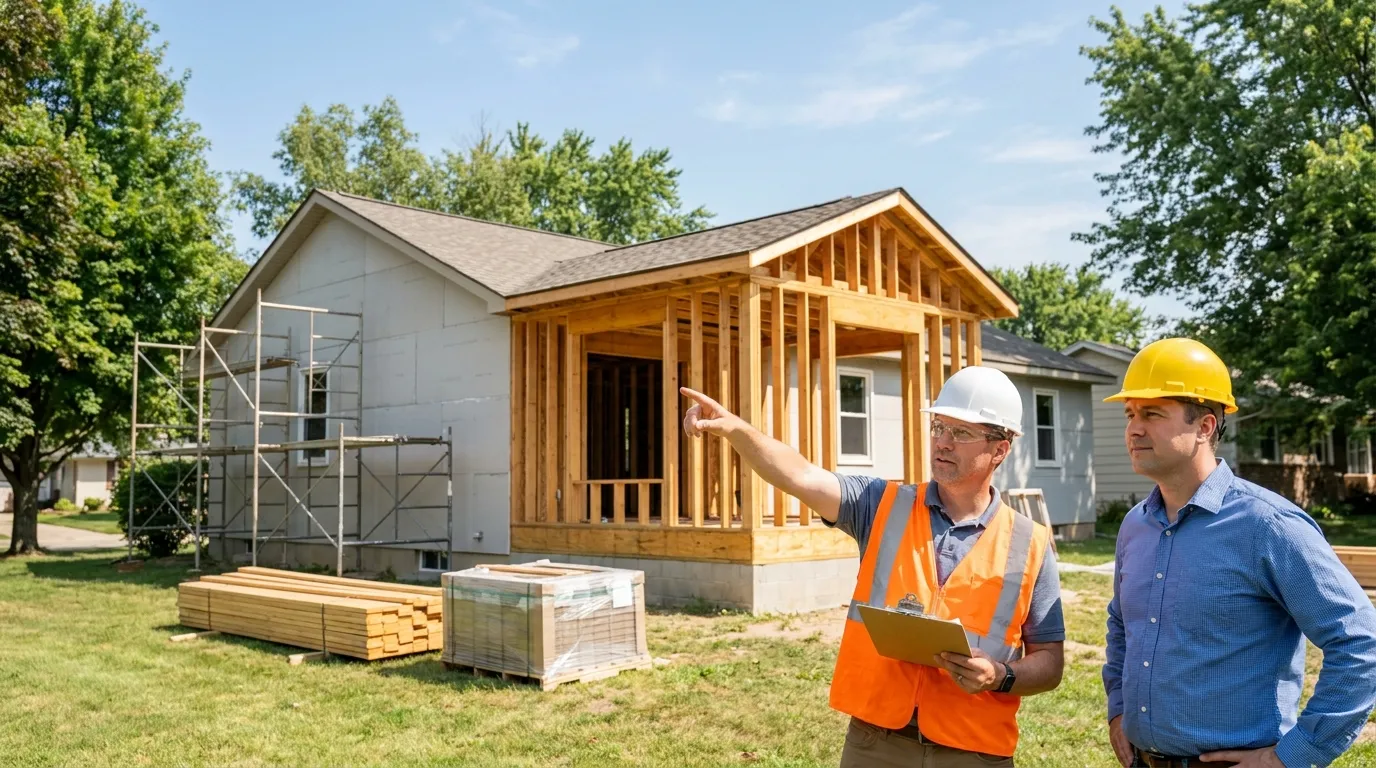
!A single-family house under construction in bright daylight with two people reviewing plans on site.
Nationally, fewer owners were named as their own builder in 2024 than in 2022. However, the structure remains legal and common in some regions, so the shift reflects a changing mix, not a ban.
How Does a Lender View a GC-Managed Project Versus an Owner-Builder Project?
A lender asks whether the work gets finished on time and on budget. The structure running the job matters less than the answer. A general contractor's license, insurance certificate and track record answer most of that question before anyone asks it. An owner-builder has to answer it another way: documented experience, a detailed scope of work, cash reserves beyond the construction budget, and often a smaller or simpler first project.
Lenders check draw inspections and lien waivers in both structures, but the paperwork arrives differently. A draw inspection is a site visit that confirms completed work before the lender releases the next funding tranche. A lien waiver is a signed document in which a contractor or supplier gives up its right to file a lien for work already paid. In a GC-managed job, the license and insurance usually cover that paperwork by default. In contrast, in an owner-builder job, the investor must supply the equivalent another way. For the mechanics, see how draw requests and inspections actually work.
Experience gets evaluated differently, too. A GC brings a track record a lender can check against a license number: completed projects, reference contacts, and permits pulled under that license. An owner-builder without a license has to build the same case another way, through their own completed projects, prior permits pulled in their own name, or trade licenses they personally hold. For example, a first attempt at owner-building on a large or structurally complex scope makes a harder file than the same investor's first flip with a GC already under contract.
Across our lending programs, we have originated $4B+ and processed 30k+ proposals. In that work, we review a file the same way whichever structure runs the job. So why does the structure matter at all? Because the accountability question has to be answered on paper, whoever answers it. Working with one direct lender for the whole process also matters here. That differs from using a marketplace or broker that connects you to lenders.
> The practical test: a file is easiest to review when the paperwork answers the lender's accountability question before it is asked. A GC's contract and insurance certificate do that by default. An owner-builder can do the same with trade licenses they personally hold, a line-item scope, proof of reserves and a realistic schedule. The structure differs, but the question stays the same.
Talk to our team about financing your next project
What Does Each Route Actually Cost an Investor?
A general contractor's price bundles overhead and a markup on the trades into one number. Self-managing trades that markup for the investor's own time, coordination risk, and the cost of mistakes a professional would likely have caught. Timing matters as well. In 2026, the typical flip took 165 days from purchase to sale, up from 160 days the quarter before (ATTOM Q1 2026 Home Flipping Report, June 2026). A scheduling misstep under either structure adds real holding-cost dollars to that clock, not just inconvenience.
A GC's bid typically bundles overhead, a profit margin, a warranty on the finished work, and relationships with subcontractors that can mean better scheduling or better pricing than an investor gets cold. Self-managing shifts a different set of costs to the investor. That includes sourcing and vetting subs, sequencing the trades, and covering the gap when one sub's delay pushes back the whole schedule. The holding-cost clock keeps running the entire time.
So is the markup the only number that matters? It is not. Neither route is universally smaller once the full picture is counted. Both still have to size the same contingency and carrying-cost reserve. For how those figures are sized, see how holding costs and contingency should be sized rather than a restatement here.
When Does Hiring a General Contractor Make More Sense on an Investor Project?
Hiring a GC tends to make more sense on a larger scope, a structurally complex project, a tight timeline, or a first deal where the investor has no track record to show a lender. The typical NAHB builder member started a median of five housing units in 2025, with median member revenue of $3.7 million (NAHB 2026 Builder Member Census, via Eye on Housing, September 2026). That is a useful reminder that even a "professional builder" is usually a small operation, not a large production company.
Scope complexity is the clearest trigger. In practice, structural work, an electrical service upgrade, or several trades that need tight sequencing all raise the cost of a scheduling mistake. A GC's existing subcontractor relationships also tend to move faster than an investor sourcing trades cold. On a tight timeline, that speed has real value. The lender-file benefit matters too: a licensed GC's documentation answers the accountability question before a lender asks it.
!A contractor crew working on a residential rooftop in bright daylight.
Hiring a GC does not automatically mean hiring a large firm. Before signing, ask how many projects the GC has open, who runs the schedule day to day, and which subcontractors they already use. Those answers say more about bandwidth than the size of the company's name.
When Does Self-Managing as an Owner-Builder Make Sense, and What Does It Take?
Self-managing tends to make sense for an investor with real hands-on experience, a straightforward scope, and the time to be on site through the whole project. A tight labor market raises the stakes, because coordinating trades directly can decide whether a sub shows up this month or next. Construction job openings stood at a 2.9% rate, or 251,000 openings, in August 2026. That was down from 3.5% in July, but still above the 2.5% rate of August 2025 (BLS Job Openings and Labor Turnover Survey, September 2026). Trades remain harder to book than a year ago.
At that rate, an owner-builder competes for the same scarce crews a GC would use, without a GC's standing relationships to smooth the way. Before applying, an owner-builder should assemble prior completed projects, any trade licenses personally held, a detailed line-item scope, and proof of reserves beyond the construction budget. Starting with a smaller or simpler scope, then scaling up, follows the same track-record logic a first-time GC-managed investor should use. For how schedule risk compounds either way, see how the project timeline affects your payoff.
!A residential construction site being walked with a clipboard and project paperwork in daylight.
An owner-builder without a GC's standing relationships feels a tight trades market first and hardest. Each time a sub has to be sourced cold, instead of pulled from a roster that already works, the schedule absorbs the delay.
How Does State Contractor Licensing Affect Your Options?
Licensing thresholds and owner-builder exemptions vary by state and sometimes by project cost. An owner-builder exemption is a rule that lets a property owner act as their own contractor without a license, usually within a set cost or scope limit. So the honest answer to "can I be my own GC" is "check your state and local building department first," not a single rule that applies everywhere. Some states exempt an owner working on their own property up to a point, then require a license past a cost or scope threshold. Others have no statewide licensing requirement and leave oversight to local permit offices.
The exemption is the part investors most often get wrong. Many owner-builder exemptions assume an owner-occupant, so the rule for a property built to sell can be narrower or different. A project meant to be flipped or sold may not qualify for the same exemption as a home the owner plans to live in. Read the exemption text for resale intent, not just the headline threshold. For example, the California Contractors State License Board publishes its owner-builder guidance as one example of how a state board frames the rule.
This is a legal question for the investor's own research or counsel, and thresholds change. Confirm the current rule with your state's contractor licensing board and your local building department before committing to either path.
Frequently Asked Questions
Can I be my own general contractor on an investment property?
Often, but the exemption is narrower for property built to sell, and requirements vary by state and sometimes by project cost. Check your state licensing board and local building department before assuming a rule from one state applies in another.
Is it cheaper to self-manage a flip instead of hiring a GC?
Not automatically. A GC's price bundles overhead, scheduling and a warranty on the work. Self-managing shifts coordination risk and mistake cost onto the investor instead of removing it, and neither number is universally smaller once that full picture is counted.
Does a lender care if I self-manage construction on a flip?
A lender cares about who is accountable for finishing the work. A licensed GC's license, insurance and track record answer that by default, while an owner-builder answers it through documented experience, scope detail and reserves. Subject to approval and eligibility either way.
What does a general contractor actually do on an investor project?
A GC holds the construction contract, pulls permits, coordinates and schedules subcontractors, and is typically the party assembling draw requests and lien waivers for the lender. See how draw requests and inspections work for the mechanics.
Do I need a contractor's license to manage my own flip?
It depends on the state, the project scope and the cost threshold. Some states have an owner-builder exemption up to a point, while others have no statewide licensing requirement at all. Confirm with the state or local licensing board, not a national rule of thumb.
Who Should Manage Your Next Project?
The structure you choose changes what your lender asks for, not whether your file gets taken seriously. A few things to carry forward:
- Hiring a GC and self-managing are both legitimate ways to run a project, not a professional-versus-amateur split.
- A GC's license and insurance answer a lender's accountability question by default, while an owner-builder answers it through documented experience, scope detail and reserves.
- Neither route is automatically cheaper once coordination risk, scheduling and holding costs get counted.
- A larger or structurally complex scope, a tight timeline, or a thin track record all point toward hiring a GC.
- Real hands-on experience, a straightforward scope and the time to be on site point toward self-managing, with your state's licensing rule as the first thing to confirm.
Whichever structure you choose, our business-purpose financing for real estate projects looks at the file you actually bring, not the title on your contract. For more investor financing guides, visit the Eos Loan blog.
Ask about flexible terms for fix and flip projects
Prefer to talk it through? Call +1 833-989-3737.
---
About the author: Eduardo Donadi is the CEO of Eos Loan, a US direct lender financing essential projects including business-purpose real estate, truck fleet expansion, battery energy storage, EV chargers, and water filtration. He works directly with investors on how fix and flip, fix and keep and fix and hold projects get structured and funded, regardless of who manages the construction.
---
Sources
1. NAHB, analysis of Census Bureau Survey of Construction data, via Eye on Housing. "Custom Home Building Share Declines in 2024." Published October 14, 2025. Retrieved 2026-10-06. https://eyeonhousing.org/2025/10/custom-home-building-share-declines-in-2024/
2. NAHB Eye on Housing. "Who Are NAHB's Builder Members?" Published September 9, 2026. Retrieved 2026-10-06. https://eyeonhousing.org/2026/09/who-are-nahbs-builder-members-2/
3. ATTOM. "Q1 2026 US Home Flipping Report." Published June 18, 2026. Retrieved 2026-10-06. https://www.attomdata.com/news/market-trends/flipping/q1-2026-home-flipping-report/
4. US Bureau of Labor Statistics. "Job Openings and Labor Turnover Survey." Released September 29, 2026. Retrieved 2026-10-06. https://www.bls.gov/news.release/jolts.htm
5. California Contractors State License Board. "Owner-Builder Overview." Retrieved 2026-10-06. https://www.cslb.ca.gov/consumers/building_officials/owner_builder_overview.aspx