

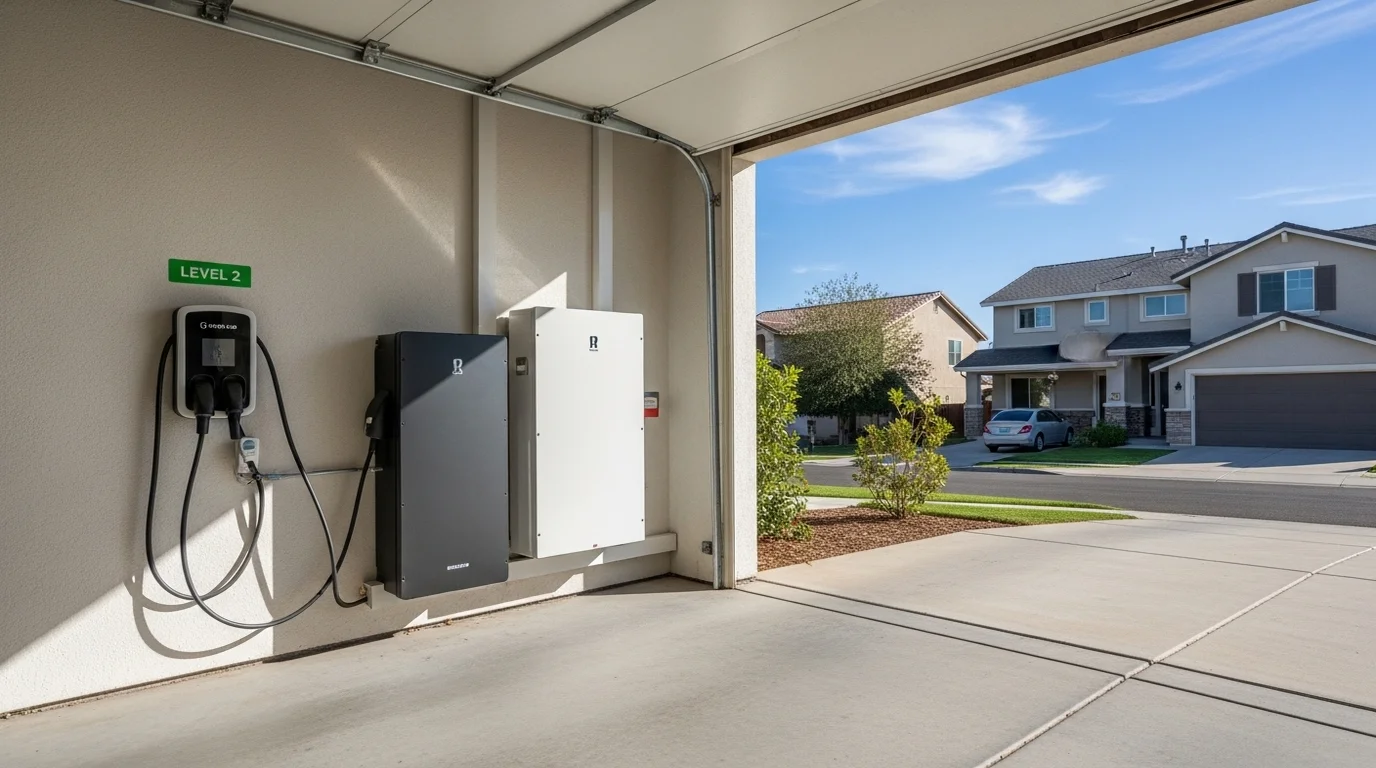
A home Level 2 EV charger install runs $1,400–$2,200 all-in in 2026 (CostToCharge, 2026). Add a residential battery storage system and the combined project lands at roughly $13,000–$22,000 before any credits. That is one visit, one licensed electrician, one panel assessment, and one permit. Yet most contractors still quote these as two separate jobs with two separate sales cycles.
The installers who have shifted to the bundle model are not closing harder; they are closing smarter. One approval covers both products. One monthly payment replaces two sticker prices. The customer who was hesitant about battery storage alone becomes an easier yes when the EV charger is already in the same conversation.
This guide covers the combined cost math, the one-approval financing mechanics, the kitchen-table sales script, which projects qualify, and why the first bundle customer is your best long-term customer.
> Key Takeaways
> - A combined EV charger and battery storage project runs roughly $13,000–$22,000 in 2026 (EnergySage, CostToCharge). Labor savings from one visit versus two visits reduce per-project overhead.
> - Over 80% of EV charging in the US occurs at home (Mordor Intelligence, 2025), making in-home infrastructure the core investment, and the natural companion to battery storage.
> - A multi-vertical direct lender covers both products under one approval, with battery energy storage terms from 6 to 240 months and flexible terms on EV chargers. No dealer fees. Subject to approval and eligibility.
See how Eos Loan financing helps you close more projects
Why does bundling an EV charger with battery storage make financial sense?
In 2025, Mordor Intelligence reported that over 80% of EV charging in the United States occurs at home (Mordor Intelligence, Residential EV Charger Market Report, 2025). That statistic tells you something important: the household investing in a battery storage system is, very often, the same household that needs an EV charger. They are not two separate customers. They are the same customer at two points in the same project.
The financial argument for bundling is simpler than most contractors expect. Both products require a licensed electrician, a panel assessment, and a permit. Done together, that fixed overhead is paid once. Done separately, it is paid twice. A home adding a battery storage system frequently needs a 200A service upgrade anyway, and a Level 2 EV charger install on the same panel runs through that same upgrade. You are not adding a second project; you are finishing the job the panel upgrade already started.
The residential EV charger market was valued at $9.68 billion in 2025 and is projected to reach $32.12 billion by 2030, growing at a 27.11% CAGR (Mordor Intelligence, 2025). That growth curve runs through the same driveways where battery storage is already being installed. Quoting both together is not a stretch. It is a logical next question.
> Our take: The bundle is not really a sales tactic. It is a grid-resiliency argument that most contractor-facing content has missed entirely. A battery alone provides backup power. An EV charger alone fills a commuting need. Together, they form a household energy independence system: the battery stores power for outages, and for households with V2H-capable vehicles, the car can feed the home. That combined value narrative is one customers repeat to their neighbors.
!A licensed electrician working on a residential electrical panel in a bright garage.
For the full picture on EV charger financing as a standalone product, see our EV charger financing guide for installers.
What does a combined EV charger and battery storage project cost in 2026?
In 2026, a residential battery storage system runs $9,000–$18,000 before incentives (EnergySage, 2026). A Level 2 EV charger install adds $1,400–$2,200 (CostToCharge, 2026). A panel upgrade, if the home needs one, adds another $1,500–$3,000 (EcoFlow, 2026). The combined project lands at roughly $13,000–$22,000, and the panel upgrade, if triggered, is shared cost across both products.
Here is the cost breakdown in plain terms:
- Battery storage unit and installation: $9,000–$18,000
- Level 2 EV charger wallbox and installation: $1,400–$2,200
- Panel or service upgrade (if required): $1,500–$3,000 (counted once, not twice)
- Combined total range: roughly $13,000–$22,000 before any available credits
- Residential Level 2 EV charger (wallbox) paired with a residential battery energy storage system
- Panel upgrades included in the financed project amount (check eligibility at submission)
- Water filtration systems added as a third vertical for a three-product bundle under the same program
- Present the combined monthly payment before the total price. The bundle is a different conversation than two separate sticker prices.
- Ask the EV question during the battery conversation. 75% of new EV buyers install a home charger within the first month (Mordor Intelligence, 2025). For most battery customers, the charger question is not a stretch.
- Eos Loan is a direct lender with no dealer fees and coverage across battery energy storage, EV chargers, and water filtration, all subject to approval and eligibility.
- The first bundle customer is your best long-term customer. One financing relationship, established early, is the anchor for every essential project that follows.
- CostToCharge, Level 2 EV Charger Installation Cost Guide, retrieved 2026-06-18, https://costtocharge.com/guides/level-2-ev-charger-installation-cost
- EnergySage, How Much Do Home Batteries Cost?, retrieved 2026-06-18, https://www.energysage.com/energy-storage/how-much-do-batteries-cost/
- EcoFlow, Level 2 Charger Installation Cost, retrieved 2026-06-18, https://energy.ecoflow.com/us/blog/level-2-charger-installation-cost
- Mordor Intelligence, Residential EV Charger Market Report, retrieved 2026-06-18, https://www.mordorintelligence.com/industry-reports/residential-ev-charger-market
- Wood Mackenzie, 2025 U.S. Energy Storage Installations Set New Record, retrieved 2026-06-18, https://www.woodmac.com/press-releases/2025-u.s.-energy-storage-installations-set-new-record-surpass-2024-by-52
- IRS, Residential Clean Energy Credit, retrieved 2026-06-18, https://www.irs.gov/credits-deductions/residential-clean-energy-credit
- IRS, Alternative Fuel Vehicle Refueling Property Credit (Section 30C), retrieved 2026-06-18, https://www.irs.gov/credits-deductions/alternative-fuel-vehicle-refueling-property-credit
The delta between a battery-only project and a battery-plus-EV-charger project is, at most, $2,200 added to a project already in the five-figure range. When you present it as a monthly payment, that delta is often smaller than a customer's current monthly car payment.
A note on tax credits: The residential clean-energy credit (Section 25D) ended December 31, 2025 (IRS). The Section 30C EV charger credit covers 30% of qualifying property up to $1,000, but only for installs placed in service by June 30, 2026, in eligible low-income or non-urban census tracts (IRS). In most 2026 bundles, financing is the primary affordability tool. This is general information, not tax advice; consult a qualified tax professional.
According to Wood Mackenzie's press release on 2025 US energy storage records, residential battery storage reached 2.7 GW in 2025, a 92% increase year over year (Wood Mackenzie, 2026). That demand base is the customer pool also considering an EV charger.
For the standalone battery side of this calculation, see our battery storage financing guide for installers.
How does one-approval financing work for a bundled project?
A multi-vertical direct lender covers both the EV charger and the battery storage system under a single application. The installer submits one combined project, the customer approves one monthly payment, and the lender funds the full amount. One credit relationship. No second sales cycle. No second credit pull when the second product comes up two months later.
The alternative is what most contractors are doing today: financing the battery through one program, then hunting for a second program that covers EV chargers, or asking the customer to put the charger on a credit card. That path doubles the friction for both the installer and the customer, and it splits the monthly payment into two separate conversations at two separate times.
> From the lender's desk: When a customer applies for both an EV charger and battery storage under one program, the blended monthly payment often represents a smaller per-project delta than customers expect. The battery drives the number. Adding an EV charger on the same term adds less than most customers assume, and the objection that would have killed the charger as a standalone quote rarely surfaces when it is presented as part of the battery payment.
With Eos Loan, battery energy storage terms run from 6 to 240 months. EV chargers are covered on flexible terms. Both products fall under one consistent direct-lender standard, subject to approval and eligibility. One underwriting decision covers the full project scope.
Eos Loan charges no dealer fee on either product, including on a combined project. Some single-vertical lenders charge a dealer fee on each financed product. On a combined EV-plus-battery project, that can mean two dealer fees applied to a single sale. With Eos Loan, neither fee applies.
For a detailed breakdown of how direct-lender financing differs from marketplace financing in structure and cost, see our comparison of direct lender vs marketplace financing models.
Add financing to your installs, talk to our team
What is the sales script for presenting a bundle at the kitchen table?
In 2025, Mordor Intelligence found that 75% of new EV buyers in the US install a home charger within the first month of owning the vehicle (Mordor Intelligence, Residential EV Charger Market Report, 2025). For every battery-storage customer who has an EV now or expects to get one within two years, the charger is a near-certain need. The question is not whether they will install it. It is whether you are the one who installs it.
The bundle pitch has three steps. None of them require a hard close.
Step 1: Quote both projects together on one proposal. Not two separate line items at different appointments. A combined proposal with one total and one monthly payment. The customer sees a complete project, not two separate decisions.
Step 2: Present the monthly payment before the total price. A $20,000 combined project on a 120-month flexible term is a different conversation than "$20,000 upfront." Lead with the payment. Follow with the total if they ask.
Step 3: Ask the EV question during the battery conversation. The script is direct: "Do you have an electric vehicle, or are you planning to get one in the next couple of years? We can add the Level 2 charger to the same approval today, one payment covers both." Most customers who are already buying a battery have already thought about the charger. You are not introducing a new idea; you are removing the friction from acting on one they already had.
The customer who finances one essential project is the easiest customer to sell the second. They have already crossed the commitment threshold with you and with the lender. The kitchen-table conversation about the EV charger is not a new sale; it is a continuation of the one already in progress.
!A contractor and homeowner reviewing a project proposal on a tablet in a bright, daylight kitchen.
For more on how financing changes close rates and average ticket size, see how financing increases contractor close rates across essential projects.
Which projects qualify for a bundled financing program?
Most residential and light-commercial EV charger and battery storage projects qualify for a multi-vertical financing program, subject to lender approval. The key eligibility factors are the customer's creditworthiness and the project scope, not the product combination itself.
What qualifies as a bundled project under a direct-lender program:
Commercial installs are handled separately. But for the residential and light-commercial market, the product combination does not create a special underwriting hurdle. The lender is financing the customer, not the product mix.
Eos Loan is a direct lender, not a broker or marketplace. One underwriting standard covers all verticals, and no dealer fees apply to any project in the program. For a practical guide to setting up a contractor financing program, see how to set up a contractor financing program.
How does the battery-plus-EV bundle create a long-term customer relationship?
In 2025, US total energy storage installations hit a record 18.9 GW and 51 GWh, up 52% year over year (Wood Mackenzie, 2026). The homeowners making that investment are building energy infrastructure, not buying a single product. Battery storage and an EV charger are the first two nodes in a household energy system that, within five years, may include solar, a second vehicle, or a commercial charging solution for a home business.
The contractor who runs a multi-vertical program is the installer of record for all of it. The one who sold only the battery will field a call about the charger, give a referral to a competitor, and lose the relationship at the moment the customer is most ready to spend.
> What we see in our partner base: Eos Loan installer partners running multi-vertical financing programs report that EV charger and battery storage projects frequently co-occur in the same household. The installer who asks the EV question during the battery conversation closes the second project at the first visit, rather than losing it to a competitor six months later.
The cross-sell lifecycle looks like this: battery storage leads to EV charger, EV charger leads to solar, solar leads to a second vehicle or commercial EV infrastructure for the home business. Each financing relationship, established early, compounds referrals across every vertical.
The household energy independence argument closes this loop. A battery alone cuts utility bills and provides backup. An EV charger alone handles daily commuting. Together, they reduce grid dependence in a way neither does alone, and that is the story the customer tells their neighbor, which is the referral you earn without a second sales call.
For context on standalone battery financing versus a bundled approach, see our guide to standalone battery financing and how the economics shift when solar or EV is added.
Offer your customers flexible financing on essential projects
Or call +1 833-989-3737 to talk through a financing program for your business.
Frequently Asked Questions
{ question: "Can I finance an EV charger and battery storage together under one approval?", answer: "Yes. A multi-vertical direct-lender program covers both under one application. With Eos Loan, battery energy storage terms run 6 to 240 months, with flexible terms on EV chargers, all subject to approval and eligibility. One approval, one monthly payment, one lender relationship for the combined project." }, { question: "Does bundling an EV charger with battery storage cost less than installing them separately?", answer: "The combined hardware cost is similar, but labor and permitting costs are lower when done in a single visit. One site assessment, one electrical inspection, and one panel upgrade (if needed) instead of two. The per-project labor savings vary by home, but the efficiency gain is real on any job that would otherwise require two truck rolls." }, { question: "What is the Section 30C EV charger credit, and does it apply to a bundle?", answer: "The Section 30C credit covers 30% of qualifying EV charger property, up to $1,000 for an individual, but only for installs placed in service by June 30, 2026, in eligible low-income or non-urban census tracts (IRS). The battery component falls under Section 25D, which ended December 31, 2025. This is general information, not tax advice. Consult a qualified tax professional." }, { question: "What if my customer wants to add the EV charger later? Can they still finance it?", answer: "Yes, they can finance the EV charger as a separate project later. But there are real advantages to doing it now: shared labor, a single credit relationship, and the Section 30C window closes June 30, 2026. For customers who already have or expect an EV, the lower-friction time is while the battery approval is still on the table." }, { question: "How does Eos Loan handle a combined EV charger and battery storage project?", answer: "Eos Loan is a direct lender that finances both EV chargers and battery energy storage under a single multi-vertical program. One application, one underwriting standard, no dealer fees on either product. The installer submits the combined project scope and the customer approves a single monthly payment. All subject to approval and eligibility." } ]} />The bottom line
A combined EV charger and battery storage project in 2026 runs roughly $13,000–$22,000, with labor savings from one visit versus two visits reducing the per-project overhead. Multi-vertical financing covers both products under one approval: one payment, one lender relationship, no second sales cycle.
Key points to carry into your next install:
To explore Eos Loan EV charger financing or Eos Loan battery storage financing as part of your contractor program, reach out to our team and we will walk through the program structure with you.
---
Sources: