

EV Charger Financing When the Site Needs a Grid Capacity Upgrade
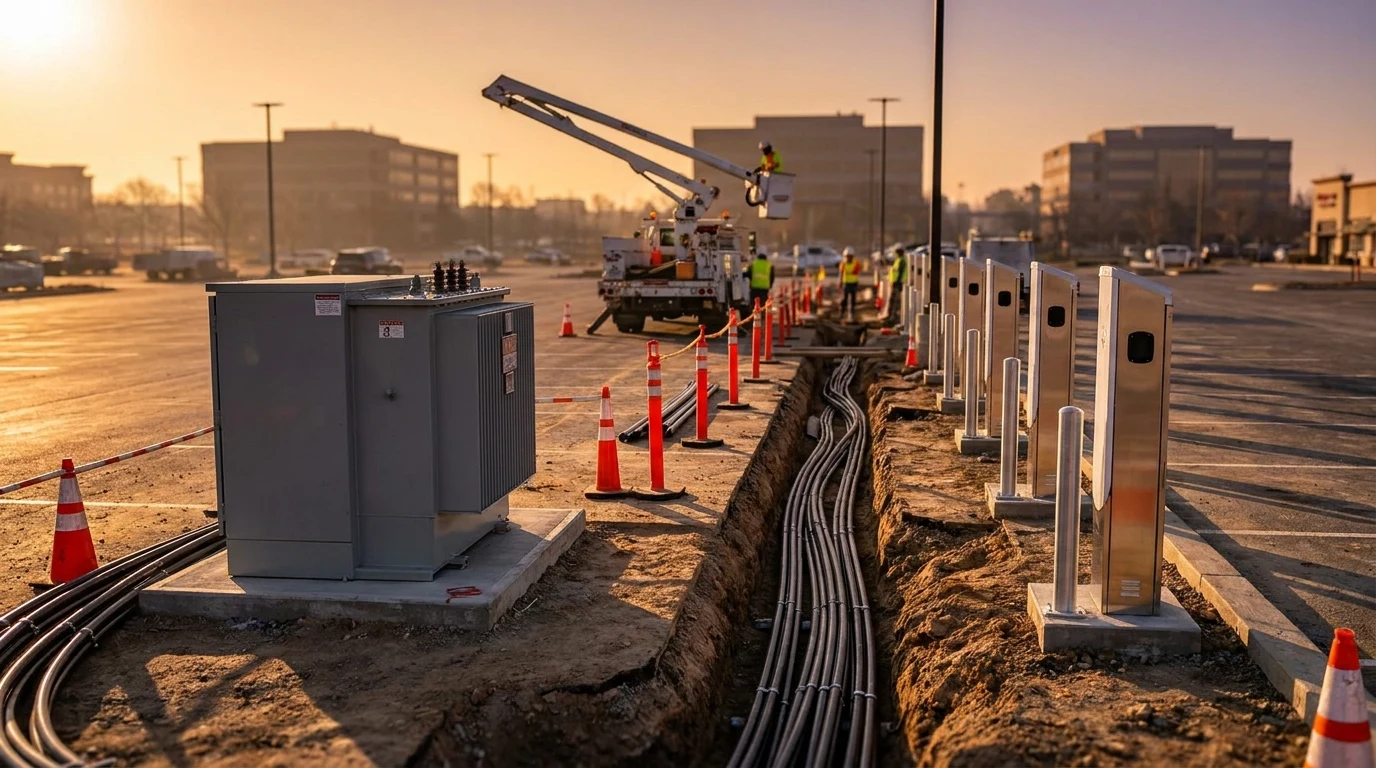
Current utility practices lead to an 18-month, and sometimes longer, turnaround to connect a high-powered EV charger to the grid (DOE Joint Office of Energy and Transportation, 2026). That delay rarely shows up on the original quote. It shows up weeks later, after the installer files the service request and the utility comes back asking for a capacity upgrade.
Most EV charger financing content treats the utility side of a project as a footnote inside a cost breakdown. It is not a footnote. It is a separate decision point with its own timeline, its own payer question, and its own financing answer, one that can decide whether a commercial charging deal closes this quarter or next year.
This guide covers what actually triggers a grid capacity upgrade, how long the wait really runs, who tends to pay for it, what delaying it costs a project in lost revenue, and how financing keeps the deal moving while the utility works through its queue.
> Key Takeaways
> - Utility practices currently lead to an 18-month, or longer, turnaround for connecting high-powered EV chargers to the grid (DOE Joint Office of Energy and Transportation, 2026).
> - A six-month faster timeline is worth $104,200 to $165,500 in net present value for a light-duty public fast-charging station, and an 18-month faster timeline is worth $1.79 million to $3.4 million for a heavy-duty depot station (Nealer & Sharpe, Atlas Public Policy, February 2026).
> - Nevada's Public Utilities Commission now requires NV Energy to track and report grid-connection timelines for large EV charging projects, the first rule of its kind in the country.
> - A direct lender can finance the charger, the installation, and the utility-required electrical infrastructure work as one loan, subject to approval and eligibility.
See how Eos Loan financing helps you close more projects
Why does an EV charger project trigger a grid capacity upgrade?
A capacity upgrade gets triggered when the load a new charger (or bank of chargers) will draw exceeds what the site's existing transformer, service panel, or local distribution line can carry. A single home wallbox almost never does this. A multi-port Level 2 site or a DC fast charger very often does, because the utility has to confirm the circuit it is about to connect to can actually absorb that much added power.
Here is the part that catches installers off guard. Utilities generally do not map and publish spare capacity ahead of time at a level of detail that lets a contractor self-serve the answer. The shortfall usually only surfaces once a formal service or interconnection request gets filed, which means it is discovered after the site has already been scoped, often after the quote has already gone out the door (Interstate Renewable Energy Council survey findings, via Nealer & Sharpe, Atlas Public Policy, February 2026).
A pattern we see on the lender's side: a site that looked like a straightforward ten-port Level 2 install on paper becomes a fourteen-month project the moment the utility flags insufficient transformer headroom. The contractor did not misjudge the job. The information about available capacity simply was not there to check before filing the request.
Isn't the installer supposed to know this before quoting? In an ideal world, yes. In practice, most utility territories do not offer investment-grade hosting capacity data, so the first real answer often comes back from the utility itself, mid-deal. That timing mismatch, not the upgrade's price tag, is what actually stalls commercial charging sales. For the installation and equipment cost side of the project this capacity question sits on top of, see our breakdown of commercial EV charging install costs.
How long does a grid capacity upgrade actually take?
In 2026, current utility practices lead to an 18-month, and sometimes longer, turnaround to connect a high-powered charger to the grid (DOE Joint Office of Energy and Transportation, 2026). That is the headline figure, and the research backs it with real deployment timelines, not just an estimate.
A February 2026 Atlas Public Policy analysis modeled typical energization timelines directly from industry deployment data. A light-duty DC fast charging station, the kind used at a public fast-charging site, typically runs an 18-month baseline timeline from initial planning through commissioning, based on EVgo's own deployment framework. Heavy-duty depot stations run longer: 30 months for a 4-megawatt depot and 36 months for an 8-megawatt depot, reflecting the larger service upgrades those sites require (Nealer & Sharpe, Atlas Public Policy, February 2026).
A real-world data point backs this up. In 2024, the median time from application to utility activation across California's three largest investor-owned utilities exceeded 950 days: 1,106 days at San Diego Gas and Electric, 959 days at Southern California Edison, and 989 days at Pacific Gas and Electric (Cadmus Group and CLEAResult Energetics evaluation for the CPUC, cited in Nealer & Sharpe, Atlas Public Policy, September 2025). That is nearly three years in one of the country's most EV-forward states, and activation timelines there were found to be lengthening, not shortening.
A Level 2 site skips a lot of this when it stays within existing service capacity, which is most single-port and small multi-port jobs. The moment a quote adds enough simultaneous load, whether that is a bank of Level 2 ports or a single DC fast charger, the utility clock starts, and it rarely runs short.
Who pays for the utility capacity upgrade?
The split varies by utility tariff and by state make-ready program, and no single national rule governs it. In most territories the project carries some or all of the upfront capacity-upgrade cost, sometimes offset by a partial utility cost-share through a make-ready program, sometimes not offset at all.
What is changing is regulatory visibility into the problem. Nevada's Public Utilities Commission ordered NV Energy, under Docket 24-05041, to track and report grid-connection timelines for large-scale EV charging infrastructure, with one year of data collection beginning January 2026, the first rule of its kind in the country (EV Infrastructure News, reporting on the Nevada PUC order, 2026). The Interstate Renewable Energy Council campaigned for the transparency requirement, arguing accountability in the energization process is essential to the state's clean-energy buildout.
That is one state, one utility, one docket. It still matters for the sales conversation, because it signals that regulators are starting to treat energization delay as a named, trackable problem rather than an industry anecdote. A 2025 GAO review of federal EV charging infrastructure efforts similarly found that the agencies running the national buildout lack measurable, time-bound performance goals for getting sites connected (U.S. GAO-25-106992, July 2025). Whoever ends up writing the check, the honest answer a contractor gives a client is simple: budget for the upgrade as part of the project cost, and do not assume a rebate or cost-share will appear in time to close the deal on it.
What does delaying the upgrade actually cost the project?
A faster energization timeline is worth real money, not just a shorter wait. For a light-duty public fast-charging station, cutting the timeline by six months is worth $104,200 in net present value for a 600-kilowatt station and $165,500 for a 1-megawatt station, driven mostly by starting to earn charging revenue sooner. For a heavy-duty depot station, where capital intensity and utilization run higher, cutting the timeline by 18 months is worth $1.79 million for a 4-megawatt station and $3.4 million for an 8-megawatt station (Nealer & Sharpe, Atlas Public Policy, February 2026).
The researchers behind that analysis were explicit that their numbers understate the real cost of waiting, because the model does not count the sunk cost of projects that drop out entirely during a long wait. Project dropout runs an estimated 6% to 14% across EV charging sites generally, with some individual program estimates running far higher, and every one of those dropouts carries sunk design and permitting cost with zero revenue to show for it (Nealer & Sharpe, Atlas Public Policy, February 2026). The project that finishes late is not the worst outcome. The project that never finishes is.
That reframes the conversation a contractor should be having with a business client. The capacity upgrade itself is rarely the line item that kills a deal's economics. The months spent waiting on it, not earning revenue while fixed costs accrue, are.
How does financing cover a grid capacity upgrade?
A direct lender can finance the full project scope, charger hardware, installation labor, and the utility-required electrical infrastructure work, as a single loan rather than splitting the capacity upgrade into a separate change order, subject to approval and eligibility. That matters because splitting the scope is exactly where commercial EV deals tend to stall or lose momentum.
Here is why the split hurts. A change order forces the client back into a second buying decision months after they already said yes to the project, right when utility delay has already strained their patience and their cash flow. Financing the whole scope up front, charger plus the transformer, switchgear, or service upgrade the utility requires, keeps one approval covering the entire job, so the contractor's cash flow stays intact no matter how long the utility review runs.
Add financing to your installs, talk to our team
What we see across the Eos Loan partner base: when a commercial EV quote gets trimmed late over utility-upgrade uncertainty, the capacity-upgrade line is usually the first thing cut from scope, not the charger itself. That is backwards. Cutting the upgrade does not shrink the timeline risk; it just means the client discovers the real cost later, with no financing already in place to cover it. We frame this as a pattern we observe in our partner base, not a guarantee of results on any specific deal.
Eos Loan is a direct lender, not a marketplace or broker, and funds EV charger financing with flexible terms and no dealer fee, subject to approval and eligibility. For the underwriting fundamentals behind the program, see our EV charger financing guide for installers, and for Eos Loan's EV charging program details, visit our EV charger financing solution.
How can a contractor avoid getting blindsided by a capacity upgrade mid-deal?
Request the utility's load or capacity information before the quote goes final, not after the contract is signed. That single sequencing change is the most effective fix available to a contractor, because it turns a mid-deal surprise into a known variable priced into the proposal from the start.
Build a capacity-check step into the sales process for any multi-port or DC fast charger quote. On a single-port Level 2 job, the risk is usually low enough to skip. The moment a quote adds simultaneous multi-port draw or a DC fast charger, treat a preliminary utility inquiry as a standard part of the site walk, not an optional extra.
Keep two separate utility conversations straight with the client. This capacity-upgrade question is a one-time, upfront event tied to getting the site energized. It is a different issue from an ongoing monthly demand charge, which is an operating cost that shows up on the utility bill every month after the site goes live. Our guide to demand charges and EV charging financing covers that operating-cost side in full.
Charger type is the single biggest variable in whether any of this applies at all. For the equipment-tier tradeoffs that drive utility exposure in the first place, see Level 2 vs. DC fast charger financing. And for a project that spans many ports across one or more depot sites, where the utility conversation compounds across every site in the build, see our guide to fleet depot EV charger financing.
Frequently Asked Questions
How do I know if my EV charger site needs a grid capacity upgrade?
The installer or utility typically flags it during the service or interconnection application, when the requested load exceeds what the existing transformer or service panel can carry. Few utilities publish detailed spare-capacity data ahead of time, so this is often the first firm answer a project gets.
Does a Level 2 charger ever trigger a capacity upgrade?
Rarely for a single port. It happens more often on multi-port sites, where several chargers drawing power at once push total site load past the existing service capacity, even though no single charger looks large on its own.
How long does a grid capacity upgrade take for EV charging?
Current utility practices lead to an 18-month, and sometimes longer, turnaround for high-powered chargers (DOE Joint Office of Energy and Transportation, 2026). Heavy-duty depot stations can run 30 to 36 months under current baseline timelines, according to a 2026 Atlas Public Policy analysis. Confirm the specific utility's current queue before committing to a client deadline.
Who pays for the utility upgrade, the site owner or the utility?
It varies by utility tariff and state make-ready program, with no single national rule. In most territories the project funds some or all of the upgrade upfront, sometimes with a partial utility cost-share. Regulatory attention is increasing; Nevada's PUC now requires grid-connection timeline reporting for large EV charging projects, the first such rule nationally.
Can financing cover the utility upgrade along with the charger itself?
Yes. A direct lender can finance the full project scope, hardware, installation, and the required electrical infrastructure work, as one loan, subject to approval and eligibility. Eos Loan charges no dealer fee and offers flexible terms on EV charger financing.
Price the utility clock into the deal, not after it
A grid capacity upgrade is not a reason to lose a commercial EV charging deal. It is a known, priceable variable the moment a contractor treats it as part of the quote instead of a surprise that shows up after the contract is signed. Carry these points into the next multi-port or DC fast charger conversation:
- Capacity upgrades get triggered by multi-port and DC fast charger sites, far more than single wallboxes, and most utilities only confirm the shortfall once a formal request is filed.
- Current utility practice runs an 18-month baseline for light-duty DC fast charging and 30 to 36 months for heavy-duty depot stations, and real-world California data shows multi-year waits in practice.
- The value of a faster timeline runs from roughly $104,000 to $3.4 million depending on station size, driven mostly by revenue the site is not yet earning while it waits.
- Financing the full scope, charger plus the utility-required infrastructure work, as one loan keeps the deal moving on the contractor's timeline, subject to approval and eligibility.
Quoting a multi-port or DC fast charger project this quarter? Become an Eos Loan financing partner and put the utility timeline in the proposal before the utility puts it in your client's inbox.
Prefer to talk it through? Call +1 833-989-3737.
---
question: "How do I know if my EV charger site needs a grid capacity upgrade?",
answer: "The installer or utility typically flags it during the service or interconnection application, when the requested load exceeds what the existing transformer or service panel can carry. Few utilities publish detailed spare-capacity data ahead of time, so this is often the first firm answer a project gets."
},
{
question: "Does a Level 2 charger ever trigger a capacity upgrade?",
answer: "Rarely for a single port. It happens more often on multi-port sites, where several chargers drawing power at once push total site load past the existing service capacity, even though no single charger looks large on its own."
},
{
question: "How long does a grid capacity upgrade take for EV charging?",
answer: "Current utility practices lead to an 18-month, and sometimes longer, turnaround for high-powered chargers (DOE Joint Office of Energy and Transportation, 2026). Heavy-duty depot stations can run 30 to 36 months under current baseline timelines, according to a 2026 Atlas Public Policy analysis. Confirm the specific utility's current queue before committing to a client deadline."
},
{
question: "Who pays for the utility upgrade, the site owner or the utility?",
answer: "It varies by utility tariff and state make-ready program, with no single national rule. In most territories the project funds some or all of the upgrade upfront, sometimes with a partial utility cost-share. Regulatory attention is increasing; Nevada's PUC now requires grid-connection timeline reporting for large EV charging projects, the first such rule nationally."
},
{
question: "Can financing cover the utility upgrade along with the charger itself?",
answer: "Yes. A direct lender can finance the full project scope, hardware, installation, and the required electrical infrastructure work, as one loan, subject to approval and eligibility. Eos Loan charges no dealer fee and offers flexible terms on EV charger financing."
}
]} />
---
About the author: Eduardo Donadi is the CEO of Eos Loan, a direct lender specializing in financing for essential projects including battery energy storage, EV chargers, and water filtration. He works directly with electrical contractors and EV charging installers on project scope and financing structure, from a single Level 2 wallbox to a utility-scale depot buildout working through a multi-year interconnection queue.
---
Sources
1. US Department of Energy, Joint Office of Energy and Transportation. "Utility Programs." https://driveelectric.gov/utility-programs Retrieved 2026-10-01.
2. Nealer, R. and Sharpe, B. "Cost Savings from Improving Energization Timelines for EV Charging." Atlas Public Policy, February 2026. https://atlaspolicy.com/cost-savings-from-improving-energization-timelines-for-ev-charging/ Retrieved 2026-10-01.
3. EV Infrastructure News. "US: Nevada Sets Precedent With First-in-Nation EV Charger Grid Connection Reporting Rules." https://www.evinfrastructurenews.com/ev-networks/us-nevada-sets-precedent-with-first-in-nation-ev-charger-grid-connection-reporting-rules Retrieved 2026-10-01.
4. US Government Accountability Office. "Electric Vehicle Infrastructure: Improved Performance Management Needs to Be Part of Any Related Federal Efforts." GAO-25-106992, July 2025. https://files.gao.gov/reports/GAO-25-106992/index.html Retrieved 2026-10-01.