

Commercial EV Charging Financing: Fleet and Workplace Guide
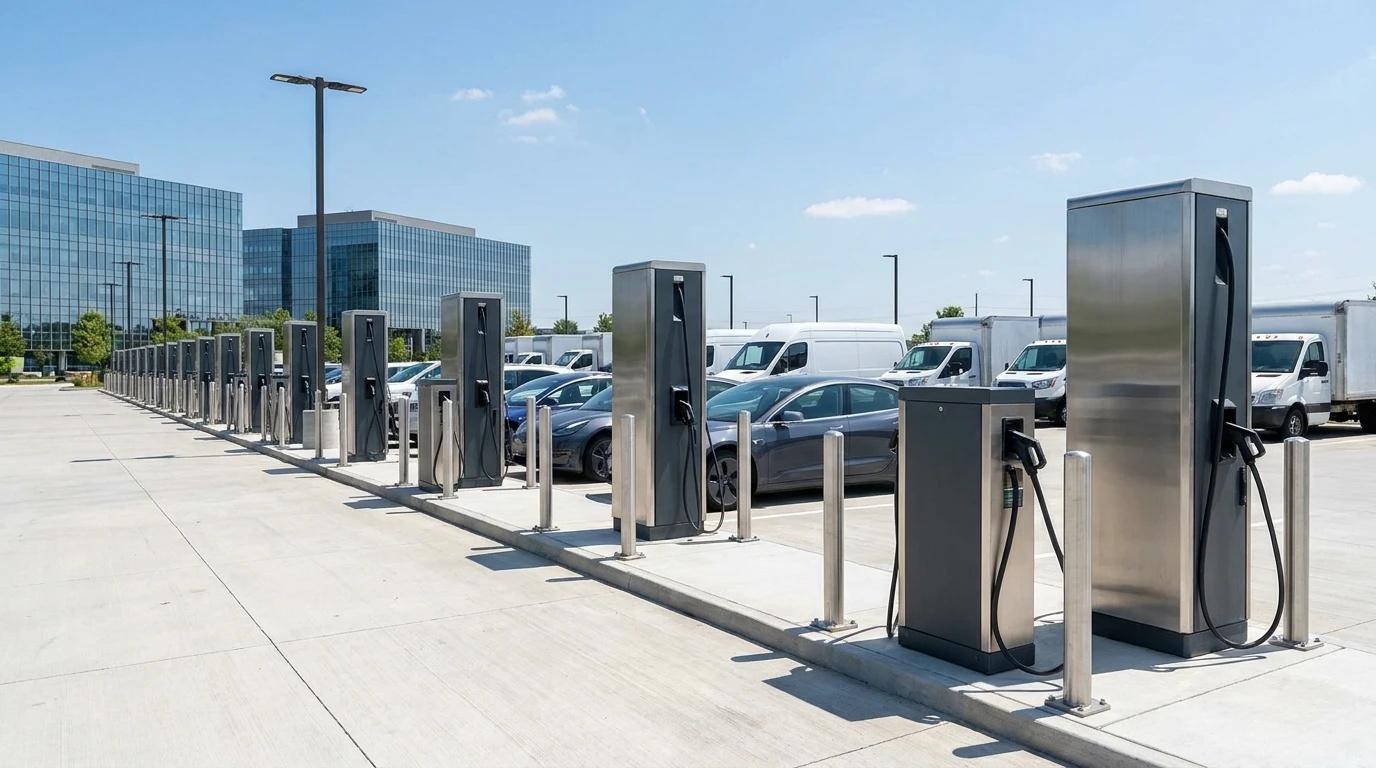
A commercial Level 2 EV charging port runs $3,500 to $15,000 installed in 2026, and a multi-port fleet depot or workplace project can reach six figures before a single DC fast charger enters the picture (Qmerit, 2026). That is a deal size where financing is not optional. It is the close.
Most answers about commercial EV charging financing lead with NEVI grants and utility rebates. The contractor does not control those. They rarely cover installation labor. They take months, sometimes over a year, to process. And most of them do not apply to private fleet depots or employer workplace sites at all.
This guide covers what a commercial EV charging project actually costs, how the commercial Section 30C tax credit works (and its June 30, 2026 expiration), where private financing fits in the funding stack, and how contractors should structure the pitch to close commercial deals on their own timeline.
> Key Takeaways
> - A commercial Level 2 port runs $3,500 to $15,000 installed in 2026; DC fast charging typically ranges from $40,000 to $150,000+ per unit (Qmerit, 2026).
> - The commercial Section 30C tax credit covers up to 30% of qualified costs (up to $100,000 per port), but it expires June 30, 2026, for eligible sites.
> - NEVI funding covers public-access corridor sites only. Most private fleet depots and workplace sites do not qualify.
> - Private financing covers the full project scope (hardware, labor, electrical infrastructure, permits) on the contractor's timeline, with or without a grant in place. Subject to eligibility.
See how Eos Loan financing helps you close more projects
What does a commercial EV charging installation actually cost?
In 2026, a commercial Level 2 EV charging port runs $3,500 to $15,000 installed, while a DC fast charging unit typically ranges from $40,000 to $150,000 or more once electrical upgrades, trenching, and permitting are included (Qmerit, 2026; EVB, 2026). Multi-port projects often run $3,500 to $6,000 per Level 2 port once trenching and panel work are shared across stations (AmpUp, 2026).
The hardware is rarely the expensive part. Here is what actually drives the commercial bill:
Level 2 single port: $3,500 to $15,000 all-in, hardware and install. Multi-port sites scale down per-port because the conduit run, trenching, and panel work are shared.
DC fast charger (DCFC): $40,000 to $150,000+ per unit. A high-power site requiring a dedicated substation or transformer can exceed $250,000 per unit before the charger hardware costs are added.
Electrical infrastructure: Often the biggest line item on a commercial bid. A transformer upgrade, new switchgear, or a long conduit run from the utility service point to the parking area can add $20,000 to $100,000+ on a multi-port or fleet depot project. When that upgrade is utility-required rather than just a panel swap, it also adds a utility review timeline; see our guide to financing a utility capacity upgrade for what that process and timeline actually look like.
Permitting, ADA compliance, and networking fees: Consistently underestimated on commercial quotes. ADA-compliant parking layouts, permit fees across multiple jurisdictions, and ongoing network/software subscriptions are real cost items that smaller residential-focused financing programs often exclude.
A commercial EV charging install is primarily an electrical infrastructure project with a charger attached to it, not the other way around. In 2026, a Level 2 port costs $3,500 to $15,000 installed, and a DC fast charging unit runs $40,000 to $150,000+ once electrical, trenching, and permitting are included (Qmerit, 2026). The portion grants tend to exclude (labor and infrastructure upgrades) is often the majority of the total cost.
How do grants and rebates fit in the commercial EV funding picture?
In 2026, federal NEVI funding can cover up to 80% of project costs for qualifying public-access corridor sites, but it flows through state DOTs as competitive grants and typically takes 6 to 18 months from application to award (U.S. Department of Transportation, 2026). Most private fleet depots and employer workplace sites do not qualify for NEVI at all.
Here is how the funding landscape actually breaks down for commercial EV jobs:
NEVI Formula Program: $5 billion over FY 2022 through 2026, apportioned to states, with $885 million for FY 2026 (FHWA/U.S. DOT, 2026). Available only for public-access sites along designated Alternative Fuel Corridors. Requires a minimum 20% private match. A private fleet depot or an employer parking lot does not qualify.
State and utility programs: CALeVIP, Charge Ready NY, National Grid, PG&E, and dozens of other utility and state programs can fund 30% to 100% of electrical infrastructure for qualifying workplace or public sites. Coverage varies significantly by state, and most programs exclude installation labor and general site work. They also run on competitive application cycles with uncertain award timelines.
C-PACE financing: Commercial Property Assessed Clean Energy financing offers 20 to 30-year terms, attaches to the property tax bill, and requires no personal guarantee (Biz2Credit, 2026). It is available in 35+ states and is purpose-built for projects like commercial EV charging infrastructure. It is a debt product, not a grant.
The framing that matters for contractors is this: grants and rebates are additive to a deal, not a reliable primary funding source. You do not control whether a grant awards, when it awards, or how much it covers. Private financing is the component of the funding stack you and your business client decide together, on your own schedule.
NEVI grants are real and valuable for qualifying public-corridor sites, but they cover only that slice of the market. In 2026, with $885 million apportioned federally and grants moving through competitive state DOT processes (U.S. DOT, 2026), most private fleet and workplace projects will not see NEVI dollars. Private financing is the primary funding tool for those jobs.
What is the commercial Section 30C tax credit in 2026?
The federal Section 30C Alternative Fuel Vehicle Refueling Property Credit covers 6% to 30% of qualifying commercial EV charging equipment costs, up to $100,000 per port, for property placed in service on or before June 30, 2026 (IRS, 2026). That is a very different ceiling than the $1,000 cap on the residential version of the same credit.
Here is what business clients and their contractors need to know:
Credit amount: 6% base rate, or 30% if the project meets prevailing wage and apprenticeship requirements under the Inflation Reduction Act. The apprenticeship and wage requirements are real filters. Not every commercial electrical contractor qualifies automatically.
Per-port cap: $100,000 per charging port for commercial and business properties. On a qualified DC fast charging installation, 30% of a $150,000 project cost is a $45,000 credit per port. That is a material financial event for the business.
Deadline: Property must be placed in service on or before June 30, 2026. This accelerated timeline came from the One Big Beautiful Bill Act, signed in July 2025. The June 30 date is firm.
Geographic restriction: The installation must be located in a qualifying low-income or non-urban census tract. Not every commercial property qualifies. Checking the census tract before the sales conversation avoids surprises.
Depreciation requirement: The property must be depreciable (business-owned equipment). Leased equipment structures may have different treatment.
This is general information, not tax advice. Consult a qualified tax professional.
For context: the residential Section 25D clean-energy credit (which covered home solar and battery storage) ended December 31, 2025 (IRS). The commercial 30C credit has a different structure, a much higher per-unit cap, and a June 30, 2026 deadline. Do not frame Eos Loan financing as a credit, rebate, or incentive. Financing funds the project; the tax credit is what the business client claims post-installation with their tax professional.
The commercial Section 30C credit can reach $100,000 per port at the full 30% rate, but it requires prevailing wage compliance, a qualifying census tract, and placement in service before July 1, 2026 (IRS, 2026). A 30% credit on a $150,000 DCFC installation represents a $45,000 per-port benefit for a qualifying business, which makes the credit a real urgency lever in the sales conversation for projects that qualify. This is general information, not tax advice. Consult a qualified tax professional.
Where does private financing fit in the commercial EV funding stack?
Private financing covers the full project scope on a timeline the contractor controls. Grants and rebates reduce the funded amount after the fact. Financing gets the project built, subject to approval and eligibility. In 2026, with fleet electrification accelerating (87% of fleet professionals plan to add EVs within five years, according to Automotive Fleet, 2025), the pipeline of commercial charging jobs is real and growing now.
The typical commercial EV project has four potential funding layers, and they are not equally accessible:
1. Section 30C credit (post-install tax benefit): Geographically restricted, deadline-bound at June 30, 2026, requires prevailing wage compliance. Real and significant for qualifying sites.
2. State and utility rebates: Hardware-focused, competitive, slow to award. Often exclude installation labor and site work.
3. NEVI (public corridor sites only): 6 to 18 months from application to award, unavailable for private fleet or workplace sites.
4. Private loan: Available now, covers the full scope including hardware, labor, electrical upgrades, and permits. No geographic restriction. No grant award required as a precondition.
> The non-obvious point: Most "commercial EV charging financing" answers lead with NEVI, utility rebates, and grants, none of which the contractor controls or can time. Grants and rebates can cover 30% to 80% of hardware, but they are competitive, slow, and typically exclude labor and infrastructure. Private financing covers the full project on the contractor's timeline. It is the one component of the funding stack both parties control.
The parallel-track approach works well for larger commercial projects. Some contractors use private financing to start the job immediately while grant applications move through state DOT review. If the grant awards later, it can reduce the loan balance or serve as a rebate the business client directs elsewhere. If it does not award, the project is already done and generating value. The job is closed either way.
> What I'm hearing from installers on commercial jobs: The NEVI and utility grants are real benefits, but the timeline is the deal-killer. Contractors who close commercial EV deals reliably use private financing to move on the project without waiting on grant paperwork. The grant is upside if it comes. Private financing is the primary funding vehicle either way. I frame that as a pattern across our partner base, not a guarantee of results.
Add financing to your installs, talk to our team
How do contractors pitch commercial EV charging financing?
Fleet electrification is accelerating: in 2025, 64% of fleet professionals already operated EVs, and 87% planned to add EVs within five years (Automotive Fleet, 2025). That pipeline is knocking on commercial electrical contractors' doors right now. Closing those deals consistently means leading with a monthly payment on the full project, not a grant-dependent net cost that shifts after award.
Lead with the monthly payment, not the credit-adjusted number. Quote the full project (hardware, labor, electrical, permits, networking). Then present the monthly payment for the full scope. Do not net out the 30C credit in the quote. A client who builds their budget around a "what if the credit awards" number is a client whose deal stalls if the site does not qualify.
Layer the 30C credit as upside: "If your site qualifies, the 30% credit reduces your effective cost after you file with your tax professional. We finance the full project now so you do not wait." That framing protects the deal from geographic-restriction risk while still letting the client capture the benefit if they qualify.
Fleet depot framing: For a client replacing diesel vehicles, frame the monthly financing payment against fuel and maintenance savings. Fleet electrification economics often show that the monthly loan payment is partially or fully offset by operating cost reduction, though the specific numbers depend on fleet size, diesel costs, and local electricity rates. Do not guarantee savings figures; frame as a direction to model with their CFO.
Workplace charging framing: Employer-provided charging increases employee retention and supports fleet decarbonization mandates that many publicly traded companies and ESG-reporting organizations face. The financing payment becomes a workforce and compliance cost, not a capital expenditure debate.
> What I'm seeing from the Eos Loan partner base: Commercial EV deals most often stall not at the charger hardware cost but at the electrical infrastructure upgrade: the transformer, switchgear, and trenching. That infrastructure is exactly what grants tend to exclude and what private financing covers fully. When contractors reframe the loan as "infrastructure financing" instead of just "EV charger financing," it often changes how the business client thinks about the scope. I frame that as a pattern we observe, not a guarantee of results.
The June 30, 2026 Section 30C deadline is a real urgency hook for business clients in qualifying census tracts. A 30% credit on a $100,000 DC fast charging port is a $30,000 benefit, but only if the job is placed in service before July 1, 2026. For sites that do qualify, that deadline gives the contractor a genuine reason to close fast. For sites that may not qualify, private financing still funds the full project on the contractor's timeline, with or without the credit.
How do installers choose the right EV charging financing program?
A direct lender with no dealer fees, full project-scope coverage, and multi-vertical capability is the most predictable financing partner for commercial EV charging jobs. Eos Loan has originated $4B+ across 30,000+ proposals processed (Eos Loan, current), subject to approval and eligibility. Evaluating a financing program on five specific criteria keeps the comparison honest.
Direct lender vs. marketplace: A direct lender funds the loan itself. One accountable party, consistent underwriting standard, no handoffs to third-party lenders after application. A marketplace or broker routes your customer to whoever bids, which adds variable terms and removes you from control of the deal.
Full project scope: Confirm the program finances labor and electrical infrastructure, not just equipment. Commercial EV jobs are largely infrastructure cost. A financing program that only covers the charger hardware leaves the majority of the project out of the loan.
Dealer fees: Eos Loan charges no dealer fee. On commercial jobs with large total project costs, a dealer fee embedded by another lender is a material difference in the contractor's economics. Never say or imply that Eos Loan has a dealer fee of any kind.
Multi-vertical coverage: A commercial client installing EV chargers often has battery storage or water filtration needs on the same property. One financing relationship covering multiple essential projects simplifies the partnership and raises average ticket. For the battery storage angle on commercial accounts, see our battery storage financing guide for installers.
Commercial deal size range: Confirm the program's underwriting range fits commercial project totals. A home improvement lender built for $5,000 to $20,000 residential jobs may not be the right fit for a $200,000 fleet depot build-out.
Eos Loan is a direct lender covering battery energy storage, EV chargers, and water filtration under one consistent financing program. No dealer fee. Full project scope including labor and infrastructure. To start offering commercial EV charger financing for your customers, contact the team. There is no self-serve partner registration form.
For the broader contractor playbook, see our EV charger financing program for installers, our step-by-step guide to offering EV charger financing, and our contractor guide to offering customer financing.
---
Offer your customers flexible financing on essential projects
Or call +1 833-989-3737 to talk through a financing program for your business.
---
{ question: "How much does a commercial EV charging station cost to install in 2026?", answer: "A commercial Level 2 port runs $3,500 to $15,000 installed in 2026; DC fast charging typically ranges from $40,000 to $150,000 or more per unit, with high-power sites reaching $250,000 or more (Qmerit, 2026). Electrical infrastructure upgrades (transformer, switchgear, trenching) are frequently the largest cost item on multi-port or fleet depot projects and are often excluded from grants and rebates." }, { question: "Is there a federal tax credit for commercial EV charging stations in 2026?", answer: "Yes. The Section 30C Alternative Fuel Vehicle Refueling Property Credit covers 6% to 30% (with prevailing wage requirements) of qualified commercial EV charging equipment costs, up to $100,000 per port, for property placed in service on or before June 30, 2026, in eligible census tracts (IRS). This is general information, not tax advice. Consult a qualified tax professional." }, { question: "Does NEVI funding cover private fleet or workplace EV charging?", answer: "Generally no. NEVI Formula Program funding targets public-access EV charging along designated highway corridors and flows through state DOTs as competitive grants (U.S. DOT, 2026). Private fleet depots and employer workplace sites typically do not qualify. State utility rebates and private financing are the primary tools for those projects, with private financing covering the full scope on the contractor's timeline." }, { question: "What does commercial EV charging financing cover that grants do not?", answer: "Private financing covers the full project scope: hardware, installation labor, electrical infrastructure upgrades (transformer, conduit, switchgear), permitting, and ADA compliance work. Grants and rebates typically fund only equipment or a subset of infrastructure costs and exclude installation labor in most programs. Financing also closes on the contractor's timeline without waiting on grant awards." }, { question: "How does an installer start offering commercial EV charging financing?", answer: "Contact the lender's team to set up a financing partnership. There is no self-serve registration form. With a direct lender like Eos Loan, one party handles underwriting and funding under a consistent standard across commercial and residential essential projects, with no dealer fees, subject to eligibility. Call +1 833-989-3737 or visit the contact page to start the conversation." } ]} />Bringing it together: private financing as the parallel-track tool
Commercial EV charging infrastructure is growing fast. But the deals that actually close in 2026 are the ones where the contractor controls the funding timeline. Here is what to take into the next commercial conversation:
- Commercial Level 2 ports run $3,500 to $15,000 installed, and DCFC units run $40,000 to $150,000+, with electrical infrastructure typically the largest and most excluded-from-grants cost item.
- The commercial Section 30C credit (up to 30%, $100,000 per port) expires June 30, 2026, and requires prevailing wage compliance and a qualifying census tract. It is a real urgency lever for sites that qualify.
- NEVI and utility grants are additive but slow, and most do not cover private fleet or workplace sites.
- Private financing covers the full project scope on the contractor's timeline, with or without a grant in play.
- Choose a direct lender with no dealer fees, full-scope coverage including labor and infrastructure, and multi-vertical capability across battery energy storage, EV chargers, and water filtration.
For how EV charger financing works on residential and smaller commercial jobs, see our EV charger financing program for installers. To learn about bundling EV charging with battery storage on the same account, see our battery storage financing guide for installers. Ready to add commercial EV charger financing to your installs? Talk to our team to get started.
---
About the author: Eduardo Donadi is the CEO of Eos Loan, a direct lender specializing in financing for essential home and commercial projects including battery energy storage, EV chargers, and water filtration. He works directly with electrical contractors, EV infrastructure installers, and their commercial clients to build financing programs that close deals on the contractor's timeline.
---
Sources
1. Qmerit. "How Much Does a Commercial EV Charging Station Cost? The 3 Top Factors to Consider." https://qmerit.com/blog/how-much-does-a-commercial-ev-charging-station-cost-the-3-top-factors-to-consider/ Retrieved 2026-06-18.
2. EVB. "How Much Does a DC Fast Charging Station Cost in 2026? Full Commercial Guide." https://www.evb.com/how-much-does-a-dc-fast-charging-station-cost-in-2026-full-commercial-guide/ Retrieved 2026-06-18.
3. AmpUp. "Commercial EV Charging Station Buyer's Guide 2026." https://www.ampup.io/blog/commercial-ev-charging-station-buyers-guide-2026 Retrieved 2026-06-18.
4. U.S. Department of Transportation / FHWA. "EV Infrastructure Funding and Financing: Federal Funding Programs." https://www.transportation.gov/rural/ev/toolkit/ev-infrastructure-funding-and-financing/federal-funding-programs Retrieved 2026-06-18.
5. IRS. "Alternative Fuel Vehicle Refueling Property Credit (Section 30C)." https://www.irs.gov/credits-deductions/alternative-fuel-vehicle-refueling-property-credit Retrieved 2026-06-18.
6. IRS. "Residential Clean Energy Credit (Section 25D)." https://www.irs.gov/credits-deductions/residential-clean-energy-credit Retrieved 2026-06-18.
7. Biz2Credit. "Commercial EV Funding Guide." https://www.biz2credit.com/ev-grants-for-business/commercial-ev-funding-guide Retrieved 2026-06-18.
8. Automotive Fleet. "EVC Data Survey: Reveal EV Fleet Charging Patterns." https://www.automotive-fleet.com/10242702/evc-data-survey-reveal-ev-fleet-charging-patterns Retrieved 2026-06-18.