

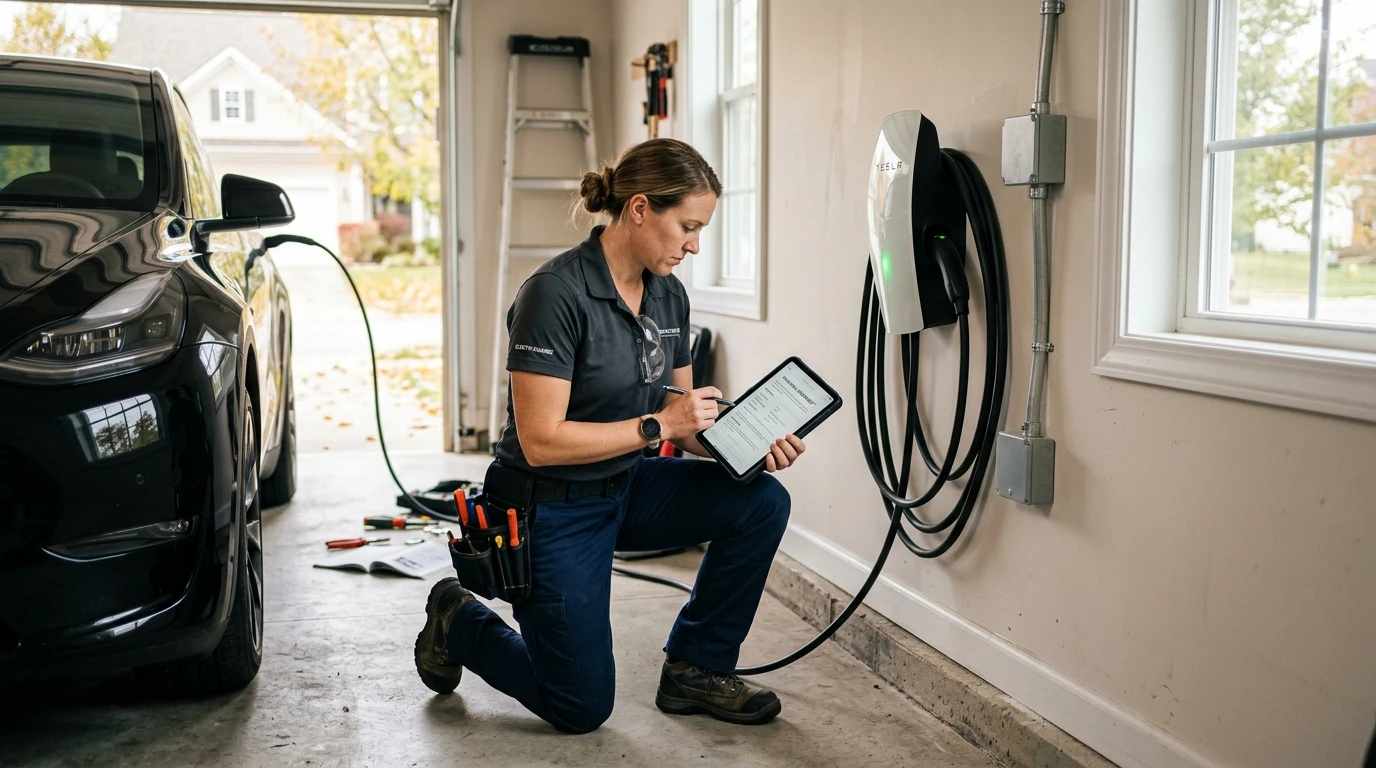
Here is the moment most EV charger installs die: the customer asks "how much?" and you tell them the all-in number before you mention the monthly payment. In 2024, 64% of EV charging happened at single-family homes via Level 1 and Level 2 chargers (DOE, Fact of the Week #1335, 2024). Every new EV on a driveway is a potential install job. The question is whether you close it.
Most online answers about "EV charger financing" point installers toward automaker lease deals or utility rebates. Neither covers install labor, and neither is something you control. This tutorial walks the five steps to set up an installer-controlled direct-lender program, contrast it with the OEM programs you cannot rely on, and bundle EV charger financing with battery storage to raise your average ticket.
> Key Takeaways
> - In 2024, 64% of EV charging happened at home (DOE, Fact of the Week #1335, 2024), so home install demand is real and growing.
> - OEM lease programs and utility rebates rarely cover the 75% of a typical install that is labor, materials, and permit (CostToCharge, 2026). Installer-controlled financing covers the whole project.
> - Presenting the monthly payment before the all-in total is the single change that saves the most deals, especially when a panel upgrade is in play.
> - Bundling EV charger financing with battery storage raises ticket size on one approval, without a second sales cycle. Subject to eligibility.
See how Eos Loan financing helps you close more projects
Why OEM Lease Programs Are Not the Same as Installer Financing
OEM lease programs discount the vehicle, not the install. On a typical $1,800 home Level 2 install in 2026, roughly 75% of the all-in cost is labor, materials, and permit, and only about 25% is the wallbox hardware (CostToCharge, 2026). That labor share is precisely what automaker programs and utility rebates almost never touch.
Consider what an OEM lease deal actually is. The automaker discounts the vehicle purchase or offers charging credits tied to the car. You, the installer, are not in that transaction. You do not set the terms, you cannot quote the customer a payment at the kitchen table, and you will not know what they qualify for until after they buy the car. The install labor, the conduit run, the breaker, the permit, these are your line items, and none of them appear in the automaker's offer.
Utility rebates are narrower still. They sometimes knock a partial amount off hardware, but the amount changes by utility, by year, and by the customer's income bracket. Availability is not something you can rely on when you are trying to close a job.
An installer-controlled financing program changes the equation. You quote the monthly payment, you present the option at the job site, and you get paid upfront by the lender regardless of what the customer's automaker offers. The US electric vehicle charging infrastructure market reached USD 5.09 billion in 2024, projected to grow at a 30.3% compound annual rate through 2030 (Grand View Research, 2025, vendor estimate). More EVs on driveways means more installs to win, and more jobs to lose at the quote stage if your affordability story depends on programs you do not control.
On a typical $1,800 home Level 2 EV charger install in 2026, roughly 75% of the all-in cost is labor, materials, and permit, and only about 25% is the wallbox itself (CostToCharge, 2026). OEM lease programs and utility rebates cover almost none of that labor share. Installer-controlled financing covers the whole project, which is why it belongs in every quote.
Step 1: Choose a Direct Lender, Not a Marketplace
The single most important setup decision is who funds the loan. In Q1 2025, 42 new EVs were registered for every new public charging port added (Alliance for Automotive Innovation, 2025). Home install demand is not slowing, and the lender you pick determines how consistently you can close it.
A direct lender funds the loan itself. You deal with one party, one underwriting standard, and one fee structure. When you call about an approval, you are talking to the entity that made the decision. A marketplace routes your customer's application to multiple third-party lenders, each with their own criteria. You do not know which one will approve, at what terms, or what the customer will be quoted until after the application travels.
For an EV charger job that includes a panel upgrade (adding $1,500 to $3,000 to the all-in cost), you need a consistent and fast approval answer. A panel upgrade that turns a $1,800 quote into a $4,500 quote is exactly the moment where approval consistency matters most. One slow or unpredictable decision at that stage can cost you the deal and the upsell.
Eos Loan is a direct lender: one party, no dealer fees, multi-vertical coverage across EV chargers, battery energy storage, and water filtration. With $4B+ originated and 30,000+ proposals processed, the program is built for installer volume, subject to approval and eligibility. For the full overview of EV charger financing program types, see our EV charger financing guide for installers.
In Q1 2025, 42 new EVs were registered for every new public charging port added (Alliance for Automotive Innovation, 2025). That gap means home install demand is structural, not seasonal, and a direct-lender program with consistent approval standards is what lets you quote financing confidently on every job, not just the ones you think will qualify.
Step 2: Structure Your Quote with the Monthly Payment First
The deal stalls when price lands before payment. Present the monthly payment alongside the cash price on every EV charger quote, before the customer has time to anchor on the all-in total. This single change recovers the panel-upgrade objection more consistently than any other adjustment. The EV charging market recorded 369,000 units in 2024, forecast to reach 498,000 units by end of 2025 (NextMSC, 2025, vendor estimate). More units means more quotes, and more quotes to win or lose at the presentation stage.
Show the all-in project cost and the estimated monthly payment side by side on the same proposal line. Do not bury the monthly option in a footnote. The customer's comparison frame shifts the moment both numbers are visible at the same time.
!A contractor and a homeowner reviewing a project quote on a tablet at a sunlit kitchen table.
The panel-upgrade script is worth drilling specifically. When a home needs a 200A service upgrade, frame the whole project as one monthly payment so the upgrade reads as a few extra dollars per month, not a separate sticker shock stacked on top of the charger price. A home Level 2 install runs roughly $1,400 to $2,200 all-in for a median job in 2026, with a panel upgrade adding $1,500 to $3,000 on top (CostToCharge, 2026; EcoFlow, 2026). A combined $4,500 job is a different conversation than a $4,500 sticker, when you frame it as a payment.
Pre-qualifying before the site visit also helps. Knowing what payment range fits before you scope the job keeps you from quoting a system the customer cannot approve. Digital applications your customer can complete from their phone (rather than fax or paperwork) are also more likely to get finished the same day.
Monthly payments turn the panel-upgrade from a deal-killer into a few extra dollars per month. The installers in the Eos Loan partner base who lead with payment at quote time, not after the customer sees the sticker, lose fewer panel-upgrade jobs to price hesitation. This is a pattern we observe across the partner base, not a promise of results.
Step 3: Bundle EV Charger Financing with Battery Storage
The highest-return EV charger opportunity for most installers is the bundle. In 2025, US residential storage grew 92% year over year to 2.7 GW (Wood Mackenzie, US Energy Storage Monitor, 2025). The household primed to add an EV charger is increasingly the same one that just asked about battery energy storage, and one approval can cover both.
The bundle logic is straightforward. A customer installing battery storage already has an electrician on site, a panel being assessed, and a clean-energy mindset. Adding an EV charger to that same job shares the labor, shares the approval, and avoids a second truck roll. The upsell happens at the kitchen table while the scope is still open, not six months later when you need to book a new appointment.
One financing relationship covers both projects. With Eos Loan, battery energy storage terms run from 6 to 240 months, with flexible terms on EV chargers, so you can put both on one consistent approval standard. For the full storage playbook, see our battery storage financing guide for installers.
Bundling EV charger financing with battery storage raises ticket size on a single approval. US residential storage grew 92% in 2025 to 2.7 GW (Wood Mackenzie, 2025), so the household primed to add an EV charger is increasingly the same one already thinking about storage. One multi-vertical approval covers both projects, which means one visit and one close instead of two.
Add financing to your installs, talk to our team
Step 4: Handle the Tax Credit Deadline Without Burning the Deal
The Section 30C Alternative Fuel Vehicle Refueling Property Credit covers 30% of qualifying EV charger property up to $1,000 for individuals, but only for property placed in service on or before June 30, 2026, and only in eligible low-income or non-urban census tracts (IRS, 2026). Two hard limits, a date and a geographic test, mean many of your customers will not qualify. After that date, or outside an eligible tract, financing is the only affordability lever left.
Do not promise the credit. Your role is to inform the customer that the credit may exist for their property, and to direct them to a qualified tax professional for their specific situation. What you can promise is that financing works regardless of the tax outcome.
The contrast with solar is worth flagging. The residential clean-energy credit (Section 25D) that once covered solar and battery storage already ended on December 31, 2025 (IRS, 2025). So for most residential clean-energy work in 2026, the federal credit is either gone or closing fast. Financing is what fills that gap.
A clear script for the 30C window: "The 30C credit may reduce the effective cost if your property qualifies. Either way, financing lets you pay over time regardless of the tax outcome. Consult a tax professional for your specific situation." That framing uses the deadline to create urgency without making a promise you cannot keep.
This is general information, not tax advice. Consult a qualified tax professional.
The Section 30C EV charger credit covers 30% of qualifying property up to $1,000 for individuals, but only for installs placed in service by June 30, 2026, in eligible census tracts (IRS, 2026). After that date, or outside an eligible tract, financing is the customer's primary affordability lever, which is exactly why it belongs in the pitch now, not as a backup.
Step 5: Start the Program by Contacting the Lender Directly
Setting up an installer financing program is not a self-serve signup. With a direct lender like Eos Loan, you contact the team, discuss your install volume and project mix, and the program is set up with you directly. No form to fill out alone at midnight. No waiting on a portal to tell you whether your business is approved.
What to bring to the first conversation: your average install ticket size, the project types you sell (EV charger only, bundle with storage, panel upgrades), and whether your customers are primarily residential or commercial. The more specific you are, the faster the team can match the program to your typical job.
What your customers experience once you are set up: they apply (typically in minutes), receive a credit decision subject to eligibility, and if approved, choose a monthly payment that fits their budget. You receive payment at install. Your cash flow is not tied to the customer's payment schedule.
That fast decision is also the answer to the "how long will this take" question customers ask before they commit. See how long EV charger financing approval takes for the full timeline, including why the install itself still depends on permitting and utility sign-off.
Eos Loan has originated $4B+ and processed 30,000+ proposals across battery energy storage, EV chargers, and water filtration installs. The program is built for contractors who run volume, not one-off jobs. Subject to approval and eligibility.
For the broader contractor financing playbook across all essential project verticals, see our contractor guide to offering customer financing.
Starting an installer financing program means a direct conversation with the lender, not a web registration form. Eos Loan has originated $4B+ across 30,000+ proposals in battery energy storage, EV chargers, and water filtration. One conversation sets up your program so you can quote financing on every job, subject to approval and eligibility.
Offer your customers flexible financing on essential projects
Or call +1 833-989-3737 to talk through a financing program for your business.
Frequently Asked Questions
How do installers offer EV charger financing to customers?
You partner with a direct lender like Eos Loan, quote the monthly payment at the job site, and present both the all-in price and the payment option on the same proposal. The customer applies (typically in minutes), the lender approves and funds the loan, and you get paid at install. The customer repays the lender over time. Subject to approval and eligibility. About 75% of a typical Level 2 install is labor and materials (CostToCharge, 2026), the part rebates rarely cover.
What is the difference between an OEM lease and installer-controlled EV charger financing?
An OEM lease program discounts the vehicle and is controlled by the automaker. It does not cover install labor, and you, the installer, cannot set the terms or present a payment at quote time. Installer-controlled direct-lender financing covers the whole project, hardware plus labor plus permit. On a typical $1,800 Level 2 install, about 75% is labor (CostToCharge, 2026). That labor share is what you control and what financing funds.
Can I bundle EV charger financing with battery storage on one loan?
Yes. A multi-vertical program covers both projects on one consistent approval standard, which raises ticket size without a second sales cycle. With Eos Loan, battery energy storage terms run from 6 to 240 months, with flexible terms on EV chargers. US residential storage grew 92% in 2025 to 2.7 GW (Wood Mackenzie, 2025), so the household primed for an EV charger is increasingly the same one already looking at storage. Subject to eligibility.
Is there still an EV charger tax credit in 2026?
The Section 30C credit covers 30% of qualifying EV charger property up to $1,000 for individuals placed in service by June 30, 2026, in eligible low-income or non-urban census tracts only (IRS, 2026). Many properties will not qualify on both the date and the geographic test. This is general information, not tax advice. Consult a qualified tax professional for your specific situation.
How does an installer get paid when a customer uses financing?
You get paid in full at install by the lender. The customer repays the lender over time on their chosen monthly payment. Your cash flow is not tied to the customer's payment schedule, which means a financed deal pays the same as a cash deal from your perspective, with a potentially higher ticket because the customer chose the payment option over a lump sum.
The 2026 Setup Checklist
Getting your EV charger financing program running comes down to five moves:
- Choose a direct lender, not a marketplace, so you have one accountable party, one fee structure, and one approval standard on every job.
- Present the monthly payment before the all-in total on every estimate, especially when a panel upgrade is in scope.
- Bundle EV charger financing with battery storage so one approval covers two projects and raises ticket size without a second sales cycle.
- Use the Section 30C deadline (June 30, 2026, eligible tracts only) to create urgency, but never promise a credit outcome. Always direct the customer to a tax professional.
- Start the program through a direct conversation with the lender, not a self-serve form.
- DOE, Fact of the Week #1335 (64% of EV charging at single-family homes via Level 1 and Level 2 chargers), retrieved 2026-06-16, https://www.energy.gov/eere/vehicles/articles/fotw-1335-march-18-2024-64-electric-vehicle-charging-home
- CostToCharge, Level 2 EV Charger Installation Cost guide (home install ~$1,400-$2,200 all-in; ~$800-$3,000 range; ~75% labor/materials/permit share), retrieved 2026-06-16, https://costtocharge.com/guides/level-2-ev-charger-installation-cost
- EcoFlow, Level 2 Charger Installation Cost (200A panel/service upgrade adds ~$1,500-$3,000), retrieved 2026-06-16, https://energy.ecoflow.com/us/blog/level-2-charger-installation-cost
- Alliance for Automotive Innovation, EV registration and charging port data (42 new EVs per new public port, Q1 2025), retrieved 2026-06-16, https://www.autosinnovate.org/
- Grand View Research, Electric Vehicle Charger and Charging Station Market (USD 5.09B in 2024; CAGR 30.3% through 2030; vendor estimate), retrieved 2026-06-16, https://www.grandviewresearch.com/industry-analysis/electric-vehicle-charger-and-charging-station-market
- NextMSC, EV Charging Market Report (369,000 units 2024, forecast 498,000 by end 2025; vendor estimate), retrieved 2026-06-16, https://www.nextmsc.com/
- Wood Mackenzie, US Energy Storage Monitor (2025 residential storage 2.7 GW, +92% YoY), retrieved 2026-06-16, https://www.woodmac.com/
- Internal Revenue Service, Alternative Fuel Vehicle Refueling Property Credit (Section 30C: 30% up to $1,000, placed in service by June 30, 2026, eligible census tracts), retrieved 2026-06-16, https://www.irs.gov/credits-deductions/alternative-fuel-vehicle-refueling-property-credit
- Internal Revenue Service, Residential Clean Energy Credit (Section 25D ended December 31, 2025), retrieved 2026-06-16, https://www.irs.gov/credits-deductions/residential-clean-energy-credit
Eos Loan is a direct lender with no dealer fees, multi-vertical coverage across battery energy storage, EV chargers, and water filtration, and battery energy storage terms from 6 to 240 months with flexible terms on EV chargers, all subject to approval and eligibility. Contact our team to set up your program. There is no self-serve signup; we work with you directly.
For a head-to-head comparison of financing, leasing, and cash for EV charger installs, see our EV charger financing vs. leasing vs. cash guide.
---
Sources
About the author: Eduardo Donadi is the CEO of Eos Loan, the fintech built to finance essential projects (battery energy storage, EV chargers, and water filtration) for installers, contractors, and resellers across the United States.