

EV Charger Financing for Employer Workplace Charging Programs
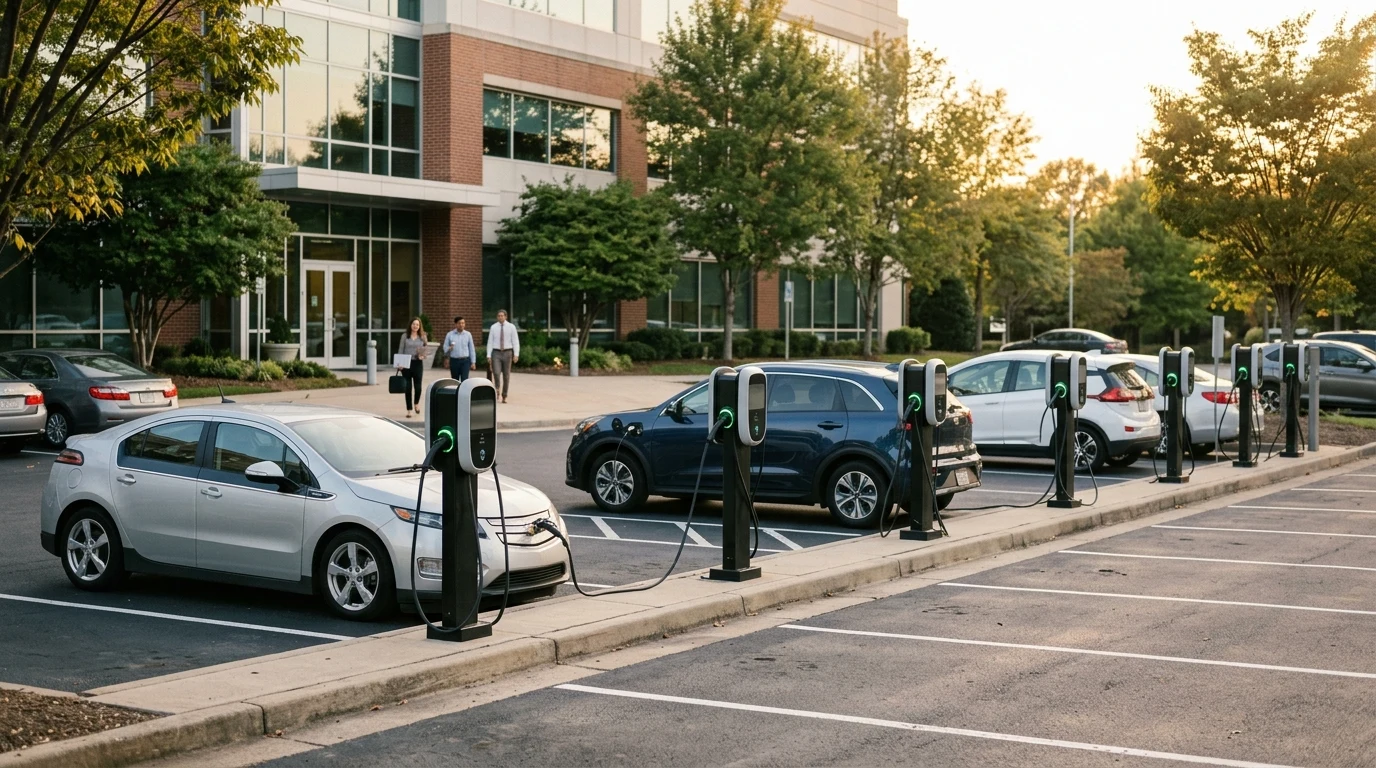
If you are planning a workplace EV charging program now, the tax credit math already changed. A Level 2 port runs $3,500 to $15,000 or more installed in 2026 (Qmerit, 2026), and the federal Section 30C credit that used to offset part of that cost expired for property placed in service after June 30, 2026 (IRS Instructions for Form 8911, Rev. December 2025). Meanwhile, the IRS still has not said plainly whether free workplace charging counts as a taxable perk for employees. This guide covers what a workplace program costs today, how the benefit is taxed, and how financing fits once the credit is off the table.
> Key Takeaways
> - A workplace Level 2 port costs $3,500 to $15,000 or more installed in 2026, before any panel or trenching work is added (Qmerit, 2026).
> - Section 30C terminated for property placed in service after June 30, 2026, ending a credit that covered 6% to 30% of cost up to $100,000 per item (IRS Form 8911 instructions, 2025).
> - The IRS has not issued explicit guidance on whether free workplace charging is a taxable fringe benefit, so most employers pick a fee-based model to keep the tax position clean.
> - Financing covers the installed cost regardless of the credit's status, on flexible terms, subject to approval and eligibility.
Talk to our team about financing a workplace charging program
What does a workplace EV charging program cost in 2026?
A Level 2 EV charging port costs $3,500 to $15,000 or more installed in 2026, with the range driven mostly by electrical work rather than the charger itself (Qmerit, 2026). Hardware is a small slice of that number. Labor, conduit runs, and any panel or service upgrade make up most of the bill.
Multi-port sites change the math. When several stations share one trench and conduit run, the per-port cost drops compared to a single standalone install (AmpUp, 2026). That is why a company adding 4 to 10 ports at once typically pays less per port than a business installing one charger in isolation.
It helps to separate a workplace benefit program from a company's own fleet infrastructure early, because the two get quoted and financed differently. A workplace program funds charging for employees' personal vehicles as a perk, usually 4 to 10 ports to start. That is a different asset and a different buyer than a company electrifying its own delivery vans or service trucks, which we cover separately in our guide to financing a company's own fleet depot. Do not quote or scope the two the same way.
According to Qmerit's 2026 commercial charging cost data, a workplace Level 2 port runs $3,500 to $15,000 or more installed, and multi-port sites reduce that per-port figure through shared trenching (AmpUp, 2026). That range, not a single flat number, is what an employer should plan a budget around before scoping ports.
What happened to the Section 30C tax credit for workplace chargers?
Section 30C terminated for property placed in service after June 30, 2026, under the One Big Beautiful Bill Act, cutting short a credit that used to run through 2032 (IRS Instructions for Form 8911, Rev. December 2025). If your program is being scoped today, that credit is already gone, not just expiring soon.
At its widest, the credit covered 30% of qualifying cost for property meeting prevailing-wage requirements, or 6% otherwise, capped at $100,000 per item for business-use property (IRS Form 8911 instructions, 2025). What mattered was "placed in service," not the date a contract got signed. A charger installed and operational on July 1, 2026 does not qualify, even if the employer signed the purchase order months earlier.
Before June 30, 2026, Section 30C offset a real share of a workplace charging project's cost. After that date, the same install carries the full price tag with no federal offset (IRS, 2025). Any employer evaluating a program now should plan the budget assuming the credit is not coming back for this project.
Is free workplace EV charging a taxable benefit for employees?
The IRS has not issued explicit guidance stating whether free workplace electric vehicle charging is a tax-exempt fringe benefit, and the honest answer is that it depends on facts and circumstances specific to each program (Georgetown Climate Center, 2016). That gap has sat unresolved for years, and it is the one open question every employer should get advice on before launch.
Tax literature lays out two possible paths for treating free charging as exempt: a de minimis fringe benefit (something so small and infrequent that tracking its value is not worth the administrative cost) or a working condition fringe benefit (something an employer provides that would otherwise be deductible if the employee paid for it themselves) (Georgetown Climate Center, 2016). Neither path has a clean, EV-charging-specific answer from the IRS. General fringe-benefit rules in IRS Publication 15-B (2026 edition) still apply by default, and they were not written with plug-in charging in mind.
This is general information, not tax advice. Consult a qualified tax professional about how a workplace charging benefit applies to your specific program before you decide how to structure it.
> The open question most guides skip: Most workplace-charging content treats the tax credit as the hard part and the benefit's taxability as a footnote. It is the other way around. The credit is gone and the math is simple now. The fringe-benefit question is the one with no clean answer, which is exactly why most employers we have seen structure the program around a small fee rather than gamble on an unresolved exemption.
That unresolved question is precisely why most employer programs land on a fee-based model rather than a pure free perk. A documented, metered fee sidesteps the ambiguity instead of resolving it.
Should employers charge employees for workplace charging?
Most employer programs pick one of three models: free as a recruiting perk, a flat monthly fee, or a per-kWh cost-recovery charge, and each one trades off differently on tax exposure and administration. There is no single right answer, only the tradeoff that fits your program.
Free charging is the strongest recruiting and retention signal, and it carries real weight. Companies with workplace charging programs see employees who are six times more likely than the average U.S. worker to drive a plug-in electric vehicle (U.S. Department of Energy, Workplace Charging Challenge, 2016). Free access is also the model with the murkiest tax position, since it leans hardest on an exemption the IRS has never confirmed in writing.
A per-kWh fee is the cleanest tax position on paper, because the employee is paying for what they use rather than receiving an unpriced benefit. It requires networked, metered hardware to bill accurately, which adds a modest cost over a simple non-networked charger. A flat monthly fee sits in between: simple to administer, but it does not track actual usage the way a per-kWh model does.
> What we see across employer programs: Across the EV charger projects Eos Loan has financed for installers, fleets, and property owners, employers who wait for a final tax answer before launching a workplace program often wait a long time, because there is no final answer coming soon. The pattern that works is financing the equipment and install now, then deciding the fee-versus-free question with a tax advisor on its own timeline, so the program launch is not blocked on a question nobody can fully answer yet.
What does an employer workplace charging program buildout actually involve?
A workplace charging program is an electrical infrastructure project first and a charger purchase second, the same lesson that applies to any commercial EV charging install (Qmerit, 2026). Skipping the electrical assessment to focus on picking a charger model is the most common way a project's budget goes sideways mid-install.
Start with a panel and service capacity assessment. Many office buildings were not built with headroom for a bank of Level 2 chargers, and finding that out after signing a hardware order is the expensive way to learn it. From there, most employer programs start with 4 to 10 ports rather than scaling to depot-size builds, and networked hardware is worth the added cost if you plan to bill by usage. ADA-compliant parking layout and accessible charging spots round out the planning list.
> Our finding: Across the workplace-scale programs Eos Loan has helped finance, the single biggest budget swing has never been the charger hardware itself. It has been whether the building's existing electrical panel had spare capacity or needed an upgrade, a detail no charger price sheet will tell you.
!An electrician installing conduit and wiring for a Level 2 EV charging station wallbox in daylight.
See what financing a workplace charging program could look like
How does financing fit once the tax credit is gone?
Financing covers the full installed cost, hardware, labor, panel work, and permits, in one approval, on flexible terms, subject to approval and eligibility, regardless of whether a federal credit applies to the project. That decoupling matters more now than it did before June 30, 2026, because the project math no longer has a credit to lean on.
Relying on a since-expired credit to justify a workplace charging budget no longer works as a planning assumption. Eos Loan is a direct lender, not a marketplace or a broker matching you to multiple funding sources, and we do not charge a dealer fee on any project we finance. That structure pairs cleanly with a fee-based cost-recovery model: the employer finances the build once, then lets a per-kWh or flat fee offset the payment over time, without either decision blocking the other.
For employers weighing how to structure the purchase itself, our financing vs. leasing vs. cash comparison breaks down the tradeoffs port by port. For a fuller look at commercial charging economics generally, see our commercial EV charging cost breakdown, and for how quickly approvals typically come back, see how fast EV charger financing approval typically comes back. For the fundamentals installers and facilities teams use to scope any charging project, start with our EV charger financing guide for installers. You can also review Eos Loan EV charger financing directly.
Ask our team about financing an employee EV charging program
Prefer to talk it through? Call +1 833-989-3737.
Bringing it together: building a workplace program after the credit expired
A workplace EV charging program still runs $3,500 to $15,000 or more per port installed in 2026, and that number no longer has a federal tax credit to soften it. Section 30C ended for anything placed in service after June 30, 2026. The employee-benefit tax question remains genuinely unresolved, which is exactly why a fee-based model is worth a serious look before you launch a free perk. None of that changes what financing does: it covers the installed cost now, on flexible terms, subject to approval and eligibility, while the credit and tax questions get settled separately with the right advisors.
Frequently Asked Questions
Is workplace EV charging a taxable benefit for employees?
The IRS has not issued explicit guidance on this question, so it comes down to facts and circumstances for each program (IRS Publication 15-B, 2026; Georgetown Climate Center, 2016). This is general information, not tax advice. Consult a qualified tax professional about your specific program.
Does the Section 30C tax credit still apply to workplace chargers installed today?
No. Section 30C terminated for property placed in service after June 30, 2026, under the One Big Beautiful Bill Act (IRS Instructions for Form 8911, Rev. December 2025). A charger installed today does not qualify.
How much does a workplace EV charging program cost per port?
A Level 2 port runs $3,500 to $15,000 or more installed in 2026, with the range driven mostly by electrical and labor work rather than the charger hardware (Qmerit, 2026).
Should a small company start with a few chargers or build for future demand?
Most employer programs start with 4 to 10 ports and assess panel capacity before scaling further, since a service upgrade is usually the largest swing in total cost. For the broader commercial cost breakdown behind that decision, see our commercial EV charging cost breakdown.
{ question: "Is workplace EV charging a taxable benefit for employees?", answer: "The IRS has not issued explicit guidance on this question, so it comes down to facts and circumstances for each program (IRS Publication 15-B, 2026; Georgetown Climate Center, 2016). This is general information, not tax advice. Consult a qualified tax professional about your specific program." }, { question: "Does the Section 30C tax credit still apply to workplace chargers installed today?", answer: "No. Section 30C terminated for property placed in service after June 30, 2026, under the One Big Beautiful Bill Act (IRS Instructions for Form 8911, Rev. December 2025). A charger installed today does not qualify." }, { question: "How much does a workplace EV charging program cost per port?", answer: "A Level 2 port runs $3,500 to $15,000 or more installed in 2026, with the range driven mostly by electrical and labor work rather than the charger hardware (Qmerit, 2026)." }, { question: "Should a small company start with a few chargers or build for future demand?", answer: "Most employer programs start with 4 to 10 ports and assess panel capacity before scaling further, since a service upgrade is usually the largest swing in total cost." } ]} /> --- About the author: Eduardo Donadi is the CEO of Eos Loan, a direct lender specializing in financing for essential home and commercial projects including battery energy storage, EV chargers, and water filtration. He works directly with installers, employers, and facilities teams to structure financing for workplace EV charging programs. ---Sources
1. Qmerit. "How Much Does a Commercial EV Charging Station Cost? The 3 Top Factors to Consider." https://qmerit.com/blog/how-much-does-a-commercial-ev-charging-station-cost-the-3-top-factors-to-consider/ Retrieved 2026-10-08.
2. AmpUp. "Commercial EV Charging Station Buyer's Guide 2026." https://www.ampup.io/blog/commercial-ev-charging-station-buyers-guide-2026 Retrieved 2026-10-08.
3. IRS. "Instructions for Form 8911, Alternative Fuel Vehicle Refueling Property Credit." Rev. December 2025. https://www.irs.gov/instructions/i8911 Retrieved 2026-10-08.
4. IRS. "Publication 15-B, Employer's Tax Guide to Fringe Benefits." 2026 edition. https://www.irs.gov/pub/irs-pdf/p15b.pdf Retrieved 2026-10-08.
5. Georgetown Climate Center. "Federal Income Tax Treatment of Workplace Electric Vehicle Charging as a Fringe Benefit." June 2016. https://www.georgetownclimate.org/files/report/GCC_TaxConsiderationsforWorkplaceCharging_June2016_0.pdf Retrieved 2026-10-08.
6. U.S. Department of Energy. "Workplace Charging Challenge Progress Reports." https://www.energy.gov/eere/vehicles/articles/workplace-charging-challenge-reports Retrieved 2026-10-08.