

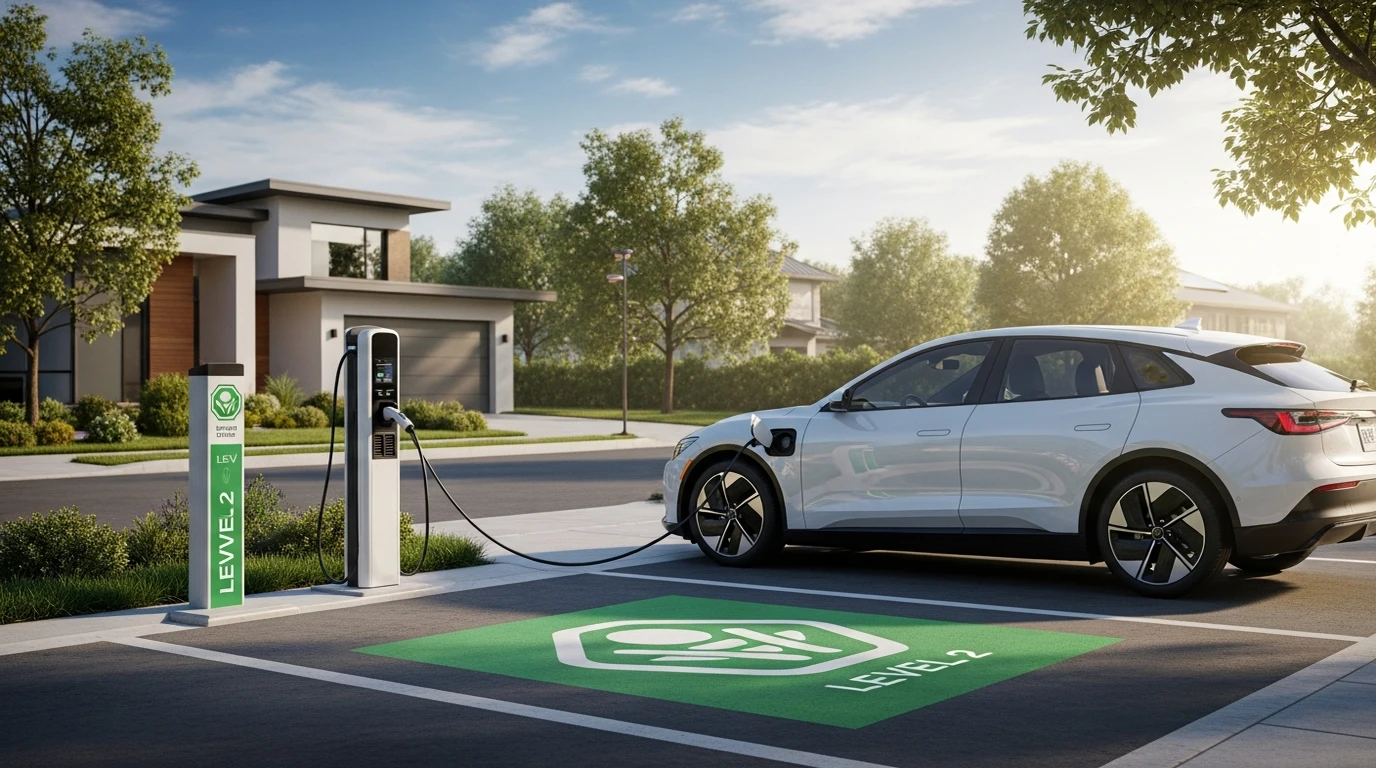
A home Level 2 EV charger install runs $1,400 to $2,200 all-in in 2026 (Recharged, 2026). That quote just lost you a deal, unless you offered a monthly payment alongside it. Three payment paths exist for your customer: financing, leasing, and cash. Each one changes who controls the sale, what gets covered, and whether the panel upgrade gets approved or rejected.
This guide maps all three options so you can present them confidently, know which to lead with, and give your customer the right answer before a competitor does.
> Key Takeaways
> - A home Level 2 install runs $1,400–$2,200 all-in; about 75% of that is labor and materials, not the wallbox (CostToCharge, 2026).
> - Financing covers hardware, labor, permit, and panel upgrades (the items OEM leases and utility rebates skip).
> - OEM equipment leases (like GM Energy's V2H system) do not cover install labor; the installer invoices that separately.
> - The Section 30C EV charger tax credit (up to $1,000 residential) expires June 30, 2026. Consult a tax professional.
> - Eos Loan charges no dealer fee, subject to eligibility and approval.
See how Eos Loan financing helps you close more projects
What Are the Three Ways to Pay for an EV Charger?
In 2026, the US EV charging market is projected to grow at roughly 25% compound annually through the early 2030s (Grand View Research, 2025; this is a vendor estimate). More charger jobs are coming. But the payment conversation is where installs are won or lost. Three distinct paths exist, and they behave very differently.
Financing means a direct lender (not the automaker) funds the full project. Hardware, labor, conduit, permit, and panel upgrade all go on one loan. The customer pays monthly; you get paid upfront. Subject to eligibility and approval.
Leasing means a third party (typically the equipment manufacturer or an independent leasing company) provides the charger hardware on a monthly payment plan. The key difference: install labor is your separate invoice, not part of the lease. You are not the financing party. The customer's monthly payment goes to the OEM or leasing company.
Cash means the customer pays the full invoice in one lump sum at or after completion. No monthly payment, no lender relationship, fastest close on simple jobs.
> Market signal: The GM Energy V2H bidirectional charging system lease (announced February 2026) bundles a charger and battery storage into a single system priced at $15,297 to $26,997 (GM Authority, 2025; Axios, 2026). This is not a standalone charger lease. It is a V2H plus storage bundle managed by GM, not by you. Many customers may confuse "EV charger lease" with this product. Knowing the difference helps you redirect the conversation.
How Does EV Charger Financing Work, and What Does It Cover?
Financing covers the complete project: hardware, labor, conduit run, permit, and the panel upgrade if needed. That last item matters. In 2026, roughly 75% of a typical home EV charger install is labor, materials, and the permit (CostToCharge, 2026). Utility rebates and OEM incentives almost never touch that share.
Here is how the mechanics work. You quote the full job. The customer applies with the lender. The lender approves and funds the loan, paying you upfront. The customer repays on flexible terms over time. You keep your cash flow intact; they keep their budget.
For EV charger installs, Eos Loan offers flexible terms. The specific range depends on the job and the customer's profile, subject to approval. What you can state clearly: Eos Loan charges no dealer fee. That is a real differentiator. Many lenders charge a dealer fee that comes out of your revenue. With Eos Loan, that fee does not exist.
> From the installer lens: When you present three options and one is a monthly payment, the conversation shifts. Your customer stops asking "can I afford $2,200?" and starts asking "which month works?" That same shift applies to the panel upgrade. The customer who balks at $4,500 all-in will often say yes to $4,500 spread over flexible monthly payments.
The citation capsule for this section: On a typical home EV charger install in 2026, roughly 75% of the total cost is labor, materials, and the permit, not the wallbox hardware (CostToCharge, 2026). Utility rebates and OEM incentive programs almost never cover that labor share, which is exactly where installer-offered financing through a direct lender earns its value.
For a deeper breakdown of how to structure the pitch, see our EV charger financing guide for installers.
What Is an EV Charger Lease, and When Does It Make Sense?
An equipment lease lets customers pay monthly for the charger itself, but install labor is the installer's separate invoice. In 2026, the GM Energy V2H system introduced a bundled lease at $15,297 to $26,997 that includes both the bidirectional charger and battery storage (GM Authority, 2025). That is not a standalone charger lease. It is a different product.
Equipment leasing for EV chargers also exists through independent providers. SaaSCharge, for example, offers equipment leasing with terms from 6 to 72 months (SaaSCharge, 2026). In those programs, the leasing company owns the equipment, the customer pays monthly, and your install labor is a separate charge.
Key limitation for you as the installer: In a lease, you are not the financing party. You do not control the approval, the terms, or the customer relationship after the equipment is placed. Your labor invoice stands alone, and it either gets paid at close or it doesn't. The monthly payment the customer makes goes to the OEM or leasing company, not to a program you manage.
When might a lease fit? A lease can work when a customer wants the lowest possible monthly number and only needs the charger hardware (no panel upgrade, short run from the panel). It can also fit in a utility territory where a hardware-subsidy program handles the rebate side and the customer only needs to cover the equipment cost monthly.
The citation capsule for this section: GM Energy's bidirectional V2H home charging system, announced for leasing in February 2026, bundles the charger and home energy storage into a single system at $15,297 to $26,997 (GM Authority, 2025; Axios, 2026). Installers should note that this system lease does not cover the installer's labor or permitting fees, which remain a separate invoice.
!An EV charging station in a residential garage with a visible electrical panel in the background.
Financing vs Leasing vs Cash: Side-by-Side Comparison
The single most important differentiator is not the monthly payment amount. It is whether you, the installer, control the financing relationship and whether the full project cost is covered. Here is how the three paths line up:
| | Financing | Lease | Cash |
|---|---|---|---|
| Covers install labor? | Yes | No (equipment only) | Yes |
| Installer controls terms? | Yes (direct lender) | No (OEM/lessor controls) | N/A |
| Monthly payment option? | Yes | Yes | No |
| Customer owns equipment? | Yes (after payoff) | No (OEM/lessor owns) | Yes |
| Covers panel upgrade? | Yes | No | Yes |
| Installer gets paid upfront? | Yes | Separate invoice | Yes |
| Section 30C eligible?* | Yes | Depends on ownership | Yes |
Section 30C eligibility requires the customer to own the charging property and the equipment. For leased equipment, eligibility depends on ownership structure. This is general information, not tax advice. Consult a qualified tax professional to confirm eligibility.
The panel-upgrade scenario is where the payment option matters most. Add a 200A service upgrade to a median install and the total can reach $4,500 or more (EcoFlow, 2026). Cash customers frequently decline upgrades when they see that number. Financed customers are choosing a monthly payment, so the upgrade becomes "how much does it add to the monthly?" rather than "can I write a bigger check?"
The citation capsule for this section: For an installer, the most meaningful comparison is not the monthly payment size but who controls the financing relationship. With a direct lender, the installer presents the option, the customer applies, and the installer gets paid upfront for the full project including labor. With an OEM lease, the installer invoices labor separately, and the leasing relationship belongs to the manufacturer, not the installer.
For actual install cost ranges broken down by scenario, see our piece on how much does an EV charger installation cost.
The Section 30C Deadline and What It Means for Your Customer's Decision
In 2026, the Section 30C EV charger tax credit (up to $1,000 for residential, up to $100,000 per unit for commercial) expires June 30, 2026, for installs placed in service on or before that date (IRS, Plug In America). The Inflation Reduction Act had extended this credit through 2032. The One Big Beautiful Bill Act, signed in July 2025, shortened it to June 30, 2026.
This deadline intersects with the payment decision. A $1,000 credit on a $1,800 median install represents a 56% reduction in net hardware cost for the customer who can claim it. That is a powerful close-assist argument, regardless of which payment path the customer chooses. The financing mechanics do not change: the customer claims the credit on their tax return, and the installer gets paid in full by the lender.
How to use it in the conversation: "The 30C credit of up to $1,000 expires June 30. Whether you pay cash or go with a monthly payment, you'll want the install done by then." Urgency without pressure. The credit simply makes the math better, and it applies whether the customer finances or pays cash.
This is general information, not tax advice. Consult a qualified tax professional to confirm eligibility and filing requirements for your specific situation.

Add financing to your installs, talk to our team
Which Option Should Installers Lead With?
Lead with financing on the majority of residential jobs. It covers the full project, keeps you in control of the sale, and converts the panel-upgrade objection into a monthly payment. Here is a simple decision framework:
Job is simple, customer is cash-ready: Cash closes fastest. No lender relationship, no application. Just close and move on.
Job involves a panel upgrade ($4,500+ all-in): Lead with financing. The lump sum is the objection that kills the deal. A monthly payment removes it.
Customer wants hardware-only and has a utility rebate in hand: An equipment lease from the OEM may be an option. Invoice your labor separately. Note that you do not control the lease terms or the customer relationship after that point.
Customer is undecided: Present all three options but anchor on the financed monthly payment. "Most of my customers pick the monthly payment because it lets them add the panel upgrade without blowing the budget." That framing works.
The installer who offers financing wins the job on panel-upgrade quotes more often than the installer who requires cash. It is not because financing is "cheaper," it is because the customer's decision frame changes. Choosing a payment amount feels different from choosing a lump sum. Framing the entire project as a monthly number removes the psychological barrier of a large invoice.
For a full playbook on adding financing to your install business across all project types, see our contractor guide to offering customer financing.
Offer your customers flexible financing on essential projects
Or call +1 833-989-3737 to talk through a financing program for your business.
Frequently Asked Questions
{ question: "Is it better to finance or lease an EV charger?", answer: "For most installs, financing is better for the installer because it covers the full project including labor and panel upgrades, keeps the installer in control of the customer relationship and approval, and the customer owns the equipment after payoff. OEM equipment leases cover hardware only and are managed by the manufacturer, not the installer. Subject to eligibility and approval." }, { question: "Does the Section 30C tax credit apply to financed or leased EV chargers?", answer: "The 30C credit (up to $1,000 residential, up to $100,000 per unit commercial) generally applies when the customer owns the property and the equipment. For financed installs, the customer owns the equipment and typically qualifies, but eligibility depends on individual circumstances. For leased equipment, eligibility depends on ownership structure. The credit expires June 30, 2026. This is general information, not tax advice. Consult a qualified tax professional. (IRS; Plug In America)" }, { question: "Can I offer EV charger financing directly to my customers as an installer?", answer: "Yes. By partnering with a direct lender like Eos Loan, you quote the full project (hardware, labor, permit, panel upgrade if needed), the customer applies, and you get paid upfront. You do not need to operate as a lender yourself. Eos Loan charges no dealer fee. Subject to eligibility and approval." }, { question: "What is the difference between OEM EV charger leasing and installer-offered financing?", answer: "OEM leasing (such as GM Energy's V2H system at $15,297–$26,997) is managed by the manufacturer, covers the equipment only and not install labor, and the customer pays the OEM monthly. Installer-offered financing through a direct lender covers the full project, the installer controls the customer relationship, and there is no separate labor invoice for the customer to manage." }, { question: "Does paying cash for an EV charger make sense?", answer: "Cash works well for simple installs where the customer can absorb the full cost upfront. It closes the fastest. Where it loses out is on panel-upgrade jobs at $4,500 or more all-in (EcoFlow, 2026): the lump sum becomes the objection that kills the deal. A monthly payment option makes those larger jobs close more often." } ]} />Which Path Wins for Your Business?
Financing, leasing, and cash each have a place in the installer's toolkit. But they are not equally useful across the full range of jobs you quote.
- Financing covers the full project, including the labor and panel upgrade that rebates and OEM programs skip.
- Installer-offered financing keeps you in control of the sale, the terms, and the customer relationship.
- The Section 30C credit (up to $1,000 residential) expires June 30, 2026. Use that deadline to close the jobs on your pipeline now.
- Cash closes fast on simple installs. Financing closes bigger jobs where a lump sum becomes the objection.
- CostToCharge, Level 2 EV Charger Installation Cost Guide, retrieved 2026-06-18, https://costtocharge.com/guides/level-2-ev-charger-installation-cost
- EcoFlow, Level 2 Charger Installation Cost, retrieved 2026-06-18, https://energy.ecoflow.com/us/blog/level-2-charger-installation-cost
- Recharged, How Much Does Home EV Charger Installation Cost?, retrieved 2026-06-18, https://recharged.com/articles/how-much-does-home-ev-charger-installation-cost
- GM Authority, GM Energy to Begin Leasing Bidirectional EV Charging System in 2026, retrieved 2026-06-18, https://gmauthority.com/blog/2025/10/gm-energy-to-begin-leasing-bidirectional-ev-charging-system-in-2026/
- Axios, GM EV Home Charging, retrieved 2026-06-18, https://www.axios.com/2026/02/19/gm-ev-home-charging
- SaaSCharge, Equipment Financing, retrieved 2026-06-18, https://saascharge.com/finance/
- IRS, Credits and Deductions, Section 30C Alternative Fuel Vehicle Refueling Property Credit, retrieved 2026-06-18, https://www.irs.gov/credits-deductions/
- Plug In America, Federal EV Tax Credits: EV Charging Infrastructure 30C, retrieved 2026-06-18, https://pluginamerica.org/learn/federal-ev-tax-credits/ev-charging-infrastructure-30c/
- Grand View Research, Electric Vehicle Charger and Charging Station Market, retrieved 2026-06-18, https://www.grandviewresearch.com/industry-analysis/electric-vehicle-charger-and-charging-station-market
For the full picture on how EV charger financing works alongside battery storage bundles, see our bundling EV charger and battery storage financing guide. If you are evaluating how dealer fees work at other lenders versus Eos Loan's no-dealer-fee structure, our dealer fees explained piece covers that in detail.
---
Sources