
Most digital point-of-sale lenders return a financing decision the same day. Eos Loan applications often decide in minutes, subject to credit approval (NerdWallet, 2026). That part is fast. The part that confuses people is what comes after: a quick approval doesn't mean the charger goes in next week, and that mismatch causes real friction between customers and contractors mid-project.
This article breaks down what actually happens during an EV charger financing decision, what speeds it up or slows it down, and why the real wait for most jobs comes from permitting and utility sign-off, not the lender.
> Key Takeaways
> - Most digital point-of-sale lenders return an EV charger financing decision the same day; Eos Loan applications often decide in minutes, subject to credit approval (NerdWallet, 2026).
> - Regulation B sets a 30-day legal maximum for a completed application, far longer than the typical wait (CFPB).
> - Residential permitting typically runs 1-4 weeks, and utility interconnection for load-adding EV charger work can take 60-120 days in many markets, per industry guidance.
> - Financing speed is rarely the install bottleneck. Permitting and utility approval usually are.
Offer your customers flexible financing on essential projects
How Long Does EV Charger Financing Approval Actually Take?
Most digital point-of-sale lenders return a decision the same day. Eos Loan applications often decide in minutes, subject to credit approval (NerdWallet, 2026). A soft credit pull runs first with zero score impact, before any hard inquiry (myFICO).
The mechanics are simple. The customer submits basic identity and income information, the soft pull runs, and a decision comes back. From there it's an e-signature, then funding to the installer, subject to approval. That whole sequence is designed to take minutes on a phone or tablet at the kitchen table, not days of paperwork.
Regulation B, the federal rule governing credit decisions, requires a creditor to notify an applicant within 30 days of a completed application (CFPB, 12 CFR § 1002.9). That 30-day window is a legal ceiling, not the typical wait. In practice, digital decisions land far faster than that.
For the full step-by-step of what happens after a customer applies, including e-signature and funding mechanics, see the full walkthrough of what happens after a customer applies for financing. This post focuses on the question that walkthrough doesn't answer: why the project still takes weeks even when the decision doesn't.
Become an Eos Loan financing partner
Why Does My EV Charger Installation Take Weeks If Financing Is Fast?
Financing approval and project completion run on two different clocks. The financing decision is minutes to a day. The installation timeline depends on permitting and, for anything adding meter load, utility interconnection, which commonly takes far longer.
Residential EV charger permitting typically runs 1-4 weeks from application to approval, according to industry permitting guides. Permits themselves often process in 1-5 business days once an application is deemed complete. For small EV charging projects, authorities having jurisdiction commonly have a matter of business days to review an application for completeness, then roughly 20 days to approve it in jurisdictions with streamlined ordinances (U.S. Department of Energy Alternative Fuels Data Center, 2026).
Utility interconnection is where the real schedule risk lives. Anything that adds load above the existing meter commonly takes 60-120 days for utility approval in many markets, per industry electrical-contractor guidance. A panel or service upgrade can stretch that window even further. None of this is under a lender's control, and none of it moves faster because the financing came back quickly.
> What Eos Loan sees across originations: Dealer partners who quote financing decision speed alongside a realistic permit and utility timeline set better customer expectations early. In our experience, that combination correlates with fewer mid-project cancellations than when a customer is left to assume "approved" means "installed next week."
For a deeper look at what actually drives EV charger install cost and how the timeline builds up, see our breakdown of EV charger install cost and timeline drivers.
What Affects How Fast an EV Charger Financing Decision Comes Back?
Decision speed depends mainly on how complete the application is and how the lender verifies income and identity, not on the equipment being financed. A fully completed digital application with verifiable identity and income moves fastest.
A few factors matter more than others. Application completeness is the biggest lever: missing income or identity documentation is the most common reason a decision stalls. The verification method matters too. A digital point-of-sale flow with instant identity checks moves faster than a paper-based application requiring mailed documents.
Credit profile affects the decision, not necessarily the speed of getting one. Both approvals and declines can return quickly. Isn't it worth knowing that a "pending" or "needs more information" status usually just means the lender wants another document, not a quiet denial? In 2025, 48% of people who applied for a loan or financial product in the past year faced a denial on at least one application (Bankrate Credit Denials Survey, Feb 2025). That's a real share of applicants, and installers who prepare customers for either outcome close more comfortably than those who only rehearse the happy path.
For the full breakdown of what lenders weigh before that decision comes back, see how credit score affects financing approval.
Does the Size or Type of EV Charger Job Change Approval Speed?
Approval speed stays largely the same whether the job is a simple wallbox or a larger install with a panel upgrade. The lender evaluates the applicant's credit, not the equipment.
A home Level 2 EV charger install typically runs $1,400 to $2,200 all-in, and up to roughly $4,500 with a 200A panel upgrade (CostToCharge; EcoFlow, 2026). The financing decision timeline holds steady across that whole range. What changes with a larger job is the amount financed, which can affect underwriting criteria, not the turnaround time for the decision itself.
Multifamily and commercial jobs are a bit different. Larger multi-port projects may require more documentation, business financials or proof of property ownership, which can add a modest amount of time to underwriting. That's still a separate question from the permitting and utility timeline covered above. For how that plays out on larger properties, see how multifamily EV charger financing timelines differ. To see the full range of financing options built for installers, visit Eos Loan's EV charger financing solutions.
What Should Installers Tell Customers While They Wait?
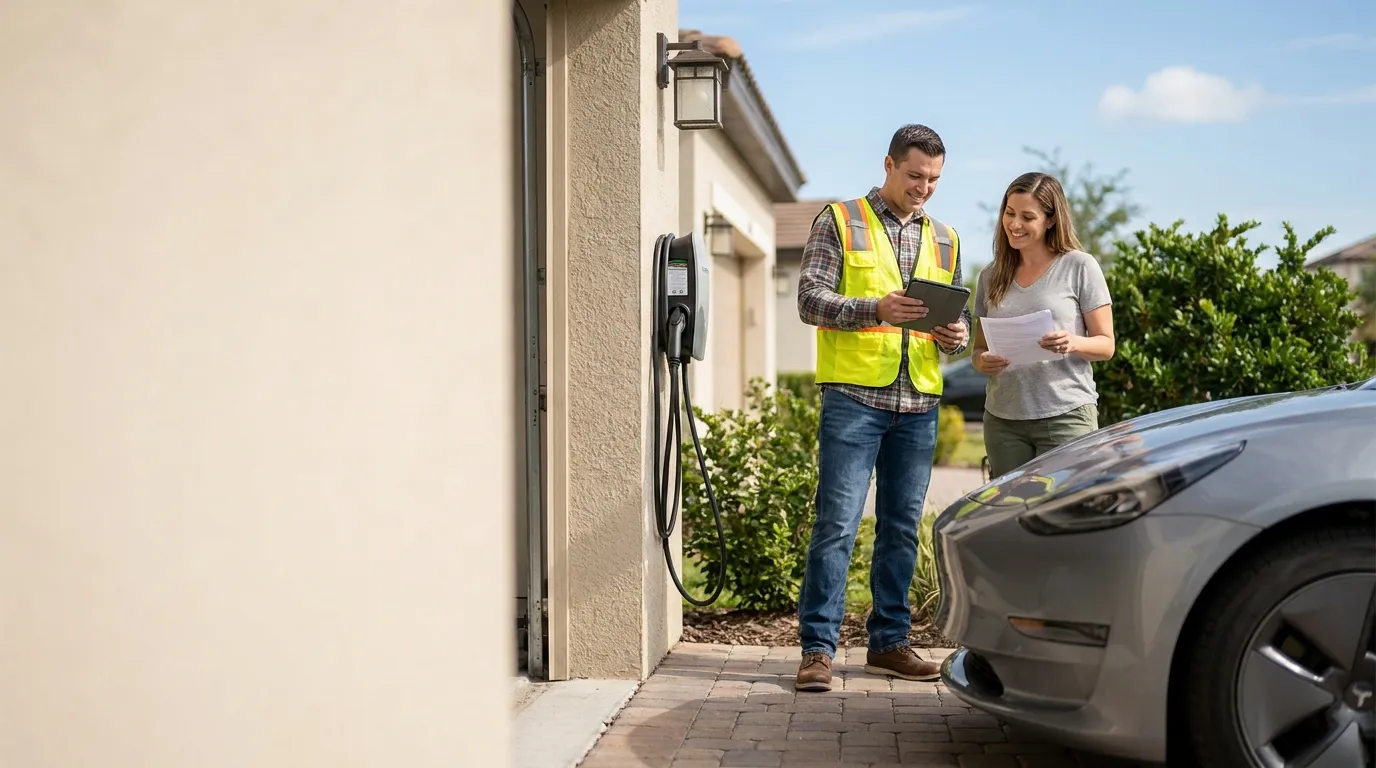
Tell customers the truth about which clock they're on. The financing decision will likely come back same-day or faster, but the project isn't finished until the permit clears and, if applicable, the utility signs off on added load.
A simple script works well at the table: "Your financing decision will likely be quick. The bigger variable is the permit and, if we need to add capacity, the utility. Let's talk through both timelines so nothing catches you off guard."
> What I hear most often, from Eduardo Donadi, CEO of Eos Loan: The number one support call I hear about EV charger jobs isn't "why was I denied." It's "why is my charger not in yet if I got approved two weeks ago?" That's a permitting and utility question, not a financing one, and installers who explain that distinction early avoid an awkward conversation later.
!Close-up of an EV charger financing application in progress on a phone, held in a well-lit setting.
Eos Loan is a direct lender, not a marketplace or broker routing applications elsewhere, and there's no dealer fee attached to that structure. Never promise or imply a guaranteed approval or a specific install date. Both remain subject to approval, eligibility, and third-party permitting and utility timing outside any lender's control. For building this conversation into a full program, see how to build a complete EV charger financing program for your installs.
Add financing to your installs, talk to our team
How Does EV Charger Financing Approval Compare to Rebate Timing?
Financing approval is typically the fastest step in the whole EV charger project. State and utility rebate processing is typically the slowest, often taking weeks to a few months rather than days.
That contrast matters for how installers sequence a job. Financing doesn't require waiting on a competitive award cycle or a funding pool to get a project moving, while rebates remain a bonus that can offset cost later, once processed. Rebate timelines vary widely by state and program, and are subject to funding availability and eligibility review. For the state-by-state detail on how those timelines actually compare, see how state EV charger rebate timelines compare to financing.
Frequently Asked Questions
How long does it take to get approved for EV charger financing?
Most digital point-of-sale lenders return a decision the same day. Eos Loan applications often decide in minutes, subject to credit approval (NerdWallet, 2026). Regulation B sets a 30-day legal maximum for a completed application, well beyond the typical wait (CFPB).
Does EV charger financing approval take longer than approval for other project types?
No. Approval speed depends on the applicant's credit profile and application completeness, not the type of equipment being financed. Battery energy storage, water filtration, and EV charger financing through a direct lender like Eos Loan typically follow the same decision timeline.
Why does my EV charger installation take longer than my financing approval?
Financing and installation run on separate clocks. The financing decision is usually fast, but installation depends on permitting, commonly 1-4 weeks for residential jobs, and, for anything adding meter load, utility interconnection approval, which can take 60-120 days in many markets (industry permitting and electrical-contractor guidance, 2026).
Can I get EV charger financing approved before my permit is issued?
Yes. Financing approval and permitting are independent processes, and there's no requirement to hold a permit before applying. Many installers sequence financing approval first so the customer has budget certainty before scheduling the permit and utility steps.
Does a lower credit score or need for a co-signer slow down the decision?
Not necessarily. Approvals and declines are typically returned on the same fast timeline. A lower credit profile affects the outcome of the decision more than the speed of getting one. A "pending" status usually reflects a request for income or identity verification, not a slow denial.
The Bottom Line on EV Charger Financing Approval Time
Financing is almost never the reason an EV charger install runs long. Most decisions come back same-day, often in minutes with Eos Loan, subject to credit approval. The real variables are permitting and, when meter load increases, utility interconnection, and both run on timelines the lender doesn't control.
Job size doesn't meaningfully change how fast a decision returns, whether it's a simple wallbox or a panel-upgrade install. What changes is the underwriting amount, not the turnaround. Set expectations about both clocks early, and a permitting delay stops looking like a lender problem.
See how Eos Loan financing helps you close more projects
Or call +1 833-989-3737 to talk through a financing program for your business.
---
Sources
- NerdWallet, How Long Does It Take to Get a Personal Loan (same-day digital decisions), retrieved 2026-08-02, https://www.nerdwallet.com/personal-loans/learn/how-long-does-it-take-to-get-a-personal-loan.
- myFICO, Managing Credit Inquiries (soft vs. hard inquiry, zero score impact from soft pull), retrieved 2026-08-02, https://www.myfico.com/credit-education/credit-reports/manage-credit-inquiries.
- Consumer Financial Protection Bureau, 12 CFR § 1002.9, Regulation B notification requirements (30-day maximum for a completed application), retrieved 2026-08-02, https://www.consumerfinance.gov/rules-policy/regulations/1002/9/.
- U.S. Department of Energy, Alternative Fuels Data Center, Electric Vehicle Charging Station Permitting and Inspection (AHJ review windows for small EV charging projects), retrieved 2026-08-02, https://afdc.energy.gov/fuels/electricity-permitting-processes.
- CostToCharge, Level 2 EV Charger Installation Cost Guide (install cost range $1,400-$2,200, up to ~$4,500 with panel upgrade), retrieved 2026-08-02, https://costtocharge.com/guides/level-2-ev-charger-installation-cost.
- EcoFlow, Level 2 Charger Installation Cost, retrieved 2026-08-02, https://energy.ecoflow.com/us/blog/level-2-charger-installation-cost.
- Bankrate, Credit Denials Survey (48% of applicants faced at least one denial in the past 12 months), retrieved 2026-08-02, https://www.bankrate.com/credit-cards/news/credit-denials-survey/.
About the author: Eduardo Donadi is the CEO of Eos Loan, the fintech built to finance essential projects (battery energy storage, EV chargers, and water filtration) for installers, contractors, and resellers across the United States.