

EV Charger Financing for Retail and Hospitality Businesses
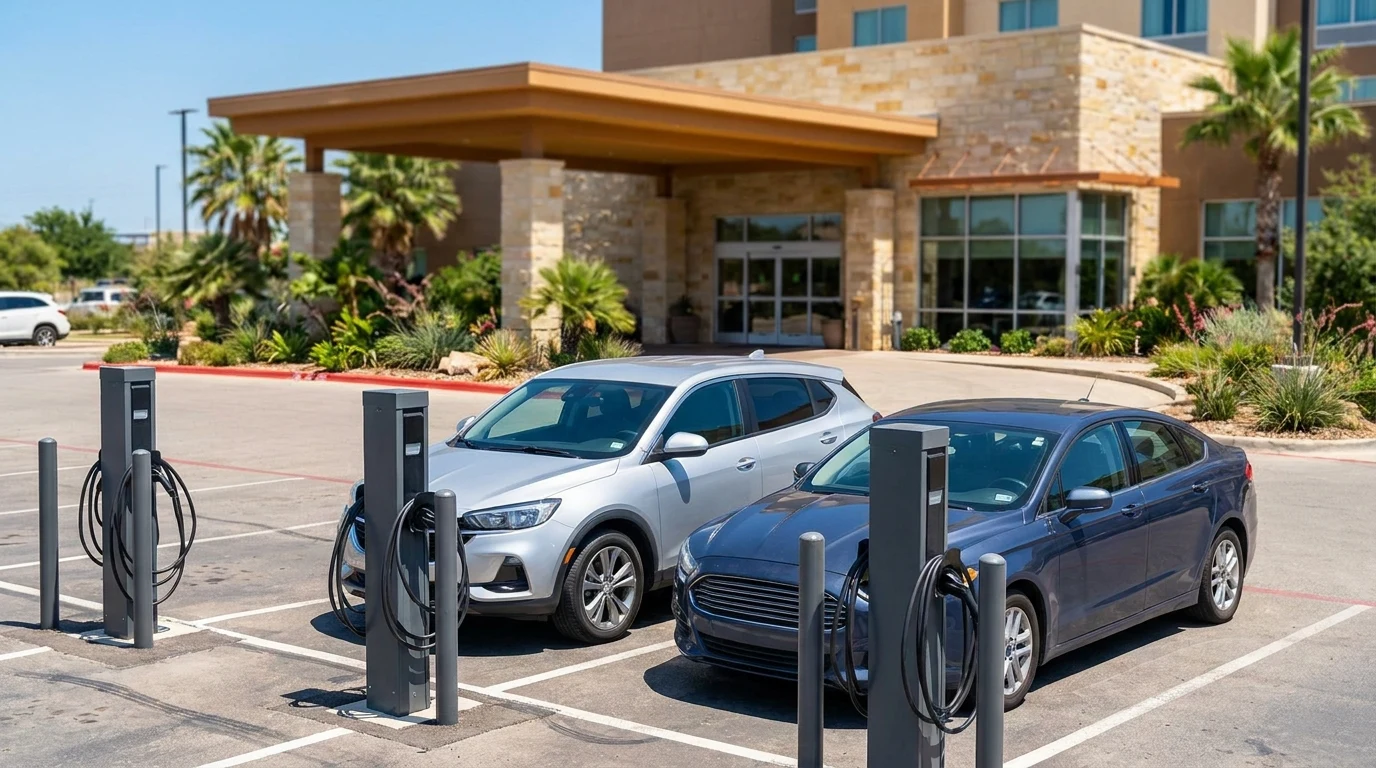
EV owners are 61% more likely to shop at retailers that offer charging stations than at ones that don't (Numerator, 2024). Even so, most retail and hospitality owners still treat a charger install as a cost line on an electrical bid. It isn't. In our experience, it's a guest amenity that shows up in visit counts, dwell time, and booking decisions. The pitch, and the financing behind it, should follow that logic, not the fleet-charging playbook.
So what does that mean in practice? This guide breaks down what makes the retail and hospitality charging pitch different from fleet or workplace charging. It also covers what the install actually costs in 2026, where the federal tax credit stands, and how contractors structure financing to close these projects without waiting on a grant cycle.
> Key Takeaways
> - EV owners are 61% more likely to shop at retailers with charging stations, and stores near fast chargers see a measurable lift in visits and spending (Numerator, 2024; Babar & Burtch, MSOM, 2024).
> - In a 2022 Virta and Kantar survey, 87% of EV drivers said EV charging availability at hotels influences their decision on where to stay (Virta, 2022).
> - A commercial Level 2 port runs $3,500 to $15,000 installed in 2026; DC fast charging runs $18,000 to $350,000+ per port (Qmerit, 2026).
> - The federal Section 30C credit no longer applies to property placed in service after June 30, 2026, which makes private financing the durable funding lever for this vertical.
See how Eos Loan financing helps you close more projects
Why Are Retail and Hospitality Businesses Installing EV Chargers?
EV owners are 61% more likely to shop at retailers that offer charging stations (Numerator, 2024). On top of that, stores within roughly 200 meters of a fast charger see a 4% increase in monthly visits and a 5% rise in spending (Babar & Burtch, Manufacturing & Service Operations Management, 2024). That's not a rounding error. In fact, it's a measurable traffic and revenue signal tied directly to a piece of parking-lot hardware.
The logic here is dwell time. Dwell time is the length of time a customer spends on-site during a single visit, and it's the real driver behind these numbers. A shopper plugging in for 30 minutes browses the store instead of leaving. Likewise, a hotel guest checking a booking site sees charging listed as an amenity next to pool and free breakfast. A restaurant patron parked next to a charger during dinner isn't rushing out, either. On top of that, EV-owning households skew higher-income, which matters for retailers and hospitality brands chasing higher-spend customers.
> The framing gap: Most retail and hospitality EV content still treats charging as a sustainability checkbox. The dwell-time and booking-influence data says otherwise. This is a foot-traffic and revenue tool first, and pitching it that way changes who signs off on the budget.
How Much Does It Cost to Install EV Chargers at a Retail or Hospitality Property?
A commercial Level 2 charging port runs $3,500 to $15,000 installed in 2026, and DC fast charging runs $18,000 to $350,000 or more per port depending on site conditions (Qmerit, 2026). Level 2 charging is AC charging that fully charges most EVs in 4 to 10 hours, a good fit for anyone parked for an hour or longer. DC fast charging, by contrast, delivers a meaningful charge in 20 to 60 minutes, built for short stops. Most retail and hospitality sites don't need DC fast charging everywhere, though. Instead, they need the right mix for how long a customer actually stays.
A hotel guest parks overnight, so Level 2 charging fits the stay well. A sit-down restaurant patron might have 60 to 90 minutes, which still works for Level 2. A quick-service restaurant or a gas-station-adjacent retail stop, though, only has a customer on-site for about 15 minutes. In that short window, only DC fast charging delivers a meaningful amount of range.
Beyond the charger itself, a few things drive cost up or down: available panel capacity (an older building often needs a service upgrade), trenching distance from the electrical panel to the parking spot, and how many jurisdictions' permits the project touches. Overall, a single well-placed Level 2 port near the entrance is a far smaller project than a multi-port bank that requires new switchgear.
Add financing to your installs, talk to our team
Is There Still a Tax Credit for Commercial EV Chargers in 2026?
Section 30C, the Alternative Fuel Vehicle Refueling Property Credit, is the federal tax credit that covers part of the cost of installing EV charging equipment. It covers 6% of qualified costs, or 30% with prevailing wage and apprenticeship compliance, up to $100,000 per port (IRS, 2026). However, it does not apply to property placed in service after June 30, 2026. That deadline moved up from December 31, 2032, under the One Big Beautiful Bill Act (Public Law 119-21).
On top of that, there's a geographic restriction: the site has to sit in a qualifying low-income or non-urban census tract. So not every retail or hospitality property in a dense urban area even qualifies while the credit is still live. And for projects placed in service after the deadline, the credit simply doesn't apply, regardless of location or wage compliance.
This is general information, not tax advice. Consult a qualified tax professional. And to be clear: Eos Loan financing is not a tax credit, rebate, or incentive. It's a loan that funds the project regardless of whether the site qualifies for 30C.
How Does EV Charger Financing Work for Retail and Hospitality Projects?
So, with the federal incentive window closing for new installs, private financing becomes the tool retail and hospitality owners and their contractors control directly on every project, no matter the census tract or the calendar. Eos Loan is a direct lender, not a marketplace or broker connecting borrowers to third-party funding sources.
Financing terms are structured around the project scope, subject to approval and eligibility. That matters because Eos Loan charges no dealer fee, a real difference from lenders that build a dealer fee into the rate a contractor never sees disclosed to the client. To date, Eos Loan has originated $4B+ across 30,000+ proposals (Eos Loan, current), spanning battery energy storage, EV chargers, and water filtration projects.
> What we hear from installers pitching retail and hotel groups: The most common objection isn't cost, it's timing. Property managers want to know the payment fits this year's capex cycle before they'll sign. In our experience, financing that closes in days, instead of a grant cycle that takes months, is what actually moves the deal off a GM's desk.
What Should Contractors Pitch to Retail and Hospitality Clients?
Retail and hospitality decision-makers respond to guest-experience and revenue framing, not kWh throughput specs. That's why the pitch should open with dwell-time and booking-influence data before it opens with hardware. For example, in a 2022 Virta and Kantar survey, 87% of EV drivers said EV charging availability at hotels influences their decision on where to stay (Virta, 2022). Lead a proposal with that number, and the financing conversation lands as a growth investment instead of an electrical expense.
In our experience, a proposal that works in this vertical follows a specific order: amenity value first (visit lift, booking influence, guest reviews mentioning charging), financing terms second (monthly payment, no dealer fee, flexible structure), hardware and install specs third. Site selection matters too, since visible parking near the entrance beats a spot in the back lot. Likewise, a mix of Level 2 and a smaller number of DC fast ports usually outperforms an all-one-type layout.
Budget approval on these deals usually runs through a property owner, a general manager, or a facilities and capex committee, not a single decision-maker who signs off in one meeting. That's exactly why financing shortens the approval cycle: it removes the large upfront outlay from the conversation entirely. A monthly number is simply an easier line item for a capex committee to approve than a six-figure lump sum.
Retail vs. Hospitality vs. Fleet Charging: How Does the Financing Pitch Differ?
Retail and hospitality charging is financed as a guest-amenity investment measured in foot traffic and booking lift. Fleet and workplace charging, on the other hand, is financed as operational infrastructure measured in uptime and vehicle throughput. Both use the same financing mechanics. Still, the pitch and the metrics that justify it are different.
A fleet depot project, for example, is typically a large, multi-port buildout financed against fuel and maintenance savings and vehicle availability. Our commercial EV charging financing guide for fleet and workplace projects covers that version in depth, including how the Section 30C credit and NEVI funding interact with fleet-scale projects. Meanwhile, a multifamily property install, covered in our EV charger financing for apartment and multifamily properties guide, is financed around tenant retention and rent premium instead of guest traffic. For the broader contractor playbook across every vertical, see our EV charger financing program for installers.
So retail and hospitality sits apart from both: fewer ports, higher visibility, and a financing pitch built on customer behavior data rather than fleet economics or lease terms. In short, contractors working across verticals should adjust the pitch, not just the invoice.
Worth noting honestly: EVs were 5.8% of new-vehicle sales in Q1 2026, down from a 10.6% peak in Q3 2025 (Cox Automotive, 2026). That's a real deceleration in new EV sales growth, not a reason to skip this vertical, though. The installed base of current EV owners is what retail and hospitality businesses are actually capturing with charging infrastructure. That base skews higher-income and higher-spend, and it keeps growing regardless of how fast new EV sales move next quarter.
Offer your customers flexible financing on essential projects
Or call +1 833-989-3737 to talk through a financing program for your business.
Frequently Asked Questions
Do EV chargers actually bring more customers to a retail store?
Yes. EV owners are 61% more likely to shop at retailers with charging, and stores near fast chargers see a measurable lift in visits and spending (Numerator, 2024; Babar & Burtch, MSOM, 2024). The effect is tied to dwell time: customers stay and browse while charging instead of leaving right away.
How much does an EV charger cost for a hotel or restaurant parking lot?
A commercial Level 2 port runs $3,500 to $15,000 installed in 2026. DC fast charging costs significantly more, from $18,000 to $350,000 or more per port depending on site conditions (Qmerit, 2026). Most hotels and sit-down restaurants only need Level 2, given typical guest dwell time.
Is the federal tax credit for commercial EV chargers still available in 2026?
Only for property placed in service on or before June 30, 2026. After that date, the Section 30C credit no longer applies to new installs (IRS, 2026; Public Law 119-21). A geographic census-tract restriction also applies. This is general information, not tax advice; consult a qualified tax professional.
Does Eos Loan charge a dealer fee on EV charger financing?
No. Eos Loan does not charge a dealer fee on EV charger financing. Eos Loan is a direct lender, and financing is subject to approval and eligibility, with flexible terms structured around the project scope.
How is financing an EV charger for a retail or hotel property different from financing one for a vehicle fleet?
Retail and hospitality projects are typically fewer, highly visible ports financed as a guest-amenity investment tied to visit and booking data. Fleet and depot projects, by comparison, are larger, multi-port buildouts financed as operational infrastructure. See the commercial EV charging financing guide for the fleet and workplace version.
---
{ question: "Do EV chargers actually bring more customers to a retail store?", answer: "Yes. EV owners are 61% more likely to shop at retailers with charging, and stores near fast chargers see a measurable lift in visits and spending (Numerator, 2024; Babar & Burtch, MSOM, 2024). The effect is tied to dwell time: customers stay and browse while charging instead of leaving right away." }, { question: "How much does an EV charger cost for a hotel or restaurant parking lot?", answer: "A commercial Level 2 port runs $3,500 to $15,000 installed in 2026. DC fast charging costs significantly more, from $18,000 to $350,000 or more per port depending on site conditions (Qmerit, 2026). Most hotels and sit-down restaurants only need Level 2 given typical guest dwell time." }, { question: "Is the federal tax credit for commercial EV chargers still available in 2026?", answer: "Only for property placed in service on or before June 30, 2026; after that date the Section 30C credit no longer applies to new installs (IRS; Public Law 119-21). A geographic census-tract restriction also applies. This is general information, not tax advice; consult a qualified tax professional." }, { question: "Does Eos Loan charge a dealer fee on EV charger financing?", answer: "No. Eos Loan does not charge a dealer fee on EV charger financing. Eos Loan is a direct lender, and financing is subject to approval and eligibility, with flexible terms structured around the project scope." }, { question: "How is financing an EV charger for a retail or hotel property different from financing one for a vehicle fleet?", answer: "Retail and hospitality projects are typically fewer, highly visible ports financed as a guest-amenity investment tied to visit and booking data. Fleet and depot projects are larger, multi-port buildouts financed as operational infrastructure. See the commercial EV charging financing guide for the fleet and workplace version." } ]} />Bringing It Together
EV charging is a measurable amenity for retail and hospitality businesses, not a sustainability line item. EV owners are 61% more likely to shop where charging is available, and 87% of EV drivers factor charging availability into hotel booking decisions. On top of that, the federal Section 30C window closes for new installs after June 30, 2026. That makes private financing the tool contractors and property owners control on every deal going forward, not just the ones lucky enough to sit in a qualifying census tract before the deadline.
So bring financing into the retail and hospitality pitch now, before assuming the client needs a tax credit to move forward. For hotels and restaurants layering charging with on-site battery storage, see our guide on bundling EV charger and battery storage financing. For the full picture across every essential project category, see financing every essential project: storage, EV, and water. Ready to add retail and hospitality EV charger financing to your installs? Talk to our team to get started.
---
About the author: Eduardo Donadi is the CEO of Eos Loan, a direct lender specializing in financing for essential home and commercial projects including battery energy storage, EV chargers, and water filtration. He works directly with EV infrastructure installers pitching retail chains and hospitality groups on financing programs that close deals inside the client's capex cycle.
---
Sources
1. Numerator. "61% of Electric Vehicle Owners More Likely to Shop at Retailers with Charging Stations, Numerator Reports." https://www.numerator.com/press/61-of-electric-vehicle-owners-more-likely-to-shop-at-retailers-with-charging-stations-numerator-reports/ Retrieved 2026-08-10.
2. Babar, Y. & Burtch, G. "Examining the Impact of Public Fast-Charging Infrastructure on Retail Sales." Manufacturing & Service Operations Management (INFORMS). https://pubsonline.informs.org/doi/10.1287/msom.2022.0519 Retrieved 2026-08-10.
3. Virta. "Hotel EV Charging: Q&A with Virta's Sales Expert" (citing Virta and Kantar survey, 2022). https://www.virta.global/blog/hotel-ev-charging-interview-with-virta-sales-expert Retrieved 2026-08-02.
4. Qmerit. "How Much Does a Commercial EV Charging Station Cost? The 3 Top Factors to Consider." https://qmerit.com/blog/how-much-does-a-commercial-ev-charging-station-cost-the-3-top-factors-to-consider/ Retrieved 2026-08-10.
5. IRS. "Alternative Fuel Vehicle Refueling Property Credit (Section 30C)." https://www.irs.gov/credits-deductions/alternative-fuel-vehicle-refueling-property-credit Retrieved 2026-08-10.
6. Cox Automotive. "Q1 2026 EV Sales Report Commentary." https://www.coxautoinc.com/insights/q1-2026-ev-sales-report-commentary/ Retrieved 2026-08-10.