

EV Charger Financing for Apartment and Multifamily Properties
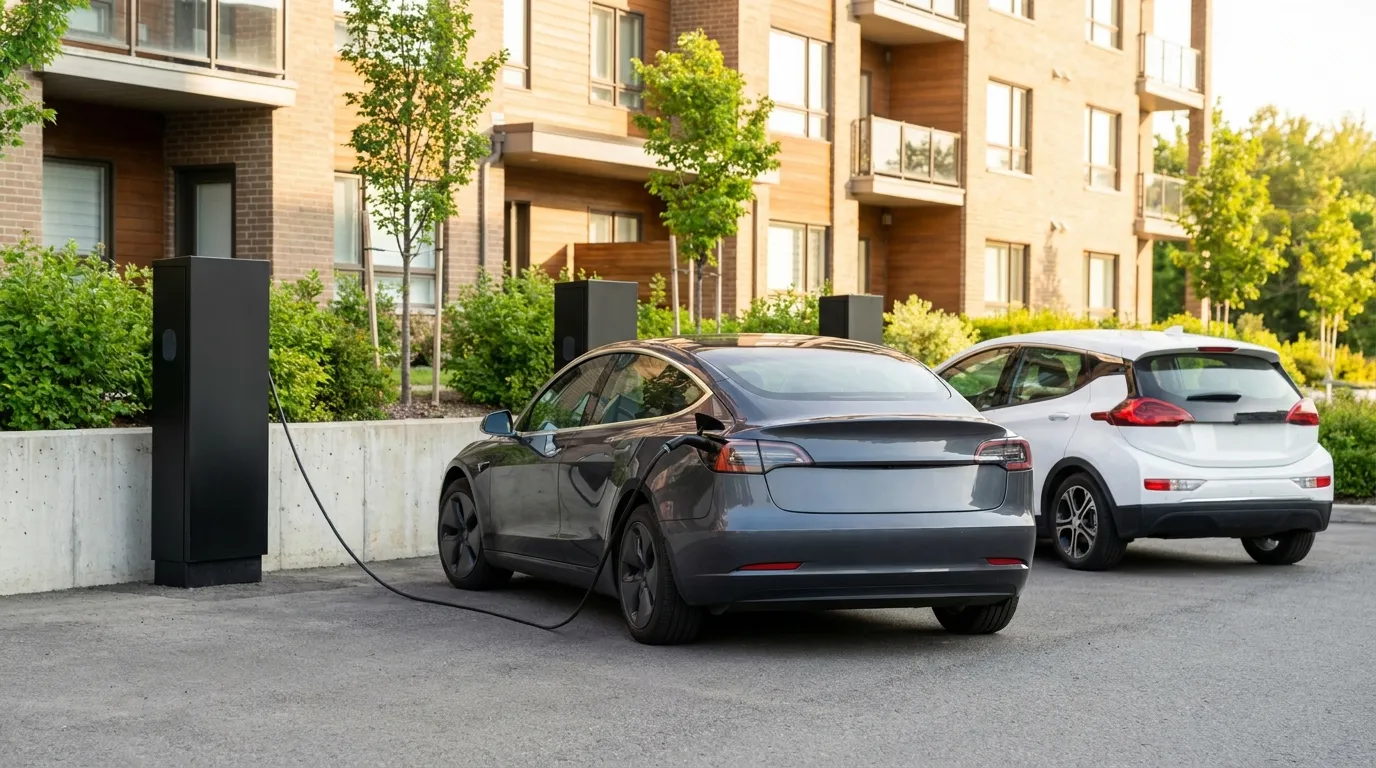
Only about 5% of U.S. rental properties currently offer on-site EV charging (SEPA, 2025), even as renter interest in the amenity keeps climbing. Between 2022 and 2024, the share of renters wanting on-site charging rose from 27% to 34% (NMHC/Charge At Home Renter Preferences Survey, 2024). That gap between demand and supply leaves property managers and multifamily owners stuck. Grants are competitive and narrow. Meanwhile, the federal commercial credit carries a hard 2026 deadline. Neither one covers the whole bill.
Most articles on this topic point property owners toward grants and tax credits first. That framing misses the structural problem underneath it. Split incentive is the industry term for the mismatch: the owner pays the capital cost, but the tenant captures the amenity value. Grants do not solve that split incentive, and the commercial tax credit only shrinks part of it. In our experience reviewing multifamily EV charging deals, financing is the piece most owners consider last, when it should come first. This guide covers what a multifamily EV charging install actually costs in 2026, where public funding falls short, and how direct-lender financing covers the gap. For the fundamentals of the program itself, see our EV charger financing guide for installers.
> Key Takeaways
> - Only about 5% of U.S. rental properties offer on-site EV charging, despite renter interest rising from 27% to 34% between 2022 and 2024 (NMHC/Charge At Home, 2024).
> - Level 2 ports run $3,500-$15,000+ installed in 2026, with multifamily per-connector costs starting around $1,300 before shared trenching and panel work (Qmerit, 2026; AmpUp, 2026).
> - The commercial Section 30C credit and state programs like CALeVIP rarely cover the full project and come with hard deadlines and eligibility limits.
> - Direct-lender financing covers hardware, labor, panel upgrades, and permits in one approval (how fast that approval typically comes back), subject to approval and eligibility.
See how Eos Loan financing helps you close more projects
Why does EV charger demand matter for multifamily property owners?
Renter demand for on-site EV charging is outpacing supply, and it is starting to move rent. In 2024, 58% of renters planning to buy an EV said they would pay more rent for on-site charging access (National Car Charging, 2026). Dedicated charging spots at multifamily properties commonly price at $25-$200 a month. Meanwhile, one-third of EV-owning renters report having no charging option at their current property at all (NMHC/Charge At Home, 2024).
That is the split-incentive problem in plain terms. Split incentive is the mismatch that happens when one party pays for an upgrade and a different party captures the benefit. Here, the property owner funds the capital cost of the charging equipment and the electrical work behind it. The tenant captures the amenity instead: a shorter commute to charge, a monthly fee already worth paying, or the deciding factor in signing one lease over another. Neither state grants nor the federal commercial credit fix that gap. They just shrink the owner's upfront number a little.
> The non-obvious point: Most multifamily EV charging content leads with grants and rebates. But grants do not touch the structural reason on-site charging stays scarce, the owner pays capex while the tenant captures the value. Financing is the tool that actually closes that gap. It lets the owner spread the cost over the same lease terms the amenity is meant to support, instead of waiting on a competitive award cycle. So why do most guides still lead with the grant application? Because it is the easier story to tell, not the more useful one for an owner who needs the install finished before the next leasing cycle. In our experience, owners who finance the full project first, then apply any grant or credit that comes through as a bonus, get chargers installed months faster than owners who wait on an award decision.
Still, not every renter is holding out for charging. 31% of non-EV-owning renters cite the lack of home charging as a reason they have not made the switch yet (National Car Charging, 2026). That is a retention and future-leasing signal a property owner can act on today, not a wait-and-see problem.
Renter demand for on-site EV charging is rising faster than supply. Only about 5% of rental properties currently offer it, while interest climbed from 27% to 34% of renters between 2022 and 2024 (SEPA, 2025; NMHC/Charge At Home, 2024). Overall, properties that close that gap now are positioned ahead of a demand curve that shows no sign of slowing.
How much does it cost to install EV chargers at an apartment complex?
A Level 2 EV charging port runs $3,500 to $15,000+ installed in 2026 (Qmerit, 2026). Multifamily-specific per-connector estimates start around $1,300 to $6,000+ before shared trenching or panel work is added (AmpUp, 2026 Multifamily EV Charging Solutions Guide). The wide range comes down to two things: how many ports go in at once, and whether the site needs a panel or service upgrade first.
Three factors drive the multifamily quote specifically: shared-trench phasing, panel capacity, and ownership structure.
Shared-trench phasing is a construction method where multiple charging stations share one electrical conduit run. It lowers the per-port cost, which is why a multi-port phase often prices lower per connector than a single standalone port.
In practice, panel and service capacity is usually the biggest swing on the quote. Many older apartment complexes were not built with the electrical headroom for a bank of EV chargers. As a result, a service upgrade can add tens of thousands of dollars before a single charger is mounted.
Ownership structure matters too. HOA and condo boards typically fund common-area wiring collectively. Individually metered units, however, may need separate sub-panels per unit owner.
| Install scenario | Approx. cost per port (2026) | What drives the price |
|---|---|---|
| Single Level 2 port (standalone) | $3,500 - $15,000+ | Full trenching and hookup for one charger |
| Multi-port, shared trench | $1,300 - $6,000+ | Multiple stations share one conduit run |
| Panel or service upgrade required | $6,000 - $20,000+ | Added electrical capacity before chargers are mounted |
Source: Qmerit, 2026; AmpUp, 2026 Multifamily EV Charging Solutions Guide. Ranges are approximate per port and vary by site conditions and geography.
A 100-unit property adding a modest first phase of 10 ports could see a combined project cost anywhere from $35,000 to well over $150,000. The low end assumes a shared-trench build; the high end assumes a required panel or service upgrade. That range is exactly why owners need a financing structure that can flex with project scope, not a fixed loan amount decided before the site survey.
What funding options exist for multifamily EV charging, and where do they fall short?
Section 30C is the federal tax credit for alternative fuel vehicle refueling property, which includes EV chargers (IRS, Alternative Fuel Vehicle Refueling Property Credit). It covers up to 30% of qualifying costs, capped at $100,000 per port. It expires, though, for property placed in service after June 30, 2026. State and utility programs add another layer. However, they are narrower than most owners expect walking in.
CALeVIP is a California statewide incentive program that funds EV charging infrastructure by region and incentive window (CALeVIP general eligibility requirements, 2026). It restricts eligibility to shared-use parking and specific incentive windows or regions. That means a given property's eligibility depends on where it sits and when it applies, not simply on whether it wants to install chargers.
Programs like it typically fund hardware and a portion of electrical work. They routinely exclude the labor share, and they rarely fund a full multi-port build-out. In practice, award timelines commonly run months to over a year. That timeline does not match a leasing cycle or a renewal season an owner is trying to compete in.
This is general information, not tax advice. Consult a qualified tax professional.
> What we see across multifamily deals: In our experience underwriting these deals, ownership entities that assume a grant or tax credit will cover most of the project are usually surprised. Labor, trenching, and panel-upgrade costs typically fall outside every program they qualify for. We've found that financing the full scope upfront works best, treating any grant or credit that lands afterward as a bonus. That approach keeps the install timeline on the property's schedule, not a program's award calendar.
Read the full breakdown of the commercial Section 30C credit, NEVI, and state rebate mechanics in our commercial EV charging financing and Section 30C credit guide. For the multifamily owner, the practical takeaway is the same either way. Grants and credits reduce the bill after the fact. They are not a substitute for a funding plan that covers the whole project now.
Add financing to your installs, talk to our team
How does EV charger financing work for a multifamily property?
Direct-lender financing is financing that comes straight from the lender providing the capital, not a broker or a marketplace matching multiple lenders. For a multifamily EV charging project, that means the property ownership entity, not individual tenants, can cover hardware, labor, panel upgrades, and permits in one approval, subject to approval and eligibility. Terms stay flexible, and Eos Loan charges no dealer fee on any project it finances.
The mechanics differ from a single-family homeowner loan in one key way: the borrower is the property ownership entity. That might be an LLC, a REIT, an HOA, or a condo association board, not a single homeowner. Underwriting looks at the entity's financials and the project scope. As a result, the approval covers the whole install rather than a single unit's charger.
> What differs from a homeowner loan: In our experience, a multifamily EV charging deal is underwritten against the ownership entity, not a resident. The signer is whoever has authority to bind that entity: a property manager with delegated authority, an LLC principal, or a board president. Contractors originating these deals should confirm signing authority early. It is the detail that most often slows down an otherwise straightforward multi-port approval.
For the installer, that means the sales conversation shifts from a single homeowner to a property management company or ownership group. The deal size shifts with it too. One approval can fund hardware, labor, panel or service upgrades, and permits together. That keeps a multi-port project from stalling on a piecemeal funding plan.
Offer your customers flexible financing on essential projects
How should property managers handle billing for shared EV chargers?
Most multifamily properties bill shared EV chargers through submetering or a flat monthly access fee. Submetering is a billing method that measures and assigns electricity use directly to the unit or resident using the charger, separate from the building's main meter. It is the cleaner long-term approach, because separating EV charging load from whole-building demand charges gives owners a clean cost-recovery trail instead of folding charging usage into common-area electric costs (Emergent Metering, 2026).
This detail matters operationally, but it stays secondary to the financing question. A per-kWh submeter model recovers the actual electricity cost from the tenant using the charger. A flat monthly fee, the $25-$200 range noted earlier, is simpler to administer but does not track usage as precisely. Either way, billing and financing solve different problems. Billing recovers ongoing electricity cost. Financing covers the capital project.
How can multifamily owners bundle EV charging with other essential projects?
Bundling EV charging with battery storage or other essential upgrades on the same property lets an owner cover multiple projects under one approval. It also means sharing the truck roll and the permitting work, instead of running separate projects on separate timelines. That is a meaningful efficiency on a multi-building property, where the electrical contractor is often already on site assessing panel capacity for EV charging anyway.
A property adding common-area battery storage for resiliency, alongside a first phase of EV charging, can often finance both under one consistent underwriting standard. That beats opening two separate financing relationships. See our guide to bundling EV charger and battery storage financing for how that pairing works project by project. The same board and metering questions that shape EV charger financing apply to battery storage on the same property, see battery storage financing for multifamily and HOA properties for that structure.
How can contractors pitch EV charger financing to multifamily accounts?
Multifamily accounts are an underused ticket-size opportunity for contractors who already sell EV charging. In fact, a single property management client can turn into a multi-port, multi-phase project, rather than a single-unit job. Renter demand for the amenity is real: 58% of renters planning to buy an EV say they would pay more rent for on-site access (National Car Charging, 2026). That gives the contractor a demand-side argument the property manager can bring to ownership.
Positioning the financing conversation with a property management company looks different than a residential pitch. Lead with the monthly payment across the full multi-port scope, not a per-unit number. Reference the split-incentive problem directly: financing is what lets the owner capture the leasing and retention upside now, instead of waiting on a grant cycle. And be direct that there is no dealer fee to disclose. That keeps the economics clean for an ownership group comparing financing partners.
For the full ticket-size argument across every project type, see our guide to raising average ticket size with financing. For the mechanics of how dealer fees work at other lenders, and why Eos Loan does not charge one, see our dealer fees explained breakdown. For the step-by-step version of adding financing to a quote, our guide to offering EV charger financing to your customers covers the process end to end. For water treatment financing for the same multifamily buyer, see our guide to the per-unit vs. shared-system decision in water treatment.
Become an Eos Loan financing partner
Or call +1 833-989-3737 to talk through a financing program for your business.
---
Frequently Asked Questions
Who pays for EV chargers in an apartment complex?
The property ownership entity typically funds EV charger installation, while tenants capture the amenity value through shorter commutes or paid access. That split incentive is why 58% of EV-buying renters say they would pay more rent for on-site charging, yet only about 5% of rental properties currently offer it (National Car Charging, 2026; SEPA, 2025).
Can property managers finance EV charging installation instead of paying cash?
Yes. Direct-lender financing lets the property ownership entity cover hardware, labor, panel upgrades, and permits in one approval, subject to approval and eligibility. Terms stay flexible, and financing lets an owner install now rather than waiting on a grant award cycle.
Do EV charging grants cover multifamily properties?
Some do, with real limits. State and utility programs like CALeVIP restrict eligibility to shared-use parking and specific incentive windows or regions (CALeVIP, 2026), and most exclude installation labor. The commercial Section 30C tax credit covers up to 30% of costs (up to $100,000 per port) but expires for property placed in service after June 30, 2026 (IRS).
How much does a multi-port EV charging install cost for a 100-unit apartment building?
A first phase of about 10 ports can run roughly $35,000 on the low end of a shared-trench build to well over $150,000 if a panel or service upgrade is required. That range is based on per-port estimates of $1,300-$6,000+ for shared multifamily installs and $3,500-$15,000+ for standalone Level 2 ports (Qmerit; AmpUp, 2026).
{ question: "Who pays for EV chargers in an apartment complex?", answer: "The property ownership entity typically funds EV charger installation, while tenants capture the amenity value through shorter commutes or paid access. That split incentive is why 58% of EV-buying renters say they would pay more rent for on-site charging, yet only about 5% of rental properties currently offer it (National Car Charging; SEPA, 2025)." }, { question: "Can property managers finance EV charging installation instead of paying cash?", answer: "Yes. Direct-lender financing lets the property ownership entity cover hardware, labor, panel upgrades, and permits in one approval, subject to approval and eligibility. Terms stay flexible, and financing lets an owner install now rather than waiting on a grant award cycle." }, { question: "Do EV charging grants cover multifamily properties?", answer: "Some do, with real limits. State and utility programs like CALeVIP restrict eligibility to shared-use parking and specific incentive windows or regions (CALeVIP, 2026), and most exclude installation labor. The commercial Section 30C tax credit covers up to 30% of costs (up to $100,000 per port) but expires for property placed in service after June 30, 2026 (IRS)." }, { question: "How much does a multi-port EV charging install cost for a 100-unit apartment building?", answer: "A first phase of about 10 ports can run roughly $35,000 on the low end of a shared-trench build to well over $150,000 if a panel or service upgrade is required. That range is based on per-port estimates of $1,300-$6,000+ for shared multifamily installs and $3,500-$15,000+ for standalone Level 2 ports (Qmerit; AmpUp, 2026)." } ]} />Bringing it together: financing the gap grants and credits leave behind
Only about 5% of U.S. rental properties currently offer on-site EV charging, even as renter demand for it keeps climbing. Grants and the commercial Section 30C credit help. Neither one solves the split-incentive problem or covers the full project cost, though. Here is what to carry into the next multifamily conversation:
- Renter demand for on-site charging keeps rising while supply lags far behind, a gap property owners can act on now.
- Multifamily EV charging installs run $1,300-$15,000+ per port depending on shared infrastructure and panel capacity.
- Grants and the Section 30C credit are real but narrow: geographic limits, competitive cycles, and a June 30, 2026 deadline on the federal commercial credit.
- Direct-lender financing covers the full project scope for the ownership entity in one approval, subject to approval and eligibility, with no dealer fee from Eos Loan.
To finance an apartment or multifamily EV charging project, or to add this financing program to your installs, talk to our team to get started. Or call +1 833-989-3737.
---
About the author: Eduardo Donadi is the CEO of Eos Loan, a direct lender specializing in financing for essential home and commercial projects including battery energy storage, EV chargers, and water filtration. He works directly with electrical contractors, property managers, and ownership groups to structure financing for multifamily EV charging installs.
---
Sources
1. SEPA. "Disparities in Residential Charging Access." https://sepapower.org/knowledge/disparities-in-residential-charging-access/ Retrieved 2026-07-08.
2. NMHC / Charge At Home. "EV Charging at Multifamily Housing Properties: Renter Preferences Survey." https://chargeathome.org/wp-content/uploads/2024/11/Charge-at-Home-EV-Charging-at-MFH-Properties.pdf Retrieved 2026-07-08.
3. National Car Charging. "Multifamily & Rental Property EV Charging." https://www.nationalcarcharging.com/home/multifamily-rentals Retrieved 2026-07-08.
4. Qmerit. "How Much Does a Commercial EV Charging Station Cost? The 3 Top Factors to Consider." https://qmerit.com/blog/how-much-does-a-commercial-ev-charging-station-cost-the-3-top-factors-to-consider/ Retrieved 2026-07-08.
5. AmpUp. "2026 Multifamily EV Charging Solutions Guide." https://www.ampup.io/blog/multifamily-ev-charging-solutions-guide Retrieved 2026-07-08.
6. IRS. "Alternative Fuel Vehicle Refueling Property Credit (Section 30C)." https://www.irs.gov/credits-deductions/alternative-fuel-vehicle-refueling-property-credit Retrieved 2026-07-08.
7. CALeVIP. "General Eligibility Requirements." https://calevip.org/general-eligibility-requirements Retrieved 2026-07-08.
8. Emergent Metering. "EV Charging Cost Allocation and Demand Charges for Commercial Properties." https://emergentmetering.com/resources/blog/ev-charging-cost-allocation-demand-charges-commercial Retrieved 2026-07-08.