

Financing Battery Storage for Multifamily and HOA Properties
About 74% of US HOAs are underfunded, the highest rate on record (Association Reserves, 2026). That single number changes how a board can pay for battery storage. A reserve draw or a special assessment gets harder to justify when the reserve fund is already thin. Financing becomes the practical path instead, but the "who is the borrower" question looks nothing like a single-family deal.
Multifamily buildings also hold roughly 27% of the US housing stock and house an estimated 37 million Americans (Eye On Housing / NAHB analysis of Census data, 2024). That's a large and growing battery storage buyer segment, and it's governed by committees, not individual checkbooks.
This guide covers per-unit vs. shared-system financing, why your building's metering setup (not just the equipment layout) decides which path is even possible, how C-PACE compares, and why a reserve-strapped board should think about financing as reserve protection, not just cost-spreading. This guide focuses on the multifamily angle. For the foundational rules across residential and commercial battery storage deals, see the complete battery storage financing guide for installers.
> Key Takeaways
> - About 74% of US HOAs are underfunded, the highest rate on record (Association Reserves, 2026), pushing more boards toward financing instead of a reserve draw.
> - Financing splits two ways: per-unit financing (an individual owner borrows) and shared-system financing (the association borrows). Whether per-unit financing is even possible often comes down to metering, not just wiring.
> - Financing a resiliency project instead of draining reserves can also matter for mortgageability: post-Surfside, agency reviews scrutinize condo reserve funding more closely (Fannie Mae, 2026).
> - Eos Loan is a direct lender. It offers flexible terms from 6 to 240 months on battery energy storage, subject to approval and eligibility.
Offer your customers flexible financing on essential projects
Why are multifamily properties and HOAs looking at battery storage in 2026?
About 74% of US HOAs are underfunded, the highest rate the industry has recorded (Association Reserves, 2026), driven by elevated construction costs and heavier post-Surfside scrutiny. That reserve pressure is colliding with a resiliency need: in 2025, US electricity customers averaged 11 hours of outages, nearly double the prior decade's average (EIA, 2025).
A single-family outage is an inconvenience. A shared-building outage is a liability event. Elevators stop between floors. HVAC drops in units with medically vulnerable residents. Security systems, gate access, and common-area refrigeration all go dark at once, and every affected owner calls the same property manager. So who owns that risk? Increasingly, it's the board, not the individual owner, driving the conversation.
Insurance carriers and building risk assessments increasingly factor resiliency into how they underwrite multifamily properties, so battery storage now sits on the board's agenda alongside roofing and life-safety upgrades. Multifamily buildings hold roughly 27% of the US housing stock (Eye On Housing / NAHB, 2024), so this is no longer a niche corner of the market. It's a segment where reserve health, not just system cost, now drives the financing conversation.
In 2026, roughly 74% of US HOAs are underfunded, the highest rate Association Reserves has recorded across more than 100,000 reserve studies dating back to 1986 (Association Reserves, 2026). That single statistic explains why more boards are reaching for financing instead of a reserve draw or special assessment for a discretionary resiliency project.
How does multifamily battery storage financing work for shared and per-unit properties?
Multifamily battery storage financing splits into two structural paths. Per-unit financing lets each owner finance their own share as an individual borrower. Shared-system financing makes the association or property ownership entity the single borrower for a common-area system. Eos Loan is a direct lender, financing battery energy storage with flexible terms from 6 to 240 months, subject to approval and eligibility.
Per-unit financing works when the equipment is billable and, ideally, physically separable per unit. Each owner gets underwritten much like a single-family homeowner and owns their battery outright. No board vote is required, so this path tends to move fastest, when it's structurally available.
Shared-system financing applies when the project is one common-area or building-wide installation, such as a battery bank serving elevators, hallway lighting, and shared HVAC. The HOA, condo association, or property ownership entity is the borrower, and repayment gets built into dues, a special assessment, or another board-approved mechanism.
Per-unit financing's advantage is speed: the application mirrors a standard homeowner application, with no board approval needed. Its limit is scope, it only works when a system can be billed and financed per unit. Shared-system financing's advantage is scope: one signature from the board covers the whole common-area project instead of coordinating dozens of individual applications. Its limit is process, since it requires board approval and may trigger a reserve-fund or special-assessment conversation. Smaller associations also face a narrower set of financing options generally: small HOAs under 25 units, with limited reserves and borrowing needs under $500,000, face materially reduced financing options in the market (CleanFi, 2025).
In my experience working with contractors on hundreds of these deals, here's what kills them early. HOA boards often get quoted the same way a single homeowner would be. But the board isn't one buyer, it's a committee with a reserve fund and a fiduciary duty to owners, and it needs the proposal framed that way from the first conversation. The contractors who win in this segment skip the homeowner-style script entirely and build the pitch around board process from day one.
See how Eos Loan financing helps you close more projects
Does your building's metering setup determine which financing path you can use?
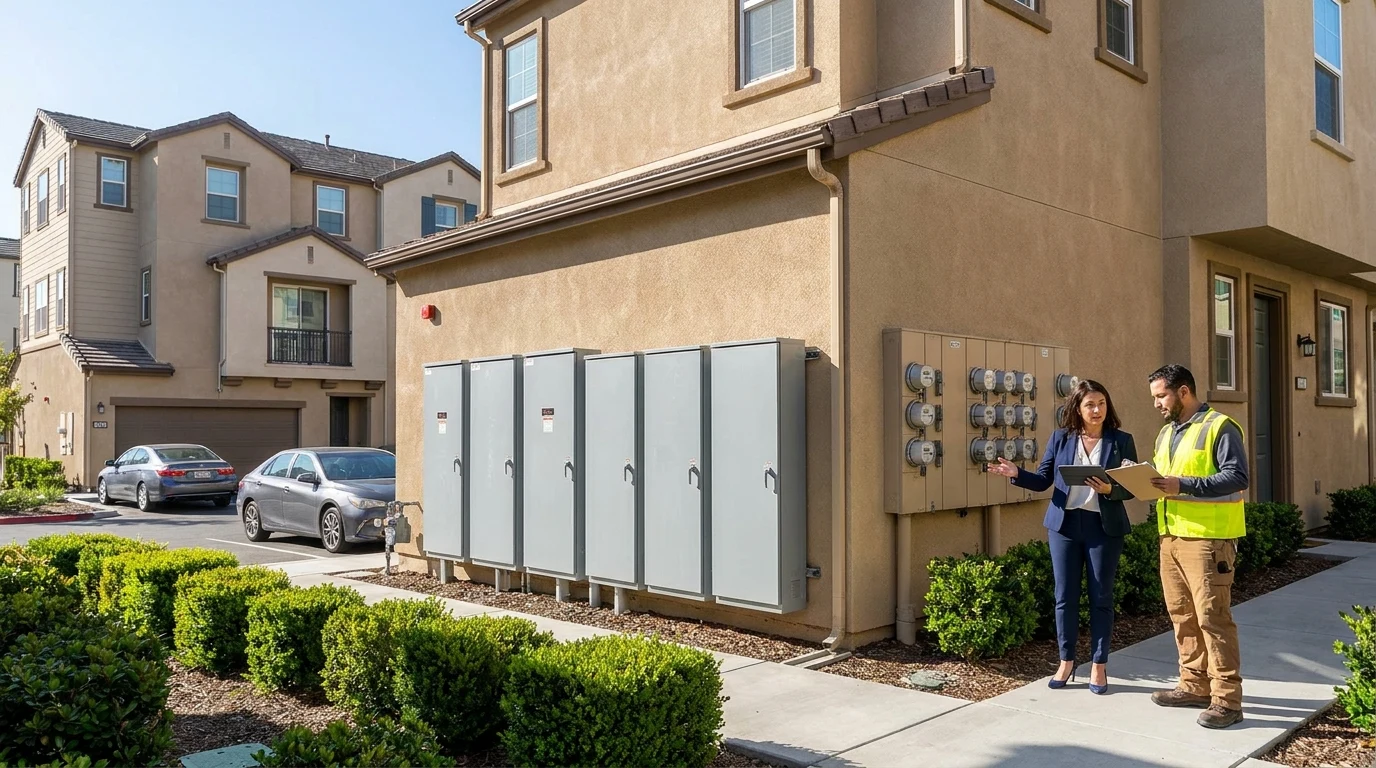
Yes, and this is the detail most financing guides skip. A master-metered building has one utility account for the whole property; the HOA pays that single bill and allocates costs back to owners through dues or a ratio-based method such as RUBS. A sub-metered building gives each unit its own utility account or meter. That distinction, not just whether the battery equipment is physically wired per unit, decides whether per-unit financing is even structurally possible.
Here's why physical separability alone isn't enough. Even a battery that's physically installed at one unit still needs a clean way to bill and finance it as that owner's standalone asset. In a master-metered building, the HOA's single utility account and blended cost-allocation method make it hard to isolate one battery as an individually financed, individually billed asset without a broader retrofit. In a sub-metered building, each unit's separate account gives a cleaner path to treat that owner's battery as their own financed asset, even if the association coordinates installation.
> Our finding: A deal we saw stall for weeks wasn't about the battery, financing terms, or the board vote. Nobody had confirmed the building's metering setup until late in underwriting, so the "per-unit" structure the contractor had proposed had to be reworked into a shared-system deal after the board had already been pitched the wrong framing.
Before assuming per-unit financing is available, a board or property manager should confirm the building's metering configuration, plus what it would cost and how long it would take to retrofit sub-metering if the association wants that option for future projects. That single question, asked in the first proposal meeting, prevents the deal from being restructured mid-process.
Metering type, not equipment layout, is the real gate on per-unit multifamily battery storage financing: a master-metered building's single utility account and blended cost allocation make individual asset financing structurally harder, regardless of how the batteries are wired.
How does this compare to C-PACE financing for multifamily properties?
C-PACE (Commercial Property Assessed Clean Energy) is a separate financing tool available to commercial and multifamily properties with 5 or more units. It works as a long-term special assessment collected on the property tax bill, typically running 15 to 30 years (EPA, 2025), and it funds battery storage and other qualifying improvements.
The structural difference matters. C-PACE is a tax-lien assessment arranged through a specialized program administrator, built for a long amortization schedule on large, whole-building capital projects. A direct-lender point-of-sale loan works differently: it's a standard financing product arranged at the time of the proposal, with flexible, shorter-to-medium terms and no property-tax lien attached to the building.
A board weighing a large, whole-building capital project alongside other long-term capital improvements might lean toward C-PACE. A board or property manager working through a contractor-led sales process that wants a faster close, without a tax-lien conversation, typically fits better with a direct-lender loan. One caveat: C-PACE isn't available for single-family residential; it applies only to eligible commercial and multifamily properties with 5 or more units.
What should a board weigh before voting: reserve draw, special assessment, or financing?
With about 74% of US HOAs already underfunded (Association Reserves, 2026), a reserve draw for a discretionary resiliency project can push a building below the funding levels lenders and insurers watch closely. Industry reserve-funding standards, as reported in the Association Reserves study, treat 70% funded or higher as well-funded and below 30% funded as critically weak. A board that drains reserves to pay cash for a battery system can move a building from "fair" toward "weak" almost overnight.
That matters beyond the reserve line item. Post-Surfside, Fannie Mae and Freddie Mac apply materially stricter condo-project reviews, evaluating reserve funding, budget adequacy, and building documentation as part of project eligibility (Fannie Mae, 2026). A building that looks underfunded on paper can face a harder mortgage review, which can affect unit owners trying to sell or refinance in that building, independent of their own personal credit.
So the framing shifts. Financing a battery system doesn't just spread cost over time, it protects the reserve fund from a large discretionary draw at a moment when the reserve is already stretched thin industry-wide. A board weighing "cash from reserves" against "financing" is really weighing a resiliency upgrade against building-wide mortgageability risk.
How do installers pitch multifamily battery storage financing to an HOA board or property manager?
Contractors close multifamily and HOA deals by identifying the actual borrower early: an individual owner, the association, or the property ownership entity. Then they structure the proposal around board approval timelines and reserve-fund realities, instead of using a single-homeowner sales script.
HOA boards move on a meeting and vote cadence, not a same-day decision. Property managers often carry the proposal to the board on the contractor's behalf, so the materials need to survive being presented by someone else, in a room the contractor isn't even in.
Framing the monthly payment against reduced liability, and against protecting reserve health, resonates with a board more than a bill-savings pitch alone. A board thinks in fiduciary duty and risk exposure first, and a monthly operating cost second. Eos Loan has originated more than $4B and processed over 30,000 proposals (Eos Loan, 2026), a track record that supports larger, multi-stakeholder deals, not just single-homeowner transactions. That matters when a board is evaluating whether a lender can actually handle a shared-property account. For the full framework on structuring a financing program and training a sales team, see the full contractor financing program guide.
Can multifamily properties earn revenue from battery storage through VPP programs?
Yes, in participating markets. Virtual power plant (VPP) programs are utility or aggregator programs that pay battery owners for dispatchable capacity. US VPP capacity reached 37.5 GW in 2025 (Electrek, 2025). Multifamily properties with a shared or aggregated battery system can enroll to earn ongoing payments, where a program allows it, and single-family VPP programs already show this pattern, paying $700 to $3,000 per year per enrolled battery (Boston Solar, 2026).
A shared-system battery at a multifamily property can aggregate more dispatchable capacity behind one enrollment than a single homeowner's battery, which is attractive to program aggregators looking to sign fewer, larger accounts. But this isn't a guaranteed revenue stream for any given building. Program eligibility varies by state and utility, and it must be confirmed directly with the program administrator.
Treat VPP enrollment as an added-value angle for the board conversation, not a promised revenue line in the financing pitch. For the full mechanics of how VPP enrollment and financing interact, see VPP financing mechanics for battery storage.
What should an HOA board or property manager confirm before financing battery storage?
Before signing, boards and property managers should confirm five things. Who will the borrower be? How does repayment get allocated if it's a shared system? Is the building master-metered or sub-metered, and does that support the financing structure being proposed? Is the lender a direct lender, or a broker routing the deal elsewhere? And what are the system's financing terms?
Governing documents typically define how the board can allocate shared expenses, whether that's a uniform rate, a square-footage split, or another blended method (HOAleader, 2025). Boards should confirm which method their own documents specify before assuming dues or a special assessment can simply be raised.
Eos Loan is never a marketplace, broker, or connector platform routing the deal to other lenders. It's a direct lender, financing battery energy storage with flexible terms from 6 to 240 months, subject to approval and eligibility, and it charges no dealer fee. For the broader distinction between financing models, see direct lender vs. marketplace distinction. Contractors serving multifamily and HOA accounts can also review the general commercial financing structure in commercial battery storage financing for businesses. For the full residential and commercial landscape, see battery energy storage solutions. To see how the same structure applies to water treatment on shared properties, review our multifamily water treatment financing guide.
Become an Eos Loan financing partner
Or call +1 833-989-3737 to talk through a financing program for your business.
Frequently Asked Questions
question: "Can an HOA finance battery storage?",
answer: "Yes. An HOA or condo association can be the borrower for a shared or common-area battery storage system, subject to approval and eligibility, with repayment typically structured through dues or a special assessment as defined in the association's governing documents. Smaller HOAs with limited reserves may face more limited financing options in the market generally (CleanFi, 2025)."
},
{
question: "What is the difference between per-unit and shared-system battery storage financing?",
answer: "Per-unit financing means an individual unit owner finances and owns their own battery system, underwritten similarly to a single-family homeowner. Shared-system financing means the HOA or property ownership entity is the single borrower for a common-area or building-wide system, repaid through the association."
},
{
question: "What is the difference between master-metered and sub-metered billing, and why does it matter for financing?",
answer: "A master-metered building has one utility account for the whole property, with costs allocated back to owners. A sub-metered building gives each unit its own account. Sub-metering supports per-unit battery financing more cleanly; master-metering usually pushes a deal toward shared-system financing, regardless of how the equipment is wired."
},
{
question: "Is C-PACE the same as a direct-lender loan for multifamily battery storage?",
answer: "No. C-PACE is a long-term special assessment collected through the property tax bill, typically over 15 to 30 years, available to commercial and multifamily properties with 5 or more units (EPA, 2025). A direct-lender point-of-sale loan is a standard financing product arranged at the time of the proposal, with flexible terms and no property-tax lien."
},
{
question: "Can financing a battery system affect a condo building's mortgageability?",
answer: "Financing a resiliency project instead of draining reserves can help protect a building's reserve funding level, which matters because Fannie Mae and Freddie Mac apply stricter condo-project reviews of reserve health post-Surfside (Fannie Mae, 2026). This is general information, not a guarantee of any specific mortgage outcome; consult the building's lender or condo-approval specialist."
},
{
question: "Can individual unit owners finance their own share of a shared battery system?",
answer: "It depends on metering and billing, not just wiring. If a unit has its own utility account (sub-metered) and the battery can be billed as that owner's standalone asset, individual financing may work. In a master-metered building, the association is typically the borrower instead."
},
{
question: "Does Eos Loan finance battery storage for multifamily and HOA properties?",
answer: "Yes. Eos Loan is a direct lender offering battery storage financing with flexible terms from 6 to 240 months, subject to approval and eligibility, and works with contractors serving residential, commercial, and multifamily and HOA accounts. Eos Loan charges no dealer fee."
}
]} />
The bottom line for boards, property managers, and contractors
About 74% of US HOAs are underfunded, the highest rate on record (Association Reserves, 2026). That's the real driver behind more shared-property battery storage deals moving from "pay cash" to "finance it." Here's what to carry into that conversation:
- Reserve underfunding, not just resiliency need, is pushing boards toward financing over a reserve draw or special assessment.
- Financing splits into two structural paths: per-unit (individual owner as borrower) and shared-system (the association as borrower), and metering type, master-metered vs. sub-metered, is the real gate on which path is possible.
- Protecting reserve health can also protect a building's mortgageability under stricter post-Surfside condo-lending reviews.
- VPP enrollment can add a revenue angle for shared or aggregated systems, where programs allow it, but it's never a guaranteed line item.
Identify the borrower and the metering structure first, then match the financing path to the property's governing documents. The rest of the proposal follows from there.
About the author: Eduardo Donadi is CEO of Eos Loan, a US fintech direct lender. He helps installers and contractors offer point-of-sale financing on essential projects, including battery energy storage, EV chargers, and water filtration.