

EV Charger Financing for Gas Stations and Convenience Stores
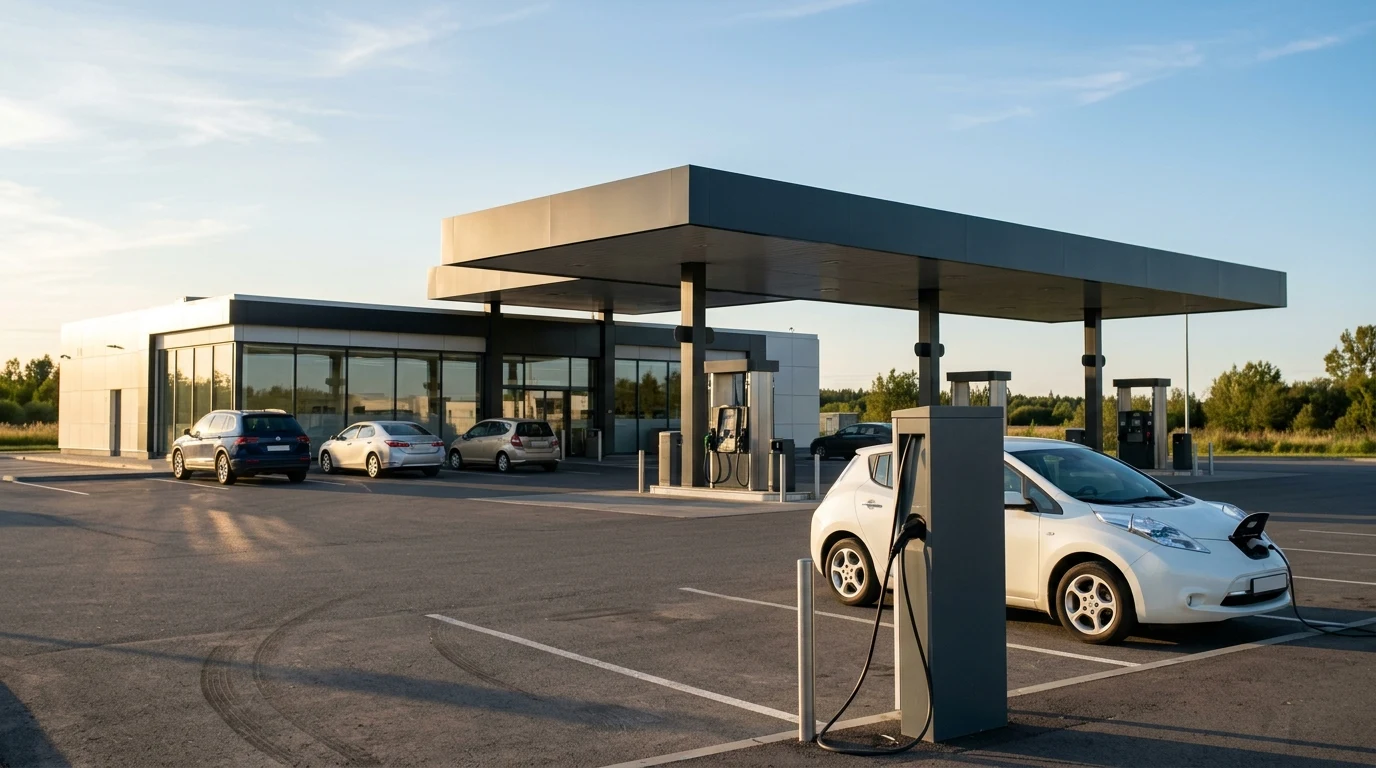
Total profits at fuel-and-convenience retailers could fall 30% by 2035 in EV-dominant markets, with fuel-specific profit down as much as 60% and up to a quarter of sites unprofitable (BCG, "The EV Opportunity for Fuel Retailers", 2024). Most gas station and convenience store owners read that number and file EV charging under "existential threat" or "someone else's problem." Neither framing gets the financing conversation anywhere. The more useful question isn't whether charging saves the fuel business. It's whether charging captures a different, higher-margin revenue stream before a competitor down the road does.
This guide breaks down what an EV charger retrofit actually costs at a fuel retail site, the constraints that make these projects different from a standalone retail parking lot, and how financing fits a margin-thin operator better than waiting on a grant cycle.
> Key Takeaways
> - Fuel-and-convenience retailer profits could fall 30% by 2035 in EV-dominant markets, with up to a quarter of sites becoming unprofitable (BCG, 2024).
> - Net profit per gallon of fuel sold runs roughly 1% of the pump price, which is why a second, higher-margin revenue stream matters (NACS, 2026).
> - A commercial Level 2 port runs $3,500 to $15,000 installed in 2026; DC fast charging runs $18,000 to $350,000+ per port (Qmerit, 2026).
> - C-store and gas-station-adjacent charging sites see far fewer daily sessions than grocery-anchored sites, so site selection and amenity mix drive the payback more than the hardware does (TEI, Electric Era, Paren, 2026).
Talk to our team about financing your EV charger retrofit
Should a Gas Station or Convenience Store Add EV Charging?
Yes, as a hedge against declining fuel margins, not as a replacement for fuel revenue. In EV-dominant markets, BCG projects total fuel-and-convenience retailer profits falling 30% by 2035, fuel-specific profit falling up to 60%, and up to a quarter of sites becoming unprofitable outright (BCG, 2024). That's the backdrop every retrofit decision sits inside now.
Here's why the math is already tight. Net profit per gallon of fuel sold runs roughly 1% of the pump price (NACS, 2026). Fuel has always been a thin-margin, high-volume business propped up by in-store sales. Nearly 152,000 convenience stores operate in the US, and more than 120,000 of them, about 79%, sell motor fuel (NACS, "Who Sells America's Fuel", 2026). That's a large base of operators facing the same slow-moving margin squeeze.
> The framing gap: Most coverage of this topic treats gas stations as an industry in decline that either adds chargers or dies. Sharper framing: fuel margins were already thin before EVs entered the picture, and charging is a hedge on a second, structurally higher-margin revenue stream (in-store spend during a longer dwell window), not a one-to-one fuel replacement.
How Much Does EV Charger Installation Cost at a Fuel Retail Site?
A commercial Level 2 port runs $3,500 to $15,000 installed in 2026, and DC fast charging runs $18,000 to $350,000 or more per port depending on site conditions (Qmerit, 2026). Fuel retail sites skew toward the higher end of that range more often than a standalone retail lot does, for a simple reason: fuel customers are habituated to a short visit, so DC fast charging fits the expectation Level 2 can't.
That habituation shapes the whole layout decision. A driver who's used to a five-minute fill-up isn't going to sit for four hours on a Level 2 port. DC fast charging delivers a meaningful charge in 20 to 60 minutes, close enough to a fuel stop that it doesn't feel like a detour. It costs more upfront, but it matches the customer behavior the site already trains.
Cost drivers beyond the hardware are also more site-specific here than at a generic retail parking lot. An electrical panel already sized for dispensers and fuel pumps often needs a service upgrade before it can carry charging load. Canopy-mounted equipment has to clear structural limits the canopy was built for, not retrofitted for. Trenching has to route around underground storage tanks instead of through open pavement. None of that is exotic, but it's real money that a generic install estimate skips.
What Site Constraints Are Specific to Gas Stations and C-Stores?
The constraint a standalone retail parking lot doesn't face: electrical capacity already committed to dispensers and pumps, underground storage tank clearance for trenching, canopy structural load for mounted equipment, and permitting that overlaps with existing fuel-handling permits. A joint PEI, NACS, and Transportation Energy Institute retrofit report names electrical installation and connectivity, construction costs, station downtime, and permitting as the specific factors fuel-retail sites have to plan around (PEI/NACS/Transportation Energy Institute, "Retrofitting Convenience Stores for Electric Vehicle Charging", 2021).
> What actually blocks a fuel-retail EV project from closing: In our experience, it's rarely the charger hardware itself. It's the utility interconnection timeline running longer than expected, a panel that's already at capacity once dispensers and lighting are accounted for, or a canopy that wasn't engineered to carry the extra mounted weight. Those are the line items that need to be scoped before a financing number gets quoted, not after.
Station downtime during construction is its own line item too. A gas station can't close the forecourt for a week the way a retail store might close a back corner of a parking lot. Phasing the work, or scheduling trenching around lower-traffic hours, is often the difference between a retrofit that stays on budget and one that doesn't.
Does EV Charging Actually Bring in Revenue at a Convenience Store?
Yes, but through dwell time and non-fuel spend, not by matching fuel margin dollar for dollar. C-store and gas-station-adjacent DC fast charging sites average roughly 9 to 13 sessions per day, compared to about 42 sessions per day at grocery-anchored sites (TEI, Electric Era, Paren, "2026 State of Retail-First EV Charging", 2026). That gap is roughly four to five times more usage at a grocery-anchored location, and it says a lot about what drives session volume.
The reason isn't the charger. It's what's next to it. A grocery-anchored site gives a driver 30 to 45 minutes of something to actually do while charging. A standalone fuel forecourt usually gives them a convenience store aisle and a bathroom. Sites that pair charging with a quick-service restaurant, a larger retail footprint, or a highway travel-center amenity mix tend to see session counts closer to the grocery-anchored end of that range.
According to the TEI, Electric Era, and Paren 2026 report, charging sessions near grocery-anchored sites run roughly five times higher than at fuel-retail-adjacent sites, underscoring that amenity mix, not fuel traffic alone, is the strongest predictor of charger utilization (TEI/Electric Era/Paren, 2026). For a fuel retailer, that's a site-planning signal: charging works best as part of a longer-dwell amenity mix, not bolted onto pumps alone. For the broader dwell-time and foot-traffic case at non-fuel retail properties, see the broader retail and hospitality case for EV charging; the fuel-retail numbers above are a different, shorter-dwell pattern and shouldn't be confused with that general retail traffic story.
See what financing an EV charger retrofit could look like for your site
How Does EV Charger Financing Work for a Fuel Retail Site?
A direct lender funds the hardware and installation upfront, and the site owner repays on flexible terms, subject to approval and eligibility. Eos Loan's EV charger financing solution works as a direct lender, not a marketplace or broker connecting operators to third-party funding sources, and there's no dealer fee added to the financing.
For a margin-thin fuel retailer, the alternative to financing is usually one of two things: paying cash out of a tight operating budget, or waiting on a grant cycle that can take months to resolve and still might not cover the full scope. Neither fits a business that runs on 1% net margin per gallon. A fixed monthly payment does. It turns a five- or six-figure retrofit into a line item that fits the same budget cycle as a walk-in cooler replacement or a canopy repaint.
Installers and contractors pitching fuel retail accounts should read this section as the close, not the footnote. A financed proposal that arrives with a monthly number attached moves faster through an owner's approval process than a bid that asks for the full amount upfront. See our full mechanics of EV charger financing for installers for how that proposal structure works across every vertical, and our commercial EV charging station financing guide for how larger, multi-port fleet and workplace projects finance differently from a single-site fuel retail retrofit.
Level 2 or DC Fast Charging: Which Fits a Gas Station Better?
DC fast charging matches the fuel-habituated short-visit expectation better than Level 2 at a pure-fuel site, but Level 2 can work where the site already has meaningfully longer dwell, like a fuel stop attached to a quick-service restaurant or a truck stop with driver amenities. The trade-off is straightforward: DC fast charging costs more per port and can trigger demand charges from the utility, while Level 2 costs less but only makes sense where customers are already staying long enough to use it.
Expected session volume should drive the decision more than a general preference for one or the other. A site with 9 to 13 sessions a day doesn't need a bank of DC fast chargers sized for grocery-anchored traffic. It needs the right number of ports for its actual dwell pattern, financed at a scale that matches the realistic payback. Our guide on how demand charges affect EV charging project economics covers the utility-billing side of that DC fast charging decision in more depth.
Should You Wait for a Grant or Finance the Project Now?
Finance now, in most cases, because the Section 30C federal credit no longer applies to property placed in service after June 30, 2026, and grant cycles rarely move fast enough to beat that deadline. Waiting on a grant or rebate cycle can cost a fuel retailer a full charging season while a competitor down the road gets a head start on the same customer base.
State-level rebate availability varies widely and changes throughout the year, so it's worth checking before assuming a program applies to a given site; our guide on how state EV charger rebates compare to financing covers that comparison in detail rather than repeating the state-by-state list here. The short version for fuel retail owners: financing doesn't require waiting for a program cycle, an award notification, or a specific census tract designation. It runs on the operator's own timeline.
This is general information, not tax advice. Consult a qualified tax professional about Section 30C eligibility for a specific site. Eos Loan financing is not a tax credit, rebate, or incentive; it's a loan that funds the project regardless of whether the site qualifies for 30C.
Ask about flexible terms for an EV charger retrofit
Prefer to talk it through? Call +1 833-989-3737.
Frequently Asked Questions
Should a gas station install EV chargers?
Yes, as a margin hedge, not a fuel replacement. BCG projects fuel-and-convenience retailer profits falling 30% by 2035 in EV-dominant markets, with up to a quarter of sites becoming unprofitable (BCG, 2024). Whether it makes sense for a specific site depends on traffic, dwell time, and what amenities sit next to the pumps.
How much does it cost to add EV charging to a convenience store?
A commercial Level 2 port runs $3,500 to $15,000 installed in 2026, and DC fast charging runs $18,000 to $350,000 or more per port (Qmerit, 2026). Fuel-retail sites often land toward the higher end due to panel capacity, canopy load, and underground tank clearance.
Can a gas station finance EV charger installation?
Yes, through a direct lender like Eos Loan, with a fixed monthly payment structured around the project scope, subject to approval and eligibility. There's no dealer fee added, and financing terms are flexible rather than tied to a fixed month count.
Will EV charging replace gas station fuel revenue?
No. It's a different, higher-margin revenue stream tied to dwell time and in-store spend, not a one-to-one fuel replacement. C-store-adjacent charging sites see fewer daily sessions than grocery-anchored sites, so the revenue case depends more on amenity mix than on matching fuel volume (TEI/Electric Era/Paren, 2026).
---
{ question: "Should a gas station install EV chargers?", answer: "Yes, as a margin hedge, not a fuel replacement. BCG projects fuel-and-convenience retailer profits falling 30% by 2035 in EV-dominant markets, with up to a quarter of sites becoming unprofitable. Whether it makes sense for a specific site depends on traffic, dwell time, and what amenities sit next to the pumps." }, { question: "How much does it cost to add EV charging to a convenience store?", answer: "A commercial Level 2 port runs $3,500 to $15,000 installed in 2026, and DC fast charging runs $18,000 to $350,000 or more per port (Qmerit, 2026). Fuel-retail sites often land toward the higher end due to panel capacity, canopy load, and underground tank clearance." }, { question: "Can a gas station finance EV charger installation?", answer: "Yes, through a direct lender like Eos Loan, with a fixed monthly payment structured around the project scope, subject to approval and eligibility. There's no dealer fee added, and financing terms are flexible rather than tied to a fixed month count." }, { question: "Will EV charging replace gas station fuel revenue?", answer: "No. It's a different, higher-margin revenue stream tied to dwell time and in-store spend, not a one-to-one fuel replacement. C-store-adjacent charging sites see fewer daily sessions than grocery-anchored sites, so the revenue case depends more on amenity mix than on matching fuel volume." } ]} />Bringing It Together
Fuel margins were already thin before EV adoption started pulling gallons away, and BCG's numbers say that pressure is only going to build through 2035. Adding EV charging to a gas station or convenience store doesn't replace that lost fuel revenue. It captures a different one: longer dwell time, higher in-store spend, and a customer base that's going to keep growing.
The cost range is wide ($3,500 for a single Level 2 port, up into six figures for a DC fast charging buildout), but the constraints are consistent: panel capacity, canopy load, and tank clearance all have to be scoped before the project is priced. Financing removes the timing pressure entirely. An operator doesn't need a grant cycle, a specific census tract, or a full cash reserve to get the retrofit done before the Section 30C deadline closes the federal-credit window for good.
Ready to look at financing an EV charger retrofit for your site? Talk to our team to get started.
---
About the author: Eduardo Donadi is the CEO of Eos Loan, a direct lender specializing in financing for essential home and commercial projects including battery energy storage, EV chargers, and water filtration. He works directly with EV infrastructure installers pitching fuel retailers and convenience store operators on financing programs that close deals inside a margin-thin operating budget.
---
Sources
1. BCG. "The EV Opportunity for Fuel Retailers." https://www.bcg.com/publications/2024/the-ev-opportunity-for-fuel-retailers Retrieved 2026-09-30.
2. NACS. "Who Sells America's Fuel." https://www.convenience.org/topics/fuels-and-energy/who-sells-americas-fuel Retrieved 2026-09-30.
3. Qmerit. "How Much Does a Commercial EV Charging Station Cost? The 3 Top Factors to Consider." https://qmerit.com/blog/how-much-does-a-commercial-ev-charging-station-cost-the-3-top-factors-to-consider/ Retrieved 2026-09-30.
4. PEI, NACS, Transportation Energy Institute. "Retrofitting Convenience Stores for Electric Vehicle Charging." https://www.transportationenergy.org/research/reports/retrofitting-convenience-stores-for-electric-vehic Retrieved 2026-09-30.
5. Transportation Energy Institute, Electric Era, Paren. "2026 State of Retail-First EV Charging." https://www.convenience.org/stay-current/news/2026/june/1/tei-ev-charging-stations-near-grocery-stores-see-five-times-more-usage Retrieved 2026-09-30.
6. IRS. "Alternative Fuel Vehicle Refueling Property Credit (Section 30C)." https://www.irs.gov/credits-deductions/alternative-fuel-vehicle-refueling-property-credit Retrieved 2026-09-30.