

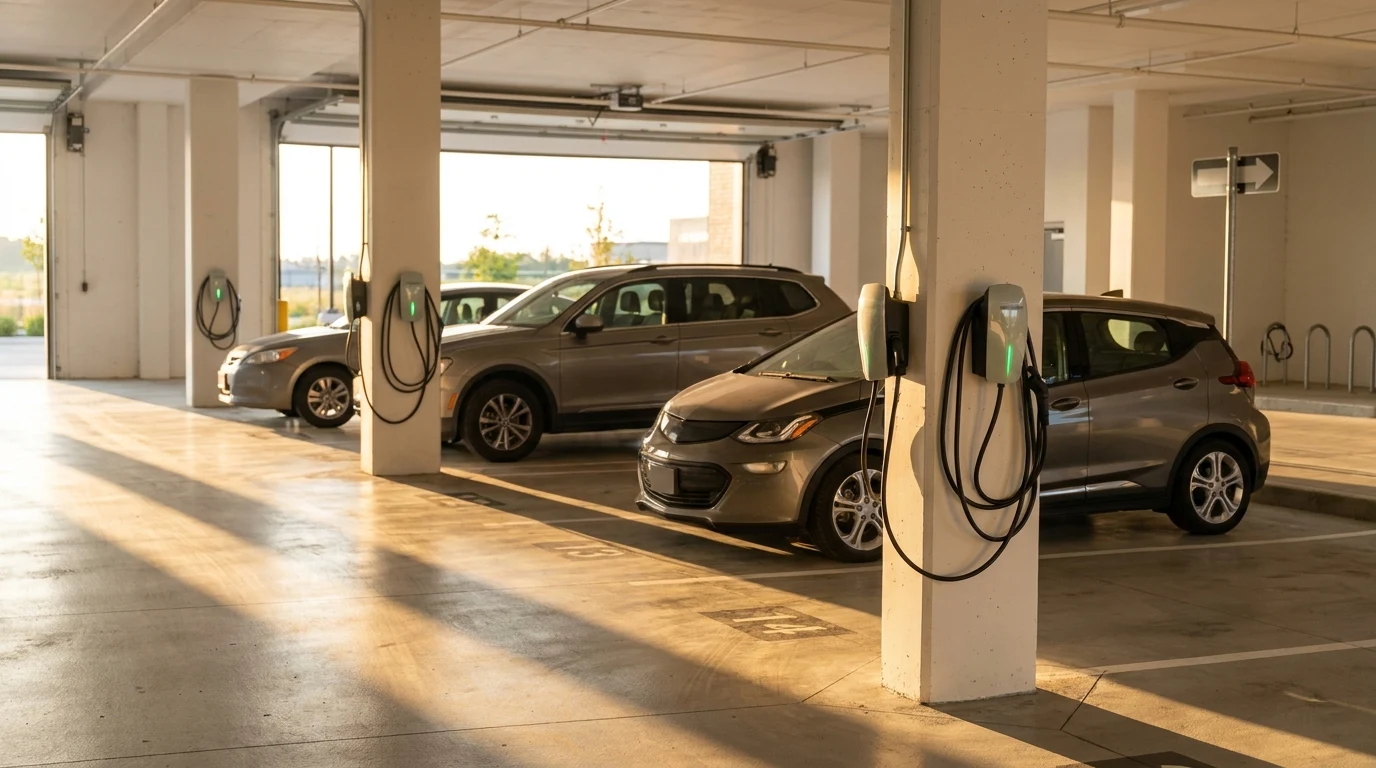
In 2026, nearly 80 million Americans live in a community governed by a homeowners association or condo board, spread across roughly 377,000 community associations and about one-third of the US housing stock (Foundation for Community Association Research, CAI, 2026). That is a lot of boards that are going to get an EV charger request, if they have not already.
That request puts a board, a property manager, or a unit owner in the middle of two separate questions at once. The first is legal: can the board say no. The second is financial: how does the community pay for it without draining reserves or forcing a special assessment. Most articles on this topic answer one question and ignore the other.
This guide covers both. It walks through what a right-to-charge law actually requires of a board, how cost allocation splits between per-unit and shared-system installs, what a condo or HOA EV charger install costs in 2026, and how financing compares to a special assessment or reserve draw. For the financing fundamentals that apply across every EV charger deal, see our EV charger financing guide for installers.
> Key Takeaways
> - In 2026, nearly 80 million Americans live in HOA or condo-governed communities, about one-third of US housing stock (Foundation for Community Association Research, CAI, 2026).
> - Most states now limit how far a board can go in denying an EV charger request under a right-to-charge law. California Civil Code Section 4745 is the model statute, and Maine's LD 1133 took effect January 1, 2026.
> - Cost allocation splits into per-unit financing (the requesting owner borrows) and shared-system financing (the association borrows), and the answer usually comes down to metering, not wiring.
> - Eos Loan is a direct lender offering flexible terms on EV charger financing, subject to approval and eligibility, so a board is not choosing only between a special assessment and saying no.
Talk to our team about financing your HOA's next EV charger project
Can a Condo or HOA Board Deny an EV Charger Request?
In 2026, most states limit how far a condo or HOA board can go in denying a resident's EV charger request under what is commonly called a right-to-charge law. California Civil Code Section 4745 is the model version: a board may impose only "reasonable restrictions," meaning rules that do not significantly increase the station's cost or decrease its performance (California Legislative Information, 2026).
A reasonable restriction can require a licensed contractor, a permit, basic aesthetic guidelines, and proof of liability insurance on the owner's exclusive-use parking space. What a board cannot do is refuse the request outright, or attach a condition expensive enough to function as a denial in practice. Under the California statute, if the board does not approve or deny the application within 60 days, it is deemed approved by default, which is a clock most boards do not realize is running.
Other states have followed a similar path. Maine's LD 1133 took effect January 1, 2026, and bars a condominium or residential association from prohibiting or unreasonably restricting an owner's EV charger in a unit-owned or limited-common-element parking space (The Maine Wire, 2025). Under Maine's law, the requesting owner still carries the insurance, maintenance, and removal costs tied to their own charger.
Exact requirements vary by state, and a board should confirm its own governing statute with legal counsel before drafting or enforcing an EV charger policy. A blanket "no chargers" rule is very likely unenforceable almost everywhere right-to-charge law applies, which is exactly why most boards end up negotiating the financial question instead of the legal one.
Who Pays for EV Charger Installation in a Condo?
Cost allocation for a condo or HOA EV charger splits two ways. Per-unit financing means the requesting owner pays and borrows for their own charger, the common path under most right-to-charge statutes when the parking space is deeded or reserved for that owner's exclusive use. Shared-system financing means the association itself pays, typically for a common-area bank of chargers, and bills the cost back through dues, a dedicated fee, or submetering.
Which path is even available usually comes down to metering, not wiring. A charger can be physically wired to one parking space and still be hard to bill as that owner's standalone asset if the building is master-metered, meaning the whole property runs on one utility account. A sub-metered building, where each unit already has its own account, makes per-unit financing and billing far more straightforward. This is the same metering question that decides per-unit vs. shared financing for battery storage at multifamily and HOA properties, and it applies just as directly to EV chargers.
Deeded and exclusive-use parking spaces usually fall to the individual owner under a right-to-charge statute. Limited-common-elements, spaces assigned to a unit but technically owned collectively, sit in a gray area that a board's own governing documents, not the statute alone, typically resolve. Getting that distinction right before a vote saves weeks of rework later.
> In our experience reviewing condo and HOA financing requests, the board question that recurs most is not whether to approve the charger. It is who signs for the money: one owner, or the association. Boards that settle that question before the vote move from request to installed charger far faster than boards that debate it mid-process.
!Exterior of a condominium or HOA community building in bright daylight.
What Does an EV Charger Actually Cost to Install at a Condo or HOA?
In 2025, NREL's techno-economic analysis of multi-unit-dwelling Level 2 charging put charger procurement at $2,270 to $2,500 and installation labor at $1,436 to $4,266 per charger, on top of ongoing network and maintenance costs (NREL/OSTI, Home Charging for All, 2025). Put simply, installation, not the hardware, is usually the larger and more variable line on the bill.
That installation range swings widely for a reason familiar to anyone who has quoted a multi-unit project: panel and service capacity, trenching distance, and whether one port is going in alone or as part of a multi-port phase. Multi-unit dwellings also have the lowest rate of an outlet already near vehicle parking of any building type NREL studied, which is exactly why installation dominates a condo or HOA quote more than the charger itself does.
For a board comparing quotes, the practical takeaway is to ask what drives the installation number specifically, trenching distance or a panel upgrade, rather than accepting one blended per-port price for every unit in the building. A quote that cannot explain its own installation range usually has not scoped the site yet.
Should a Board Use a Special Assessment, Reserve Draw, or Financing?
In 2026, Association Reserves' analysis of more than 100,000 reserve studies found that about 74% of US HOAs are underfunded, the highest rate on record (Association Reserves, 2026), with roughly a third of associations sitting below 30% funded, the range the industry treats as critically weak. A special assessment or a reserve draw can fund an EV charger project, but neither one does anything for approval speed or resident goodwill, and a reserve draw on an already-thin fund pushes a building further toward that weak range.
Financing spreads the cost without pulling from reserves at all. A financed shared install typically still needs a board vote, but not necessarily the separate per-owner assessment vote that many governing documents require for a special assessment. That said, assessment and voting rules are association-specific, so a board should confirm its exact process in its own governing documents with legal counsel before assuming financing skips a vote entirely.
The table below models the same hypothetical $40,000 shared-install scenario three ways.
| Funding approach | Effect on reserve fund | Approval path |
|---|---|---|
| Special assessment | No draw on reserves; a one-time bill goes to every owner | Often requires a separate owner vote under governing documents |
| Reserve draw | Reserve balance drops by the full $40,000 | Typically a board vote, without a separate assessment vote |
| Financing | Reserve balance stays intact; a monthly payment replaces the lump sum | Typically a board vote in most governing documents, subject to approval and eligibility |
Illustrative model based on a hypothetical $40,000 shared-install scenario, not a specific association's real numbers.
Most HOA EV charger content is written as a legal explainer, covering what the statute allows, or as a cost guide, covering what a port runs. Few connect the two. Boards that get the legal answer right still stall for months on the financial one, because nobody in the room is treating the assessment-versus-reserve-versus-financing choice as part of the same decision as the right-to-charge approval itself.
See how Eos Loan financing helps your HOA close the gap without a special assessment
How Does Financing Work for a Shared or Per-Unit EV Charger Install?
Eos Loan is a direct lender, never a marketplace, broker, or platform that connects a board to other lenders, financing EV charger hardware, labor, panel upgrades, and permits in one approval, subject to approval and eligibility. Terms stay flexible, and Eos Loan charges no dealer fee on any project it finances.
Per-unit financing works the way a standard homeowner loan works: the individual owner applies, is underwritten, and owns the charger outright once it is installed. Shared-system financing makes the association itself the borrower, financing a common-area bank of chargers with a single approval instead of coordinating dozens of individual applications. Either way, financing is separate from any automaker lease incentive or utility program, and it does not replace confirming the building's own approval process first.
Boards weighing how long financing approval takes on top of the statute's own 60-day clock should see how fast EV charger financing approval typically comes back.
!Close-up of an EV charging connector plugged into a vehicle in daylight at a residential community.
How Is This Different From Financing EV Chargers at a Rental Apartment Building?
A rental apartment building has a split-incentive problem: the owner pays for the charger, and the tenant captures the benefit. A condo or HOA has a governance problem instead, since owners vote and pay collectively or individually, and a right-to-charge statute may control how the board can respond to a request at all.
Property managers handling rental units face billing questions this guide does not repeat, like submetering rates and monthly amenity pricing charged to tenants. For that version of the financing question, see financing EV chargers at a rental apartment property. For how rebate and financing rules vary by state for either ownership structure, see state EV charger rebate and financing rules.
The Bottom Line for Condo and HOA Boards
Nearly 80 million Americans live under a community association, and more of those boards are going to face an EV charger request every year (Foundation for Community Association Research, CAI, 2026). Here is what to carry into the next board meeting:
- Most states now limit denial under a right-to-charge law, so the legal question is usually narrower than boards assume.
- Cost allocation splits into per-unit and shared-system financing, and metering setup, not wiring, decides which path is available.
- A special assessment or reserve draw both fund a project, but a reserve draw is the one that actually pulls down an already-strained reserve balance.
- Financing spreads the cost without an emergency reserve draw, and Eos Loan offers flexible terms, subject to approval and eligibility, with no dealer fee.
Ask about flexible terms for your HOA's EV charger project
Or call +1 833-989-3737 to talk through financing for your community's next EV charger project.
Frequently Asked Questions
question: "Can an HOA deny an EV charger request?",
answer: "Rarely outright. Most states now have a right-to-charge law limiting denial to reasonable restrictions, rules that do not significantly raise cost or reduce performance. California Civil Code Section 4745 is the model statute, with a 60-day deemed-approval clock if the board does not respond."
},
{
question: "Who pays for EV charger installation in a condo?",
answer: "It depends on the ownership structure. Per-unit financing means the requesting owner pays for their own charger, common for deeded or exclusive-use spaces. Shared-system financing means the association pays for a common-area bank of chargers and bills it back through dues, a fee, or submetering."
},
{
question: "Does financing an EV charger require a special assessment?",
answer: "No. Financing is an alternative to a special assessment or a reserve draw, not a requirement that triggers one. A financed shared install typically still needs a board vote, subject to the association's own governing documents and legal counsel."
},
{
question: "What is a right-to-charge law?",
answer: "A right-to-charge law limits how far a condo or HOA board can go in denying a resident's request to install an EV charger. California's Civil Code Section 4745 and Maine's LD 1133, effective January 1, 2026, are two examples, though exact requirements vary by state."
},
{
question: "How fast can an HOA get approved for EV charger financing?",
answer: "It varies by lender and the scope of the project. Eos Loan funds hardware, labor, panel upgrades, and permits in one approval, subject to approval and eligibility. See our guide on how fast EV charger financing approval typically comes back for a general timeline."
}
]} />
About the author: Eduardo Donadi is the CEO of Eos Loan, a direct lender specializing in financing for essential home and commercial projects including battery energy storage, EV chargers, and water filtration. He works directly with contractors, property managers, and community association boards to structure financing for condo and HOA EV charger installs.
---
Sources
1. Foundation for Community Association Research (CAI). "Industry Data." https://foundation.caionline.org/research/industry-data/ Retrieved 2026-09-30.
2. California Legislative Information. "Civil Code Section 4745, Electric Vehicle Charging Stations." https://leginfo.legislature.ca.gov/faces/codes_displaySection.xhtml?sectionNum=4745.&lawCode=CIV Retrieved 2026-09-30.
3. The Maine Wire. "Residential and Condo Associations in Maine Can No Longer Ban Members from Installing EV Chargers." https://www.themainewire.com/2025/06/residential-and-condo-associations-in-maine-can-no-longer-ban-members-from-installing-ev-chargers/ Retrieved 2026-09-30.
4. NREL/OSTI. "Home Charging for All: Techno-Economic and Life Cycle Assessment of Multi-Unit Dwelling Charging." https://www.osti.gov/pages/servlets/purl/2328081 Retrieved 2026-09-30.
5. Association Reserves. "HOA Reserves Industry Insights Report." https://www.reservestudy.com/wp-content/uploads/2026/05/2026-04-29-100000-Industry-Insights-Report-FINAL.pdf Retrieved 2026-09-30.