

Can You Finance Solar, Battery, and EV Charging Together?
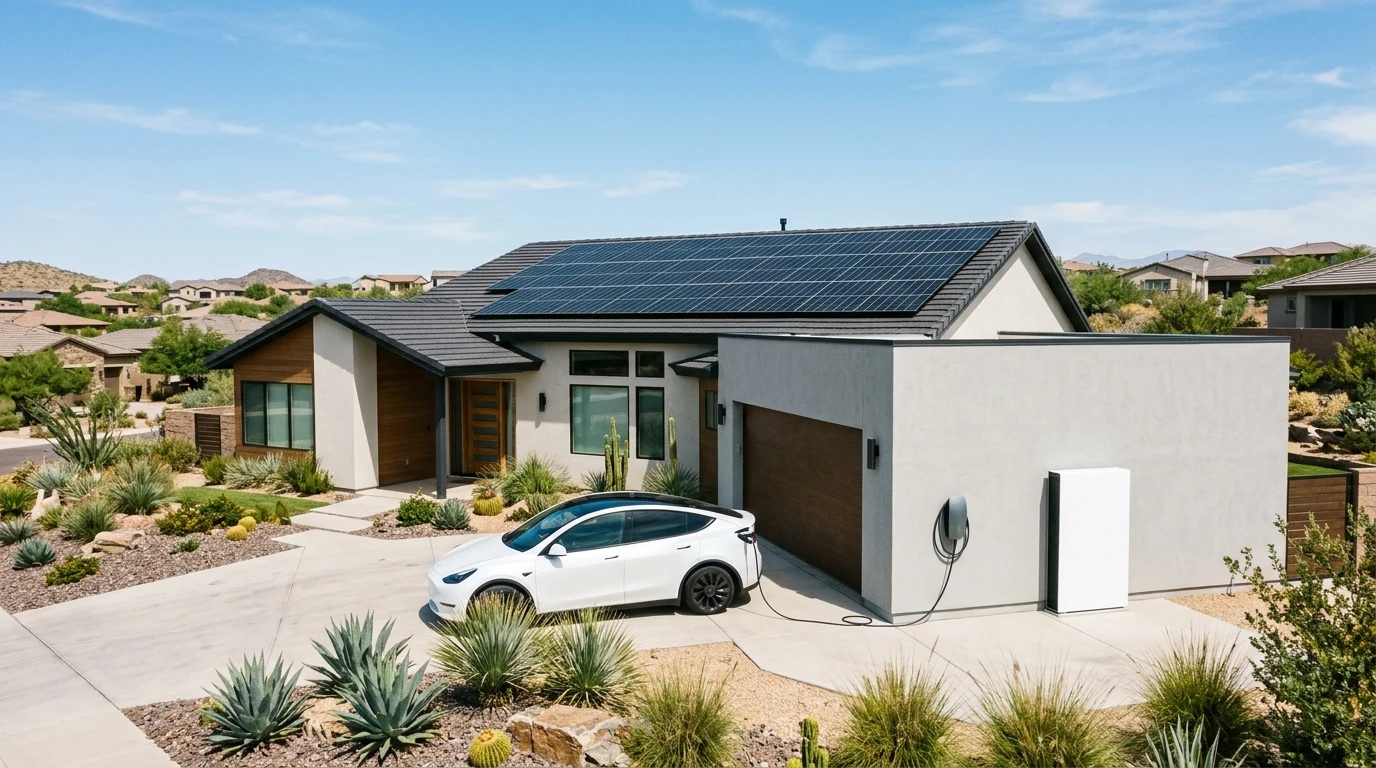
Solar-plus-storage attachment reached 45% in Q1 2026, up from 38% a year earlier (Wood Mackenzie, 2026). EV owners are three times more likely to also own solar than non-EV owners are (NREL, 2024). Put those two facts side by side and the pattern is obvious: solar, battery storage, and an EV charger are increasingly the same conversation with the same household, not three separate sales.
Most financing programs, though, were built for one product at a time. When a homeowner asks, "Can you finance all of this together?", a lot of installers do not have a clean answer.
This piece gives you one. It covers what a three-way electrification bundle actually costs in 2026, what a direct lender can and cannot finance under a single approval, how to sequence the pitch at the kitchen table, and why splitting the financing (solar separately, battery and EV charger together) is often the more honest, more closeable structure.
> Key Takeaways
> - Solar-plus-storage attachment hit 45% in Q1 2026, up from 38% in Q1 2025 (Wood Mackenzie, 2026).
> - A three-way bundle (solar, battery, EV charger) runs roughly $41,000-$51,000 before incentives in 2026 (EnergySage, CostToCharge).
> - No single approval covers solar. A direct lender can combine battery storage and EV charger financing under one approval; solar is financed separately, subject to approval and eligibility.
> - Section 25D, the residential clean-energy credit, ended December 31, 2025 (IRS), which puts more weight on financing structure in every 2026 quote.
See how Eos Loan financing helps you close more projects
Why bundle solar, battery storage, and EV charging?
Solar-plus-storage attachment climbed to 45% in Q1 2026, up from 38% in Q1 2025 (Wood Mackenzie, 2026), and 25% of EV owners also own a photovoltaic system, versus 8% of non-EV owners (NREL, 2024). Solar is no longer the anchor product that a battery or a charger gets tacked onto later. It is one line in a system.
Why the shift? Panel and service upgrades are the practical driver. A home adding solar frequently needs the same 200A service work that a battery and an EV charger also require. Quoted separately, that overhead gets paid three times, once per truck roll. Quoted together, it is paid once. Installers who used to sell "solar, then maybe storage later, then maybe a charger" are now fielding all three questions in the same first appointment, because the customer already sees them as one project.
Over 80% of EV charging in the US happens at home (Mordor Intelligence, 2025), so a household already committing to solar and storage is, more often than not, the same household that needs a charger installed on the same panel. That is not a coincidence. It is the same electrification decision, made once.
For the standalone side of this question, when solar is already on the roof and storage comes later, see our comparison of standalone battery vs. solar-plus-storage financing.
What does a three-way electrification bundle cost in 2026?
A 12kW residential solar system averages $31,135 before incentives, roughly $2.60 per watt (EnergySage, 2026). Add a battery storage system at $9,000-$18,000 (EnergySage, 2026) and a Level 2 EV charger at $1,400-$2,200 (CostToCharge, 2026), and the combined project lands at roughly $41,000-$51,000 before any incentives.
That number looks large as a single figure. It looks different once you separate it into three lines and remember that a panel or service upgrade, if the home needs one, gets counted once across all three products rather than three times:
- Solar system (12kW average): $31,135
- Battery storage system: $9,000-$18,000
- Level 2 EV charger: $1,400-$2,200
- Combined total range: roughly $41,000-$51,000 before incentives
- A homeowner already committed to solar who is now considering storage, an EV charger, or both
- An EV owner adding solar and storage to a home that did not have either
- A light-commercial property adding all three as part of a facility upgrade
- Solar-plus-storage attachment hit 45% in Q1 2026, up from 38% a year earlier (Wood Mackenzie). This is a market shift, not a sales tactic.
- Quote the project in three lines, not one total. The shared overhead across solar, battery, and EV charger makes the delta smaller than the headline number suggests.
- Eos Loan finances the battery-storage-and-EV-charger portion under one approval, with no dealer fee, subject to approval and eligibility. Solar stays on its own financing path.
- Section 25D ended December 31, 2025. Financing carries more of the affordability conversation in every 2026 residential quote.
- Wood Mackenzie, U.S. Energy Storage Market Sets Q1 2026 Records Across Sectors, retrieved 2026-07-10, https://www.woodmac.com/press-releases/u.s.-energy-storage-market-sets-q1-2026-records-across-sectors
- NREL, Green Wheels, Bright Skies: NREL Analysis Unveils the Connection Between Electric Vehicles and Photovoltaics, retrieved 2026-07-10, https://www.nrel.gov/grid/news/press/2024/news-release-green-wheels-bright-skies-nrel-analysis-unveils-the-connection-between-electric-vehicles-and-photovoltaics
- Mordor Intelligence, Residential EV Charger Market Report, retrieved 2026-07-10, https://www.mordorintelligence.com/industry-reports/residential-ev-charger-market
- EnergySage, Solar Panel Cost, retrieved 2026-07-10, https://www.energysage.com/local-data/solar-panel-cost/
- EnergySage, How Much Do Home Batteries Cost?, retrieved 2026-07-10, https://www.energysage.com/energy-storage/how-much-do-batteries-cost/
- CostToCharge, Level 2 EV Charger Installation Cost Guide, retrieved 2026-07-10, https://costtocharge.com/guides/level-2-ev-charger-installation-cost
- IRS, Residential Clean Energy Credit, retrieved 2026-07-10, https://www.irs.gov/credits-deductions/residential-clean-energy-credit
- IRS, Clean Electricity Production Credit (Section 48E), retrieved 2026-07-10, https://www.irs.gov/credits-deductions/businesses/clean-electricity-production-credit
- finmkt.io, AI, AR, and POS Financing: The Home Improvement Trifecta of 2026, retrieved 2026-07-10, https://www.finmkt.io/blog-posts/ai-ar-and-pos-financing-the-home-improvement-trifecta-of-2026
Presented as one number, $41,000-$51,000 stalls a conversation. Presented as three lines with one shared payment structure for two of them, it reads as a plan. The delta between a two-product quote and a three-product quote is usually smaller on a monthly basis than the total suggests, because the shared overhead (electrician time, panel work, permitting) does not scale linearly with each added product.
One more thing belongs in every 2026 quote: the residential clean-energy credit (Section 25D) ended December 31, 2025 (IRS). That credit used to soften the solar sticker price for homeowners. It no longer applies to new installs, which means financing structure carries more of the affordability conversation this year than it did in 2025. This is general information, not tax advice. Consult a qualified tax professional.
Add financing to your installs, talk to our team
Can one lender finance the whole bundle?
No. No single Eos Loan approval covers solar. Eos Loan is a direct lender for the battery-storage-and-EV-charger portion of a three-way project, financed under one approval, while solar is typically financed separately: cash, a solar-specific lender, PACE, or already sitting on the roof from an earlier purchase.
That is not a limitation dressed up as a feature. It is worth saying plainly, because splitting the financing this way is often the better structure, not a compromise. A $41,000-$51,000 ask is a large single credit decision for one underwriter to carry. Splitting it, solar on its own financing path, battery and EV charger combined under one direct-lender approval, keeps each decision sized to what it actually is: a $31,000 solar purchase and a $10,400-$20,200 battery-plus-charger project.
> Our take: The instinct in this market is to promise "one lender for everything" because it sounds simpler. It usually is not true, and when it is, it often means overloading a single credit decision with a number large enough to slow down approval or shrink the amount funded. The more honest, and often more closeable, structure is two financing conversations: one for solar, one combined approval for battery storage and the EV charger. That mirrors how Eos Loan already handles the standalone-battery-versus-solar-plus-storage case.
The battery-plus-EV-charger portion works exactly like our existing two-way bundle: one application, one underwriting decision, one monthly payment covering both products. Battery energy storage terms run 6 to 240 months, with flexible terms on EV chargers, subject to approval and eligibility. Eos Loan charges no dealer fee on that combined portion of the project.
For the fundamentals of each product on its own, see our battery storage financing guide for installers and our EV charger financing guide. For the mechanics of the two-way combination in full, see our EV charger and battery bundle financing playbook. For how a direct lender differs from a marketplace or broker model, and why that distinction matters for approval speed and cost, see our comparison of direct lender vs. marketplace financing.
How should installers pitch a three-way bundle at the kitchen table?
Contractors who offer financing close projects at up to three times higher rates than those who do not (finmkt.io, 2026). That effect compounds when the quote spans three products instead of one, because financing is what keeps a five-figure total from becoming a conversation-ending number.
The sequencing matters more than the pitch itself. Solar is usually the largest and most planned-for line item, so quote it first, on its own financing path. Then introduce the battery, on the combined battery-and-EV-charger approval. Then ask the EV question, if it has not already come up: "Do you have an electric vehicle, or are you planning to get one? We can add the charger to the same battery approval today."
Present two monthly payments, not one blended number. The solar payment stands on its own financing. The battery-plus-charger payment stands on the direct-lender approval. Blending them into a single figure risks misrepresenting the structure to the customer, and a homeowner who later realizes there were actually two loans, not one, is a homeowner who trusts the next conversation less.
> From the lender's desk: When a quote covers all three products, customers do the math differently than they do on a single-product quote. A $31,000 solar number alone reads as a big decision. The same $31,000 next to a battery-and-charger payment that is already familiar, because it mirrors a two-way bundle they may have already priced, reads as the next step in a plan they have already started, not a new decision from scratch.
!A contractor and homeowner reviewing a project proposal on a tablet in a bright, daylight kitchen.
For the broader case on how financing changes close rates across every essential project, not just this bundle, see how financing increases contractor close rates and raising average ticket size with financing.
What should installers know about 2026 tax credits?
The residential clean-energy credit (Section 25D) ended December 31, 2025 (IRS). Any 2026 quote that still assumes a homeowner-level solar credit is quoting against a number that no longer exists. The commercial clean electricity credit (48E) generally remains available through 2032 for qualifying commercial projects (IRS).
For the residential three-way bundle, that end date changes the math more than it changes the pitch. Financing was already carrying part of the affordability load in 2025. In 2026, without the residential credit softening the solar line, financing carries more of it, which is exactly why the split structure (solar on its own path, battery and EV charger combined) matters: each financed piece needs to stand on its own value case rather than lean on a credit that no longer applies.
This is general information, not tax advice. Every homeowner's situation is different, and Eos Loan financing is never a substitute for a credit, rebate, or incentive. Consult a qualified tax professional before making a decision based on tax treatment.
For a fuller look at how the credit's end reshapes contractor quoting generally, see our financing after the solar tax credit playbook.
Which projects are the best fit for the full electrification bundle?
The residential EV charger market was valued at $9.68 billion in 2025 and is projected to reach $32.12 billion by 2030, a 27.11% CAGR (Mordor Intelligence, 2025). In California, distributed solar attachment rates are projected to exceed 80% by 2027 following the state's NEM 3.0 rules (Wood Mackenzie, 2026), which shows the three-way bundle accelerating fastest in markets where net-metering changes make standalone solar less attractive on its own.
Eligibility for the battery-plus-EV-charger portion comes down to creditworthiness and project scope, not the number of products in the quote. The best-fit customer profiles are straightforward:
Water filtration is worth one mention here, not a bundle claim: for a customer already financing battery storage and an EV charger, adding a third essential project under the same direct-lender relationship is straightforward. See one financing partner for every essential project for how that multi-vertical structure works across all three categories.
Offer your customers flexible financing on essential projects
Or call +1 833-989-3737 to talk through a financing program for your business.
Frequently Asked Questions
question: "Does Eos Loan finance solar panels?",
answer: "No. Eos Loan finances battery energy storage and EV chargers, plus water filtration; solar is typically financed separately through cash, a solar-specific lender, PACE, or a pre-existing system. On a three-way bundle, Eos Loan covers the battery-storage-and-EV-charger portion under one approval, subject to approval and eligibility."
},
{
question: "What does a combined solar, battery, and EV charger project cost in 2026?",
answer: "Roughly $41,000-$51,000 before incentives: about $31,135 for a 12kW solar system (EnergySage), $9,000-$18,000 for battery storage (EnergySage), and $1,400-$2,200 for a Level 2 EV charger (CostToCharge). Shared costs like a panel upgrade are counted once across the whole project, not once per product."
},
{
question: "Can I get one monthly payment for a solar-plus-battery-plus-EV project?",
answer: "Not one blended payment across all three. Battery storage and an EV charger can be combined under one Eos Loan approval with a single monthly payment. Solar carries its own separate financing, so the homeowner typically sees two payments: one for solar, one for the combined battery-and-charger project."
},
{
question: "Did the solar tax credit go away in 2026?",
answer: "The residential clean-energy credit (Section 25D) ended December 31, 2025 (IRS). It no longer applies to residential solar, battery, or related property placed in service after that date. The commercial 48E credit path generally remains available through 2032 for qualifying commercial projects. This is general information, not tax advice; consult a qualified tax professional."
}
]} />
The bottom line
Solar, battery storage, and EV charging are converging into a single household decision, with attachment rates climbing and financing programs still catching up. The math is real: a three-way bundle runs $41,000-$51,000 before incentives in 2026, and no single Eos Loan approval covers all three products.
Carry these points into your next three-way quote:
To standardize the battery-and-EV-charger portion of every electrification quote under one direct-lender program, see how Eos Loan financing helps you close more projects and talk to our team about setting it up.
---
Sources: