

Battery Storage Financing for Data Centers, Cold Storage, and Critical-Load Businesses
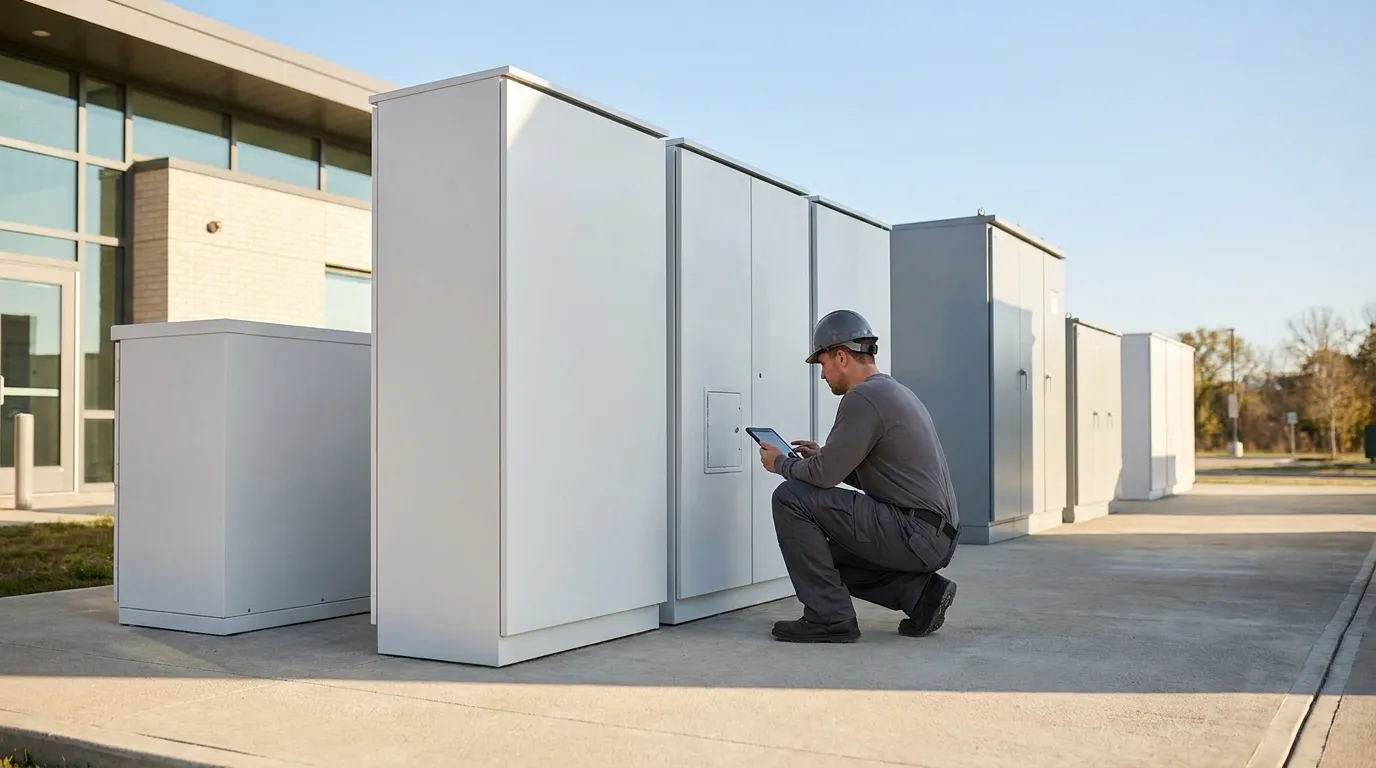
In 2025, 57% of data center operators said their most recent major outage cost more than $100,000. A portion of operators reported losses well past $1 million (Uptime Institute, Annual Outage Analysis 2025). For a data center, a cold storage warehouse, or a telecom site, an outage is not an inconvenience. It's a line item that shows up in the next board meeting. Generators have been the default backup for decades. But diesel fuel logistics, maintenance contracts, and emissions exposure make them an expensive answer on their own. Battery storage is a cleaner, often quieter alternative. Still, it only pays off if it gets financed and sized around the real cost of downtime, not a standard commercial demand-charge pitch.
A critical-load business is any facility where a power outage doesn't just cost money, it stops operations outright: a data center, a cold storage warehouse, a telecom site, or a water or wastewater pump station. This guide covers how battery storage financing works for these businesses, how contractors size these projects, and how the avoided-outage number helps close larger deals in this vertical. Assisted living and senior care facilities carry a different, life-safety-driven version of this same financing conversation; see battery storage financing for assisted living and senior care facilities.
> Key Takeaways
> - In 2025, 57% of data center operators reported their most recent major outage cost more than $100,000 (Uptime Institute, 2025).
> - Unplanned power outages cost the US economy an estimated $150 billion a year, a stake far above what a standard commercial demand-charge pitch captures (Lawrence Berkeley National Laboratory research, cited in 2025-2026 industry reporting).
> - Eos Loan finances battery storage for critical-load businesses as a direct lender, with flexible terms from 6 to 240 months, subject to approval and eligibility.
> - For uptime-critical buyers, avoided-outage cost, not demand-charge savings, is usually the number that gets budget approved fastest.
See how Eos Loan financing helps you close more projects
Why does uptime-critical battery storage financing look different?
More than half of data center operators, 57%, said their most recent major outage cost over $100,000. Meanwhile, unplanned power outages cost the US economy an estimated $150 billion a year (Uptime Institute, 2025; Lawrence Berkeley National Laboratory research, cited in 2025-2026 industry reporting). For data centers, cold storage warehouses, telecom sites, and water or wastewater pump stations, that stake sits an order of magnitude above what a standard retail or light-industrial account weighs when it evaluates backup power. Avoided-outage cost, the dollar value of downtime a business prevents by installing backup power, is the number that reflects that gap. It's usually far larger than the demand-charge savings a standard commercial pitch leads with.
A retail account or light-commercial property mostly cares about demand-charge reduction, a monthly line item on a utility bill. An uptime-critical business cares first about what happens the moment power drops: server racks losing state, refrigerated inventory starting to warm, a pump station losing pressure. That's why generators became the default. A generator delivers extended runtime, and for decades it was the only practical answer to "what happens when the grid fails." Battery storage changes that equation. It adds instant, silent ride-through, either as a standalone system for shorter outages or paired with a generator for the highest-criticality sites that need both immediate coverage and hours of extended backup.
According to Uptime Institute's 2025 Annual Outage Analysis, 57% of data center operators report their most recent major outage cost more than $100,000 in direct and indirect losses. In other words, this single data point is why the financing conversation for critical-load businesses has to start with downtime cost, not a demand-charge worksheet built for a standard commercial account.
For the broader commercial battery storage picture that applies across less time-sensitive accounts, see commercial battery storage financing for businesses.
How much do power outages cost data centers and cold storage facilities?
Unplanned power outages cost the US economy an estimated $150 billion a year. That figure traces back to Lawrence Berkeley National Laboratory research on the cost of power interruptions, and 2025-2026 government and industry reporting on grid reliability repeats it often. Inside that total, though, the per-facility numbers for uptime-critical businesses are what actually drive a financing decision.
For larger data centers, unplanned downtime is commonly cited in 2025-2026 industry reporting at roughly $8,000 to $10,000 per minute, depending on facility size and workload criticality. That's not a typo. An hour-long outage at that rate can exceed the cost of the entire backup power system it was meant to prevent. Cold storage carries a different but equally sharp exposure. A mid-size supermarket's refrigerated section can hold $200,000 to $500,000 in perishable inventory vulnerable to total loss during an extended outage. A grocery distribution center, by comparison, can hold $2 million to $5 million (2025-2026 industry reporting on cold chain and refrigeration risk).
That gap between a standard commercial account's demand-charge savings and an uptime-critical business's outage exposure is the entire reason this vertical needs a different financing pitch. After all, a monthly payment sized against $2,000 in demand-charge savings looks very different from one sized against a $200,000 outage that could happen tomorrow.
How does battery storage financing work for critical-load businesses?
Eos Loan finances battery storage for critical-load businesses as a direct lender, with flexible terms from 6 to 240 months, subject to approval and eligibility (Eos Loan product data, 2026). In practice, that means Eos Loan funds the loan itself. It doesn't route the business through third parties or a marketplace that hands the deal to outside bidders, the same structure that applies across residential and standard commercial accounts.
What changes at the critical-load level is scope and diligence, not the underlying mechanics. Ticket sizes run larger because the systems are larger and often paired with a generator for redundancy. Diligence, too, can take longer, because the underwriting team is reviewing a more technical project. A load-shed study, for example, is an engineering assessment of which loads can be shed and when during an outage. It's one of several documents underwriters may review, alongside generator maintenance logs or an SLA penalty clause that spells out what an outage costs the business contractually. Even so, none of that changes the point-of-sale flow. The business applies during the proposal conversation, the project moves forward once approved, and the contractor gets paid at completion while the business repays over the agreed term. No specific rate or APR is quoted here. Final terms always depend on underwriting and are subject to approval and eligibility.
In our experience underwriting these deals, a cold storage operator or a colocation data center brings documentation a standard commercial account never does. Think a load-shed study, generator maintenance logs, or an SLA penalty clause spelling out what a missed uptime commitment costs. That paperwork is what turns "we need backup power" into a number we can underwrite.
Eos Loan has originated more than $4B and processed over 30,000 proposals (Eos Loan, 2026) as a direct lender, never a marketplace, broker, or platform that connects a business to outside lenders. That distinction matters more, not less, at the critical-load level. A longer diligence cycle and a larger ticket size make a single point of accountability worth protecting.
Add financing to your installs, talk to our team
How do you size a battery storage system for a data center or cold storage facility?
Average commercial and industrial battery storage payback periods run 3 to 6 years according to 2026 industry reporting on the C&I storage sector. That timeline frames sizing as a financial exercise as much as a technical one. For a critical-load business, the loan amount and term should follow directly from how the facility answers three sizing questions, not just how many kilowatt-hours fit the site.
The first input is the critical load itself: the equipment that must stay powered no matter what, measured in kW. The second is required backup duration, in other words, how many minutes or hours the battery needs to carry that load before a generator kicks in or the grid returns. The third is facility-specific. A data center sizes around redundancy tier and instant ride-through, while a cold storage facility sizes around how long a walk-in freezer or refrigerated warehouse can hold temperature before inventory is at risk. A telecom site or water pump station usually needs less total capacity than a data center or cold storage warehouse, but it still carries the same instant ride-through requirement.
Once those three inputs are set, sizing maps directly to financing. A larger required capacity means a larger loan amount. Required backup duration, meanwhile, is often the deciding factor for whether a term should run toward the shorter or longer end of the 6-to-240-month range. For a deeper look at how term length is set relative to project scope, see how battery storage loan terms work.
Battery storage vs. generators for critical-load backup, which should a business finance?
A properly sized battery can shave peak demand 20% to 50%, with total bill reductions of 10% to 20% typical for commercial and industrial accounts (2026 industry reporting, C&I storage sector). Compare that against a generator's ongoing fuel and maintenance cost exposure, which never produces a demand-charge offset. Framed as a financing decision rather than a pure technology comparison, that gap is why more critical-load businesses are financing battery storage instead of, or alongside, a generator.
For the highest-criticality sites, though, the answer is rarely one or the other. A data center still wants a generator for multi-hour outages. Even so, it typically pairs the generator with battery storage for the instant, silent ride-through a generator cannot provide during its startup window. That hybrid scope changes what financing needs to cover: not a single asset, but a blended battery-plus-generator project, sized and termed against the combined cost and the combined avoided-outage benefit. Financing terms should reflect that blended scope from the underwriting stage, not get bolted on after the battery-only proposal is already signed.
For the full technical comparison between standalone battery storage and generator backup, including runtime tradeoffs and maintenance cost differences, see battery storage vs. generator financing. For a critical-load business that spans a full campus or multiple buildings rather than a single facility, a commercial microgrid financing structure can fit better than a single battery-plus-generator loan. See commercial microgrid financing for businesses and campuses.
How do contractors close larger critical-load battery storage deals?
Avoided-outage cost, not demand-charge savings, is the number that gets critical-load capex approved fastest. Why? Because a facilities director or VP of operations already tracks what an outage costs in dollars, not kilowatt-hours. Contractors who lead a proposal with that number, rather than a standard commercial demand-charge worksheet, tend to shorten the sales cycle at accounts where sign-off often requires board-level capex approval given the ticket size involved.
The buyer at a data center or cold storage account is rarely a single decision-maker. A facilities director or operations VP typically owns the technical case. Still, a project of this size often needs finance or board sign-off before it moves forward. That's where financing at the proposal stage helps: framing the monthly payment against the avoided-outage number, rather than the system price alone, gives that internal approval chain a number they can act on immediately. Either way, the pitch should reiterate two things every time. Eos Loan charges no dealer fee, and all terms are subject to approval and eligibility.
In our experience, contractors who bring the same two numbers into every room close faster. The first: 57% of data center operators report an outage over $100,000. The second: unplanned outages cost the US economy an estimated $150 billion a year (Uptime Institute, 2025; Lawrence Berkeley National Laboratory research, cited in 2025-2026 industry reporting). Those two figures do more to move a critical-load deal than any demand-charge spreadsheet.
Become an Eos Loan financing partner
Or call +1 833-989-3737 to talk through a financing program for your business.
Is a tax credit available for critical-load battery storage projects?
The residential clean-energy credit (Section 25D) ended December 31, 2025 (IRS, 2025), so it does not apply to these commercial and industrial buyers. The commercial clean-electricity investment credit (Section 48E), however, generally remains available through 2032 per the IRS and the underlying statute, for qualifying entities and project structures.
Eligibility for 48E depends on entity type, project specifications, and other conditions the IRS and statute define. That's not something a contractor or lender can determine on a business's behalf. This is general information, not tax advice. Consult a qualified tax professional. Eos Loan financing is a loan, never a tax credit, rebate, or incentive, and the two should never be conflated in a proposal.
For the full breakdown of what qualifies and how the credit is structured, see the 48E commercial credit guide. For how this vertical fits into the wider commercial storage picture, see the residential battery storage financing pillar guide for installers.
Frequently Asked Questions
How much does a data center outage typically cost?
More than half of operators, 57%, report their most recent major outage exceeded $100,000. A portion also reported losses over $1 million in prior-year survey data (Uptime Institute, 2025). That exposure is why financing for this vertical should be sized against outage cost, not a standard demand-charge worksheet.
Can a cold storage facility finance battery backup instead of paying cash?
Yes. Eos Loan finances battery energy storage for commercial and critical-load facilities as a direct lender, with flexible terms from 6 to 240 months, subject to approval and eligibility. No dealer fee applies, and no specific rate or APR is quoted here.
Is battery storage enough backup for a data center, or is a generator still required?
Many uptime-critical sites use a hybrid approach: battery storage for instant, silent ride-through and a generator for extended runtime. That means financing should cover the blended scope rather than treating the battery and the generator as two separate purchases.
Does the commercial tax credit still apply to critical-load battery storage projects?
The commercial 48E clean-electricity investment credit generally remains available through 2032 for qualifying entities per the IRS and statute. The residential 25D credit ended December 31, 2025. This is general information, not tax advice. Consult a qualified tax professional.
The bottom line for critical-load businesses and their contractors
Data centers, cold storage facilities, telecom sites, and water or wastewater pump stations don't evaluate backup power the way a standard commercial account does. So the financing conversation shouldn't treat them the same. Here's what to carry into every critical-load proposal:
- In 2025, 57% of data center operators reported an outage over $100,000. Unplanned outages, in turn, cost the US economy an estimated $150 billion a year (Uptime Institute, 2025; Lawrence Berkeley National Laboratory research, cited in 2025-2026 industry reporting).
- Eos Loan finances these projects as a direct lender, with flexible terms from 6 to 240 months, subject to approval and eligibility, and no dealer fee.
- Sizing is a financial decision built on critical load, required backup duration, and redundancy tier, not just kilowatt-hours.
- The highest-criticality sites often need financing structured around a blended battery-plus-generator scope, not a single asset.
- The commercial 48E credit generally remains through 2032 for qualifying projects; the residential 25D credit ended December 31, 2025. This is general information, not tax advice.
Lead with the avoided-outage number, not the demand-charge number, and the budget conversation moves faster.
About the author: Eduardo Donadi is CEO of Eos Loan, a US fintech direct lender that helps installers and contractors offer point-of-sale financing on essential projects, including battery energy storage, EV chargers, and water filtration.