

Battery Storage vs Generator: Which Backup Power Financing Fits?
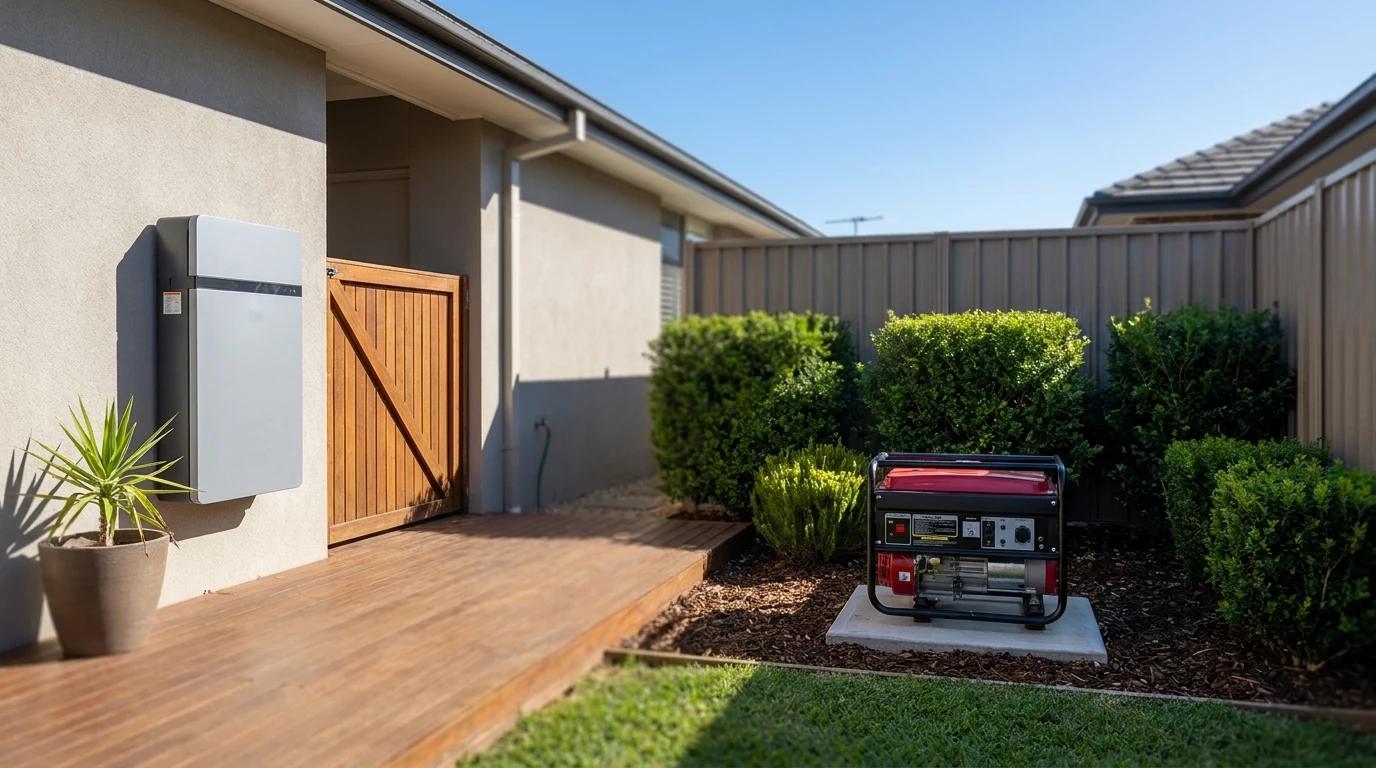
Whole-house generators run $6,000 to $25,000 installed (Angi, 2026). A typical residential battery costs more upfront before any fuel or maintenance is counted. Most homeowners comparing the two focus on specs and skip the question that actually decides the sale: how does each one get paid for?
That gap costs installers deals. A customer who likes the battery quote but panics at the sticker price walks away before hearing that financing exists. This piece compares upfront cost, ongoing cost, and reliability for both options, then walks through how each one actually gets financed.
> Key Takeaways
> - Whole-house generators cost $6,000-$25,000 installed, with $300-900 a year in upkeep (Angi, 2026; EcoFlow, 2026).
> - Battery storage costs more upfront (roughly $15,200, EnergySage, 2026) but carries no fuel bill and no comparable annual service contract.
> - Eos Loan finances battery energy storage on terms from 6 to 240 months, subject to approval and eligibility.
> - Neither purchase has to be paid in cash. The real difference is what you're financing and for how long.
See how Eos Loan financing helps you close more projects
How much does a backup generator cost installed?
Whole-house generator installation runs $6,000 to $25,000, with most homeowners landing in the $10,000-$15,000 range for a properly sized system (Angi, 2026; HomeGuide, 2026). A common 22kW Generac-class unit installs for $11,000-$14,000 (HomeGuide, 2026), which is the sweet spot most single-family homes land on.
!A residential standby generator installed beside a home's exterior wall in daylight
That price stacks several line items: the generator unit itself, a transfer switch to isolate the home from the grid during an outage, a gas line (natural gas or propane), permits, and labor. Bigger homes with higher wattage needs push toward the top of the range, and rural properties without existing gas service can add cost for a propane tank and delivery setup.
Why does the range swing so wide? Capacity is the biggest driver. A small 8-10kW unit that runs a few essential circuits costs far less than a 22kW-plus unit sized to run an entire house, including HVAC. Site conditions (how far the unit sits from the gas meter and electrical panel) move the labor line up or down too.
How much does battery storage cost installed?
A typical home battery installation runs roughly $15,200 before any incentives (EnergySage, 2026), and the residential clean-energy credit (Section 25D) that used to offset that cost ended December 31, 2025 (IRS, 2025). That's a real shift: buyers can no longer subtract 30% off the top the way they could a year ago.
!A wall-mounted residential battery storage unit installed in a garage in daylight
The higher upfront number isn't the whole story, though. A battery has no fuel dependency at all; it stores electricity rather than burning anything to generate it. In 2026, US residential battery storage reached 2.7 GW installed in 2025, up 92% year over year (Wood Mackenzie, 2025). That growth happened right as the credit was sunsetting, which tells you the category is scaling on its own merits, not just the tax break.
This is general information, not tax advice. Consult a qualified tax professional regarding the credit's expiration and how it applies to your situation. For the full picture on financing a battery after the credit ended, see financing a home battery after the tax credit ended.
Generator vs battery storage: upfront cost, fuel, and maintenance compared
Generators cost less upfront but add recurring fuel and $300-900 a year in maintenance (EcoFlow, 2026; LatestCost, 2026). Batteries cost more upfront with no fuel bill and no annual service contract, since they're solid-state units with no moving parts to wear out.
Here's the side-by-side breakdown installers can walk a customer through in one conversation:
| Factor | Generator | Battery storage |
|---|---|---|
| Upfront cost | $6,000-$25,000 installed | ~$15,200 before incentives |
| Annual maintenance | $300-900/year | No comparable annual service bill |
| Fuel dependency | Yes (gas or propane) | None |
| Noise during use | Audible engine noise | Silent |
| Runtime, multi-day outage | Continuous while fueled | Limited by battery capacity, extendable with solar |
| Moving parts | Yes, engine and components | No, solid-state |
Most comparison content stops at cost and specs. The number that actually decides whether a deal closes is the financing structure behind each option, since that's what turns a $15,200 quote into something a household can say yes to on the spot. For the full mechanics of battery financing, see the complete guide to battery storage financing.
Which option handles outages better?
Non-major-event power interruptions average about 2 hours per year for most US customers, but major-event outages (storms, hurricanes) averaged nearly 9 hours in 2024, up from about 4 hours per year on average from 2014-2023 (EIA, 2025). That split matters because it maps directly to which technology fits which household.
Generators are built for long, multi-day events since they can refuel indefinitely as long as fuel keeps arriving. Batteries are better suited for short, frequent interruptions and daily load-shifting, and can be paired with solar to recharge during extended outages rather than draining down to zero. Neither one is universally "better." It depends on what kind of outage a household actually experiences most often.
Offer your customers flexible financing on essential projects
How do you finance a backup generator?
Generator buyers typically use a home equity loan or HELOC, manufacturer financing (sometimes with a promotional 0% period), a credit card, or a lease-to-own program (generator financing guide, 2026). In 2026, the national average HELOC rate was 7.46% as of July 1 (Bankrate, 2026), a rate that moves with the broader lending market rather than the generator purchase itself.
Each path has a trade-off worth knowing before you sign. A HELOC ties up home equity and typically carries a variable rate, so the payment can move over time. Manufacturer financing is often structured for a short promotional window, and the rate can jump once that period ends. A lease-to-own program means you don't actually own the unit until the final payment lands, which matters if you plan to sell the home before then.
!A homeowner and installer reviewing a backup power financing proposal together in daylight
None of these paths is wrong, but they all put something else on the line, whether it's home equity, a promotional rate that expires, or ownership timing.
How do you finance battery storage?
Eos Loan finances battery energy storage on terms from 6 to 240 months, so the cost spreads into a predictable monthly payment instead of a lump sum, subject to approval and eligibility. That's a wider range than most single-purpose HELOC or manufacturer plans offer for a generator.
A dedicated installment loan keeps home equity untouched entirely, since it isn't secured against the house the way a HELOC is. Term length is the lever that changes the monthly payment: a longer term lowers each payment, a shorter term pays the balance off faster. Installers who can offer financing at the point of sale close more deals, because the customer doesn't have to leave and shop for a separate loan before committing.
No rate or APR is quoted here, on purpose. Eos Loan is a direct lender, not a marketplace or broker, and rates are set by underwriting rather than published as a fixed number. For the deeper mechanics of how term length changes the payment, see how loan term length changes the monthly payment.
Add financing to your installs, talk to our team
Should you finance a generator, a battery, or both?
A hybrid approach, a battery for daily use and short outages plus a generator for extended multi-day events, is increasingly common among homeowners who want both. Each piece can be financed on its own timeline rather than forcing an all-cash bundle for the whole project.
> What I'm hearing from installers in 2026: When a customer is comparing a generator quote to a battery quote, the first question almost never changes: "will this run my whole house?" The second question is the one that decides the sale, and it's about the loan, not the equipment: "how long is the term, and can I finance both if I want them?" Eduardo Donadi, CEO, Eos Loan
The decision framework comes down to three things: how often and how long a household loses power, budget, and whether they already have solar. A homeowner in a region with frequent short outages and existing solar leans battery-first. A homeowner who's weathered multi-day outages from major storms often wants a generator as the anchor, sometimes with a battery layered on top for the quieter, more frequent interruptions. US residential battery storage is still growing fast, up 92% year over year to 2.7 GW in 2025 (Wood Mackenzie, 2025), which shows batteries are increasingly the default add-on rather than the exception.
For installers, this is a ticket-size opportunity. Bundling both quotes with separate financing terms raises the total project value without asking for more cash down at signing. For more on the cost conversation itself, see pitching battery cost to a hesitant customer, and for where the category is headed, see the 2026 battery storage market outlook.
CTA placement (end-of-article, mandatory slot 3, before FAQ)
Become an Eos Loan financing partner
Or call +1 833-989-3737 to talk through a financing program for your business.
Frequently Asked Questions
{ question: "Is a battery backup or a generator cheaper long-term?", answer: "Generators cost less upfront ($6,000-$25,000 installed, Angi/HomeGuide 2026) but add $300-900/year in maintenance plus ongoing fuel cost. Batteries cost more upfront (roughly $15,200, EnergySage 2026) with no comparable annual service bill, since they have no moving parts and no fuel to buy." }, { question: "Can you finance a whole-house generator?", answer: "Yes, through a home equity loan/HELOC, manufacturer financing, a credit card, or a lease-to-own program (mtruhl.com financing guide, 2026). Each option has different rate and equity implications; a HELOC ties up home equity and often carries a variable rate that can move over time." }, { question: "Does a home battery still make sense without the tax credit?", answer: "The Section 25D residential clean-energy credit ended December 31, 2025 (IRS, 2025), but financing is separate from the credit and remains available subject to approval. Batteries were growing 92% year over year even as the credit sunset (Wood Mackenzie, 2025), so demand isn't solely credit-driven." }, { question: "What lasts longer, a battery or a generator?", answer: "Generators run on fuel and have moving parts requiring regular service, so lifespan depends heavily on maintenance and total runtime. Batteries are solid-state with no moving parts, which typically supports a longer service-free lifespan, though exact warranty terms vary by manufacturer and should be confirmed at quote time." } ]} />The takeaway on generator vs battery financing
Generators cost less upfront but bring ongoing fuel and $300-900 a year in maintenance, typically financed through a HELOC or manufacturer plan. Battery storage costs more upfront with no fuel bill, and it's financeable on terms from 6 to 240 months through a direct lender like Eos Loan, subject to approval. A growing share of households are financing both, one for daily resilience, one for the long multi-day event.
The equipment comparison matters, but the financing structure is what actually gets a project signed. Ask about term length and collateral before assuming either option is out of reach.
---
Written by Eduardo Donadi, CEO of Eos Loan. Eos Loan is the fintech built to finance essential projects (battery energy storage, EV chargers, and water filtration) for installers, contractors, and resellers across the United States.
Sources
- Angi, How Much Does It Cost to Install a Generator, retrieved 2026-07-01, https://www.angi.com/articles/how-much-does-it-cost-install-generator.htm
- HomeGuide, Generator Installation Cost, retrieved 2026-07-01, https://homeguide.com/costs/generator-cost
- EnergySage, Battery Backup Power vs Generators: Which Is Right for You, retrieved 2026-07-01, https://www.energysage.com/energy-storage/battery-backup-power-vs-generators-which-is-right-for-you/
- Wood Mackenzie, US energy storage monitor (residential 2.7 GW in 2025, +92% YoY), retrieved 2026-07-01, https://www.woodmac.com/
- IRS, Residential Clean Energy Credit (Section 25D), retrieved 2026-07-01, https://www.irs.gov/credits-deductions/residential-clean-energy-credit
- EcoFlow, Home Generator Maintenance Cost Guide, retrieved 2026-07-01, https://www.ecoflow.com/us/blog/home-generator-maintenance-cost-guide
- LatestCost, Annual Generator Maintenance Cost, retrieved 2026-07-01, https://latestcost.com/annual-generator-maintenance-cost-price/
- EIA, Today in Energy: outage duration data, retrieved 2026-07-01, https://www.eia.gov/todayinenergy/detail.php?id=66744
- mtruhl.com, Home Generator Financing Options, retrieved 2026-07-01, https://mtruhl.com/articles/home-generator-financing-options/
- Bankrate, HELOC Rates, retrieved 2026-07-01, https://www.bankrate.com/home-equity/heloc-rates/
- Eos Loan, battery energy storage financing terms (6-240 months), internal product data, retrieved 2026-07-01