

Battery Storage Financing for Assisted Living and Senior Care Facilities
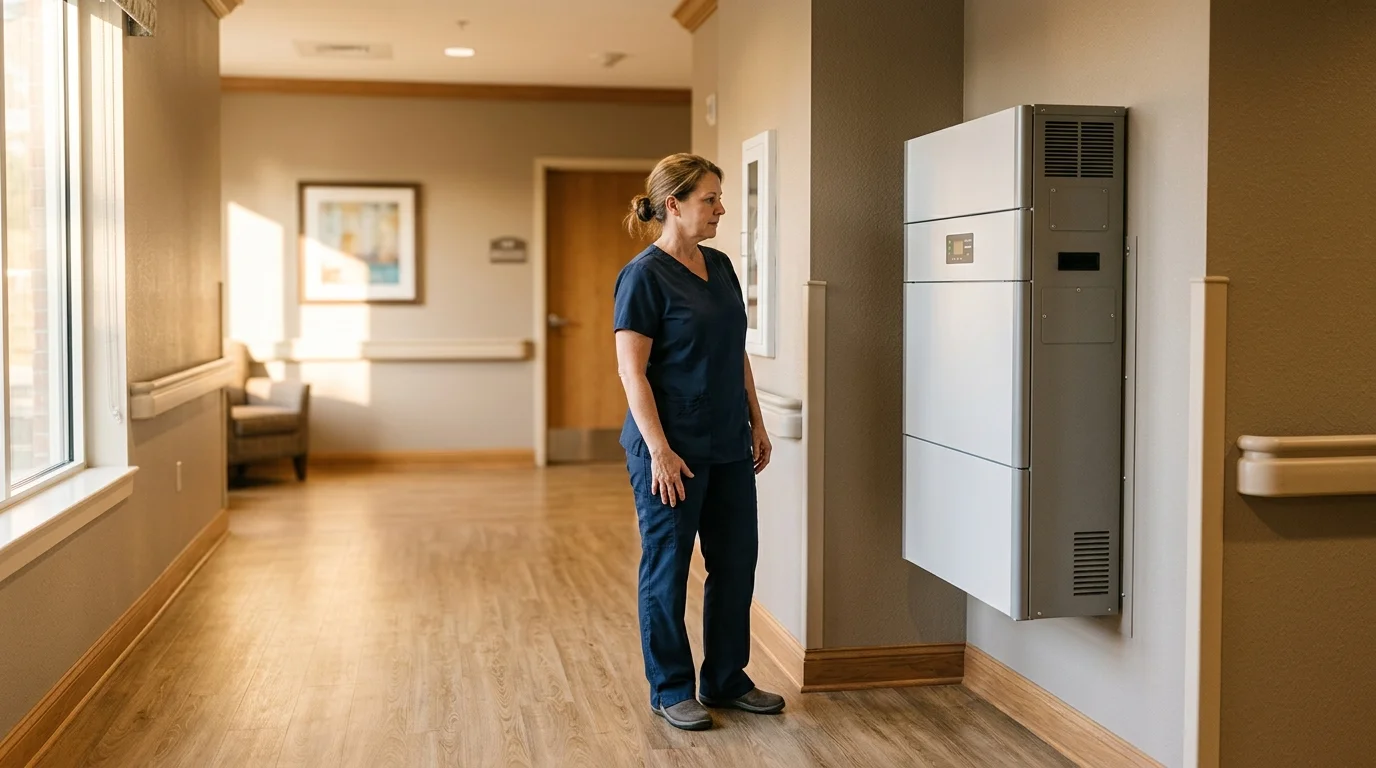
In September 2017, Hurricane Irma knocked out the transformer that powered air conditioning at a nursing home in Hollywood, Florida. At least eight residents died in early reporting, and the Broward County Medical Examiner later ruled 12 of the 14 deaths homicides linked to heat exposure (ABC News; CBC, 2017). That case is why backup power at a senior care facility is a life-safety question first and a financial one second.
Assisted living communities and senior care facilities now face an uneven patchwork of federal and state backup-power rules. A full-building battery system is still a large capital outlay. This guide covers what the law requires, how battery storage fits alongside a generator, and how these facilities and their contractors finance the work.
> Key Takeaways
> - CMS's federal 96-hour emergency power rule covers skilled nursing and long-term care, not assisted living, which states regulate separately (CMS, via AHCA/NCAL, 2017).
> - US customers averaged 11 hours of interruptions in 2024, nearly twice the prior decade's annual average, and three hurricanes accounted for 80% of hours without power (EIA, 2025).
> - Battery storage usually complements a generator. Eos Loan finances it as a direct lender, with flexible terms from 6 to 240 months, subject to approval and eligibility.
See how Eos Loan financing helps you close more projects
Why do assisted living and senior care facilities need backup power?
More than 30,500 assisted living communities serve over 800,000 residents across the US (The Senior List, citing NIC and AHCA/NCAL data, 2026). Many of those residents cannot evacuate quickly, and many depend on powered equipment such as oxygen concentrators, dialysis machines, or refrigerated medication. When cooling or power fails, the outage can become a medical emergency within hours.
The Hollywood case shows how that happens. According to 2017 reporting, the facility said it had a standby generator in place, but the transformer feeding its air conditioning failed anyway. A generator only protects the equipment on the circuits it feeds.
For the broader critical-load framing, see battery storage financing for data centers and critical-load businesses. That post covers facilities where downtime is costly but not a direct life-safety event.
What does the law actually require for backup power at these facilities?
There is no single national mandate. CMS's Emergency Preparedness Rule requires Medicare- and Medicaid-certified hospitals and long-term care (skilled nursing) facilities to plan for 96 hours of emergency power. It does not cover assisted living communities (CMS, via AHCA/NCAL, 2017).
Florida's post-Irma rule, as summarized by Epstein Becker Green (2018), requires nursing homes and assisted living facilities to keep ambient temperature at or below 81°F for 96 hours after losing primary power. Texas is the newest addition. HB 3595 requires assisted living communities to adopt a formal backup-power plan by January 1, 2026, and sets standards for new-construction permits begun after September 1, 2026, including generator connection or multiple backup sources (Texas Legislature, HB 3595 bill analysis, 2025).
A facility's actual obligation depends on its license type and state. Confirming the applicable rule with the state licensing agency is the first step, not an assumption.
How does battery storage fit alongside a generator at a senior care facility?
Battery storage can cover the first minutes of an outage, the gap before a generator starts and takes the load. A generator then carries the extended runtime. For a resident on an oxygen concentrator or a medication refrigerator, that opening gap is the riskiest window, and a standby generator generally cannot close it on its own.
For a facility bound by a 96-hour standard, battery storage is typically a complement to a generator, not a replacement. It also reduces reliance on diesel deliveries during a regional disaster, when fuel logistics can be disrupted for days.
For the full comparison of standalone battery storage and generator backup, see battery storage vs. generator financing.
How often do outages hit these facilities, and is the risk growing?
Yes. US electricity customers averaged 11 hours of power interruptions in 2024, nearly twice the annual average of the decade before. Major events such as Hurricanes Beryl, Helene, and Milton accounted for 80% of the hours without electricity (EIA, 2025). Interruptions not triggered by major events routinely average about two hours per year, so one severe storm season can dominate a facility's annual exposure.
For how demand for backup power moves after major outages, see battery storage demand after outages and disasters.
How does battery storage financing work for assisted living and senior care facilities?
Eos Loan finances battery storage for assisted living and senior care facilities as a direct lender, with flexible terms from 6 to 240 months, subject to approval and eligibility. Eos Loan has originated more than $4 billion to date (Eos Loan company data, 2026), and it funds its own loans rather than passing the deal to outside bidders.
The contractor presents the battery system and the financing together in one proposal, and the facility applies during that conversation. No specific rate or APR is quoted here, and Eos Loan charges no dealer fee. Final terms depend on underwriting and are subject to approval and eligibility.
Ticket size tracks facility size and existing generator capacity. Larger operators with an ownership group may need board or ownership sign-off before a project this size moves forward, so the proposal should show the compliance deadline and the payment structure in one place. For how these terms are built, see how battery storage loan terms work.
Add financing to your installs, talk to our team
How do contractors pitch and close these deals?
Lead with the specific rule that applies to the facility, not a generic resilience pitch. A skilled nursing facility answers to the federal 96-hour rule. A Florida assisted living community answers to the 81°F standard. A Texas assisted living operator is working against the HB 3595 dates. Naming the rule and its date gives the administrator a concrete reason to act.
The administrator usually owns the operational case, but multi-site operators often need finance-level sign-off. A proposal that frames the project around the compliance deadline and the payment structure gives that approval chain something it can act on. Eos Loan charges no dealer fee, and every term remains subject to approval and eligibility.
For the installer-side playbook behind these conversations, see the 2026 battery storage financing guide for installers.
Is a tax credit available for battery storage at these facilities?
The commercial 48E clean-electricity investment credit generally remains available through 2032 for qualifying entities, according to the IRS (IRS, 2026). The residential clean-energy credit, Section 25D, ended December 31, 2025, and does not apply to a commercial facility (IRS, 2025).
Eligibility depends on entity type, project specifications, and other conditions the statute defines, so the facility's own tax advisor should confirm them. This is general information, not tax advice. For the full breakdown, see the 48E commercial credit guide.
Frequently Asked Questions
Do assisted living facilities have to have a generator by law?
It depends on the state and license type. CMS's federal rule covers Medicare- and Medicaid-certified skilled nursing and long-term care facilities, not assisted living. Florida requires nursing homes and assisted living facilities to keep temperature at or below 81°F for 96 hours, per Epstein Becker Green, and Texas requires assisted living communities to adopt a backup-power plan by January 1, 2026.
How long must a nursing home maintain backup power during an outage?
CMS's Emergency Preparedness Rule requires covered hospitals and long-term care facilities to plan for 96 hours of emergency power (CMS, via AHCA/NCAL, 2017). Florida's post-Irma rule adds an 81°F temperature ceiling for the same 96-hour window for nursing homes and assisted living facilities.
Can battery storage replace a generator at a senior care facility?
Usually it complements a generator rather than replacing it. Battery storage provides immediate, silent ride-through when power drops, while a generator supplies the extended runtime a multi-day outage requires. A facility bound by a 96-hour standard should plan for both and confirm the design with its state licensing agency.
What happened at the Hollywood nursing home during Hurricane Irma?
In 2017, Hurricane Irma knocked out the transformer that powered air conditioning at the Rehabilitation Center at Hollywood Hills, even though the facility had a standby generator, according to its statement. At least eight residents died in early reporting. The Broward County Medical Examiner later ruled 12 of 14 deaths homicides linked to heat exposure (CBC, 2017), and the deaths prompted new state regulations (PolitiFact, 2017).
What should a facility or contractor carry into the next proposal?
Senior care facilities evaluate backup power as a life-safety requirement, not a convenience upgrade, so the financing conversation should reflect that. Here is what to carry into the next proposal:
- CMS's 96-hour rule covers skilled nursing and long-term care, not assisted living, which states regulate with real variance, including Florida's 81°F standard and Texas's HB 3595 dates.
- US customers averaged 11 hours of interruptions in 2024, nearly twice the prior decade's annual average, with major hurricanes accounting for 80% of hours without power (EIA, 2025).
- Battery storage typically complements a generator at these facilities, covering the opening minutes of an outage that a standby generator cannot cover alone.
- Eos Loan finances these projects as a direct lender, with flexible terms from 6 to 240 months, subject to approval and eligibility, and no dealer fee.
- The commercial 48E credit generally remains available through 2032 for qualifying projects. This is general information, not tax advice.
Lead with the specific rule that applies to a facility's license type and state, and the financing conversation moves faster. For how demand for this kind of backup power moves after a major outage, see battery storage demand after outages and disasters. For the install-timeline math behind financing ahead of storm season, see battery storage financing before hurricane season.
Become an Eos Loan financing partner
Or call +1 833-989-3737 to talk through a financing program for your facility.
About the author: Eduardo Donadi is CEO of Eos Loan, a US fintech direct lender that helps installers and contractors offer point-of-sale financing on essential projects, including battery energy storage, EV chargers, and water filtration.