

Commercial Microgrid Financing: A Guide for Businesses and Campuses
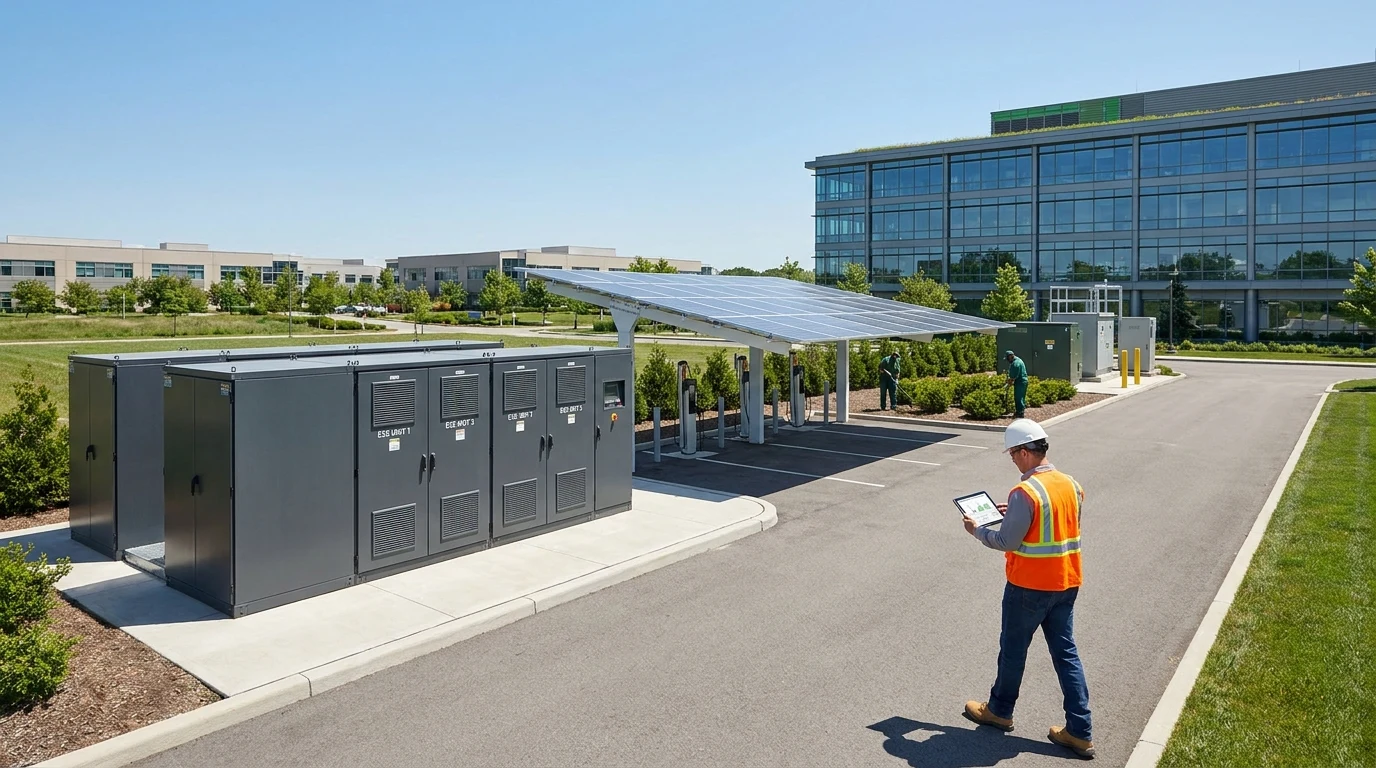
Most facilities directors who search for microgrid financing picture one enormous capital project: generation, storage, and controls across every building, funded all at once. That is rarely how it actually gets built. North America's microgrid market is projected to reach $4.9 billion in 2026 (Fortune Business Insights, 2026), and most of that growth is happening through phased projects, not single mega-deals.
The problem is framing. A campus, hospital network, or industrial park scoping a resiliency project conflates "microgrid" with a single all-at-once buildout, when in practice financing is usually structured asset-by-asset or in phases. That misunderstanding stalls deals before they start, because a $2 million capital ask is a much harder conversation than a $400,000 first phase.
This guide explains what a commercial microgrid actually is, why businesses and campuses are investing in 2026, how the financing gets structured, what a phased approach looks like in practice, and how contractors position multi-building projects to close. For the single-building version of this conversation, see the battery storage financing pillar guide.
> Key Takeaways
> - North America's microgrid market is projected to reach $4.9 billion in 2026 (Fortune Business Insights, 2026), driven largely by C&I resilience demand.
> - Major US power outages cost customers $121 billion in 2024, up from a $67 billion seven-year average (Oak Ridge National Laboratory, 2026).
> - Financing typically runs through direct loans, PPAs, energy service agreements, or ESPCs, and a phased, storage-first approach is often more bankable than one all-at-once capital stack.
> - Eos Loan finances the battery storage backbone of a microgrid project as a direct lender, with flexible terms from 6 to 240 months, subject to approval and eligibility.
See how Eos Loan financing helps you close more projects
What is a commercial microgrid, and how is it different from a single battery system?
A microgrid is a group of interconnected loads and distributed energy resources within clearly defined electrical boundaries that acts as a single controllable entity and can disconnect from, then reconnect to, the main grid (Department of Energy, Microgrid Initiative). A single commercial battery storage system is one component of that picture, not the whole thing.
That distinction matters for financing. A single-building battery storage project is one asset with one financing conversation. A commercial microgrid usually spans generation (solar, generator, or combined heat and power), battery energy storage, a controls and energy management system (EMS), and, in the most capable projects, controllable loads that can be shed during an outage. The defining feature is islanding: the ability to disconnect from the utility grid and keep feeding critical loads from on-site resources (Department of Energy, Islanding a Microgrid).
Scope is the other variable. A single-building project serves one meter. A campus or multi-building microgrid connects several buildings, sometimes with their own internal distribution network, under one controllable system. That is why a hospital network, university campus, or industrial park scopes this differently than a single retail location: the electrical boundary, the number of critical loads, and the financing structure all scale with the number of buildings involved.
For a deeper look at single-system commercial battery projects, see the single-system commercial battery storage financing guide, which covers the one-building version of this same conversation.
Why are businesses and campuses investing in microgrids in 2026?
In 2026, major US power outages cost customers $121 billion in 2024, up sharply from a $67 billion seven-year average (Oak Ridge National Laboratory, 2026). That single stat explains most of the demand behind commercial and campus microgrid projects: outages are getting more expensive, and businesses that run multiple buildings feel that cost multiplied across every site.
Resiliency ROI is the first driver. A manufacturing campus that loses power does not just lose the outage window, it loses idle labor, spoiled inventory, and restart costs on production lines across every affected building. A hospital network or multi-family portfolio faces a liability question when elevators, HVAC, or life-safety systems go dark in more than one location at once. Microgrids convert that multi-building exposure into a single, manageable resiliency plan.
The second driver is scale economics. US microgrid operational capacity grew at a 32% annual rate, reaching 8.6 GW by the end of 2023 (Wood Mackenzie), and the broader US microgrid market is projected to grow 19% annually through 2027 (Wood Mackenzie via Utility Dive). That growth tracks the wider storage market: total US energy storage installations reached 18.9 GW in 2025, up 52% year over year (Wood Mackenzie, 2025), giving multi-building projects a maturing supply chain and contractor base to draw from.
Add financing to your installs, talk to our team
How does commercial microgrid financing actually work?
Financing options for microgrids include direct loans, power purchase agreements (PPAs), energy service agreements (ESAs), and energy savings performance contracts (ESPCs), and reliable off-taker creditworthiness is the factor that drives whether any of those structures gets approved (DOE FEMP, Financing Microgrids in the Federal Sector). Each structure shifts ownership and risk differently, and the right fit depends on whether the business wants to own the assets or pay for a service.
A direct loan is the most straightforward path when a business wants to own the equipment outright. The facility borrows, the contractor gets paid at project completion, and the business repays over an agreed term while owning and controlling the system. A PPA or ESA works differently: a third party owns the equipment and sells the business energy or resilience-as-a-service, usually with no upfront capital outlay but also no ownership at the end of the contract. An ESPC bundles efficiency and resilience upgrades into one performance-guaranteed contract, more common in public-sector and large institutional deals.
Underwriting for any of these structures weighs the host facility's creditworthiness and its willingness to commit to a long-term contract (Partridge Snow & Hahn / EPA, Third-Party Ownership Financing Structures). What we see more often in practice than a single all-at-once capital stack is a phased structure: the battery storage backbone gets financed and installed first, and generation or controls get added in a second phase once the first phase is producing measurable results. That phased path is generally more bankable, because it asks underwriting to evaluate a smaller, better-defined project rather than a multi-asset buildout with more moving parts.
What does a commercial microgrid project cost, and how do businesses size the financing?
Microgrid project cost scales with the number of buildings, the generation mix, and the level of resilience required, and not every site needs full islanding of every load, only the critical ones. A campus that only needs to keep servers, refrigeration, and life-safety systems running during an outage can finance a much smaller project than one that islands every building in full.
Value-of-resilience is how financiers translate that sizing decision into dollars: avoided-loss calculations, what an outage hour actually costs a given facility, are how underwriters assign cash-flow value to islanding capability (Microgrid Knowledge, How Financiers Think About Microgrid Project Funding). That framework is also why phasing works financially. Financing the storage backbone first reduces the initial capital ask, gets a working resilience layer in place faster, and gives the business a track record to bring to the underwriting conversation for phase two. Eos Loan finances that storage-first phase with flexible terms from 6 to 240 months (Eos Loan product data, 2026), subject to approval and eligibility.
| Structure | Who owns the equipment | Typical use case | Who carries performance risk |
|---|---|---|---|
| Direct loan | Business | Business wants full ownership and control | Business |
| PPA | Third-party owner | Business wants energy with no upfront capital | Third-party owner |
| ESA / EaaS | Third-party owner | Business wants resilience-as-a-service | Third-party owner |
| ESPC | Contractor/ESCO (guaranteed) | Public-sector, large institutional retrofits | Contractor/ESCO |
Does the 48E commercial tax credit apply to microgrid projects?
The Section 48E commercial clean-electricity investment credit generally remains available through 2032 for qualifying commercial battery storage and generation assets (IRS / statute), while the residential 25D credit ended December 31, 2025 (IRS, 2025). For a multi-asset microgrid project, that distinction matters component by component, not as a blanket answer for the whole system.
Battery storage and eligible generation assets, such as qualifying solar, are the components most likely to qualify for 48E, subject to the same prevailing wage and bonus adder rules that apply to standalone commercial storage projects. Controls, EMS software, and switchgear are typically not credit-eligible on their own; they support the system but are not themselves the clean-electricity investment property the credit targets. This is general information, not tax advice. Consult a qualified tax professional.
For the full mechanics, including base rates, bonus adders, and the FEOC compliance timeline, see the 48E commercial credit guide. This is general information, not tax advice. Consult a qualified tax professional.
How do contractors and installers pitch a multi-building microgrid financing plan?
Contractors who present a phased quote, storage backbone first, generation and controls as a second phase, close larger multi-site deals more often than those who present one lump capital number. That mirrors what we've seen across financed projects generally: contractors who present financing at the proposal stage raise average ticket size, a pattern documented in our contractor ticket-size research.
Positioning matters here too. Eos Loan is a direct lender, never a marketplace, broker, or platform that connects a business to outside lenders. For a facilities director managing a campus with several buildings, a single direct-lender relationship across every phase of the project is simpler than re-shopping financing each time a new building comes online. That consistency is part of why phased projects stay with the same lender from phase one through phase three.
Become an Eos Loan financing partner
Or call +1 833-989-3737 to talk through a financing program for your business.
Frequently Asked Questions
What's the difference between microgrid financing and battery storage financing?
Microgrid financing typically funds multiple interconnected assets, generation, battery storage, and controls, across one or more buildings, while battery storage financing funds a single storage system. Many commercial microgrid projects finance the battery storage backbone first, then add generation or controls in a second phase, subject to approval and eligibility.
Can a business get a loan for a microgrid, or is it always a PPA or ESA?
Direct loans, PPAs, ESAs, and ESPCs are all used in practice. A direct loan is generally the more straightforward path when the business wants to own the assets outright rather than pay a third party for energy or resilience services over time (DOE FEMP; Microgrid Knowledge).
Does the 48E commercial credit cover microgrid equipment?
Section 48E generally covers qualifying commercial battery storage and generation assets through 2032 (IRS / statute); controls and EMS software are typically not credit-eligible on their own. This is general information, not tax advice. Consult a qualified tax professional.
How long does it take to finance a commercial microgrid project?
Timelines vary by project scope and financing structure. A phased approach, financing the storage backbone first, can move faster than waiting to finance an entire multi-asset buildout at once, subject to approval and eligibility.
The bottom line for facilities directors and contractors
A commercial microgrid is a multi-asset, multi-building system, not one big battery, and financing it usually works better as a phased project than a single capital decision. Here is what to carry into the next campus or multi-building conversation:
- North America's microgrid market is projected to reach $4.9 billion in 2026 (Fortune Business Insights, 2026), and major outages cost customers $121 billion in 2024 (ORNL, 2026).
- Four financing structures dominate: direct loans, PPAs, ESAs, and ESPCs, each shifting ownership and performance risk differently.
- Financing the storage backbone first, then adding generation and controls in phase two, is often the more bankable first step than a single all-at-once capital stack.
- The 48E commercial credit generally remains a live federal lever through 2032 for qualifying storage and generation components; this is general information, not tax advice. Consult a qualified tax professional.
- Contractors who present a phased quote close larger multi-building deals than those who present one lump number.
Eos Loan finances the battery storage backbone of commercial and campus projects as a direct lender, with flexible terms from 6 to 240 months, subject to approval and eligibility, so contractors can bring a phased plan to every facilities team they pitch. For projects that later add grid-services revenue on top of the financed storage backbone, see virtual power plant enrollment for financed batteries.
About the author: Eduardo Donadi is CEO of Eos Loan, a US fintech direct lender that helps installers and contractors offer point-of-sale financing on essential projects, including battery energy storage, EV chargers, and water filtration.