

Water Filtration Financing for Car Washes and Laundromats
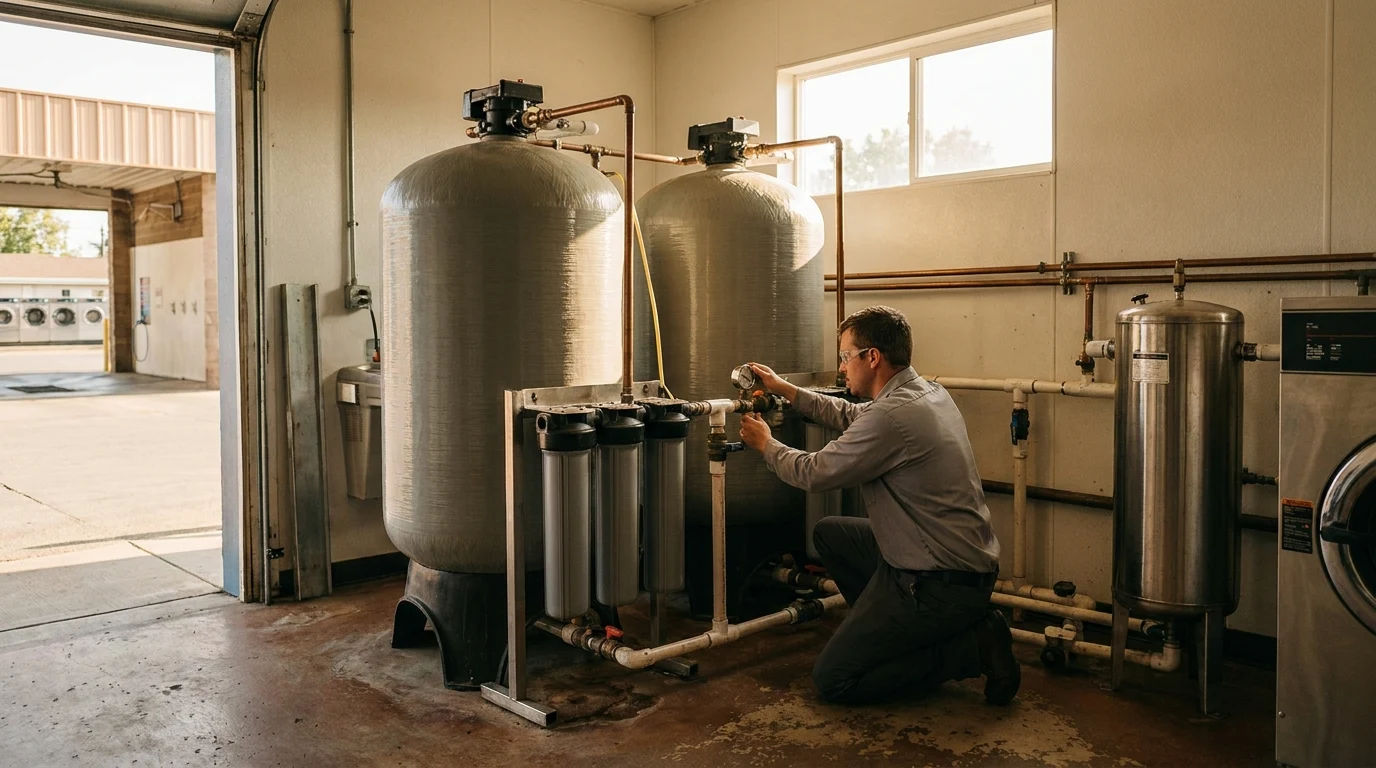
A tunnel car wash and a laundromat don't look alike, but they share one trait that puts them in a different category from almost every other commercial account: the sheer volume of water moving through their equipment every single day. A restaurant worries about a health inspection. A car wash or laundromat owner worries about scale building up inside a heat exchanger that runs eight hours straight, seven days a week.
That continuous high-flow operation does two things most other businesses never deal with. It wears out pumps, valves, and boilers faster than normal commercial use, and it can push a facility past the wastewater thresholds that trigger municipal discharge rules. Filtration and reclamation systems solve both problems, but they carry a real price tag. Financing is what lets an owner install now instead of waiting years to save up the cash.
> Key Takeaways
> - Conveyor car washes without reclamation use 65.8 to 85.3 gallons of fresh water per vehicle; reclamation systems cut that to as low as 7.8 gallons per vehicle (EPA WaterSense, retrieved 2026-09-30).
> - Laundromat utility costs, driven mostly by water and sewer, run 20 to 30% of gross revenue, with nearly half of owners naming it their biggest operating problem (Coin Laundry Association 2024 survey, via The Unity Washer, 2026).
> - Filtration and reclamation systems for these operators typically run from a few thousand dollars to well over $150,000 depending on scale (Crestmont Capital, 2025).
> - Facilities discharging 25,000 gallons per day or more of process wastewater can be classified as Significant Industrial Users under EPA pretreatment rules, which is squarely in range for a busy tunnel wash or multi-machine laundromat (EPA, retrieved 2026-09-30).
Add financing to your installs, talk to our team
Why Do Car Washes and Laundromats Need Different Water Filtration?
Car washes and laundromats run water continuously at a volume that dwarfs a typical commercial account, and that volume is what makes generic water treatment advice fall short. A conveyor (tunnel) car wash without a reclamation system uses 65.8 gallons of fresh water per vehicle on a friction wash and 85.3 gallons per vehicle on a frictionless wash, according to EPA's WaterSense commercial guidance (retrieved 2026-09-30). Run 300 to 400 cars a day through that tunnel, and you're looking at tens of thousands of gallons before lunch.
Run the math on a 400-car day: at the EPA's 85.3-gallon-per-vehicle figure, an unfiltered, non-reclaiming tunnel wash pushes roughly 34,000 gallons through its equipment daily. A laundromat isn't far behind. Commercial washers average close to 95 gallons of water per machine per day, and a mid-size location running a dozen machines multiplies that fast (The Unity Washer, 2026). Neither business looks like a typical retail account on a water bill.
That volume changes what the water does to the equipment. Car washes need spot-free rinse water, which typically means a reverse osmosis system dedicated to the final rinse stage so cars leave without mineral spotting. Laundromats face a different mix: detergent chemistry interacting with hard water reduces cleaning performance and leaves mineral buildup inside washer drums and heating elements. Both problems point toward filtration sized for continuous, high-flow duty rather than the intermittent use a typical office or retail account sees.
What Does Filtration and Water Reclamation Cost for These Businesses?
Filtration and reclamation system costs for car washes and laundromats scale with flow rate and reclaim goals, running from a few thousand dollars for basic point-of-entry treatment to well over $150,000 for a full tunnel reclaim loop. Crestmont Capital's equipment financing data (2025) puts general commercial water filtration projects anywhere from $1,000 to $280,000 depending on industry and system scale, and car wash and laundromat builds sit across that entire span.
A basic point-of-entry softening or sediment system for a laundromat's incoming line typically lands in the $5,000 to $15,000 range. A dedicated spot-free reverse osmosis system for a car wash's final rinse stage runs higher, often $15,000 to $50,000 depending on flow capacity. A full water reclamation and recycling loop for a tunnel wash, the kind that captures, filters, and reuses wash water across multiple cycles, is the biggest ticket, frequently $50,000 to $150,000 or more for a high-volume operation.
Crestmont Capital's own industry-specific programs confirm that scale: car wash equipment financing runs from $10,000 up to $2 million, and laundromat equipment financing ranges from $10,000 to $500,000 (Crestmont Capital, 2026; Crestmont Capital, 2026). That headroom exists because these accounts genuinely need it. A single-bay softener swap is nothing like outfitting a 120-foot tunnel with a full reclaim system.
How Does Water Reclamation Affect Discharge and Sewer Costs?
Unfiltered, high-volume wastewater from a car wash or laundromat can trigger municipal pretreatment requirements that a lower-volume business never encounters. Under EPA's National Pretreatment Program, a facility discharging an average of 25,000 gallons per day or more of process wastewater can be classified as a Significant Industrial User, subject to closer monitoring and local discharge limits (EPA, retrieved 2026-09-30). A busy tunnel wash or a multi-machine laundromat can cross that 25,000-gallon line without the owner realizing it.
Why does this matter beyond compliance paperwork? Because reclamation systems don't just reduce a water bill, they reduce the volume a municipality has to treat on the back end, which is exactly what pretreatment rules are designed to manage. Cutting fresh-water draw also cuts the wastewater stream leaving the building, which is the lever that keeps a growing operation under the threshold that invites closer oversight.
Modern car wash reclamation systems can reuse a large share of wash water across cycles. Industry coverage of the International Carwash Association's WaterSavers program points to reclaim systems reusing up to roughly 90% of water in newer installations, which lines up with the EPA's own per-vehicle numbers: dropping from 85.3 gallons per vehicle without reclamation to as low as 7.8 gallons per vehicle with it is a reduction in that same range. That's not a rounding error. It's the difference between a facility that draws attention from a local utility and one that doesn't.
How Does Filtration Protect Car Wash and Laundry Equipment?
Continuous high-flow operation without filtration shortens the service life of pumps, valves, heat exchangers, and boilers, which turns a water quality issue into a maintenance-cost problem. A restaurant's dishwasher runs a few hours a day. A car wash's rinse pumps and a laundromat's boilers run most of the business day, every day, which means scale and sediment have far more opportunity to do damage before anyone notices a performance drop.
This is a different case than the two water verticals already covered elsewhere on this site. Restaurant and healthcare filtration content tends to center on health-code compliance and sterilization standards, not equipment wear from continuous flow. The economics here are about avoided repair bills and extended equipment life, not a regulatory checklist. For the residential and general whole-home side of softener financing, including how bundling raises ticket size, see our guide to whole-home and commercial softener financing.
> Dealer observation: From the financing side of this cluster, car wash and laundromat owners are some of the most repeat-friendly accounts a water-treatment dealer can build. Many operate more than one location, so a filtration or reclamation job that goes well at site one often becomes a second and third call within a year. That changes the sales conversation from a one-time residential sale to a recurring commercial book.
Isn't it worth asking what a scaled-up heat exchanger or a worn rinse pump actually costs to replace mid-season? Unplanned downtime on a tunnel wash during a busy weekend, or a boiler failure at a laundromat during peak hours, costs far more in lost revenue than the filtration system that would have prevented it. Framing the pitch around avoided downtime, not just water quality, is what makes this case land with an owner who already knows their equipment runs hard.
How Does Financing Work for a Car Wash or Laundromat Filtration System?
Financing a car wash or laundromat filtration system works the same way as any other essential-project loan: a direct lender funds the system now, and the business owner repays over a flexible term instead of paying the full cost upfront. Eos Loan is a direct lender, never a marketplace, broker, or platform that connects you to other lenders, and we charge no dealer fee, so the price you quote stays the price your customer sees. All financing is subject to approval and eligibility, and terms are flexible, matched to the job and the owner's cash flow.
Here's how it typically plays out for a dealer or installer selling into this vertical. You quote the reclamation or softening system alongside a monthly payment estimate, the owner applies, and once the install is confirmed, funding moves quickly rather than tying up your own cash in a multi-week project. Crestmont Capital's own commercial car wash and laundromat financing programs report approval decisions within a few hours and funding within one to two business days (Crestmont Capital, 2026), which is the speed standard worth matching when you present Eos Loan alongside a system quote.
Multi-location owners are the detail worth remembering here. A car wash chain or a laundromat operator with three or four sites isn't a one-time deal, it's a relationship. Presenting financing cleanly on the first location's filtration or reclamation job often opens the door to the next site without a fresh sales pitch each time.
Offer your customers flexible financing on essential projects
Which Water Filtration System Fits a High-Volume Business?
The right system for a car wash or laundromat depends on three factors: flow rate, whether the owner operates one site or several, and whether the goal is basic protection or full water reclamation. A single-location laundromat with a handful of machines usually needs point-of-entry softening sized to its peak flow, not a full reclaim system built for a 400-car-a-day tunnel.
Flow rate should drive the first decision. A dealer should measure or estimate peak gallons-per-minute demand, not just daily totals, since car washes and laundromats both see sharp spikes during busy hours that a system must handle without pressure loss. Multi-location owners should also standardize on one system type across sites where possible, since that simplifies maintenance contracts and financing paperwork alike.

When the goal shifts from basic softening to full reclamation and recycling, that's usually the point to bring in a specialized water-reclamation contractor rather than a general water-treatment dealer, since reclaim loops involve filtration stages, storage, and pumping that a standard softener installer may not carry in their normal scope. For the broader dealer-financing mechanics across this whole category, see the full 2026 water treatment dealer financing guide, and for how other commercial accounts finance similar projects, see how other commercial water filtration projects get financed. To see how Eos Loan structures these deals directly, visit Eos Loan's water filtration financing solutions page.
The Bottom Line for Car Wash and Laundromat Filtration
Car washes and laundromats run more water through their equipment every day than almost any other commercial account, and that volume is exactly what makes filtration and reclamation pay for themselves in avoided repairs and lower discharge exposure. The core points to carry into a sales conversation:
- Daily volume is the real driver. A single tunnel wash can push tens of thousands of gallons through its equipment daily, and laundromats aren't far behind on a per-machine basis.
- Costs span a wide range, from a few thousand dollars for basic softening to well over $150,000 for a full tunnel reclaim loop, so financing needs to scale with the job.
- Reclamation protects against both equipment wear and the municipal discharge thresholds that kick in around 25,000 gallons per day.
- Multi-location owners are repeat accounts, not one-time sales, which makes this vertical worth building a real financing relationship around.
- US Environmental Protection Agency, WaterSense at Work, Section 5.5 Vehicle Washing (conveyor wash water use of 65.8 to 85.3 gallons per vehicle without reclamation, down to 7.8 to 16.8 gallons per vehicle with reclamation), retrieved 2026-09-30, https://www.epa.gov/system/files/documents/2023-05/ws-commercial-watersense-at-work_Section_5.5_Vehicle_Washing.pdf
- US Environmental Protection Agency, Pretreatment Roles and Responsibilities for Industrial Users (Significant Industrial User classification at 25,000 gallons per day or more of process wastewater), retrieved 2026-09-30, https://www.epa.gov/npdes/pretreatment-roles-and-responsibilities-industrial-users
- Crestmont Capital, Water Filtration Equipment Financing and Leasing (commercial filtration cost range of $1,000 to $280,000), retrieved 2026-09-30, https://www.crestmontcapital.com/blog/water-filtration-equipment-financing-leasing
- Crestmont Capital, Car Wash Equipment Financing & Leasing ($10,000 to $2 million financing range, 24-72 month terms), retrieved 2026-09-30, https://www.crestmontcapital.com/car-wash-equipment-financing-leasing
- Crestmont Capital, Laundromat Financing ($50,000 to $1,000,000 lending range, $10,000 to $500,000 equipment financing), retrieved 2026-09-30, https://www.crestmontcapital.com/industry/laundromats
- The Unity Washer, Commercial Washer Water Usage Benchmarks (average water use per commercial washer), 2026, retrieved 2026-09-30, https://buyunitynow.com/commercial-washer-water-usage-benchmarks-tips/
- The Unity Washer, citing Coin Laundry Association 2024 member survey (utility costs at 20-30% of gross revenue), 2026, retrieved 2026-09-30, https://buyunitynow.com/reduce-laundry-total-cost-of-ownership-guide/
- Professional Carwashing & Detailing, coverage of the International Carwash Association WaterSavers program (reclaim systems reusing up to approximately 90% of wash water), 2025, retrieved 2026-09-30, https://www.carwash.com/carwash-water-recycling/
Eos Loan finances filtration and reclamation systems for car washes, laundromats, and every other essential project we cover, including battery storage, EV charging, and real estate, with no dealer fee and flexible terms, all subject to approval and eligibility. Ready to add financing to your next car wash or laundromat quote?
Become an Eos Loan financing partner
Prefer to talk it through? Call +1 833-989-3737.
Frequently Asked Questions
How much water does a car wash or laundromat use per day?
A conveyor car wash without reclamation uses 65.8 to 85.3 gallons of fresh water per vehicle (EPA WaterSense, retrieved 2026-09-30), so a 400-car day can mean tens of thousands of gallons. Commercial washers in laundromats average close to 95 gallons per machine daily (The Unity Washer, 2026), multiplied by however many machines run.
Does filtration reduce sewer or discharge fees?
It can, by reducing the volume of wastewater a facility sends to the municipal system. Facilities discharging 25,000 gallons per day or more of process wastewater can be classified as Significant Industrial Users under EPA pretreatment rules (EPA, retrieved 2026-09-30), and reclamation systems that cut fresh-water draw also cut that discharge volume. Exact fee structures vary by municipality.
Can a water reclamation system be financed like a softener?
Yes. Reclamation and softening systems both qualify for the same kind of flexible commercial financing, sized to the project rather than a fixed loan type. Eos Loan funds these projects directly, with no dealer fee, subject to approval and eligibility, the same way it finances any other essential-project equipment.
How fast can a car wash or laundromat get financing approved?
Speed varies by lender and project size, but industry programs built for this vertical report approval decisions within a few hours and funding within one to two business days of installation confirmation (Crestmont Capital, 2026). All approvals remain subject to eligibility, and no responsible lender promises a guaranteed outcome.
What's the difference between softening and full water reclamation for these businesses?
Softening treats hardness and sediment in the incoming water line, protecting pumps, valves, and heat exchangers from scale. Full water reclamation goes further, capturing, filtering, and reusing wash or rinse water across multiple cycles, which cuts fresh-water draw by a large margin. Most laundromats need softening; high-volume tunnel car washes are the more common candidates for a full reclaim loop.
{ question: "Does filtration reduce sewer or discharge fees?", answer: "It can, by reducing the volume of wastewater a facility sends to the municipal system. Facilities discharging 25,000 gallons per day or more of process wastewater can be classified as Significant Industrial Users under EPA pretreatment rules, and reclamation systems that cut fresh-water draw also cut that discharge volume. Exact fee structures vary by municipality." },
{ question: "Can a water reclamation system be financed like a softener?", answer: "Yes. Reclamation and softening systems both qualify for the same kind of flexible commercial financing, sized to the project rather than a fixed loan type. Eos Loan funds these projects directly, with no dealer fee, subject to approval and eligibility." },
{ question: "How fast can a car wash or laundromat get financing approved?", answer: "Speed varies by lender and project size, but industry programs built for this vertical report approval decisions within a few hours and funding within one to two business days of installation confirmation (Crestmont Capital, 2026). All approvals remain subject to eligibility." },
{ question: "What's the difference between softening and full water reclamation for these businesses?", answer: "Softening treats hardness and sediment in the incoming water line, protecting pumps, valves, and heat exchangers from scale. Full water reclamation captures, filters, and reuses wash or rinse water across multiple cycles, cutting fresh-water draw by a large margin. Most laundromats need softening; high-volume tunnel car washes are the more common candidates for a full reclaim loop." }
]} />
---
Sources
About the author: Eduardo Donadi is the CEO of Eos Loan, the fintech built to finance essential projects (battery energy storage, EV chargers, and water filtration) for installers, contractors, and resellers across the United States.